Linear Asymptotic Stability of the Smooth 1-Solitons for the Degasperis-Procesi Equation
Published 3 Apr 2026 in math.AP, math-ph, and nlin.PS | (2604.03060v1)
Abstract: In this paper, we study the asymptotic stability of smooth 1-solitons in the Degasperis-Procesi (DP) equation. Such solutions necessarily exist on a non-zero background, and their spectral and orbital stability has previously been verified by Li, Liu & Wu and by Lafortune & Pelinovsky. Using the complete integrability of the DP equation to establish the strong spectral stability of smooth solitary waves, namely that the origin is the only eigenvalue of the associated linearized operator acting on $L2(\mathbb{R})$ and that, moreover, in appropriate exponentially weighted spaces the non-zero spectrum for the linearized operator admits a spectral gap away from the imaginary axis. This spectral gap result {is then} upgraded to an exponential decay estimate on the semigroup associated with the linearized operator, establishing a linear asymptotic stability result in exponentially weighted spaces. Finally, we outline analytical challenges with extending our result to the nonlinear level.
The paper rigorously establishes that smooth 1-solitons of the Degasperis-Procesi equation exhibit linear asymptotic stability with exponential decay in weighted L2 spaces.
It employs a dynamical system approach using Evans function and semigroup theory to precisely characterize the spectral gap and confirm the absence of additional eigenvalues.
The analysis identifies a key barrier to nonlinear stability due to derivative losses from the quasilinear, nonlocal nature of the equation, highlighting future research challenges.
Linear Asymptotic Stability of Smooth 1-Solitons for the Degasperis-Procesi Equation
Introduction and Context
The paper "Linear Asymptotic Stability of the Smooth 1-Solitons for the Degasperis-Procesi Equation" (2604.03060) undertakes a rigorous study of the asymptotic stability properties of smooth, spatially localized solitary waves for the Degasperis-Procesi (DP) equation. The DP equation,
ut−utxx=3uxuxx−4uux+uuxxx,
emerges as a model of dispersive shallow water waves and belongs to a family also containing the Korteweg-de Vries (KdV) and Camassa-Holm (CH) equations. It is completely integrable, bi-Hamiltonian, and notable for admitting both smooth solitons and non-smooth "peakon" solutions, with marked differences from CH in the non-self-adjoint nature of its Lax pair and in the existence of discontinuous solutions.
The focus is on smooth 1-soliton solutions—travelling waves existing on non-zero background—whose spectral and orbital stability had previously been established, but whose asymptotic (in time) linear stability had not. The paper employs a dynamical system–based approach in exponentially weighted spaces, drawing on the method for gKdV due to Pego and Weinstein, but notes fundamental obstacles in extending the analysis to nonlinear asymptotic stability due to derivative losses from the equation's quasilinear and nonlocal character.
Existence and Properties of Smooth Solitary Waves
Smooth DP solitons exist on non-zero backgrounds (u→k>0 as ∣x∣→∞), parameterized by the wave speed c and background k∈(0,c/4). Phase plane and quadrature analysis reduces the solitary wave profile ODE to
(u0′)2=E−(−u02+(c−u0)2a)
with algebraic constraints leading to a maximal amplitude maxu0=c−k+ck, which increases monotonically in c for fixed k. Exponential spatial decay to the background enables solitons and their derivatives to belong to exponentially weighted spaces, which is central for the spectral analysis.
Spectral Analysis: Essential and Point Spectrum
Essential Spectrum and Weighted Spaces
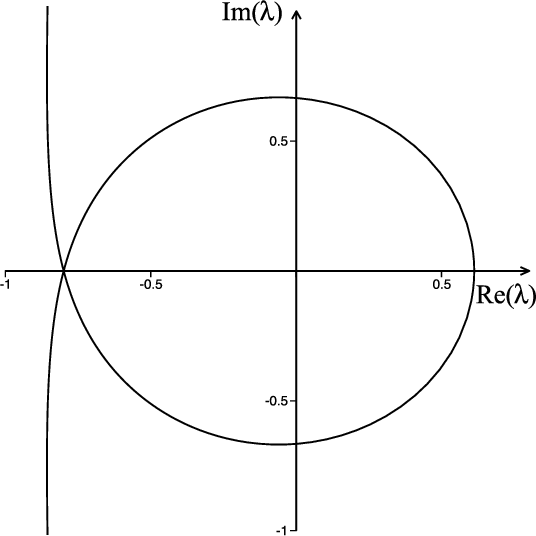
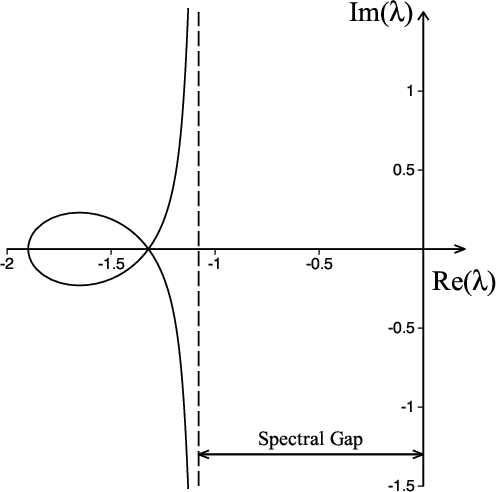
The linearization about a stationary soliton yields a non-self-adjoint third-order evolution operator, A[u0], whose essential spectrum is initially confined to the imaginary axis in u→k>00. However, when passing to exponentially weighted u→k>01 spaces, the essential spectrum moves into the open left half-plane for u→k>02, persists as a vertical half-line for u→k>03, and becomes unstable for u→k>04 exceeding certain thresholds tied to the soliton parameters.
Figure 1: The essential spectrum of u→k>05 in the complex plane for various weights u→k>06, exhibiting leftward movement for small positive u→k>07 and instability for u→k>08 above a critical threshold.
Key technical results provide the precise formulae characterizing the location and the spectral gap u→k>09 in terms of ∣x∣→∞0, ∣x∣→∞1, and ∣x∣→∞2, laying the foundation for semigroup decay estimates.
Point Spectrum and Absence of Embedded Eigenvalues
Using the Evans function framework for third-order systems, the paper establishes that ∣x∣→∞3 is the only eigenvalue of ∣x∣→∞4 on the imaginary axis in ∣x∣→∞5, i.e., there are no embedded or secondary eigenvalues in the essential spectrum. The proof leverages the DP equation's complete integrability, deploying a newly derived squared-eigenfunction connection between Lax pair eigenfunctions and linearized eigenfunctions. An explicit analysis rules out the existence of ∣x∣→∞6 eigenfunctions with ∣x∣→∞7 via algebraic and asymptotic considerations.
The zero eigenvalue arises from the continuous symmetries of the DP equation (translation and speed variation). The algebraic multiplicity is shown to be two, with the generalized kernel associated with the soliton's translational invariance and parameter derivatives.
Semigroup Theory and Linear Asymptotic Stability
The paper rigorously establishes that the linearized evolution in the weighted ∣x∣→∞8 space generates a ∣x∣→∞9-semigroup exhibiting exponential decay on the orthogonal complement of the generalized kernel. The semigroup splitting exploits the spectral gap opened in the essential spectrum and the absence of point spectrum besides the origin.
Figure 2: Essential spectrum for c0, confirming stability regime for larger exponential weights.
The main theorem proves
c1
for all c2 and c3, where c4 projects onto the (generalized) kernel associated with translations and parameter shifts. The underlying analysis combines Evans function arguments, explicit resolvent bounds, and the Prüss theorem for c5-semigroups in Hilbert spaces.
Obstacles to Nonlinear Asymptotic Stability
Although the linear theory is exhaustive, the authors identify a critical obstruction to extending the exponential decay result to the nonlinear DP equation: a loss of regularity due to the highest-order nonlinear dispersive term c6. This precludes a contraction-mapping argument in standard Sobolev spaces—a contrast to the favorable situation for gKdV or CH—because the essential spectrum for large frequencies remains vertical and does not allow a linear smoothing effect. The issue is not resolved by modulations or time rescalings, and overcoming it will require fundamentally new techniques.
Implications and Prospects
The rigorous asymptotic decay analysis for the DP linearization in weighted spaces cements the stability of smooth solitons to localized perturbations at the linearized level, refining prior spectral and orbital stability results. This paper's identification of the linear mechanisms—spectral gaps, kernel structure, and semigroup decay estimates—constitutes an important foundational advance and a source of quantitative estimates for dispersive PDE stability theory.
Practically, these results assure the persistence and eventual dominance of initial solitary wave shapes against small, spatially decaying perturbations under the linear DP flow. Theoretically, the necessity of nonzero backgrounds and the distinction from the CH equation due to the non-self-adjoint third-order Lax structure provide fertile ground for future spectral and nonlinear dynamics investigations. The explicit identification of the linear-analytic barrier to nonlinear asymptotic stability highlights a key direction for mathematical development, possibly requiring hybrid or integrable/spectral–Liouville property approaches as emerging in related work on CH and b-family equations.
Conclusion
This work delivers a comprehensive and technically robust account of linear asymptotic stability for smooth 1-solitons in the DP equation within exponentially weighted spaces, demonstrating exponential decay of small perturbations up to expected phase and speed drift. Through careful spectral, semigroup, and integrability-based analysis, it fully characterizes the stability landscape at the linear level. The results underpin ongoing attempts to settle the more challenging nonlinear asymptotic stability problem for DP and similar dispersive, nonlocal integrable PDEs.