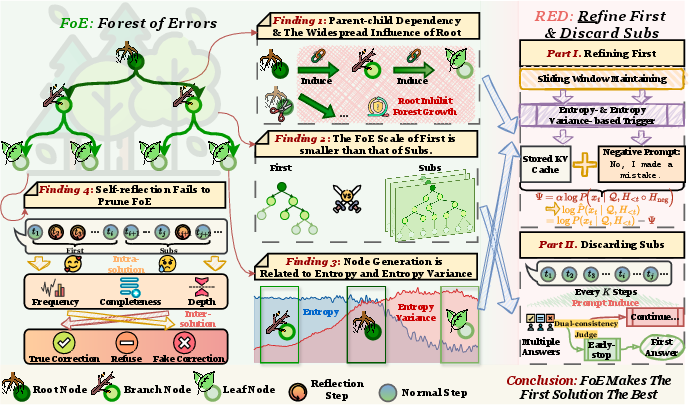
- The paper reveals that the first solution is often optimal in LRMs, with up to 93.7% of instances achieving correctness by avoiding compounded errors.
- It introduces the FoE framework, which uses entropy and variance monitoring to detect and mitigate roots of error propagation during reasoning.
- Comparative evaluations show that the method boosts Pass@1 accuracy by up to +19.0% while reducing token usage by 37.7–70.4% through early solution refinement.
Forest of Errors (FoE): Characterizing Error Propagation and Solution Optimality in Large Reasoning Models
Introduction and Core Phenomena
The paper "FoE: Forest of Errors Makes the First Solution the Best in Large Reasoning Models" (2604.02967) systematically interrogates the step-by-step reasoning behaviors of contemporary Large Reasoning Models (LRMs), explicitly DeepSeek-R1 and its derivatives, in mathematical and scientific domains. The authors document and rigorously analyze a critical, counterintuitive finding: contrary to prevailing test-time scaling intuitions, generating additional solution variants (Subs) after the initial solution (First) does not generally improve—and often actively harms—the quality of the selected answer. Specifically, error accumulation over extended reasoning paths means that the first candidate solution is, with high probability, already optimal.
This violates the common assumption, motivated by test-time sampling laws, that more samples or extended chain-of-thought reasoning increases correctness monotonically. Empirically, up to 93.7% of instances have their optimal solution at the first candidate. Subs seldom correct earlier errors (maximal correction rate below 7.1% and often 0%), and frequently introduce new errors or degrade otherwise correct First results.
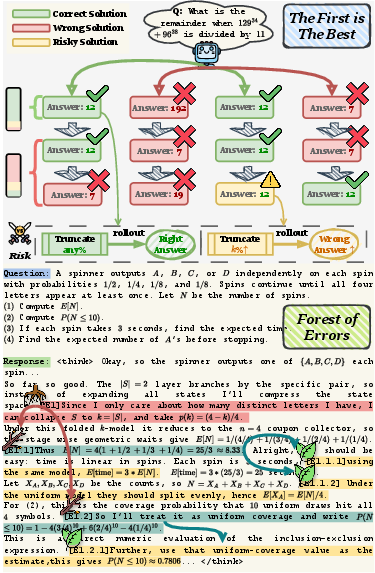
Figure 1: (Upper) Successful reasoning trajectory. (Lower) Visualization of the Forest of Errors as causally structured error propagation.
The authors formalize errors in reasoning as a "Forest of Errors" (FoE): a non-linear, causally structured collection of error nodes, where each node arises via explicit reuse of an earlier wrong artifact (numeric value, formula, assumption, etc.). Using a rigorous parent-child scoring rubric and few-shot prompting with a state-of-the-art LLM judge, they reconstruct the error causality structure for each solution trajectory.
Key findings are illustrated in the cross-modal structure of FoE, where root errors dominate error propagation, and correcting only descendant (non-root) nodes is insufficient—roots must be fixed to decelerate or cut off the error cascade.
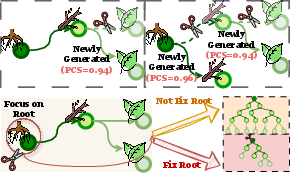
Figure 2: The effect of manual correction on child vs. root error nodes, empirically validating that root node interventions decelerate error proliferation.
Entropy-Driven Genesis of Structural Errors
A core mechanism for root error genesis is revealed: the simultaneous elevation of token-level entropy (uncertainty) and entropy variance (volatility) is a strong indicator for the imminent appearance of a new, causally central error root. Neither statistic alone suffices for prediction, but their joint escalation is highly predictive.
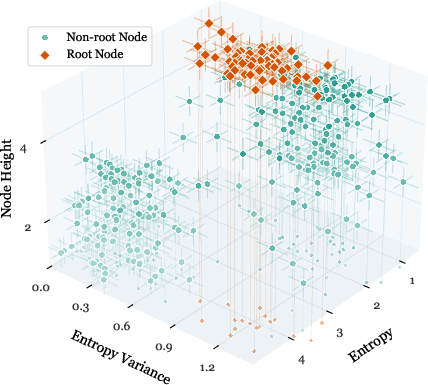
Figure 3: Distribution of various error node types as a function of entropy and entropy variance; root node triggers are disproportionately concentrated in high-high regimes.
Under identical entropy/variance conditions, root node emergence is consistently lower in First solutions compared to later Subs, indicating greater resilience against the induction of new causal errors during earlier reasoning.
Reflection Mechanisms and Correction Behaviors
While augmented LRMs showcase explicit reflective behaviors, empirical analysis demonstrates that later Subs suffer starkly degraded self-correction capabilities. Both the rate and depth of reflection decrease, and "fake" corrections—where errors are superficially edited but the causal error chain persists—substantially increase.
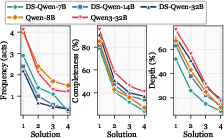
Figure 4: Declining intra-solution reflection metrics as the solution index increases, indicating decreased spontaneous self-checking and error correction in subsequent solutions.
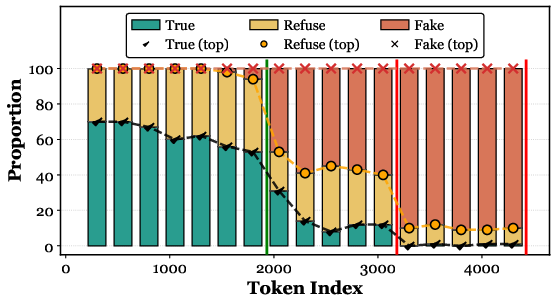
Figure 5: Shift from "true" to "fake" and refusal-to-correct behaviors in correction type prevalence from First to Subs.
Proposed Framework: Refining First, Discarding Subs
Building on the FoE analysis, the authors propose a self-guided efficient reasoning framework that couples two complementary mechanisms:
Main Results and Comparative Evaluation
Across six distinct LRM backbones and five benchmarks (GSM8K, MATH500, AIME24/25, GPQA-Diamond), the FoE-based framework consistently outperforms both training-free and RL-based competitive baselines. Performance improvements reach up to +19.0% in Pass@1 accuracy, with token reduction between 37.7%–70.4%. The approach also substantially reduces all structural FoE metrics (forest size, nodes per tree, depth, reproduction rate) by 41–68%. Unlike methods that only shorten reasoning paths, the improvements are attributable to targeted suppression of structural error growth.
Theoretical Justification
A probabilistic branching-process analysis supports the empirical findings. Under natural conditions, the expected error-induced risk bound is monotonically increasing in:
- the probability of root error triggering,
- the error reproduction rate (offspring induced by each error), and
- the total solution length.
Given empirical dominance relationships—lower root error rates, reproduction rates, and generation lengths in First vs. Subs—the theoretical error bound for First is strictly tighter. Further, artifact contamination in Subs leads to increased risk of overriding a correct First solution via late error propagation, explaining the empirically observed phenomenon where "the First is the Best".
Latency and Efficiency
The additional latency introduced by entropy and probe operations is marginal (4.6% overhead in a stress-test regime), and is dominated by efficiency gains in reduced generation due to early exit—consistently providing the lowest or near-lowest wall-clock inference time compared to all test baselines.
Practical and Theoretical Implications
These findings have significant ramifications for the design and deployment of both current and future reasoning-augmented LLMs:
- Test-time over-exploration can be actively detrimental due to compounded error propagation.
- Error-corrective interventions must focus on early, high-entropy segments and root mechanisms; late-stage or repeated solution variants waste inference budget and risk final-answer degradation.
- Classical self-consistency/ensemble schemes must be carefully adapted in this context, as naïve sampling is not necessarily beneficial.
- The formalism of the FoE motivates more granular and causality-aware error tracing and correction strategies for process reward models and efficient RL-based fine-tuning.
Conclusion
The paper provides clear empirical and theoretical evidence that, within present LRM architectures and reasoning protocols, the first generated solution exhibits optimality in both correctness and stability—even (and especially) as test-time "thinking" budgets increase. Subsequent solutions, rather than providing increased robustness through diversity, become vectors for additional error accumulation and answer regression. Therefore, computational resources should be preferentially allocated toward improving and refining the first solution, and policies that prune or discard superfluous rollouts should be favored in both research and practical production systems.