- The paper introduces Member Fabrication Attacks (MFA) that use imperceptible input perturbations to trick membership inference attacks in vision models.
- A momentum-driven, cosine-annealed optimization strategy validates MFA effectiveness across datasets like CIFAR-10 and ImageNet-100.
- Gradient-norm collapse is identified as a key geometric signature, leading to robust defenses such as MFD and AR-MIA to restore audit reliability.
A Unified Perspective on Adversarial Membership Manipulation in Vision Models
This paper addresses a critical vulnerability in neural image classification models: the susceptibility of membership inference attacks (MIAs) to adversarial input manipulation. MIAs are widely used to audit privacy leakage in vision models by inferring whether a sample was included in the training data. Standard practice presumes that the input to be audited is benign and unmodified. However, the authors reveal that this assumption is fundamentally flawed. They introduce and formalize the "adversarial membership manipulation" threat vector, showing that imperceptible input perturbations can reliably induce non-members to be classified as members by state-of-the-art MIAs, undermining the reliability of model auditing and privacy claims.
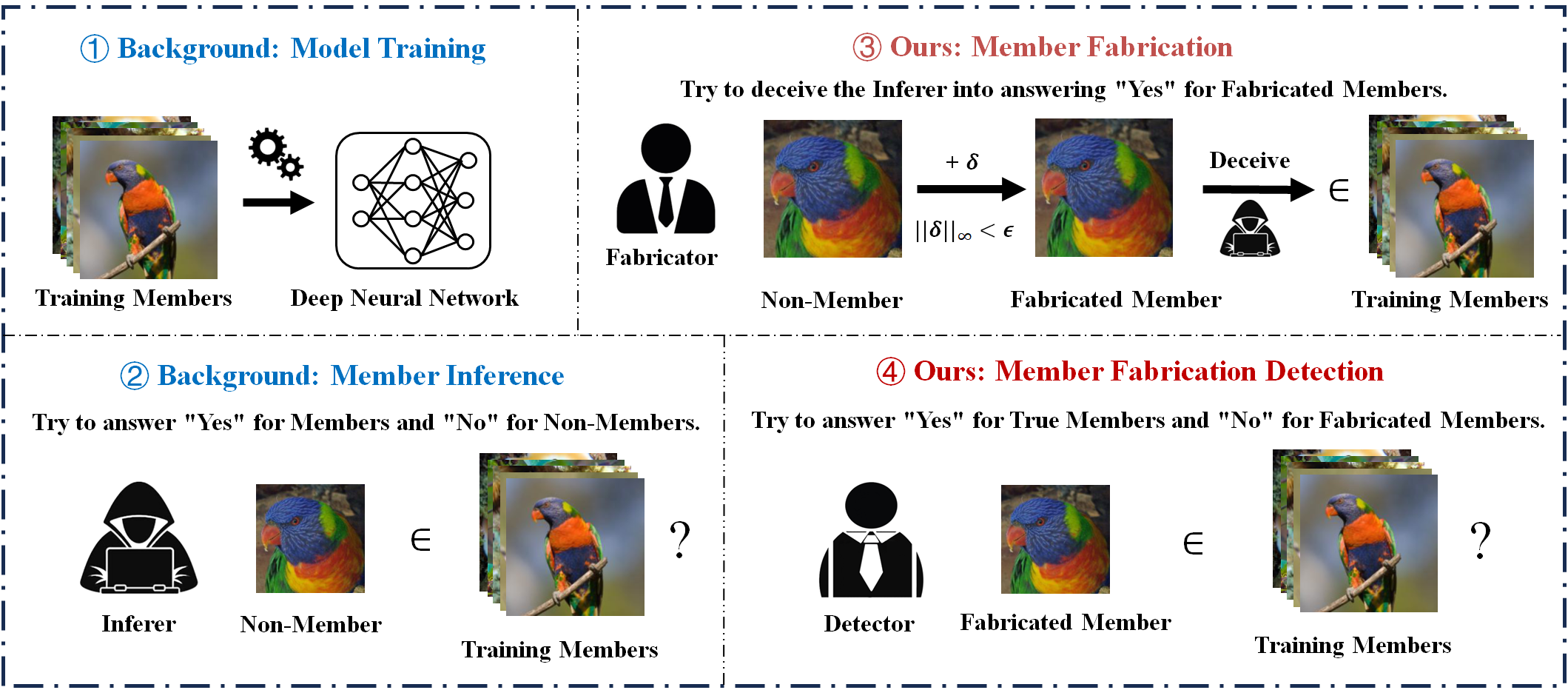
Figure 1: Overview of the background and the proposed research problems, highlighting the adversarial manipulation axis in the traditional MIA paradigm.
The identified issue is not addressed by existing OOD robustness measures or output-space defense mechanisms (e.g., MemGuard), who focus on model-side perturbations. Input-space attacks, as analyzed here, directly subvert the privacy audit pipeline itself rather than the model, which holds major practical implications for copyright verification, data provenance, and compliance with legal requirements such as "right-to-be-forgotten".
Adversarial Membership Fabrication: Mechanisms and Empirical Evidence
The main technical contribution is the formalization and systematic analysis of Member Fabrication Attacks (MFA), whereby an adversary (the fabricator) imperceptibly perturbs non-member inputs such that strong MIAs predict these inputs as members. The perturbations are visually and semantically indistinguishable but deliberately push model statistics (e.g., softmax confidence, likelihood ratios) over membership thresholds.





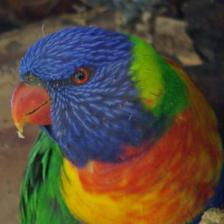





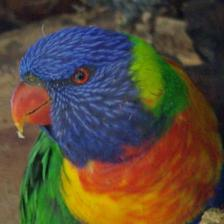
Figure 2: Imperceptible adversarial perturbations on ImageNet-100; fabricated members are visually undetectable as adversarial to human observers (ϵ=2/255 for B[x]).
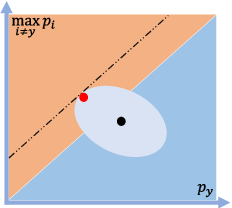
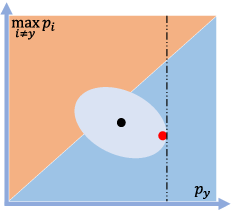
Figure 3: Comparison of traditional adversarial attacks—targeting misclassification—versus MFA which seeks to maximize confidence on the true label, thereby fabricating the appearance of membership.
The attack's effectiveness is rooted in the common reliance of SOTA MIAs on confidence-based or likelihood-based test statistics. By maximizing py (true label confidence) within a constrained ℓ∞ ball, fabricated members transferably bypass multiple MIA detectors spanning loss-based, ratio-based, and distribution-based designs.
Extensive experimental validation across CIFAR-10/100, SVHN, ImageNet-100, and CINIC-10, as well as diverse ResNet/WideResNet architectures and MIA types, demonstrates consistent, high-efficacy deception (error area and EER metrics) by MFA. In particular, a momentum-driven, cosine-annealed optimization schedule provides robustness and outperforms standard PGD/AutoAttack-based modulation strategies.
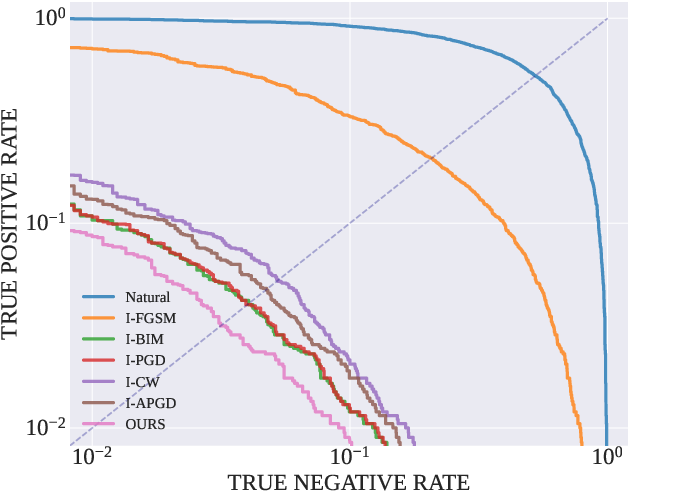
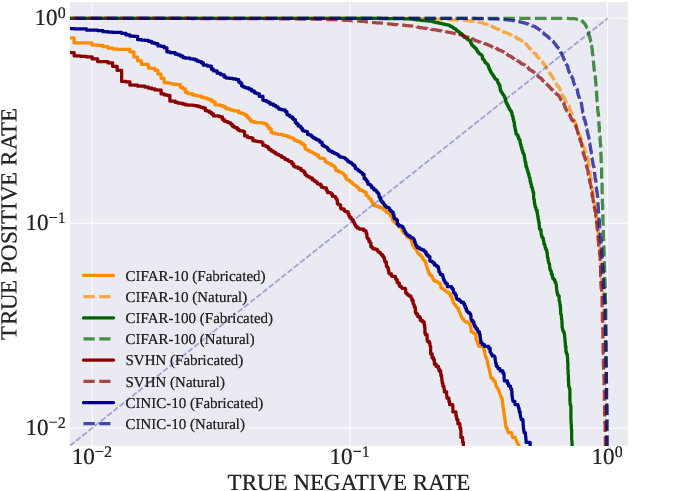
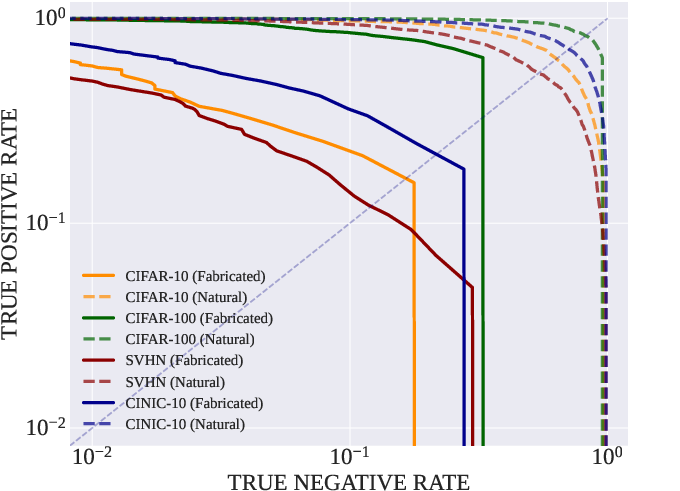
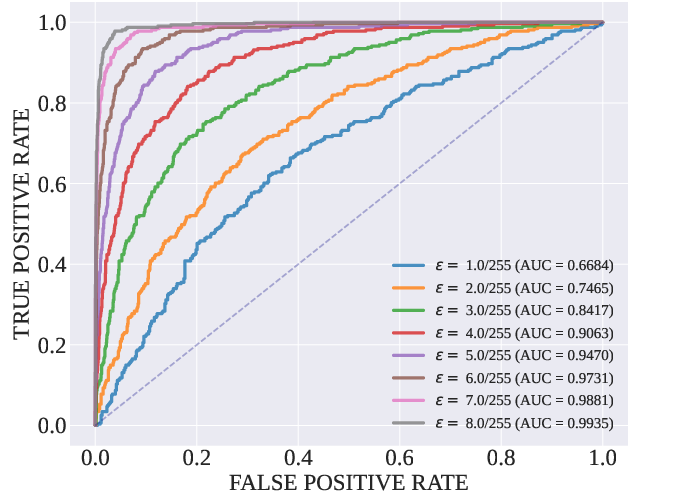
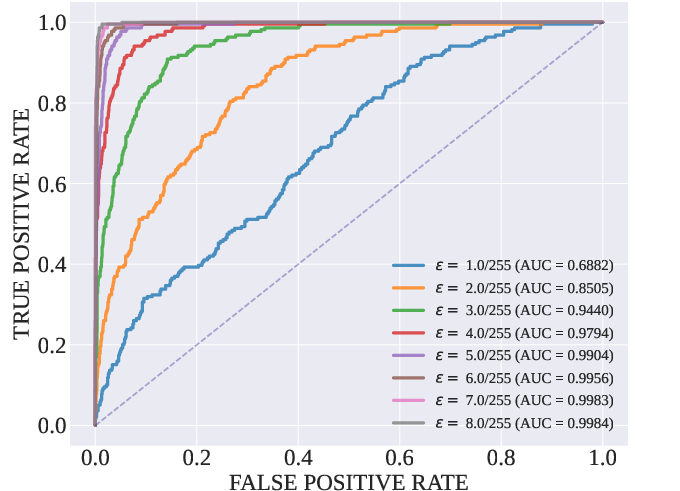
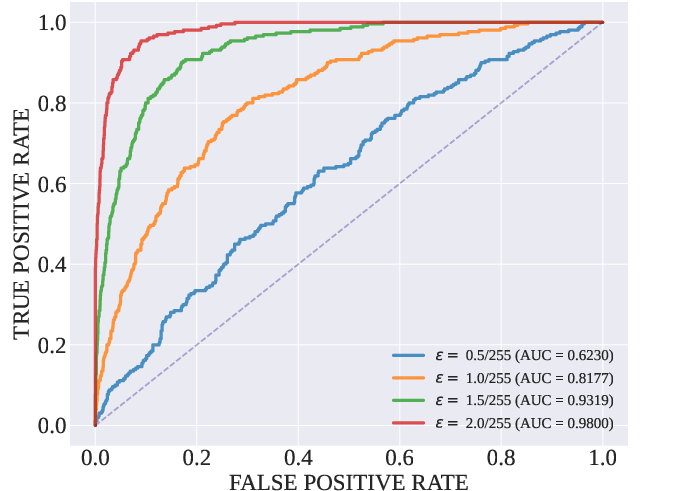
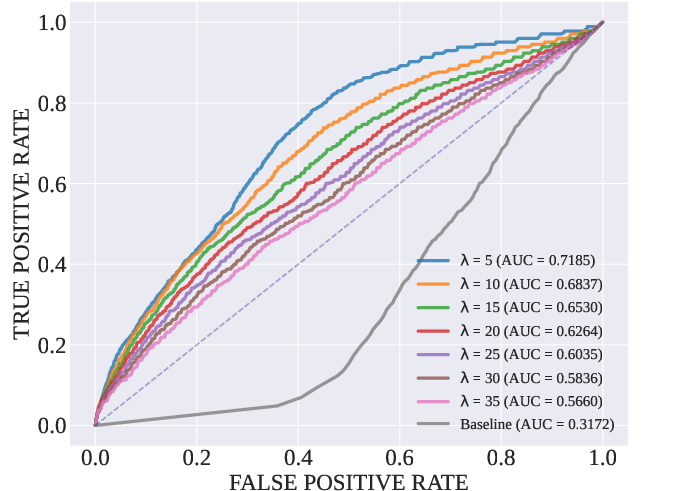
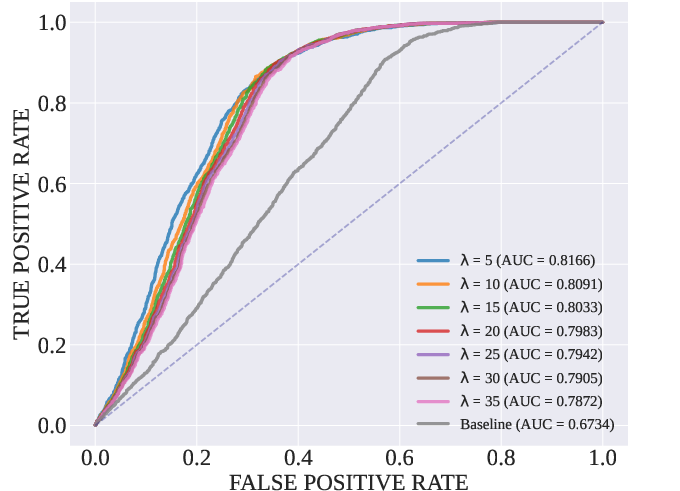
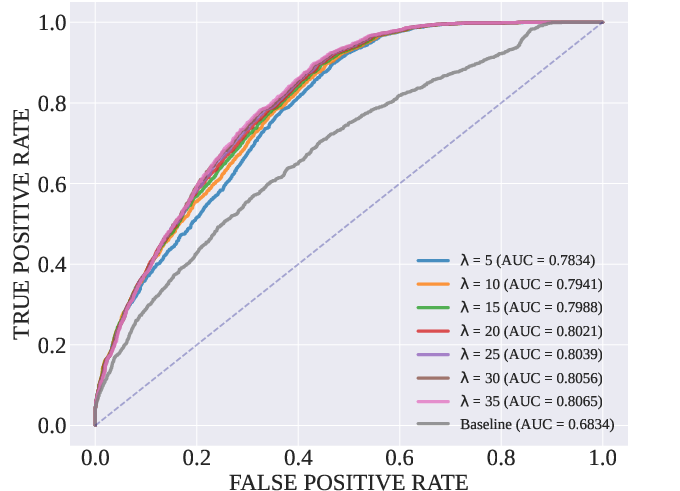
Figure 4: Representative experimental results; (a–c) show the superior performance of MFA over prior baselines across MIAs and datasets; (d–f) evaluate MFD detection, and (g–i) demonstrate AR-MIA robustness improvements.
Geometric Perspective: Semantic Indistinguishability and Gradient-Norm Collapse
A central insight is that fabricated and true members are nearly indistinguishable in semantic feature spaces, as verified with t-SNE visualizations at multiple representation layers.
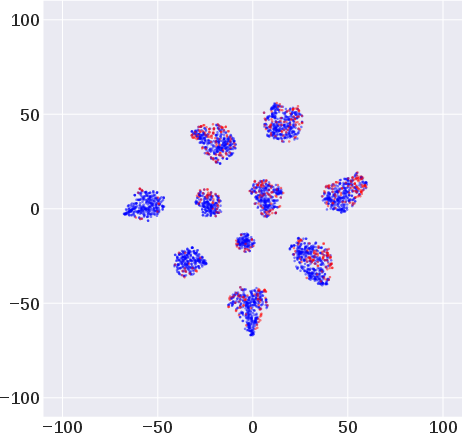
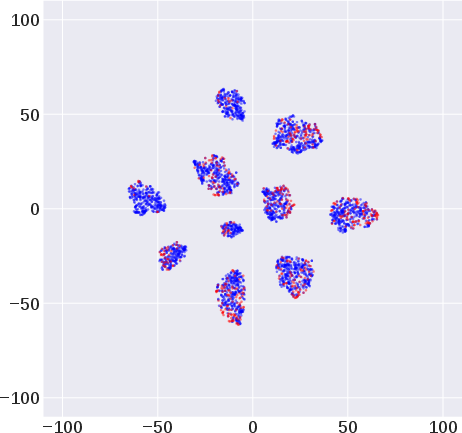
Figure 5: t-SNE visualization of fabricated and true members' distributions in high-level semantic feature space; the high overlap confirms semantic indistinguishability.
However, the authors discover a reliable geometric signature: the "gradient-norm collapse" phenomenon. During MFA optimization, the input gradient of the loss with respect to the image diminishes monotonically, landing fabricated members in low-gradient, high-confidence basins.
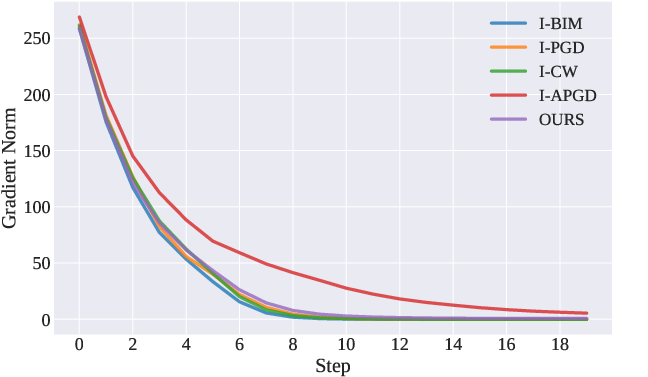
Figure 6: Decay of the input gradient norm under MFA optimization steps; fabricated members show progressively reduced gradient magnitudes.
This behavior is not captured by common adversarial detection statistics (Mahalanobis/LID), which do not separate fabricated and true members effectively in this context.
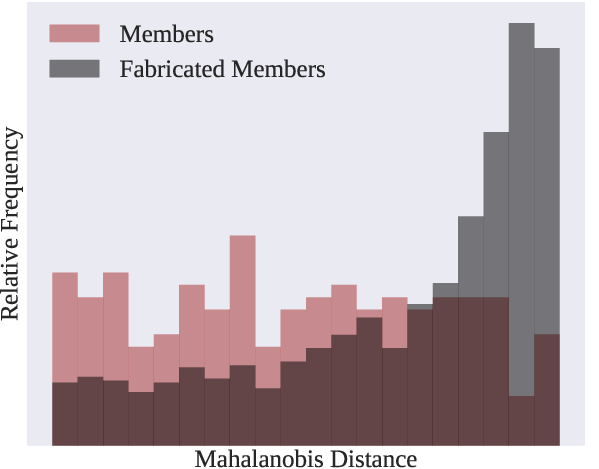
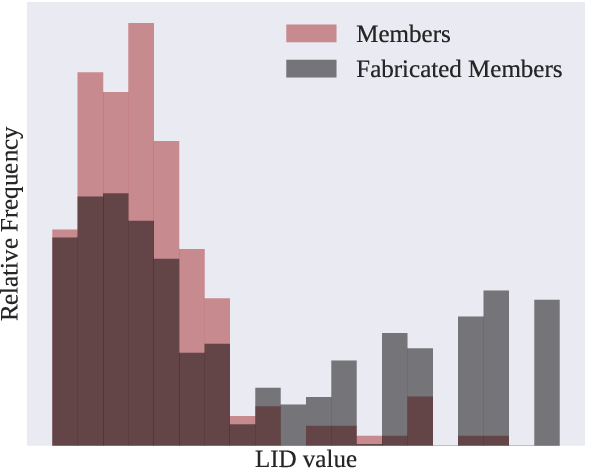
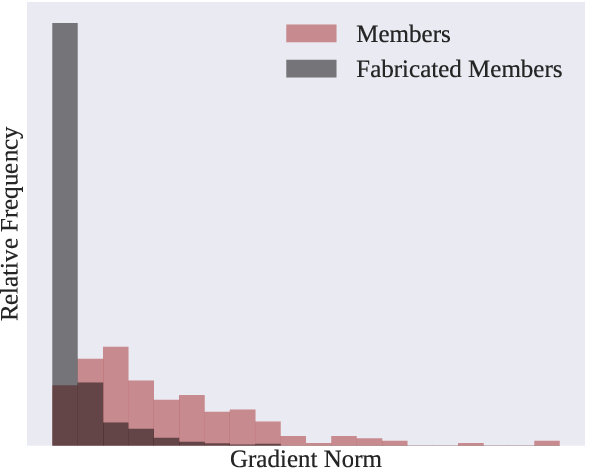
Figure 7: Comparative histograms for Mahalanobis distance, LID, and input gradient norms; only gradient-norm exhibits sharp separation between fabricated and true member classes.
Theoretical analysis, including a local approximation theorem, supports that single-step gradient ascent on confidence causes strictly decreasing input gradient norm, providing a robust mechanistic underpinning for MFD detection.
Defenses: Member Fabrication Detection and Robust Inference
The paper presents two complementary defense strategies. First, Member Fabrication Detection (MFD) is based on thresholding the input gradient norm to flag fabricated members. Due to the fundamental geometric optimization tradeoff, this detector is robust even to adaptively optimized attacks.
Second, the Adversarially Robust MIA (AR-MIA) framework integrates the gradient-norm as a weighting or calibration factor into standard MIA test statistics. Specifically, a tanh(λ∣∣∇xℓ∣∣) modulation multiplies the original statistic, eliminating the fabricated member vulnerability while preserving discriminative power for true/non-member separation. Empirical results demonstrate significant AUC and TPR@FPR increases when using AR-MIA in conjunction with strong existing MIA methods under adversarial fabrication scenarios.
Empirical and Practical Significance
The experimental results substantiate the paper's strong numerical claims:
- MFAs consistently and substantially degrade the reliability of SOTA MIAs, shifting ROC/error-area curves far from the identity and causing EERs to approach worst-case ("random guess") regimes for strong attacks and across multiple datasets.
- MFD and AR-MIA, exploiting gradient-norm signals, restore separation (high AUC, high TPR@low FPR rates) even under adversarial query manipulation, highlighting the inadequacy of prior distributional/OOD detectors.
These findings reveal previously unaccounted for failure modes in privacy auditing, suggesting that raw MIA statistics are unsuitable for real-world deployment unless adversarial query manipulation is explicitly considered and addressed.
Theoretical and Future Implications
This work raises important theoretical questions about the interplay between membership leakage, robustness, and the geometry of the loss landscape. The linkage between overconfidence, low-dimensional adversarial basins, and audit-statistics manipulation prompts reevaluation of the security game model in privacy tests, especially for models deployed in compliance-intensive contexts.
Practically, the adversarial manipulation surface mandates a reevaluation of MIA-based privacy audits and encourages exploration of geometry-based or hybrid statistics for robust downstream measures. Future research directions include extending these detection and defense techniques to non-vision domains, multi-modal models, and federated or distributed ML settings, as well as investigating tradeoffs with adversarial training and calibration defenses to further harden model accountability protocols.
Conclusion
This paper establishes a unified theory and practice of adversarial membership manipulation in vision models. By introducing and systematizing MFAs, quantifying their impact, and developing robust geometric defenses, the work exposes fundamental limitations in the prevailing methodology for privacy audit and membership inference. The theoretical framing and empirical benchmarks provided here will serve as reference points for ensuing research and deployment practices in the responsible, reliable, and adversarially-aware evaluation of privacy in machine learning systems (2604.02780).

