- The paper demonstrates that DAISY significantly improves the completeness and accuracy of AI disclosure statements compared to unsupported methods.
- It introduces a form-based, editable interface developed through co-design sessions to systematically report AI tool usage.
- Empirical results show that DAISY-supported disclosures yield longer, more policy-compliant statements without increasing user discomfort.
Structured AI Disclosure in Academia: An Analysis of DAISY
Introduction
"AI Disclosure with DAISY" (2604.02760) details an empirical investigation into the challenges and opportunities associated with disclosing academic use of AI tools, presenting DAISY as a form-based, structured system for generating AI disclosure statements. The paper explicates sociotechnical, cognitive, and emotional obstacles that impede transparent reporting, proposes DAISY as an operational tool refined via co-design methodologies, and assesses its efficacy in a controlled user study. The authors argue that structured tools like DAISY can yield more comprehensive and policy-aligned disclosure statements without diminishing user comfort, reframing AI disclosure as a multifaceted interaction shaped by disciplinary, practical, and normative factors.
Background and Motivations
Disclosure of AI use in academic manuscripts is increasingly mandated by publisher policies to ensure accountability and transparency. Despite consensus on the necessity of such disclosures, evidence demonstrates that actual practices are inconsistent and infrequent; only 2.5% of sampled medical education articles included any AI-use disclosure, despite widespread use of LLMs and related tools [ans2025presence]. The discrepancy reflects three principal barriers:
- Social: Disclosures may invite negative judgment, affect perceived competence, and trigger reputational risks [reif2025evidence, brown2025academai].
- Cognitive: Authors struggle to accurately reconstruct the extent and locus of AI involvement due to source-memory errors and misattribution [zindulka2025ai, skulmowski2024placebo].
- Emotional: The act of disclosure itself may induce AI guilt, shame, or anxiety stemming from ambiguous social norms [chan2025understanding, bao2025ai].
Prior research in adjacent domains, such as model cards [mitchell2019model], datasheets [gebru2021datasheets], and risk reporting frameworks [bogucka2025impact, rao2025riskrag], suggests that structured documentation can standardize and enhance reporting accuracy. However, translation of these strategies into author-facing tools for AI-use disclosure in research manuscripts has remained underexplored.
DAISY: Design and Development
DAISY (Disclosure of AI-Use in Your Research) implements a form-based web application that guides researchers through a structured process for detailing AI involvement across key research activities: ideation/brainstorming, coding, analysis, writing, figures/tables, and language editing. DAISY’s architecture is derived from an overview of:
- Publisher policies, which define minimal disclosure standards but vary in granularity and placement recommendations;
- A corpus analysis revealing the near-absence of detailed AI-use statements in actual publications;
- Participatory co-design sessions with a heterogeneous sample of academic stakeholders (N=11), spanning career stages and disciplines.
The co-design phase yielded domain-specific artefacts reflecting divergent attitudes toward disclosure. Non-HCI participants emphasized procedural compliance and minimal disruption, while HCI-versed participants advocated for transparency, extensible logging, and reflective interaction.

Figure 1: Speculative AI disclosure artefacts created by 11 participants (P1-11) during four co-design sessions, sorted by participant background and layout.
DAISY's interface operationalizes these insights through editable, activity-based prompts, mandatory fields for tool/version specification, and explicit attestation of authorial responsibility.
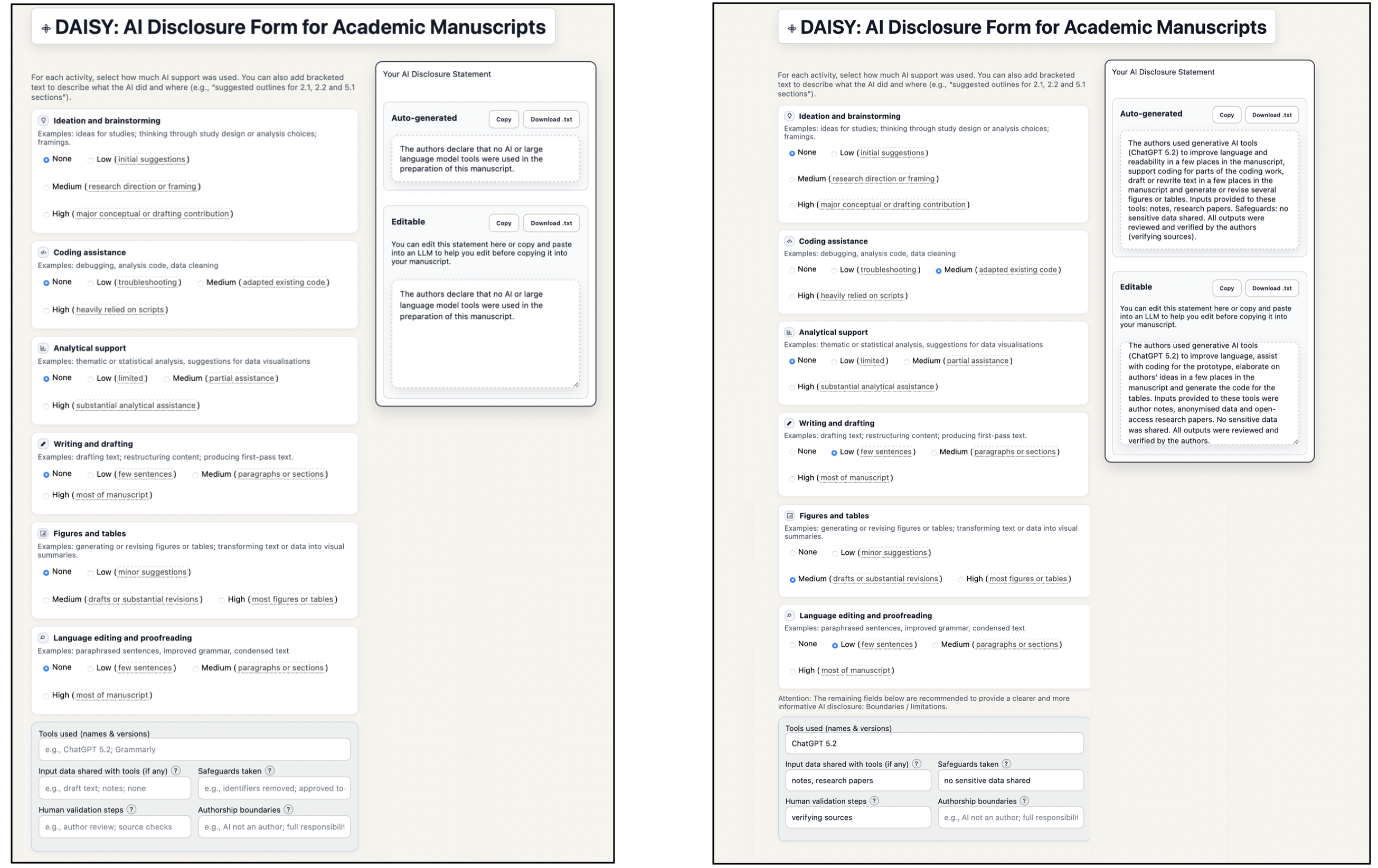
Figure 2: The DAISY interface. The left panel shows the default, unfilled form. The right panel shows a completed form and the resulting AI disclosure statement, including the editable output reviewed and refined by the author prior to submission.
Empirical Evaluation: User Study
A within-subjects study with 31 academic authors assessed the impact of DAISY on disclosure content and user experience in comparison to unsupported and purely auto-generated statements. Participants produced three versions of a disclosure for an actual publication: free-form, DAISY auto-generated, and DAISY-generated but manually edited. Quantitative metrics included disclosure length, compliance with six policy-driven completeness criteria, and self-reported comfort.
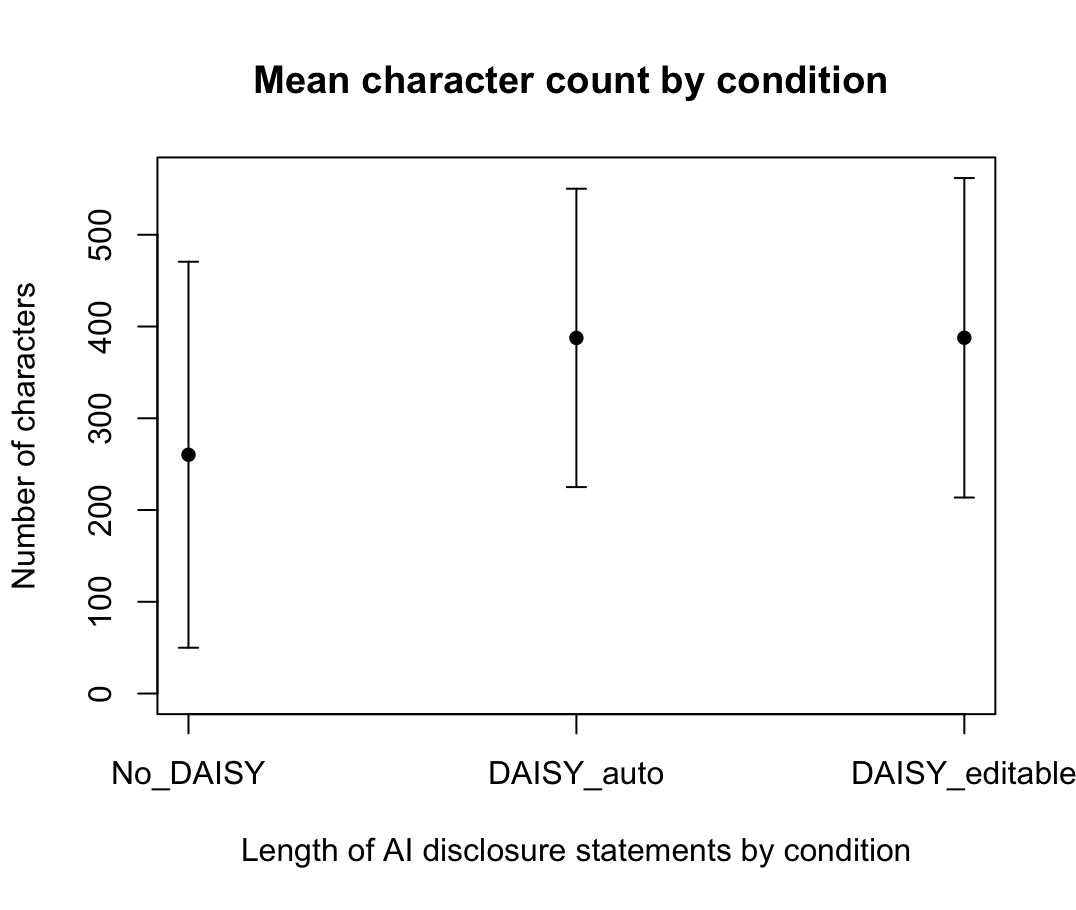
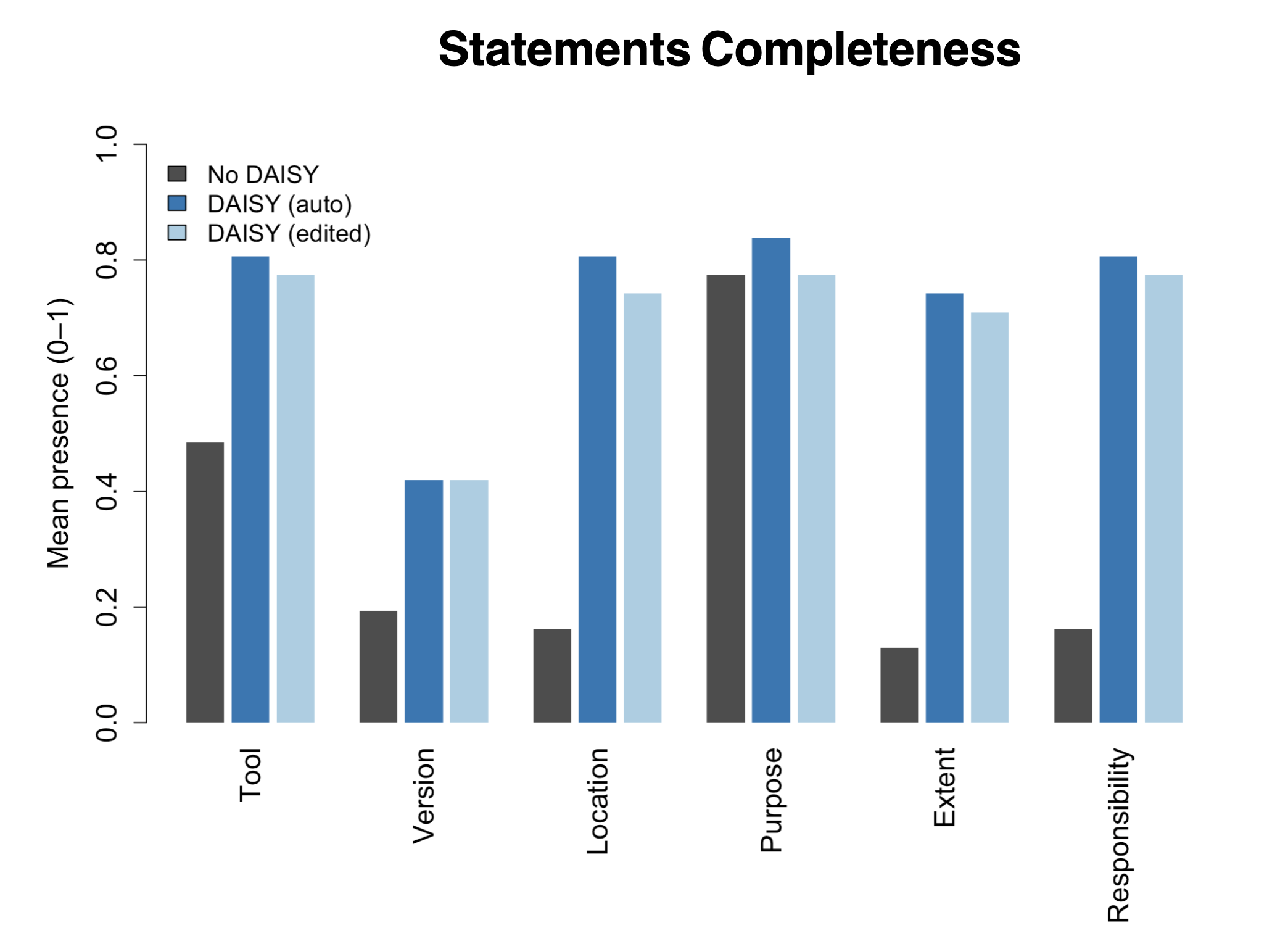
Figure 3: (Left) Mean character count in disclosure statements by condition. Error bars indicate ±1 SD. (Right) Mean presence (0–1) of disclosure statements completeness criteria by condition.
Key results:
- DAISY-supported statements exhibited greater length and a statistically significant increase in completeness (mean completeness: unsupported 1.90, DAISY auto-generated 4.42; p < .001).
- The most substantial differences were observed in explicit reporting of location and degree of AI use and statements of authorial responsibility—a common omission in unsupported disclosures.
- Comfort with disclosure remained stably high across all conditions, with a modest but non-significant trend favoring DAISY-edited disclosures.
- Most participants preferred the editable DAISY output, citing improved recall, clarity, and structure, though some prioritized control over nuanced language for risk mitigation.
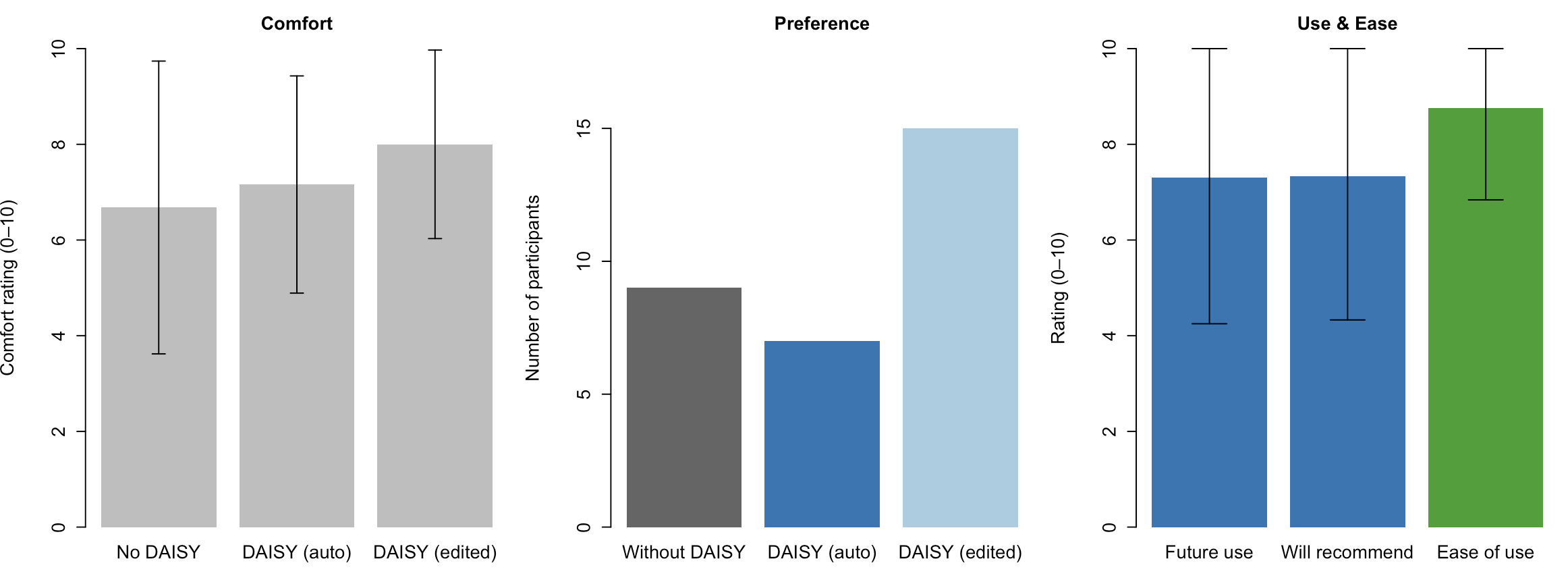
Figure 4: (Left) Mean comfort ratings (0–10) by condition (±1 SD). (Middle) Preferred disclosure approach. (Right) Participants' reported likelihood of future DAISY use, recommendation, and perceived ease of creating an AI disclosure statement.
Qualitative findings highlighted DAISY’s utility in surfacing previously neglected AI use (e.g., advanced grammar tools and LLM-driven literature tasks) and reducing cognitive burden.
The study substantiates that structured disclosure support, when paired with user editability, produces more complete and consistent AI-use statements without imposing new discomfort or resistance. The interplay between reflectiveness and compliance, and between self-report and automated capture, structures a design space for future disclosure tools. The authors articulate four quadrants: minimal binary checklists, structured reflective forms (DAISY), language-generation plugins, and prospective log-based systems with fine-grained capture.
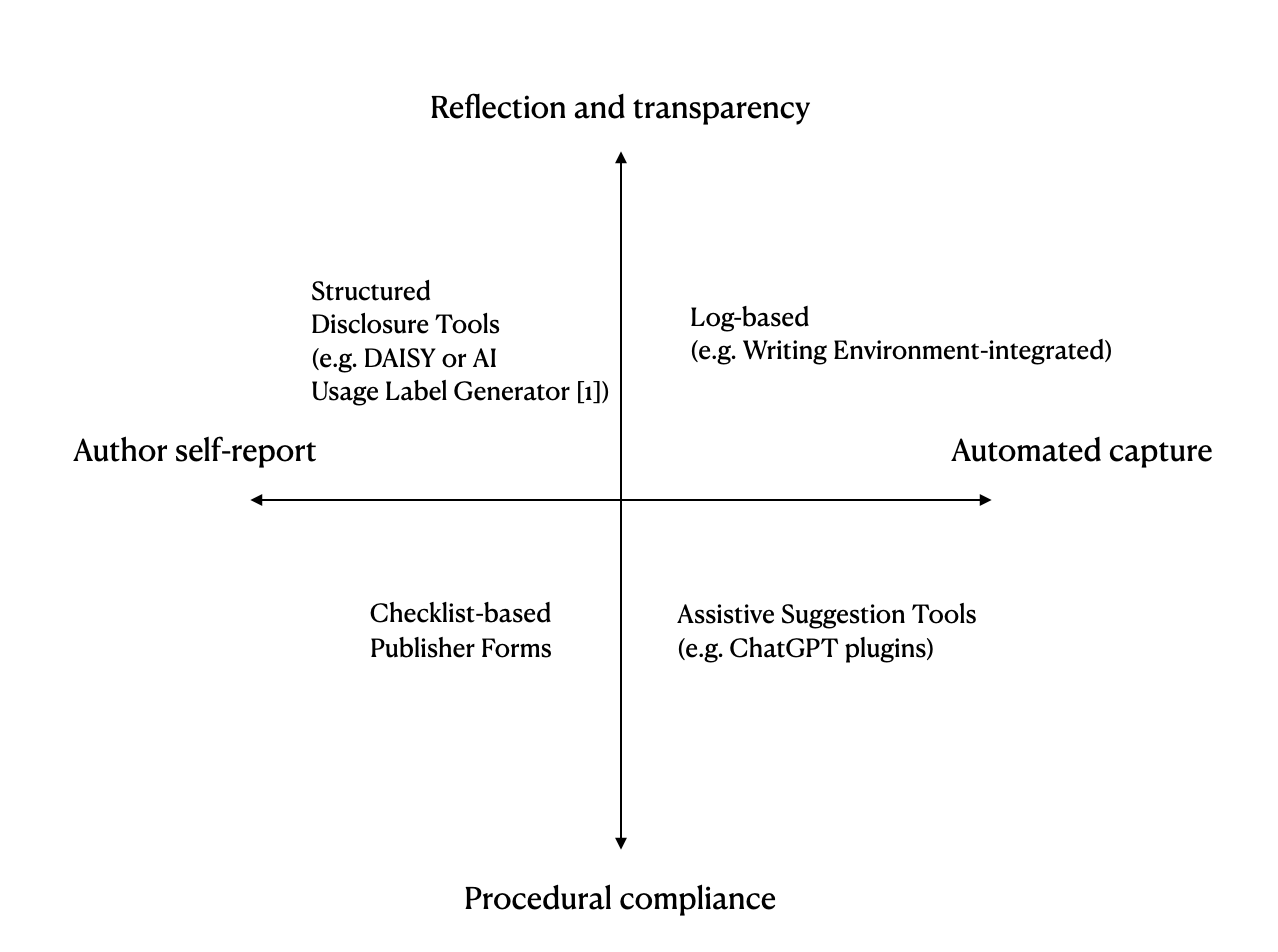
Figure 5: A speculative conceptual design space for AI disclosure tools spanning axes of author self-report vs. automated capture and procedural compliance vs. reflection/transparency.
This framework anticipates disciplinary divergence in disclosure attitudes and the potential for integration with submission workflows, LLM-driven text generation, and automated provenance capture.
Limitations and Prospective Directions
The evaluation is constrained by an HCI-skewed participant pool and the retrospective context of disclosure drafting, rather than real submission within journal platforms. Completeness was operationalized relative to current publisher policies, which are themselves in flux and variably enforced. The study also does not address the interpretive practices of reviewers, editors, or downstream readers.
Advances in tool integration, cross-disciplinary calibration, and alignment with evolving publisher standards are critical. Further, DAISY or similar structured reporting artefacts may function as valuable instruments for longitudinal and comparative studies on the normalization of AI in academic authorship and research labor. The authors call for mixed-initiative approaches, separating structural guidance from linguistic realization, and embedding reflection rather than enforcing compliance alone.
Conclusion
DAISY demonstrates that form-based, structured AI disclosure support can substantially improve the completeness and clarity of author statements without incurring additional social or emotional costs. The empirical findings suggest that friction in current disclosure practice is predominantly epistemic—rooted in uncertainty about what to report and how—rather than an intrinsic reluctance to disclose. Future AI disclosure mechanisms should accommodate diverse disciplinary needs, provide clarity and cognitive scaffolding, and strike a balance between compliance, transparency, and authorial agency. The work lays a foundation for treating AI disclosure as a dynamic sociotechnical practice rather than a check-box requirement, with implications that extend to institutional policy, research integrity, and the future of scholarly communication.

