- The paper presents ArticuSurDepth, a self-supervised framework that leverages cross-vehicle geometric consistency to enhance surround-view depth estimation in articulated vehicles.
- It introduces a direct interpolation-based surface normal consistency loss and uses vision foundation models for reliable ground plane regularization.
- Experiments on proprietary and public datasets demonstrate improved metrics, including an Abs Rel error of 0.185, validating its robust performance in complex articulated scenarios.
Cross-Vehicle 3D Geometric Consistency for Self-Supervised Surround Depth Estimation on Articulated Vehicles
Introduction and Motivation
This paper addresses the self-supervised surround-view depth estimation problem for articulated vehicles—platforms such as long combination vehicles (LCVs) and articulated rail transit—which introduce significant perception challenges due to their non-rigid structure, dynamic cross-segment geometry, and increased omnidirectional complexity. Existing self-supervised depth estimation methods are predominantly tailored for passenger vehicles and fail to capture the spatio-temporal and geometric coupling arising in articulated vehicle platforms.
The proposed solution, ArticuSurDepth, introduces a unified self-supervised framework that leverages cross-view and, crucially, cross-vehicle geometric consistency to enhance depth learning for articulated vehicles. The framework further incorporates priors from vision foundation models (specifically DepthAnything V2) to provide robust structural cues.
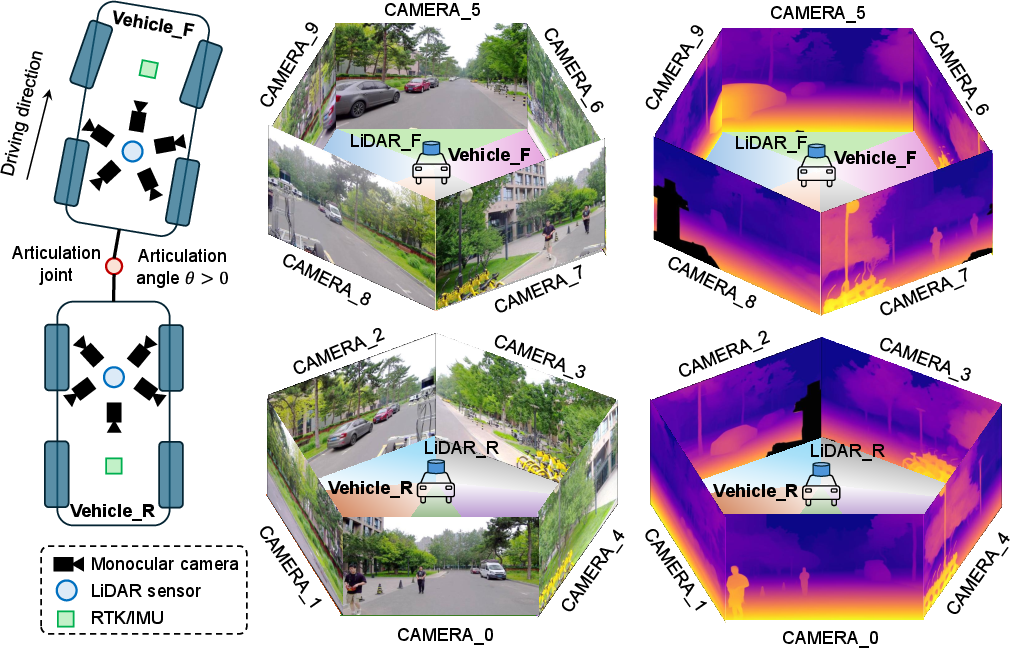
Figure 1: Surround depth estimation for articulated vehicle.
Methodology
Core Framework
ArticuSurDepth builds on a Structure-from-Motion (SfM) paradigm, jointly estimating dense depth and ego-motion from synchronized multi-camera sequences covering the full 360∘ surround. The depth network predicts per-camera depth maps, while a dedicated pose network estimates ego-motion for each articulated segment. Both are trained in a fully self-supervised regime, making use of photometric, geometric, and structural consistency objectives.
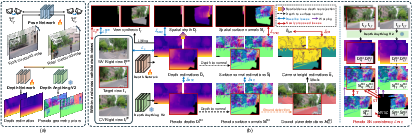
Figure 2: (a) Network architecture of ArticuSurDepth; (b) Self-supervised training framework with contextual enrichment and surface normal consistency loss.
Key to this approach is the exploitation of cross-vehicle spatial contexts—leveraging overlapping visual information between articulated segments not just within a segment (within-vehicle), but also across segments—to enrich supervision and regularize learning.
Cross-Vehicle Multi-View Spatial Context Enrichment
The method generalizes photometric view synthesis across both within-vehicle and cross-vehicle contexts. Unlike static extrinsics in passenger vehicles, cross-vehicle spatial contexts require dynamic extrinsics calibration, achieved via LiDAR pointcloud registration using ICP. This enables the model to utilize additional overlapping fields of view that arise from the articulation.
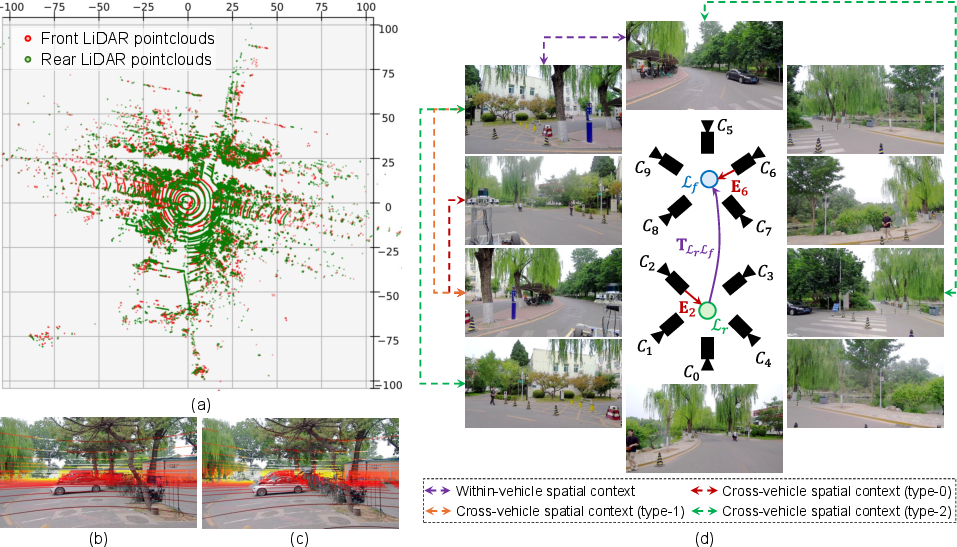
Figure 3: Example of cross-vehicle extrinsics calibration using LiDAR pointclouds, improving geometric alignment between articulated segments.

Figure 4: Visualization of spatial warps for target view C_5, showcasing the impact of both within-vehicle and cross-vehicle spatial contexts for enforcing photometric consistency.
Losses are aggregated across temporal, spatial, and spatial-temporal contexts, and further weighted according to the degree and quality of overlap. The cross-vehicle context is particularly beneficial in scenarios with moderate or high articulation, where standard within-vehicle overlap is limited.
Cross-View Surface Normal Consistency
The paper formulates a direct interpolation-based surface normal consistency constraint across spatial and temporal contexts. This is grounded in the observation that surface normals, unlike raw depth values, are invariant to scale and drift. The constraint enforces geometric coherence by aligning directly interpolated surface normals from source to target via rotation compensation, rather than the noisier method of interpolating depth and deriving normals post hoc.
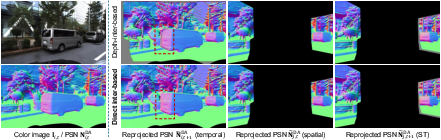
Figure 5: Comparison of surface normal reprojection methods, demonstrating that direct interpolation-based surface normal warping yields smoother, less noisy signals than depth-based reprojection.
Quantitative ablations confirm that this approach yields a measurable performance benefit, supporting the theoretical argument that cross-view normal consistency is a superior supervisory cue compared to alternatives.
Ground Plane-Aware Camera Height Regularization
ArticuSurDepth leverages the vision foundation model DepthAnything (DA) to reliably estimate pseudo-depth and robust surface normals, enabling label-free ground plane detection even in challenging early training phases. This pseudo-ground mask is then used to regularize the camera height, anchoring the network's depth predictions to metric scale without explicit 3D groundtruth or external lidar references.
Cross-Vehicle Pose Consistency
To further exploit the articulated structure, a cross-vehicle pose consistency loss is introduced. Instead of independently estimating motion for each segment, the method imposes a geometric coupling constraint, bridging poses across the articulation using dynamically estimated transforms. This increases robustness to articulated motion and enforces congruent temporal dynamics.
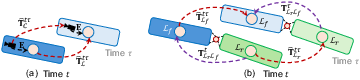
Figure 6: (a) Within-vehicle and (b) cross-vehicle pose consistency, illustrating how articulation-aware constraints couple the motion estimation between vehicle segments.
Given the dearth of public datasets for articulated vehicles, the authors constructed a custom test platform composed of two independently actuated battery-electric chassis, each mounted with a 5-camera surround system and 32-beam LiDAR, joined via a ball joint with precise articulation angle sensing.
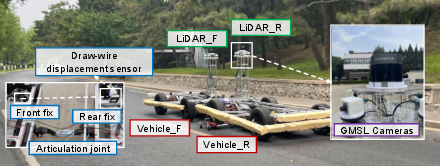
Figure 7: The self-established experimental platform with full surround visual and LiDAR coverage on an articulated vehicle proxy.
The dataset comprises over 40,000 synchronized surround-view images, LiDAR pointclouds, and articulation angles, supporting both training and quantitative validation.
Self-occlusion is addressed with masking during loss computation, particularly valuable in articulated contexts where one segment can occlude another:

Figure 8: Self-occlusion mask overlays, used to exclude invalid regions from supervisory losses when vehicles occlude each other during articulation.
Results and Analysis
Experiments are conducted over four datasets: KITTI (monocular), DDAD, nuScenes (multi-camera, passenger vehicle), and the proprietary articulated vehicle dataset. The methodology is benchmarked against FSM, VFDepth, SurroundDepth, CVCDepth, and GeoSurDepth, with adaptations as needed for the articulated configuration.
Key quantitative results on the self-collected dataset:
- Abs Rel error: 0.185 (lowest among all baselines)
- RMSE: 5.973
- Best or second-best in all primary standard depth metrics, outperforming CVCDepth and GeoSurDepth
On public datasets (DDAD, nuScenes), the inclusion of the cross-view surface normal consistency loss yields consistent improvements, especially on metrics sensitive to near-field and edge geometry.
Ablation studies independently validate:
- Each type of cross-vehicle context (Type 1 and 2) provides incremental benefit.
- The direct interpolation-based normal consistency loss outperforms prior normal or depth-based approaches.
- Camera height regularization using foundation model pseudo-normals is more robust than that with learned normals, especially when removing this regularization or using estimated (rather than DA) normals incurs measurable performance drops.
- Cross-vehicle (articulation-aware) pose consistency further improves both depth accuracy and motion estimation fidelity.
Qualitative visualizations confirm that the ArticuSurDepth model yields smoother, more semantically consistent depth maps with sharper boundaries in articulated scenarios and generalizes effectively across datasets.
Implications and Future Directions
This work demonstrates that articulated vehicle-specific geometric and kinematic priors are essential for robust depth perception in complex non-rigid contexts. The utility of cross-vehicle geometric consistency, specifically in the form of multi-view surface normal alignment and pose coupling, is substantiated both theoretically and empirically.
Practically, this framework advances depth estimation performance for autonomous systems operating in articulated domains without reliance on expensive sensors or dense 3D groundtruth, and with strong zero-shot generalization. The integration of vision foundation models for pseudo-annotation and geometric priors opens avenues for further label-free, scalable deployment.
Theoretically, the results suggest that geometric self-supervision constraints (especially at the level of normals and multi-view pose coupling) are highly beneficial, and may extend naturally to other non-rigid, multi-body robotics platforms. Future developments could explore deeper architectures for context fusion, tighter spatio-temporal coupling, and the use of generative or simulation-based priors for further performance improvements.
Conclusion
ArticuSurDepth provides a robust, self-supervised framework for surround-view depth estimation in articulated vehicles by incorporating cross-vehicle geometric consistency, direct interpolation-based surface normal alignment, and articulation-aware pose coupling, with auxiliary supervision from vision foundation models. The approach yields state-of-the-art numerical results on both public and custom articulated vehicle datasets and establishes foundational techniques for articulated 3D perception in self-supervised settings.