- The paper presents an algebraically exact framework that employs CPMZ and CPZ to propagate nonconvex reachable sets without over-approximation.
- It details a novel methodology that integrates offline initialization with online model-set refinement to iteratively tighten reachability estimates as new data arrives.
- The approach is rigorously validated on LTI and polynomial systems, demonstrating sharp, nonconservative reachable set computations essential for safety-critical verification.
Data-Driven Nonconvex Reachability Analysis using Exact Set Propagation
Overview
This work establishes an algebraically exact data-driven reachability analysis framework for discrete-time dynamical systems with unknown and possibly nonlinear (polynomial) dynamics, explicitly addressing nonconvex reachable sets. By exploiting the newly introduced constrained polynomial matrix zonotope (CPMZ) representation and its well-defined algebraic operations with constrained polynomial zonotopes (CPZs), the approach achieves exact set propagation. The framework provides both offline and rigorous online reachability guarantees, enables nonconservative treatment of model uncertainty, and supports iterative set refinement as new data becomes available.
Algebraic Set Representations
The limitations of existing data-driven deterministic reachability analysis stem from the closure properties of their chosen set representations—primarily, the inability of (constrained) zonotopes to capture nonconvexity or encode exact multiplications between uncertain models and states without over-approximation. This paper systematically extends the set-theoretic apparatus via:
- Constrained Polynomial Zonotopes (CPZs): Generalizing zonotopes, CPZs encode high-order dependencies between variables and enable representation of nonconvex sets in a tractable way, crucial for accurate reachability under nonconvexity arising from system uncertainty or logical constraints.
- Constrained Polynomial Matrix Zonotopes (CPMZs): CPMZs extend CPZs to sets of uncertain matrices (i.e., model parameters), supporting constraints and polynomial dependencies necessary for representing sets consistent with data and bounded disturbances.
The paper develops algebraically exact operators (merge, intersection, multiplication, addition) for these set classes, guaranteeing that each step of reachability propagation does not introduce conservatism, except for optional generator reduction for representation control.
Data-Driven Reachability for LTI Systems
The data-driven reachability algorithm proceeds as follows:
- Initialization: Given an initial batch of input–state measurements and a noise model, the admissible model set is represented as a CPMZ induced by data consistency and disturbance bounds.
- Exact Propagation: The next reachable set is computed as the exact image, under uncertain linear dynamics, of the product of the CPMZ model set and the CPZ reachable set, plus noise. The multiplication CPMZ × CPZ admits a closed-form CPZ representation—a key technical contribution.
- Online Model Set Refinement: As new data batches arrive, the admissible model set is recursively tightened via algebraically exact set intersection of CPMZs. The resulting reachable set representation tightens monotonically, with performance limited only by the informativeness of the data batch and the conservativeness of the disturbance model.
The exactness of reachable set propagation is visualized in the system architecture schematic:
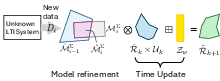
Figure 1: Data-driven reachability analysis with model refinement for LTI systems. ⊗ denotes exact multiplication; ⊞ denotes exact addition.
A rigorous formulation and proof for exact CPMZ–CPZ multiplication ensures that all dependencies and explicit nonconvexity in reachable sets are preserved—contrasting with existing approaches that rely on convex relaxations or outer approximations.
Extension to Polynomial Systems
The framework generalizes to discrete-time polynomial systems, encompassing both model-based and data-driven settings. Here, reachable set propagation requires evaluating multivariate monomials on CPZs, for which the paper develops exact CPZ-based set operations:
- Cartesian Product and Coordinate Extraction: Support for combining reach and input sets into an augmented state, facilitating monomial evaluation.
- Hadamard/Polynomial Set Multiplication: Algebraic rules for constructing the image of sets under arbitrary polynomials.
- Model-Set Learning: Given measured trajectories, the data-consistent set of polynomial coefficients is inferred and kept as a CPMZ. The recursive intersection tightens the feasible model set as more data are collected.
This approach subsumes and overcomes the need for interval arithmetic or sum-of-squares–based relaxations typical in set-based polynomial reachability.
Numerical Assessment
LTI Scenarios
The methodology is applied to high-dimensional LTI models with both convex and nonconvex initial sets. The strong points demonstrated include:
- Preservation of Nonconvexity: Via CPMZ/CPZ exact multiplication, the intricate geometry of nonconvex initial sets is exactly mapped through the uncertain linear flow, without relaxing to a convex hull.
- Incremental Refinement: Successive reachable sets after online model-set intersections exhibit marked reduction in diameter and volume, reflecting increased certainty from accumulated data.
- Sharpness Over Baselines: Compared to prior state-of-the-art (e.g., Alanwar et al. 2023), the reachable sets are systematically less conservative, as observed in the state projections and reductions in computationally relevant metrics.
Polynomial Systems
The methodology is benchmarked against CORA (state-of-the-art model-based tool) and interval-based data-driven alternatives:
- Exactness: For both convex and nonconvex initial conditions, the CPZ-based approach generates reachable sets that fully enclose all Monte Carlo trajectories, often matching the true boundary, and avoiding the wrapping/conservatism typical in interval-based or relaxation-based tools.
- Online Data Incorporation: The effect of incorporating new data batches further tightens the reachable sets, with the refinement most apparent under high-noise or large uncertainty conditions.
- Runtime Analysis: While exact set propagation incurs additional computational overhead compared to interval methods, the gains in set tightness and nonconservatism (especially for safety-critical applications) are significant and apparent in the reduced reachable set size and avoidance of false positive violation of safety constraints.
(Figures 2–5 would display relevant projections, comparisons, and tightness of exact vs. approximate reachable-sets. For brevity, see descriptive highlights above.)
Theoretical and Practical Implications
- Theoretical Strength: The architecture ensures that, modulo the structural noise model and data informativeness, reachability estimates are not systematically conservative due to the set computation pipeline. This closes a longstanding gap for nonconvex reachability under data-driven uncertainty.
- Generalization: Because CPMZ subsumes CMZ, and CPZ subsumes CZ, all existing deterministic set-based methods become subsumed/extensible under this framework.
- Practical Use: For safety–critical verification, where under- or over-approximations can lead to false positives or negatives, the ability to compute exact nonconvex reachable sets is essential. The online intersection mechanism supports adaptive verification as new system traces are collected.
Future Directions
Immediate research paths include the development of approximate or minimally conservative mechanisms for non-polynomial (e.g., Lipschitz-bounded) dynamics, exploiting the algebraic closure of CPMZ/CPZ classes. Furthermore, embedding these set representations in robust MPC and runtime monitoring pipelines is a practical avenue, as is developing set-reduction techniques that preserve essential geometric properties.
Conclusion
This paper provides an algebraically exact framework for data-driven reachability analysis under model uncertainty, capable of representing and propagating nonconvex reachable sets with minimal conservatism. The CPMZ/CPZ methodology bridges the gap between expressivity, rigorous model-set learning, and efficient nonconvex set propagation. By supporting both deterministic and polynomial data-driven systems, it offers a unified toolset for scalable and reliable reachability analysis in complex, real-world scenarios.