- The paper introduces a two-dimensional model segmenting cryptographic evolution into four quadrants to pinpoint systemic vulnerabilities.
- The study demonstrates how quantum algorithm-hardware co-design reduces RSA-2048 logical qubits to about 100,000, shortening migration timelines.
- The research underscores the urgency of immediate PQC transitions to mitigate Harvest Now, Decrypt Later attacks and secure AI protocols.
The Quantum-Cryptographic Co-evolution: A Technical Review
Analytical Framework for Quantum-Cryptographic Evolution
This paper presents a formal coordinate-based analytical framework to map the co-dependent evolution of cryptographic resilience and computational capability in the context of impending Cryptographically Relevant Quantum Computers (CRQC). The authors introduce a two-dimensional coordinate system: the x-axis quantifies cryptographic resilience (from classical/pre-quantum to quantum-safe), and the y-axis captures computational capability (from classical to CRQC). The quadrant model segments the system’s evolutionary trajectory into four phases—Classical Legacy, Proactive Transition, Vulnerability Crisis, and Dynamic Equilibrium—highlighting key technological and risk differentiators for each.
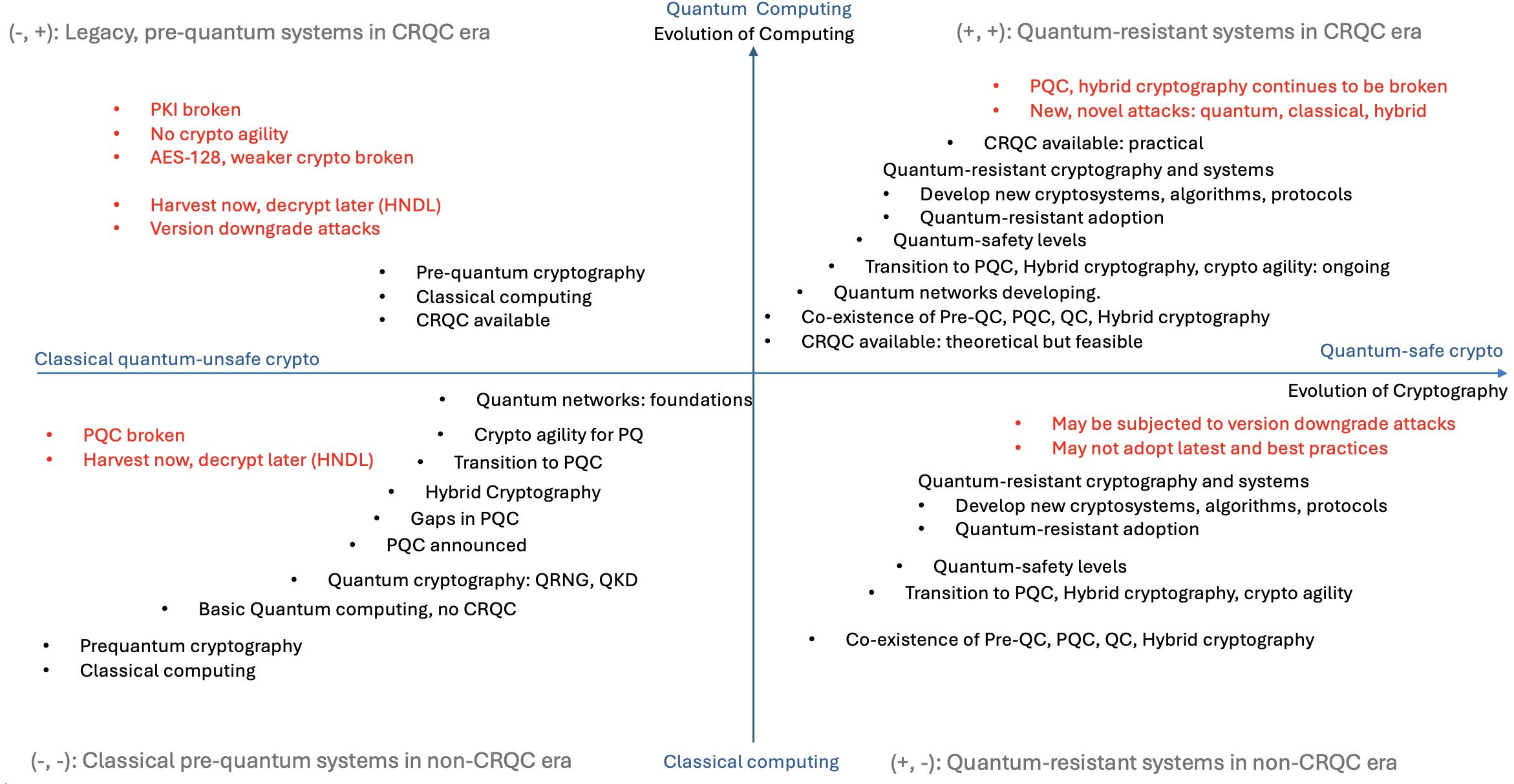
Figure 1: Detailed visualization of the quantum-cryptographic threat landscape.
The model provides explicit clarity on systemic risk. Notably, the (−,+) quadrant—where CRQC is available but cryptographic infrastructure remains pre-quantum—represents a period of maximum systemic vulnerability. In contrast, the (+,+) quadrant describes a stabilized post-quantum equilibrium, where cryptographic mechanisms and adversary capabilities are both quantum-resilient.
Acceleration of the Quantum Threat and Resource Optimization
The trajectory towards practical CRQC is significantly hastened by advances in both quantum algorithmics and hardware design, with particular focus on Shor’s algorithm optimizations and the deployment of reconfigurable neutral atom arrays. Algorithmic innovations—such as T-gate count minimization, windowed arithmetic, and optimized adders—have collectively reduced the logical qubit requirements for factoring RSA-2048 from previous estimates in the millions to approximately 100,000, contingent on high-fidelity gate operations and robust surface code QEC [fowler2024].
Hardware developments have shifted toward architectures tailored for the high-connectivity, high-coherence demands of cryptanalytic workloads. Neutral atom arrays now permit dynamic qubit movement and real-time connectivity, overcoming layout and decoherence limitations of superconducting platforms. The paper emphasizes algorithmic-hardware co-design, in which problem-specific mapping minimizes circuit depth, maximizes modular exponentiation parallelism, and thus, accelerates the “time-to-break” for legacy cryptosystems.
A strong claim is made: the co-design of quantum algorithms and specialized hardware effectively creates application-specific quantum cryptanalytic engines. This reduces the risk visibility window and tightens migration timelines for critical infrastructure.
Differential Hardness and Migration Urgency
Vulnerability analysis identifies Elliptic Curve Cryptography (ECC) as an early-stage target for CRQC attackers, given its lower logical qubit requirements per classical security bit compared to RSA [proos2003]. This necessitates defense-in-depth migration prioritization strategies, in which the most vulnerable ECC-based assets are upgraded to PQC well before RSA-based systems, informed by the specific group structure and implementation details of the underlying primitives.
The Harvest Now, Decrypt Later (HNDL) threat model further shortens effective migration windows by decoupling the time of a compromise from the time a CRQC becomes available; adversaries indiscriminately harvest encrypted data today for retrospective decryption post-Q-Day [hndl2022]. This underscores the authors’ emphasis on immediate, not deferred, PQC transitions.
Quadrant-Specific Evolution and Practical Considerations
Quadrant (-, -): Classical Pre-Quantum Era
This quadrant encompasses legacy cryptosystems premised on the intractability of factoring and discrete logarithms, implemented on classical hardware. Although quantum cryptographic primitives (e.g. QKD, QRNG) are in early deployment, the majority of infrastructure remains static and non-agile. The seeds of transition—PQC announcement and hybrid cryptography—are visible, but architectures are neither modular nor adaptable.
Quadrant (+, -): Proactive Transition
This quadrant marks the deployment phase for PQC. Lattice- and code-based protocols are implemented in parallel with legacy systems, often in hybrid modes to ensure redundancy against early implementation flaws. The concept of “crypto-agility”—the modularity required to swap cryptographic primitives—is foregrounded as the only viable strategy for timely, systemic migration. The risk of version downgrade attacks and implementation gaps is acute.
Quadrant (-, +): Vulnerability Crisis
A system in this quadrant is exposed: legacy cryptography is deployed in a CRQC-enabled adversarial environment. RSA, ECC, and associated PKI are effectively broken. AES-128 and similar symmetric ciphers, weakened by Grover’s algorithm, are demoted to 64 bits of effective security, while HNDL attacks allow past communication to be decrypted at scale. This state represents unrecoverable systemic compromise.
Quadrant (+, +): Dynamic Equilibrium
A post-quantum, dynamic equilibrium is achieved when cryptographic and computational capabilities are commensurately quantum-resilient. Here, iterative advancement is required: as PQC standards are broken by new cryptanalytic or hybrid attacks, continuous algorithmic renewal drives ongoing system adaptation. Fully integrated quantum-classical hybrid networks and perpetual cryptographic agility become baseline requirements for operational resilience.
Evolution of Defensive and Offensive Capabilities
The paper systematically tracks the trajectory of quantum hardware (from superconducting qubits to reconfigurable neutral atom and photonic networks), the maturation of QEC (from Shor’s code to topological and surface/LDPC codes), and the co-evolution of quantum networks from initial fiber-based QKD links to multi-node quantum-classical hybrid communication. Emphasis is placed on the operationalization of these technologies within enterprise-grade infrastructure [cisco_quantum2024].
On the offensive side, the paper elucidates how algebraic and combinatorial problem reductions—such as those governing Shor’s and Grover’s algorithms—directly undermine RSA/Diffie-Hellman/ECC and diminish symmetric key margins, respectively. The discussion integrates contemporary cryptanalytic events (e.g., the break of SIKE [castryck2022]) as evidence of the continuous threat to emergent PQC schemes, even those with strong initial peer review and analytic support.
Implications, Future Trajectory, and AI
The co-evolutionary framework mandates that security operations abandon static, project-based updates in favor of perpetual cryptographic renewal and real-time agility. The volatility of the threat landscape—and the possibility of future quantum algorithms efficiently solving lattice-based or combinatorial problems—implies that cryptographic agility and modularity are not optional features, but existential requirements for digital sovereignty and operational trust.
Practical implications for AI include the need for post-quantum secure protocols not only in core communication stacks but also in distributed learning, federated inference, and AI model provenance verification across hostile environments. Moreover, quantum-assisted cryptanalysis may accelerate side-channel or novel hybrid attacks on cryptographic implementations used in AI frameworks, necessitating red-teaming and rapid codebase adaptation well beyond protocol-level defenses.
Continued research will be required in operational security shelf-life metrics, continuous integration of hybrid classical-PQC stacks, and the development of AI-driven cryptographic monitoring to anticipate and respond to new quantum-classical attack surfaces.
Conclusion
This paper provides a rigorous formalization of the quantum-cryptographic co-evolution, unequivocally framing the urgency of crypto-agile PQC adoption against the accelerating trajectory of CRQC. The quadrant-based framework, grounded in both technical and operational realities, demonstrates that systemic security in the quantum era will require unceasing innovation, modularity, and resilience against an evolving spectrum of mathematical and implementation-level threats (2604.02591).

