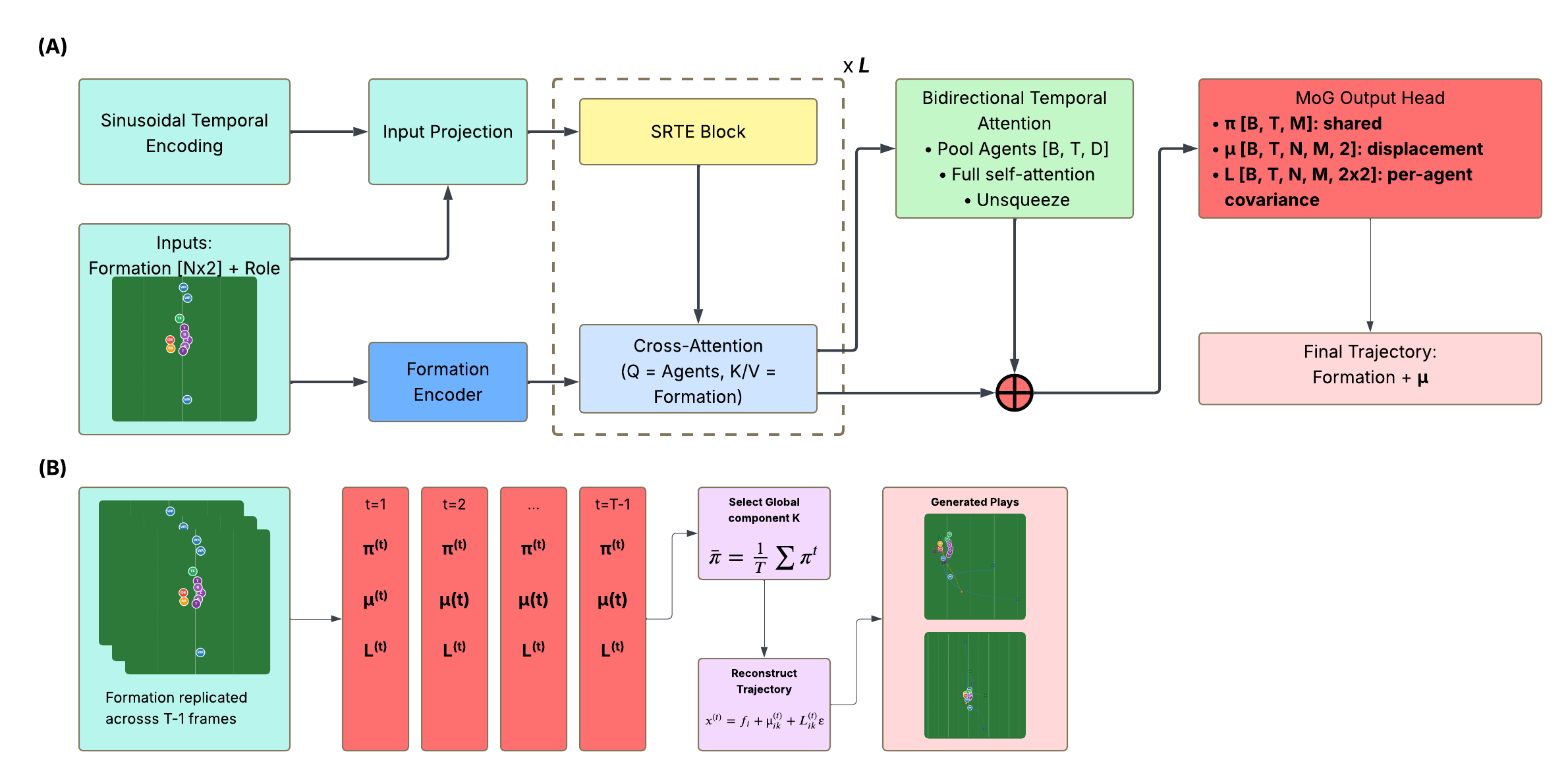
- The paper introduces a mixture-of-Gaussians framework that generates coordinated multi-agent trajectories non-autoregressively, ensuring both diversity and coherence.
- It incorporates novel formation encoding alongside relative spatial and bidirectional temporal attention to condition play generation on initial football formations.
- Empirical results on NFL tracking data demonstrate significant gains in accuracy and diversity over CVAE and diffusion-based approaches.
PlayGen-MoG: Mixture-of-Gaussians-Based Multi-Agent Trajectory Generation for Play Design
Problem Setting and Motivation
Multi-agent trajectory generation in team sports, particularly American football, presents a uniquely structured generative challenge: one must synthesize coordinated, physically plausible trajectories for all players, from only a single static initial formation, without the benefit of observed trajectory history. Existing approaches—such as CVAEs and diffusion models—struggle to jointly realize diversity and coherence. CVAE-based models typically collapse to a single mode, while diffusion approaches often yield incoherent motion, both of which are inadequate for practical play design, tactical analysis, and coaching.
PlayGen-MoG introduces a framework that directly addresses these challenges by leveraging a Mixture-of-Gaussians (MoG) head with shared mixture weights across all agents, introducing explicit coupling of player outcomes to distinct play scenarios. The model is explicitly formation-conditioned and operates in a non-autoregressive regime, predicting full trajectory displacements from the initial formation in a single forward pass.
Architectural Innovations
The PlayGen-MoG architecture is comprised of several interlocking components designed to achieve both diversity and realism in generative multi-agent settings:
This explicit play scenario mechanism ensures that sampled trajectories for all agents reflect a common, coordinated outcome, as opposed to degenerate averages or uncorrelated random draws.
Generation Dynamics and Training Strategies
The model is tasked with producing absolute displacements from the initial formation, thereby eliminating the compounding error drift endemic to frame-to-frame delta prediction. Each timestep's prediction is independent, benefitting from sinusoidal step embeddings and cross-timestep attention for temporal coherence.
Noteworthy aspects of the training procedure and objective include:
- Negative Log-Likelihood (NLL) of the MoG: The core criterion, treating the entire team and sequence jointly rather than as a collection of decoupled agents.
- Best-Component ADE Loss: Prioritizes accuracy of the most probable mixture component, sharpening spatial fidelity.
- Entropy Regularization: Maximizes the entropy of the mixture weights, explicitly guarding against mode collapse and ensuring all mixture components are active within the training regime.
- Temporal Smoothness Loss: Penalizes frame-to-frame discontinuities in means, forcing the model to learn physically plausible, continuous displacements.
At inference, trajectory generation for a given formation is controlled by sampling the mixture component from the time-averaged weights, guaranteeing coherent, realistic diversity aligned with actual football play concepts.
Empirical Findings
Experiments on NFL tracking data (2021–2022, 9,934 plays) demonstrate several key results. The non-autoregressive absolute-displacement model achieves substantial gains in both accuracy and diversity compared to autoregressive baselines and latent-variable diffusion methods:
| Method |
ADE (yds) |
FDE (yds) |
Entropy |
APD (yds) |
| PlayGen-MoG (M=8) |
1.68 |
3.98 |
2.06/2.08 |
1.13 |
| CVAE |
2.88 |
6.56 |
— |
0.10 |
| LED (diffusion) |
1.34 |
3.14 |
— |
— |
PlayGen-MoG uniquely maintains full mixture utilization, with entropy near the theoretical maximum for M=8, and produces visibly distinct, coordinated play scenarios, as confirmed both quantitatively and qualitatively.
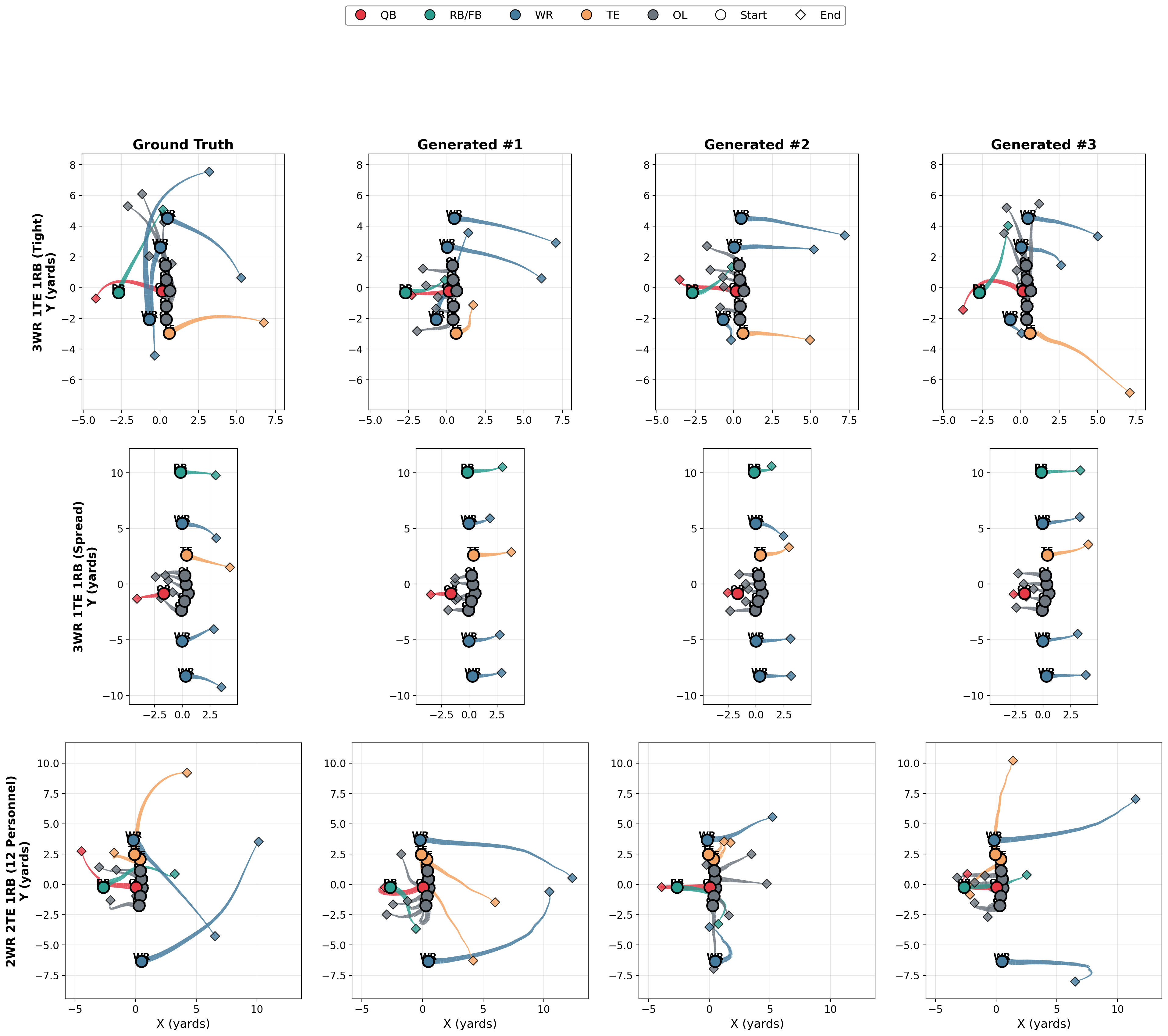
Figure 2: Generation of three distinct, realistic play concepts per formation; samples are diverse and coordinated.
Importantly, the APD metric (average pairwise diversity across samples for a fixed formation) demonstrates that increased mixture cardinality correlates strongly with meaningful diversity, particularly for receiver and quarterback roles. APD increases monotonically with mixture size, confirming that each component codes for a distinct play variant.
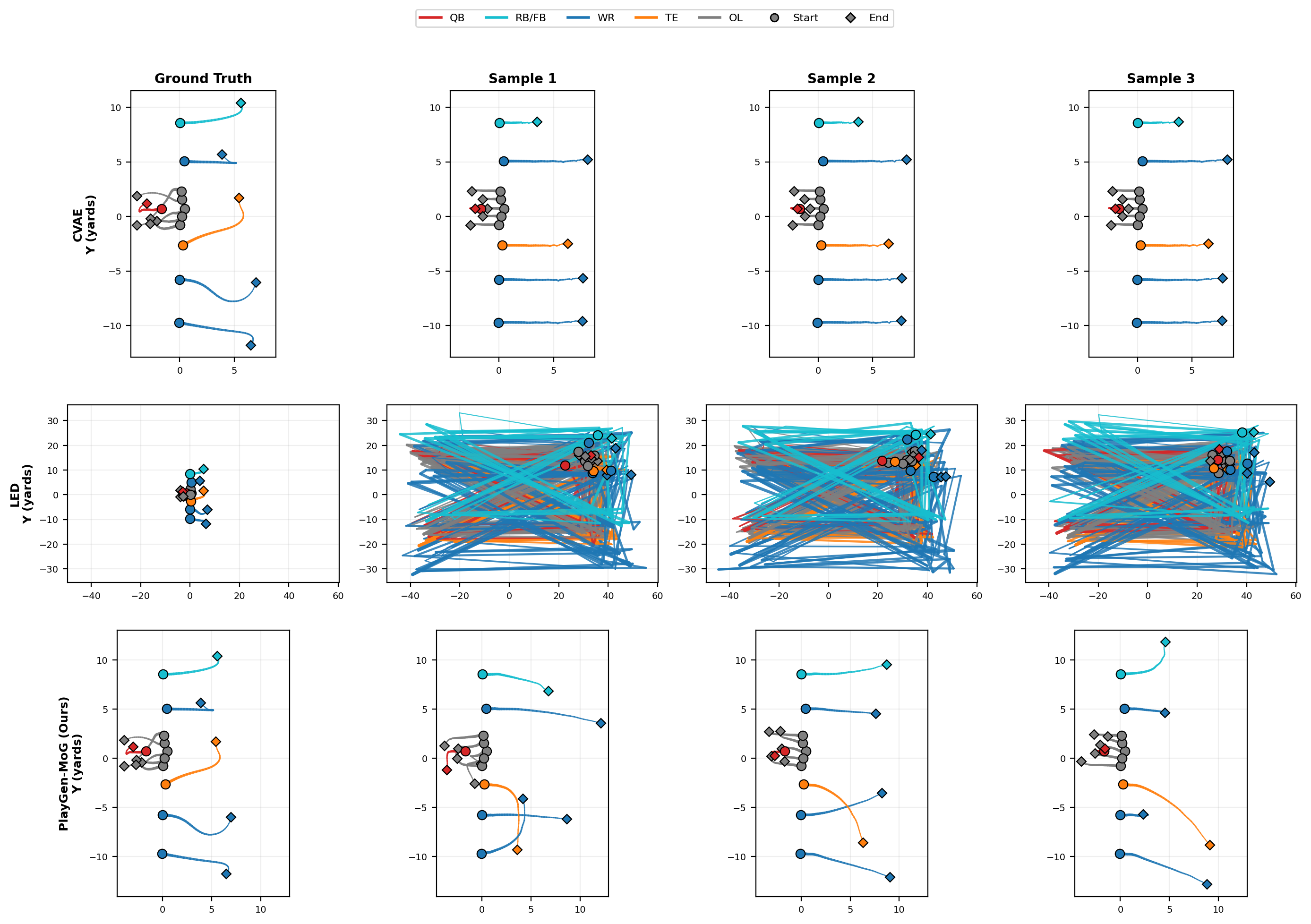
Figure 3: Qualitative comparison—CVAE shows posterior collapse, LED generates incoherent trajectories, while PlayGen-MoG yields diverse, realistic plays.
Further, PlayGen-MoG’s ADE remains stable across horizon lengths, and diversity naturally unfolds over time as routes diverge (see Figure 4).
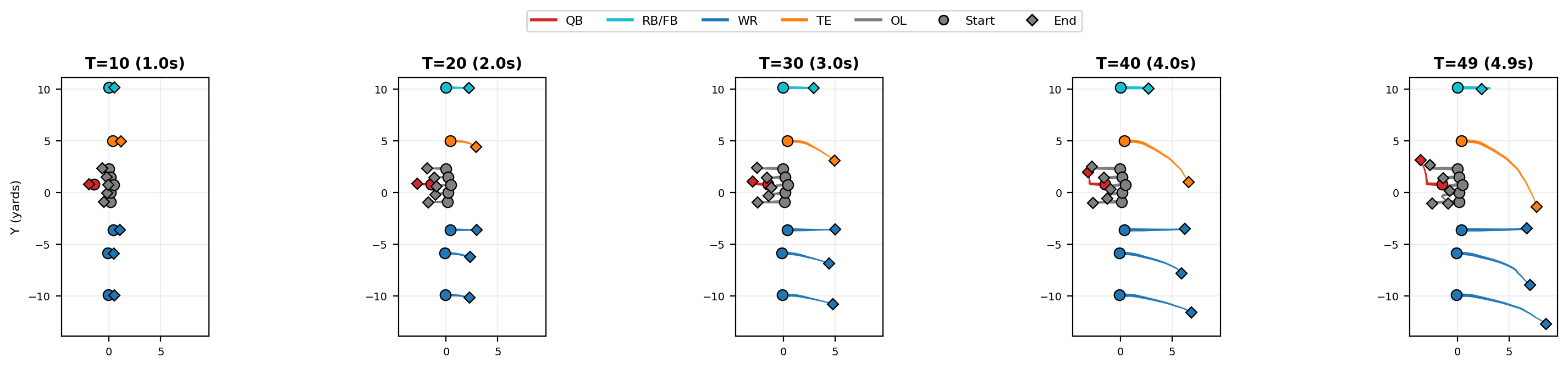
Figure 4: Progressive formation of routed play concepts across time horizons, with trajectories separating as routes develop.
Implications and Future Directions
The PlayGen-MoG framework introduces a robust and computationally efficient paradigmatic shift for multi-agent generative modeling in structured settings:
- Practical Impact: Direct applicability to play design and tactical analytics in American football, supporting rapid exploration of play concepts from canonical personnel groupings solely from the initial static alignment.
- Scalability: The shared mixture-head design avoids quadratic complexity associated with full cross-agent covariance models, thus remaining tractable even as team size or trajectory length increases.
- Versatility: While currently demonstrated on offensive football data, the architecture is sport-agnostic in principle, with extensions possible for set-plays in other structured sports.
- Extension Paths: Conditional generation on text labels or defensive alignments, as well as joint modeling of both offensive and defensive agents, could enable rich counterfactual “what-if” queries in competitive analytics.
The findings that continuous latent spaces are insufficient for discrete play distribution, and that eliminating autoregressive error propagation is critical for long-range coherence, both have broader ramifications for trajectory generation tasks across other multi-agent or robotic domains.
Conclusion
PlayGen-MoG establishes a new model class for diverse, coordinated multi-agent generative modeling under minimal conditioning. The explicit mixture mechanism, relative spatial relation modeling, and non-autoregressive displacement prediction together deliver both high-fidelity and high-diversity trajectory samples, overcoming core pathologies of prior approaches. The framework’s modularity and empirical rigor provide a strong foundation for both immediate deployment in sports analytics and further research in multi-agent generative modeling.