- The paper presents HCCS, a calibrated integer-native softmax surrogate that eliminates explicit exponentiation for efficient int8 edge inference.
- It employs offline per-head calibration and quantization-aware retraining to minimize KL divergence and preserve near-baseline model accuracy.
- HCCS achieves a 4.6×–15.1× throughput boost on AMD AI Engines while ensuring linear scaling and efficient vectorized operations.
Introduction and Motivation
The paper "Taming the Exponential: A Fast Softmax Surrogate for Integer-Native Edge Inference" (2604.02292) systematically addresses the computational limitations of conventional softmax in quantized Transformer models targeted for edge inference, specifically on AMD Versal AI Engines. The issue is that exponentiation and normalization within softmax—particularly in low-precision (int8) pipelines—substantially hinder achievable throughput, primarily due to the need for floating-point arithmetic or LUT-based exponentials on hardware that otherwise excels at vectorized integer MAC operations. This mismatch creates a bottleneck that is nontrivial when deploying compact, quantized Transformers where the non-GEMM softmax cost can dominate execution time.
Head-Calibrated Clipped-Linear Softmax (HCCS): Surrogate Construction
The authors introduce the Head-Calibrated Clipped-Linear Softmax (HCCS), a fully integer-native, strictly monotonic function that serves as a bounded and hardware-friendly surrogate to the exponential softmax. HCCS operates as follows:
- Quantized attention logits x are max-centered and their unsigned distance to the max (δi) is clamped to a per-head maximum Dmax,h.
- A calibrated affine transform si=Bh−Shδi produces positive surrogate scores (Bh>0, Sh≥0).
- The normalization is performed in fixed-point arithmetic: the scores si are summed per row, and probabilities pi are computed by integer reciprocal scaling and multiplication.
This pipeline is composed strictly of vectorized integer ops (max, sub, clamp, MAC, sum, reciprocal-approx) and fits directly onto the AI Engine's int8 MAC datapath, sidestepping any float32/bfloat16 arithmetic or LUT fetches.

Figure 1: The HCCS pipeline comprises max reduction, distance clamp, affine scoring, summation, and reciprocal normalizations—all integer vector operations without explicit exponentiation or LUTs.
Offline Headwise Calibration
A critical innovation is the introduction of a lightweight, offline, per-head calibration phase: Given empirical distributions of attention logits, calibration selects Bh,Sh,Dmax,h to minimize the KL divergence between the true (float32) softmax distribution and the HCCS surrogate. This headwise calibration enables HCCS to accurately track statistical heterogeneity across heads, essential in models where focused and broad heads exhibit distinct activation profiles.
The surrogate’s parameters are fixed for deployment and not learned end-to-end; instead, quantization-aware retraining (QAT) is used to allow model weights to compensate for surrogate-specific distortions, ensuring task-level fidelity.
Hardware Mapping and Architectural Analysis
The authors present an optimized mapping of HCCS onto AMD’s AI Engine, directly leveraging the vector MAC resources for all stages. By constraining Dmax,h and δi0 to safe integer ranges, the implementation prevents overflow at all points—no aspect of the algorithm requires precision crossing or synchronization outside of row-level reduction. Parallelism and vectorization are exploited by assigning independent softmax rows to different compute tiles, enabling linear scaling with increasing tile allocation.
Fidelity: Attention Behavior under Surrogate Normalization
Empirical analysis demonstrates that retrained models (BERT-Tiny, BERT-Small) using HCCS maintain near-identical structural properties in their attention maps compared to float32 softmax: Broad and focused heads exhibit comparable entropy and distributional shape, though absolute probabilities diverge due to the strictly monotonic, non-exponential mapping of HCCS.
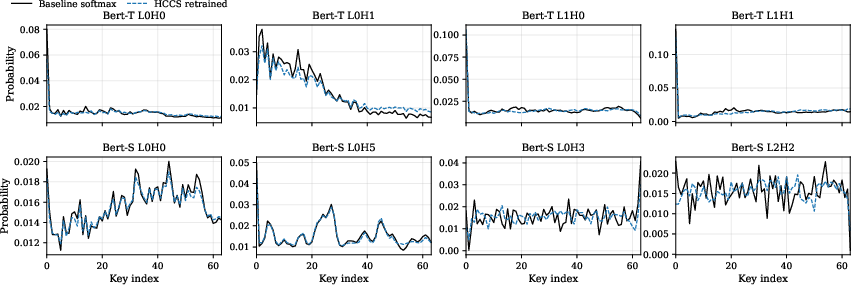
Figure 2: Attention curves for both broad and focused heads, comparing float32 softmax and retrained HCCS. While there are deterministic differences, HCCS maintains the qualitative structure of attention.
Task-Level Accuracy and Calibration Granularity
Evaluation on SST-2 (sentiment classification) and MNLI (natural language inference) confirms that HCCS, after quantization-aware retraining, incurs negligible accuracy degradation (≤ 2 percentage points on all tested configurations). Notably, per-head calibration outperforms global or per-layer parameterization, especially in datasets with high headwise heterogeneity. Direct substitution without retraining leads to severe accuracy loss, underpinning the necessity of QAT in conjunction with a monotonic surrogate.
Throughput and Scaling Characteristics
The performance advantage of HCCS is pronounced in hardware benchmarks. On AIE-ML, HCCS with integer division normalization achieves a δi1–δi2 throughput improvement over the vendor’s BF16 LUT-based softmax across different sequence lengths. When leading-bit reciprocal approximation is employed (HCCS i8+CLB), the speedup peaks at δi3 for short sequences. The implementation achieves linear multi-tile scaling, with 184 tiles reaching aggregate throughputs in excess of 400G elements/s—an efficiency unreachable by float/LUT softmax or prior FPGA softmax accelerators.
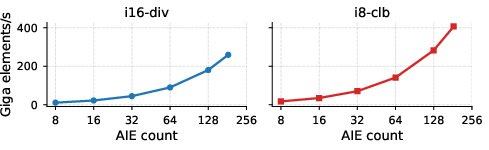
Figure 3: Aggregate softmax throughput as a function of AI Engine tile count, confirming linear scaling for both HCCS normalization variants.
Theoretical and Practical Implications
The study demonstrates that exact exponentiation in softmax is not mandatory for maintaining downstream accuracy, provided the surrogate is monotonic, bounded, and is supported by calibration plus QAT. This has significant implications for edge inference, where the integer pipeline vastly outperforms LUT or float alternatives. The method is hardware-centric: it closes the gap between existing accelerator capabilities (int8 MACs) and the needs of MHA blocks. The calibration approach also outlines a general hardware-friendly strategy for replacing other non-linearities in int8 deployment.
Conclusion
The work establishes HCCS as a compelling, efficient, and accurate alternative to softmax for int8-based Transformer inference on AMD AI Engines. By forgoing explicit exponentials in favor of a monotonic, calibrated affine surrogate—supported by QAT—the method delivers near-baseline accuracy and substantial hardware speedups. These findings open new directions for co-optimized algorithm and hardware design, especially for deploying deep models on integer-native edge accelerators. Future work may explore learnable or dynamic surrogate parameterization and extension to a broader range of non-linear normalizations in deep networks.

