- The paper presents a novel DKPC framework that leverages Koopman operator lifting and Willems’ Fundamental Lemma to enable data-driven frequency regulation in systems with black-box IBRs.
- It employs receding horizon convex optimization with hard constraints to ensure rapid convergence of frequency deviations while balancing tracking and control effort.
- Comparative analysis against DeePC on the IEEE 39-bus system demonstrates that DKPC achieves lower tracking error and reduced control effort through richer state representation.
Data-Driven Koopman Predictive Control for Frequency Regulation in Black-Box IBR Power Systems
Introduction
The proliferation of inverter-based resources (IBRs) in modern power systems introduces significant model uncertainty and nonlinearity that hinders the application of classical model-based control. This work introduces a Data-driven Koopman Predictive Control (DKPC) framework for secondary frequency regulation, targeting systems with IBRs modeled as black boxes. DKPC leverages Koopman operator theory to lift the nonlinear system dynamics into an augmented observable space, where data-consistent behavioral representations, grounded in Willems’ Fundamental Lemma (WFL), enable receding-horizon optimal control using only measured input-output data. The controller enforces hard constraints on both control actions and system outputs.
Methodological Framework
Koopman Operator Lifting and Data-Driven Modeling
The key innovation in this work is the combination of Koopman operator theory and behavioral systems methods. By defining a set of radial basis function (RBF) observables over the measured system outputs, the authors construct a lifted state that approximates the nonlinear system’s expansion in a finite but expressive higher-dimensional space. In this Koopman-lifted space, the system allows for a Hankel-based behavioral representation consistent with WFL. Persistently exciting experiments yield data that populate these Hankel matrices, forming the basis for predictive control synthesis without requiring explicit identification or knowledge of the plant’s equations.
Receding Horizon Convex Predictive Control
At each timestep, DKPC solves a convex finite-horizon problem that simultaneously optimizes the trade-off between output tracking and control effort, penalized by positive definite matrices Q and R, respectively, with an ℓ2 regularization term for robustness. Control actions and predicted behaviors are constrained to the convex hull spanned by the measured data, coupled via the lifted observables and data Hankel matrices. The first optimized control input is implemented, and the procedure iterates in receding-horizon fashion.
System Model and Data Generation
For empirical validation, the methodology is applied to the IEEE 39-bus system, where all ten synchronous machines are replaced by grid-forming IBRs, each modeled via droop control with first-order measurement and control filters. Disturbance inputs and system responses are simulated for data generation, ensuring informativity via persistently exciting randomized control signals. The measurable states are angular frequencies, while the phase angle evolution is available for diagnostics.
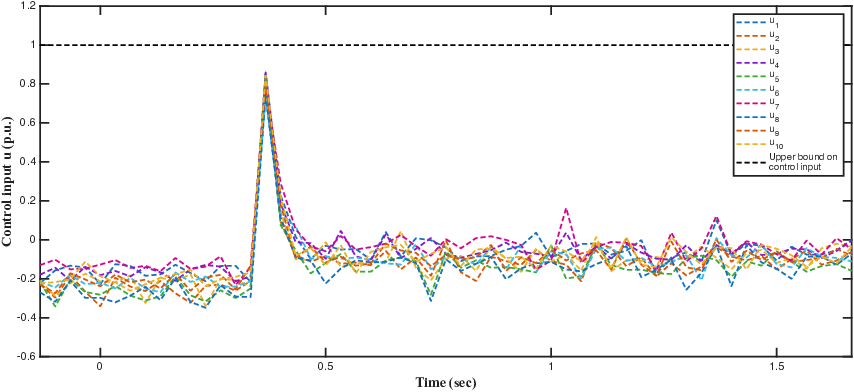
Figure 1: Control signals applied to all ten inverters, illustrating input magnitudes and transients following reference changes.
Numerical Evaluation and Results
Frequency Regulation and Control Effort
The DKPC controller demonstrates rapid convergence of frequency deviations to nominal values following a power disturbance, enforcing input constraints without inducing significant overshoot or chattering. Synchronization across the inverter nodes is maintained, and the control inputs respect admissible bounds, with transient effort corresponding to the urgency of the regulation objective.
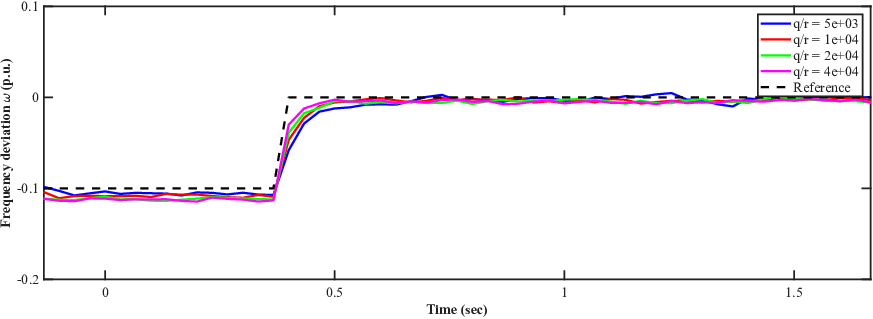
Figure 2: Frequency deviation profiles for the inverters under varying q/r weight ratios, indicating the sensitivity to tracking emphasis.
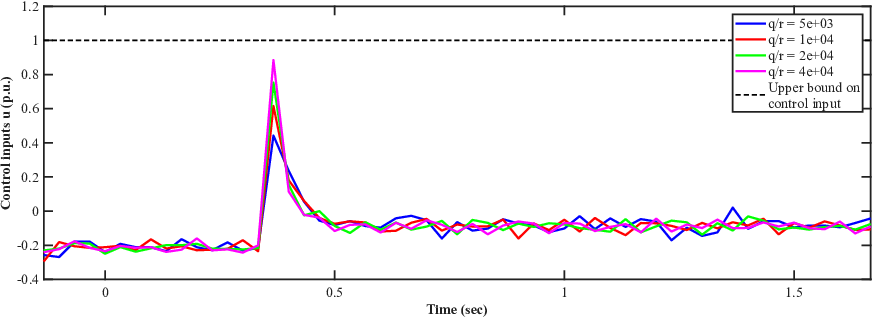
Figure 3: Associated control inputs for the inverters with varied q/r ratios, demonstrating that larger tracking weight induces greater control action.
Weight Tuning and Trade-offs
Varying the ratio of frequency tracking to control effort weights (q/r) enables direct manipulation of the tracking/effort Pareto front. Quantitative analysis examines the integrated time-weighted absolute error (ITAE) and cumulative control effort, exposing the effect of penalizing control.
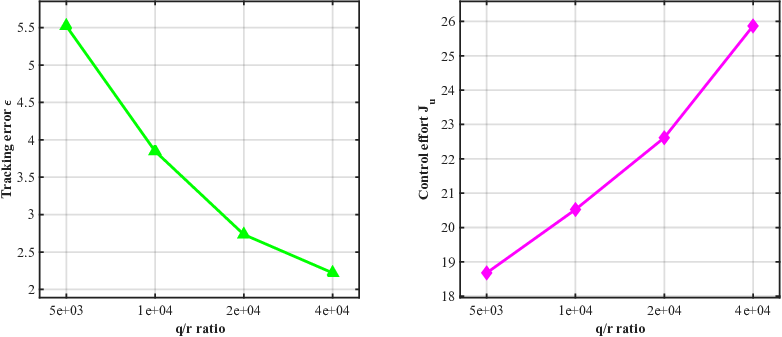
Figure 4: Quantitative comparison of tracking performance (ITAE) and aggregate control effort for different q/r ratios.
Comparative Analysis: DKPC vs. DeePC
DKPC is benchmarked against the canonical Data-enabled Predictive Control (DeePC), which operates in the native input-output space without Koopman lifting. Systematic parameter sweeps over tuning weights and regularization terms allow delineation of the Pareto-optimal boundaries for both controllers.
DKPC consistently provides superior trade-offs, delivering lower tracking error for equivalent or reduced control effort across the majority of the feasible parameter regime. This is attributed to the richer representational capacity of the lifted observable space, enabling DKPC to more effectively align the controller with nonlinear system dynamics.
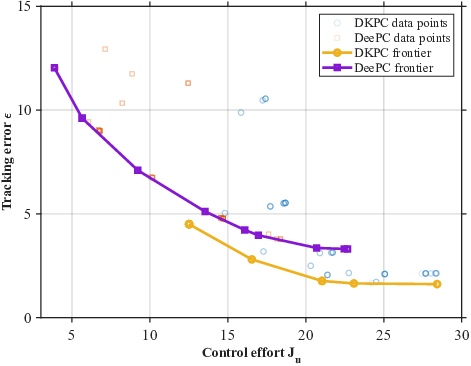
Figure 5: Empirical Pareto frontier of tracking error versus control effort for DKPC and DeePC controllers—DKPC achieves a more favorable trade-off over the design space.
A blended performance index Sα=αϵ+(1−α)Ju parametrized by α was used to further assess performance as user preference shifts from aggressive tracking (α→1) to control minimization (R0). DKPC exhibits lower minimum blended costs over the practical spectrum of operational priorities, particularly for settings favoring regulation-oriented objectives.
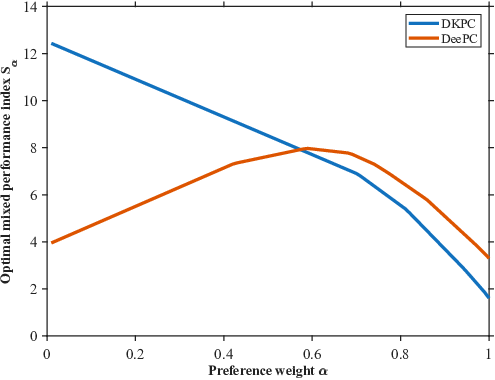
Figure 6: Minimum attainable value of the mixed performance index R1 (normalized) for DKPC and DeePC as a function of R2. DKPC outperforms DeePC, especially in regimes prioritizing tracking accuracy.
Theoretical and Practical Implications
This work demonstrates that the fusion of Koopman operator-based lifting with behavioral system identification delivers highly competitive data-driven predictive control for nonlinear, high-dimensional, and uncertain power networks. By enabling linear predictive frameworks to operate reliably on black-box systems, the approach obviates the need for physics-based modeling or proprietary plant insight—an essential advancement as power systems transition towards IBR-dominance and increasing topological and dynamical uncertainty.
From a theoretical standpoint, these results reinforce recent findings that sufficiently informative data, combined with well-designed observable spaces, can close the gap between nonlinear system control and linear convex optimization, even in the presence of hard constraints. The approach is robust to system heterogeneity, with the scalability of the RBF/kernels and Hankel matrix size determining tractability.
Future Research Directions
Future work will address extensions to larger and more heterogeneous grids, decentralization of the DKPC framework for distributed implementation, closed-loop stability certification under bounded lifting error, and robustness analysis with respect to real-world measurement noise and communication delays. Communication and computational aspects, critical for real-time centralized deployment, also warrant further investigation.
Conclusion
The DKPC framework for black-box IBR-dominated power system frequency regulation leverages the combination of Koopman operator theory and behavioral predictive control, achieving improved tracking-effort trade-offs compared to DeePC without explicit plant models. This establishes DKPC as an effective paradigm for practical, scalable, and interpretable frequency regulation in future renewable-centric power grids.

