- The paper introduces a non-separable k-inflation model that employs kinetic-potential coupling to adjust both the spectral tilt and the tensor-to-scalar ratio.
- It derives analytic slow-roll solutions and validates them numerically, achieving sub-percent accuracy in predicting inflationary observables.
- The study identifies parameter spaces that reconcile traditional monomial potentials with stringent ACT, Planck, and BAO observational bounds.
Non-Separable k-Inflation in Light of ACT Constraints
Introduction
This work examines an extension of single-field inflation within the kinetic-driven (k-essence) paradigm, focusing on models where the Lagrangian incorporates a non-separable interaction between the kinetic term and the potential. Specifically, the study explores actions of the form P(X,ϕ)=f(ϕ)[Xρ−V(ϕ)] with f(ϕ)=1+2KV(ϕ), establishing a direct coupling between the scalar potential V(ϕ) and the kinetic sector via parameter ρ and a mixing coefficient K. This non-separable XρV term modifies both the background evolution and the inflationary predictions for the spectral tilt ns and the tensor-to-scalar ratio r.
The impetus for this generalization comes from ACT DR6, Planck, and BAO (P-ACT-LB) data, which have sharpened constraints on ns and r, pushing viable inflationary scenarios toward higher scalar tilts (ns≈0.974) and lower tensors (r<0.038), threatening the viability of canonical monomial models and motivating new deformations in both potential and kinetic sectors (Louis et al., 18 Mar 2025, Calabrese et al., 18 Mar 2025, 2511.16621). The central question is whether a minimal, non-separable k-essence template suffices to bring otherwise marginal monomial models within these bounds, without running afoul of theoretical consistency (e.g., ghosts, gradient instabilities).
Model Architecture and Slow-Roll Dynamics
The considered Lagrangian, P(X,ϕ)=f(ϕ)[Xρ−V(ϕ)], generalizes separable k-inflation by introducing multiplicative kinetic-potential coupling. Here, X=−21∂μϕ∂μϕ, ρ>1/2 ensures a real and positive sound speed at all times, and f(ϕ) (with K<0) enforces perturbativity and stability.
The slow-roll regime is characterized by dominant V(ϕ) and nearly constant kinetic energy, reducing the background equations to
3H2≃f(ϕ)V(ϕ),6ρHfXρ≃−ϕ˙V,ϕ(2f−1).
From these, closed-form slow-roll expressions for εH and ηH follow as functions of the monomial index n, the mixing strength ϵmix∝K, ρ, and the remaining e-folds N. Consistency conditions require f(ϕ)>0 (ghost-free), ρ>1/2 (gradient stability), and V(ϕ)<1/(2∣K∣) (perturbativity).
The sound speed cs2=1/(2ρ−1) is constant, with larger ρ driving cs subluminal and suppressing gravitational waves.
Analytical Predictions and Numerical Validation
For benchmark monomial potentials V(ϕ)=Aϕn, analytic solutions for ns(N∗) and r(N∗) are derived to second order in ϵmix, enabling precise mapping of the inflationary observables across parameter space.
Comparison between analytic formulae and exact background integrations yields sub-percent accuracy for both ns and r across the relevant ϵmix, ρ, and N∗ ranges.
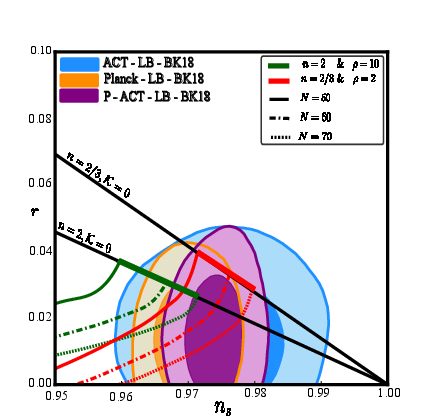
Figure 1: Predictions in the (ns,r) plane from analytic and numerical modeling; model trajectories for varying ϵmix overlaid with P-ACT-LB data contours.
The analytic expansion captures the systematic downward shift in ns and r induced by K<0, enabling otherwise excluded monomial potentials (e.g., quadratic n=2) to enter the P-ACT-LB-favored region.
Parameter-Space Structure and Observational Viability
Comprehensive scans over ϵmix, ρ, and N∗ delineate the parameter space compatible with current ACT+Planck+BAO limits. For V(ϕ)=Aϕ2, achieving ns∈[0.971,0.974] and r<0.038 requires N∗≳70 and ρ≳10 for ∣ϵmix∣<10−3. For V(ϕ)=Aϕ2/3, similar compatibility arises for N∗≳50, ρ≳1, and ∣ϵmix∣<0.03.
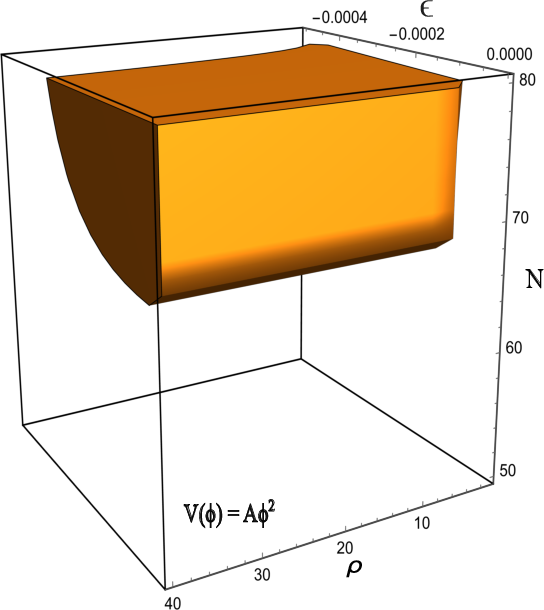
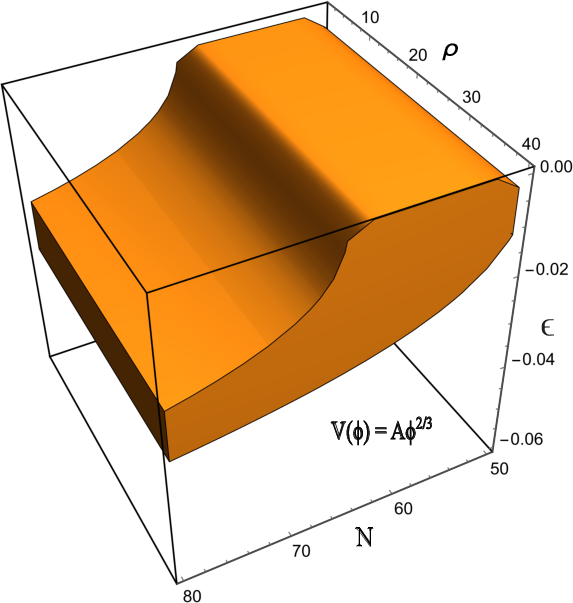
Figure 2: Three-dimensional allowed region in (ϵmix,ρ,N∗) for fixed monomial index n=2 (top) and n=2/3 (bottom); shaded points satisfy P-ACT-LB constraints.
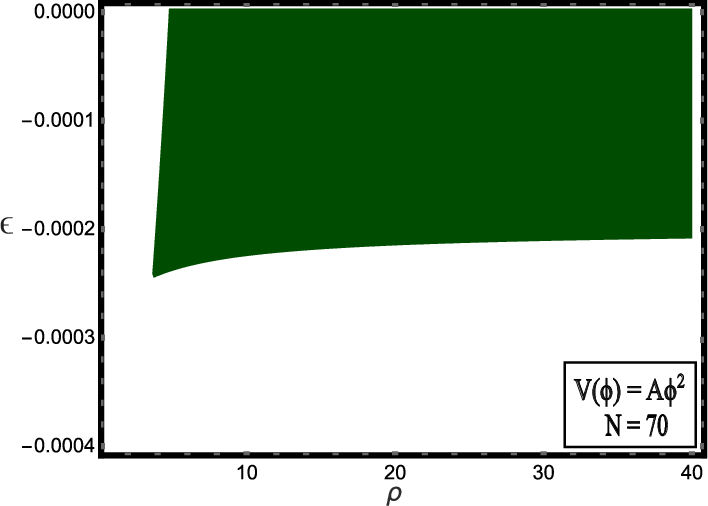
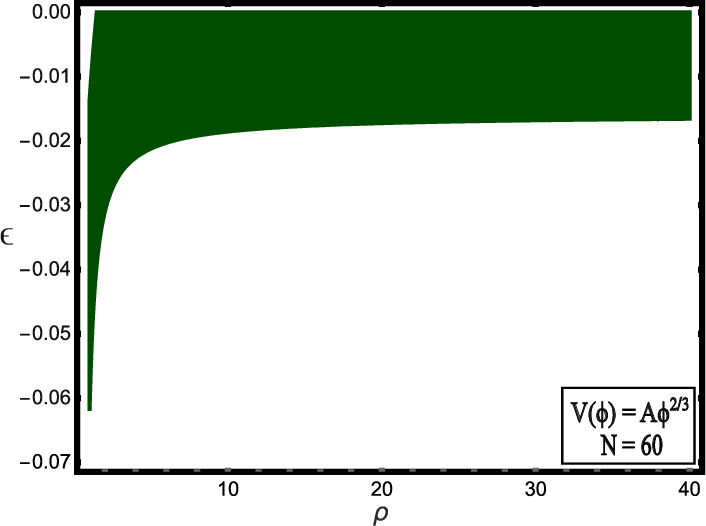
Figure 3: Two-dimensional slices in (ϵmix,ρ) for fixed N∗, highlighting parameter combinations yielding (ns,r) inside the latest observational contour.
The inflationary predictions manifest robust dependences: N∗ primarily tunes ns (via reheating), ρ alters cs (and thus non-Gaussianity), while ϵmix acts as a lever for both ns and r, enabling flexible fitting to data.
Theoretical and Phenomenological Implications
The constructed model avoids pathologies for the explored parameter space, maintaining f(ϕ)>0 and cs2>0 throughout the slow-roll epoch. The constant cs yields equilateral-type non-Gaussianity fNLequil∼O(cs−2−1), kept at O(1−10) for ρ benchmarks, well within current Planck/ACT bounds.
Practically, the non-separable template can rehabilitate monomial inflation models in tension with previous data, and provides new avenues for realizing subluminal signals and larger tilts in the primordial spectrum. The analytic control demonstrated here suggests broader applicability to other classes of interactions, including exponential potentials and UV-complete motivated coefficients.
Figure 4: Slices of parameter space showing regions where the predicted (ns,r) agree with the ACT+Planck+BAO constraints for different potentials.
Prospects and Future Directions
This analysis establishes the viability of non-separable k-inflation as a mechanism for reconciling simple monomial models with sharpened cosmological constraints. Future work should pursue:
- Rigorous likelihood analysis against full ACT+Planck+BAO data;
- Dedicated non-Gaussianity bispectrum studies;
- Exploration of broader potential classes (e.g., exponential, plateau, fractional, and GUT-motivated forms);
- Investigation of late-time ramifications, especially with respect to H0 and S8 tensions, leveraging the link between XρV mixing and cosmological dynamics (Mansoori et al., 2024).
Conclusion
This research delivers a minimal non-separable k-inflation model in which the kinetic-potential interaction encodes a mechanism for reducing both ns and r, harmonizing canonical inflation with stringent ACT+Planck+BAO constraints. Analytical predictions, validated numerically, furnish accurate mapping of viable parameter domains. The framework remains theoretically robust, retains controlled non-Gaussianity, and is amenable to further model-building and data-driven refinement. These results support non-separable extensions of single-field inflation as important candidates for ongoing and future cosmological data analyses (2511.16621).