- The paper introduces a quantum-dot-based source that deterministically generates polarization-entangled photon pairs with singlet fidelity up to ~98%.
- It employs resonant pulse excitation and temporal post-selection to achieve high photon indistinguishability, with Hong-Ou-Mandel visibility exceeding 98%.
- The study shows that the QD method significantly enhances entanglement swapping rates for quantum networks compared to traditional SPDC sources.
High-Fidelity Entangled Photon Pairs from a Quantum-Dot Single-Photon Source
Introduction
Scalable quantum networks and distributed quantum information applications critically rely on bright, high-fidelity sources of entangled photon pairs with high single-photon purity and indistinguishability. The probabilistic nature and multi-photon emission inherent to SPDC sources, while suitable for laboratory-scale demonstrations, impose strong rate constraints in practical quantum networking, especially for entanglement swapping protocols involving multiple distant nodes. This work presents an alternative approach: deterministic generation of polarisation-entangled photon pairs using an InGaAs quantum dot (QD) embedded in a tunable microcavity, coupled with precise temporal and spectral control. The study establishes that such QD-based sources can achieve fidelity and rate metrics unattainable for SPDC-based platforms without massive multiplexing overheads, directly addressing central bottlenecks in quantum networking architectures (2603.29971).
Experimental Architecture
The entanglement source uses resonant-pulse excitation of a microcavity-coupled InGaAs QD, producing indistinguishable single photons at a rate determined by the pulsed laser. Polarisation modulation is achieved using a resonant electro-optic modulator (EOM), alternating the polarisation of consecutive photons. These photons are separated by a polarising beam splitter (PBS), with one arm delayed in a low-loss Herriott cell. After recombination at a 50:50 non-polarising beam splitter (NPBS), entanglement is generated by post-selecting events with a coincidence at both outputs, thus projecting onto the singlet Bell state. Quantum state tomography is conducted using waveplates and additional PBS elements in each output arm, while coincidence detection is performed with high-efficiency superconducting nanowire single photon detectors (SNSPDs).
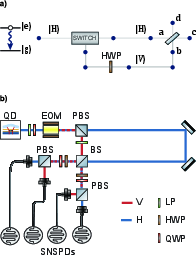
Figure 1: Experimental architecture for deterministic generation and tomography of entangled photon pairs from a modulated, temporally-separated stream of QD-emitted photons.
Entanglement Generation and Characterization
Initial experiments employ a pulse rate RL=76.3 MHz, achieving end-to-end single-photon efficiency η=49%. Quantum tomography reconstructs the two-photon state after the beam splitter, yielding a singlet fraction (fidelity with the Bell state) F=96.1±0.5%, as confirmed by density matrix analysis.
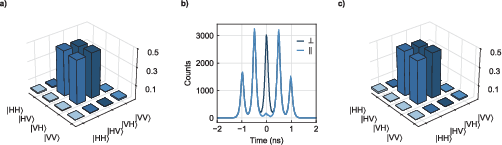
Figure 2: Reconstructed two-photon density matrix demonstrating high-fidelity post-selected entanglement, with Hong-Ou-Mandel interference visibility VHOM>97%.
The achieved Hong-Ou-Mandel visibility (VHOM=98.1±1.4%) underpins the high indistinguishability crucial for scalable network protocols. A key demonstration is operation at higher pump rates: by time-bin encoding two pump pulses separated by 500 ps, the effective repetition rate is doubled, and state tomography confirms maintenance of high fidelity (F=95.2±0.5%).
Fidelity-Limiting Mechanisms
A quantitative study reveals two main fidelity constraints: temporal distinguishability due to imperfect path matching, and photon-number impurity quantified by g(2)(0). Controlled path delays show fidelity decreasing from F=95.8±0.5% (zero delay) to F=69.1±0.5% at a 60 ps offset, consistent with the QD radiative lifetime.
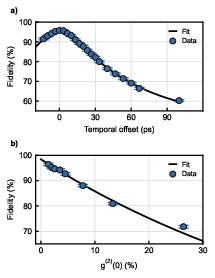
Figure 3: Entanglement fidelity as a function of temporal misalignment and g(2)(0) reveals sensitivity to both temporal overlap and residual multi-photon events.
Increasing η=49%0 through laser leakage or sub-optimal excitation leads to pronounced fidelity reduction, highlighting the critical need for single-photon purity. The main source of these multi-photon events is identified as double excitations within a single pump pulse, producing spectrally broad photons detectable in early emission windows.
Fidelity Enhancement Protocols
The study systematically compares spectral and temporal filtering to mitigate fidelity loss. Inserting a 5-GHz bandwidth etalon dramatically reduces η=49%1 from 2.0% to 0.9%, raising the entanglement fidelity to η=49%2. However, the etalon introduces significant loss, motivating a more practical temporal post-selection protocol: by excluding detection events within ≈5 ps of the pump pulse, where large-bandwidth multi-photon events are concentrated, fidelity is boosted to η=49%3 with only a modest (24%) reduction in rate.
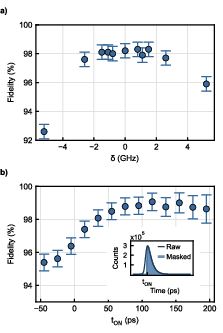
Figure 4: Entanglement fidelity improvement by spectral (a) and temporal (b) post-selection, revealing practical pathways to achieve near-unity fidelity with manageable rate compromises.
Analysis of histograms of detection events relative to excitation timing confirms that residual noise events are temporally and spectrally distinct from the target single-photon emission, and effectively isolated by temporal gating.
Quantum-State Tomography and Scaling
Complete density matrices reconstructed under various protocols validate the stability of entanglement generation at high rates and with post-selection strategies. Standard operation, high-rate (pulse-doubled) excitation, and temporally-filtered regimes all exhibit high singlet fractions.
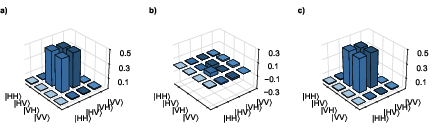
Figure 5: Real and imaginary components of the reconstructed density matrix under standard operation, demonstrating robust maximally entangled Bell-state generation.
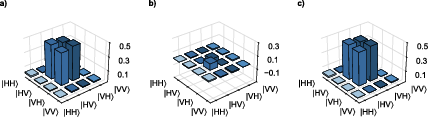
Figure 6: High-rate operation (2 GHz effective pulse rate) preserves the entangled state with minimal fidelity loss.
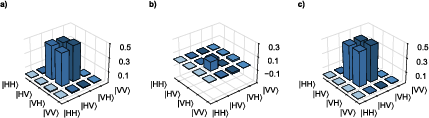
Figure 7: Temporal filtering further purifies the state, with post-selection raising the singlet fidelity to η=49%4.
Comparison with SPDC Sources and Network Implications
A thorough rate-versus-fidelity analysis is presented, contrasting the QD-based architecture with leading SPDC-based sources, including implementations with various levels of photon-number-resolving detection and spatial multiplexing. For entanglement swapping—a crucial network primitive where interference of independent photon pairs is required—the deterministic nature and photon indistinguishability of the QD source confers a strong advantage. Unless SPDC systems employ extensive multiplexing with unity efficiency switches and photon-number resolution, QD-based sources yield up to two orders of magnitude higher rates for a fixed target fidelity (η=49%5).
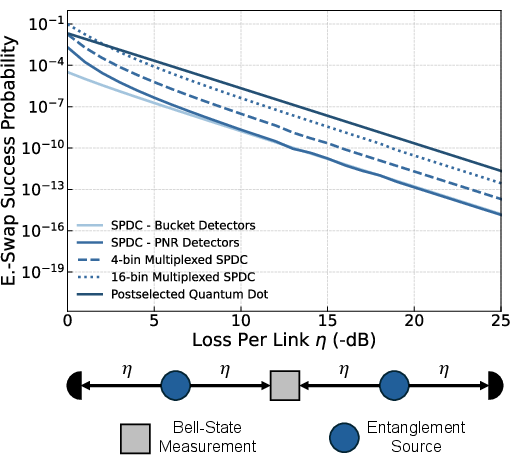
Figure 8: Theoretical comparison of entanglement-swapping rates for QD-based and SPDC-based sources, highlighting the superior operational envelope of the QD architecture for quantum networking tasks.
This marks a substantial step toward quantum repeaters and distributed protocols with minimized resource overhead, as QD systems remove the fundamental brightness–fidelity trade-off intrinsic to SPDC schemes.
Conclusion
This work demonstrates that a resonantly-pumped, microcavity-coupled quantum dot single-photon source—in combination with active polarisation control and temporal post-selection—constitutes a robust, high-rate, and high-fidelity generator of polarisation-entangled photon pairs. The maximal achieved singlet fidelity (η=49%6) rivals or surpasses SPDC-based approaches, and the architecture can be scaled to generation rates exceeding η=49%7 Gpairs/s with further improvements to emitter efficiency and source parallelization. These findings establish semiconductor quantum dots as a leading platform for quantum network-compatible swappable entangled photon sources, fundamentally advancing both the rates and fidelities achievable in practical quantum communication and distributed quantum information protocols (2603.29971).