- The paper demonstrates that singular curvature in quantum wires induces localized bound states with non-differentiable wavefunctions.
- It employs a regularization method based on singular Sturm-Liouville theory to establish self-adjoint Hamiltonians and discrete energy spectra.
- Numerical results show a negative ground state energy localized near sharp bends, with implications for nanoscale transport and optical properties.
Curvature-Induced Bound States in Quantum Wires
Introduction and Motivation
The study provides a rigorous extension of the confinement potential approach (CPA) for quantum particles constrained to move on one-dimensional submanifolds—specifically quantum wires with singular geometric features. Traditional CPA, built upon works such as Jensen and Koppe [Jensen1971] and da Costa [Costa1981], prescribes an effective dimensionally-reduced quantum theory. However, it mandates smoothness restrictions on the embedding manifold, typically requiring a C2 Riemannian structure. Singularities—sharp bends, vertices, or points of diverging curvature—are ubiquitously observed in realistic nanostructures but fall outside the regularity domain of standard CPA. This paper classifies such geometric pathologies, investigates their physical implications, and introduces a mathematically robust scheme based on singular Sturm-Liouville theory to analyze curvature-induced phenomena in quantum wires, particularly bound states localized near singularities.
Classification of Geometric Irregularities
A foundational contribution is the codification of degenerate configuration spaces arising in physically relevant constrained quantum systems. The paper categorizes several classes of irregularities:
- Deficient differentiability: Manifolds lacking requisite smoothness for well-defined geometric quantities.
- Non-manifold points: Edges, vertices, or tip singularities destroying the manifold structure.
- Self-intersections and immersions: Non-injective parametrizations with non-unique local frames.
- Metric degeneracies: Collapse of tangent spaces, resulting in critical or singular points in the sense of singularity theory, necessitating sub-Riemannian analysis.
These classes are formally encapsulated, motivating the necessity for an analytic extension beyond the field of regular CPA.
Singular Curvature and Extension of the CPA
Focusing on planar quantum curves with sharply localized bends, the study proposes to treat singularities via limiting sequences of regularized curves. Let M be a plane curve, parametrized by arc length s on interval J⊂R, whose curvature κ(s) is integrable (κ∈L1(J)) but diverges at an isolated point, generically s=0. The limiting case is mathematically ill-defined in the classical sense, yet physically corresponds to the configuration of a sharply bent quantum wire.
To regularize, a family {Mε} with smooth, bounded curvatures {κε} is constructed such that, away from the singularity, all geometric and analytic data converge pointwise, and crucially, the distributional limit of the geometric potential and its primitive (entering the Schrödinger equation) converge in L2(J). This notion of admissible regularization is necessary to obtain well-posed limits of the quantum Hamiltonian.
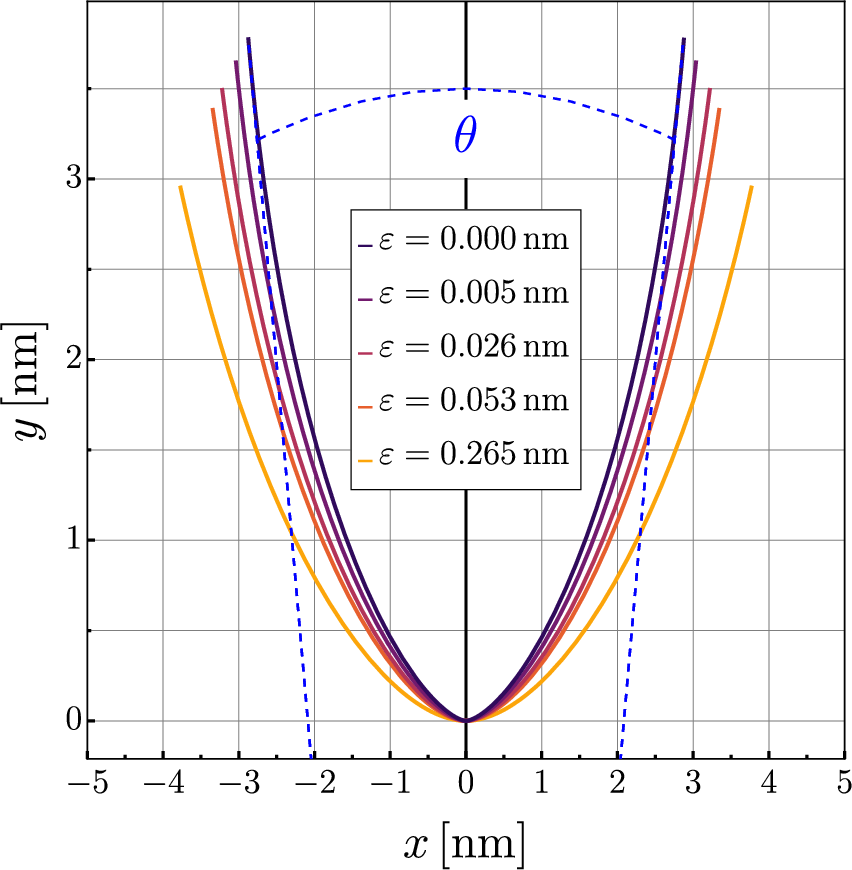
Figure 1: Four representatives of the regularized curve family M0 converging pointwise to the degenerate singular-curve, parameterized by opening angle M1.
The technical core leverages singular Sturm-Liouville theory, particularly results by Savchuk and Shkalikov [A.M.Savchuk1999, Savchuk2003]. By adapting the notion of quasi-derivatives to account for distributional potentials, self-adjoint realizations of the Hamiltonian with singular geometric potentials are defined, ensuring the existence of real, discrete spectra and M2 orthonormal bases of eigenfunctions.
Spectral and Physical Consequences: Emergence of Bound States
Numerical and analytic study of the regularized problems yields several salient physical results. For the prototypical singular curvature M3, with M4, the geometric potential diverges as M5. In the limiting case M6, one has a one-dimensional Coulomb-like attraction centered at the bend.
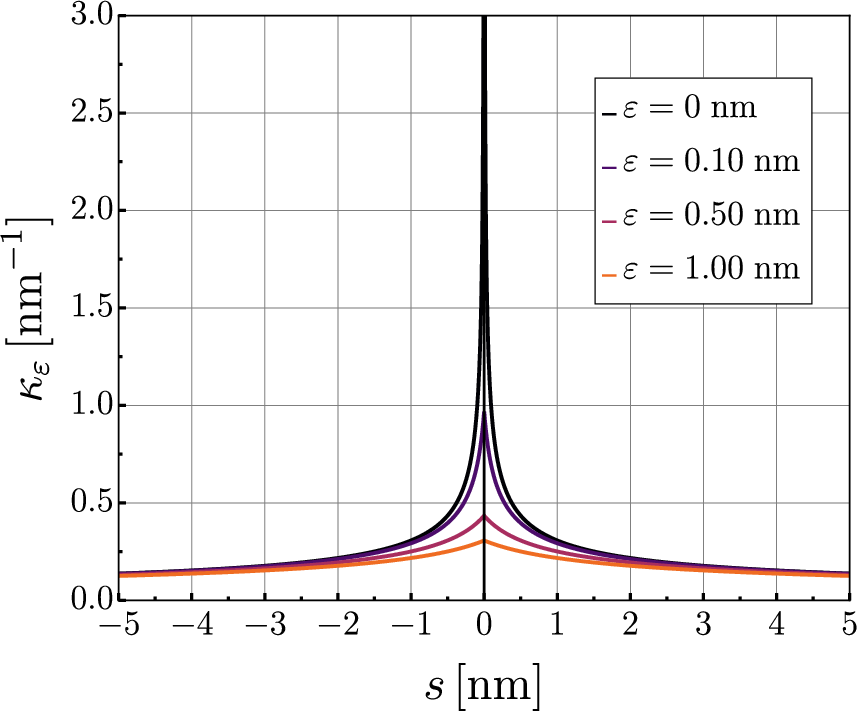
Figure 2: Curvature functions M7 interpolating between bounded regular and divergent singular limits.
The spectrum of the regularized Schrödinger operators is computed as the regularization parameter M8:
- Ground state energy: Becomes negative and converges monotonically, indicating the realization of a bound state localized near the bend.
- Excited states: Remain above threshold (positive energy) in the large-interval limit, corresponding to delocalized scattering states.
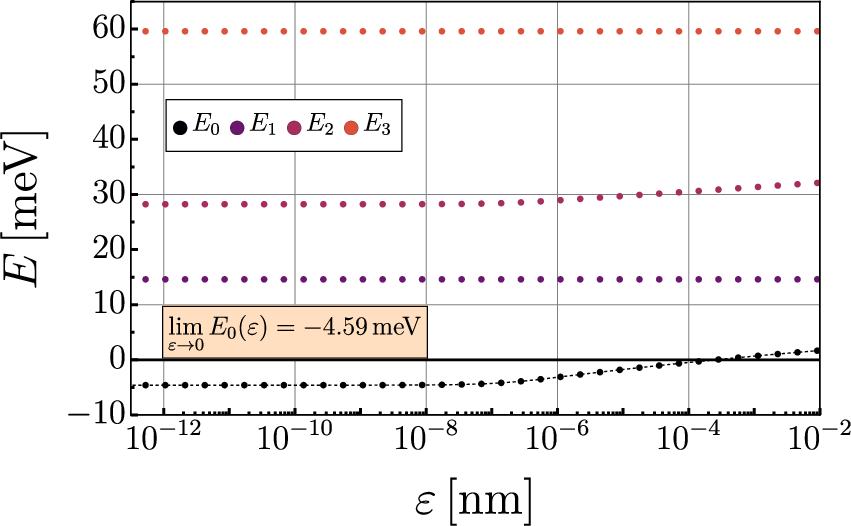
Figure 3: The lowest four eigenenergies of the regularized Hamiltonian versus the regularization parameter, evidencing convergence and the development of a negative ground state.
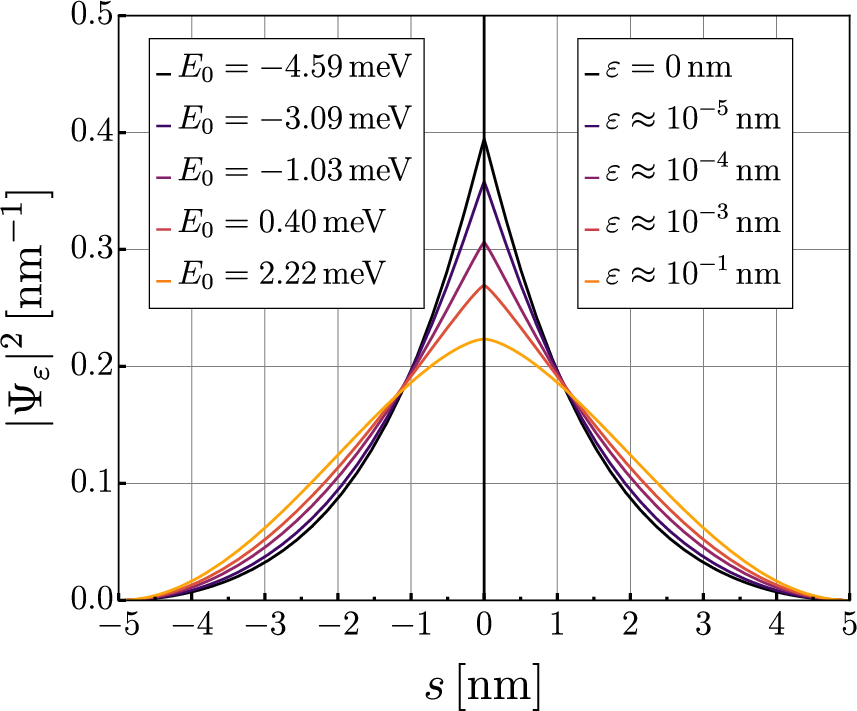
Figure 4: Probability densities M9 for the ground state localized near the singularity, narrowing and approaching non-differentiability as the curvature regularization sharpens.
The dependence of the ground state energy on the total geometric bend (quantified by the "turn" or integrated curvature) is encapsulated in the final figure.
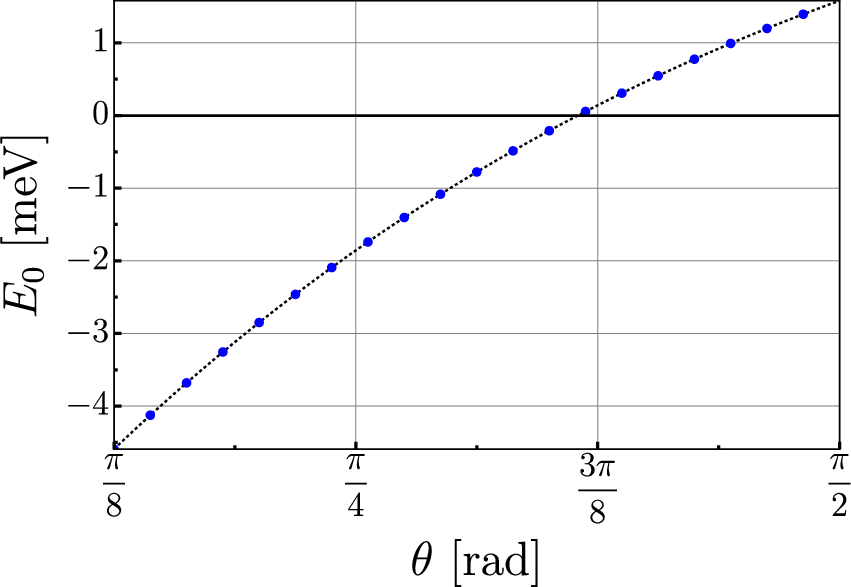
Figure 5: Ground state energy in the degenerate limit as a function of the total turn of the curve, demonstrating monotonic behavior and eventual loss of binding at large opening angles.
Implications and Outlook
This work establishes that singularities in the geometry of quantum wires—realizable experimentally via controlled mechanical deformation—are not merely mathematical pathologies but induce robust and observable physical effects: localization and the existence of curvature-induced bound states with non-differentiable wavefunctions. The generality of the strategy, based on operator-theoretic regularization and singular Sturm-Liouville analysis, allows for rigorous treatment of quantum mechanics on manifolds with mild singularities, extending CPA beyond its classical regime.
Practical implications are direct for the design and interpretation of transport, optical, and spectroscopic properties of nanostructures, where sharp bends or kinks unavoidably arise. From the theoretical viewpoint, this scheme can be combined with advanced functional analytic tools to handle more complex geometric degeneracies, possibly in higher codimensions or under additional physical (e.g., electromagnetic, spin-orbit) interactions.
Future developments include the incorporation of electron-electron interactions (notoriously relevant in 1D systems [giamarchi_book]), generalization to quantum graphs and networks with manifold singularities, and treatment of curvature effects in the presence of topological and gauge structures, with anticipated consequences on transport anomalies and localization phenomena.
Conclusion
This paper rigorously extends the quantum mechanics of constrained particles to include sharp geometric singularities by coupling singular Sturm-Liouville theory with operator-theoretic regularization. It demonstrates the emergence of curvature-induced bound states in quantum wires with singular bends, characterized by non-differentiable, localized wave functions even in the presence of integrable but divergent curvatures. The work provides foundational tools to analyze and engineer quantum phenomena in realistic nanostructures with geometric irregularities and necessitates future studies on correlated systems and multidimensional generalizations.
Reference:
"Curvature-induced bound states in quantum wires" (2604.01856)