- The paper introduces a chain-of-agents framework that operationalizes expert principles to automate the synthesis of water-centric, culturally coherent Jiangnan gardens.
- It employs a genetic algorithm for terrain evolution and detailed semantic constraints for asset selection and layout optimization using the GardenVerse dataset.
- Quantitative metrics and human evaluations confirm the system’s superior aesthetic fidelity, spatial logic, and cultural authenticity over traditional methods.
GardenDesigner: Encoding Aesthetic Principles into Jiangnan Garden Construction via a Chain of Agents
Overview and Motivation
GardenDesigner presents a comprehensive system for automated Jiangnan garden synthesis by operationalizing aesthetic, spatial, and cultural principles through a multi-agent procedural modeling framework. The work targets fundamental challenges in digital cultural heritage, specifically the recreation and design of Jiangnan gardens—a canonical style in classical Chinese landscape architecture. Traditional workflows in this domain rely on expert-driven manual modeling, which is slow, labor-intensive, and domain-dependent in both data acquisition and creative design.
GardenDesigner addresses three central bottlenecks:
- The demand for water-centric and symbolic spatial logic;
- The necessity to encode implicit, expert-driven aesthetic principles computationally;
- The absence of a sufficiently annotated, semantically rich asset dataset for Jiangnan contexts.
The proposed framework not only operationalizes expert principles as explicit computational constraints but also introduces a curated, annotated 3D garden dataset—GardenVerse—bridging gaps that have limited prior efforts in both procedural and AI-driven 3D scene generation.
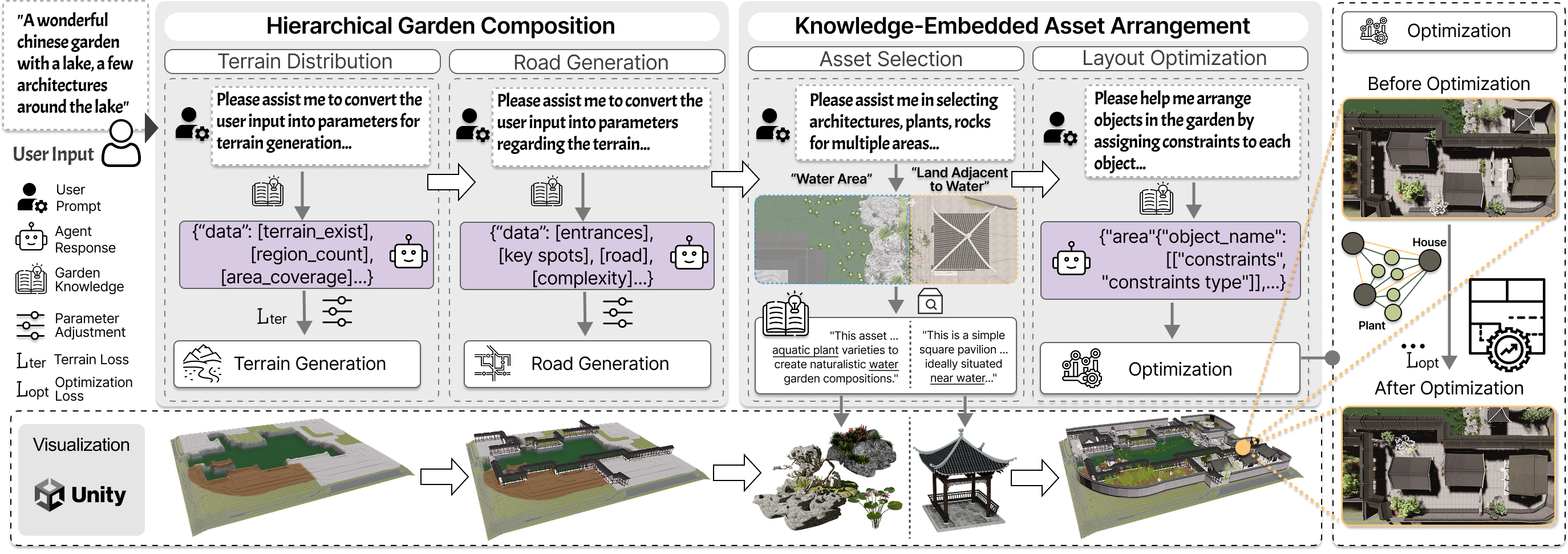
Figure 1: Overview of the GardenDesigner pipeline, illustrating the sequential interaction between hierarchical garden composition and knowledge-embedded asset arrangement agents.
Methodological Architecture
Problem Decomposition and Chain of Agents
The pipeline is structured as a sequence of four specialized agents:
- Terrain Distribution Agent (AT): Parameterizes and generates terrain with an explicit water-centric loss, ensuring the prevailance of the pond as the spatial organizer, in line with Jiangnan aesthetics.
- Road Generation Agent (AR): Produces exploratory, non-linear paths via a grid-based procedural method, scoring for both boundary-following and aesthetic complexity.
- Asset Selection Agent (AS): Leverages textual prompts, area metadata, and a vector store of expert-labeled objects to select contextually appropriate assets from GardenVerse.
- Layout Optimization Agent (AC): Arranges selected objects subject to a set of semantically grouped soft constraints (global, position, distance, alignment, rotation).
The agent chain ensures that parametric outputs of one stage (e.g., terrain and roads) serve as explicit priors for subsequent spatial configuration and asset selection, enforcing hierarchical dependency in spatial logic and composition.
Hierarchical Garden Composition
GardenDesigner diverges from standard procedural modeling and scene synthesis methods by encoding stylistic and aesthetic rules directly into the generative procedure. The terrain agent utilizes a genetic algorithm to evolve grid-based land/water distributions optimized for water-centric organization. The path agent incorporates expert principles (e.g., avoidance of symmetry and straight routes) to synthesize walkways that channel discovery and compositional layering.
Knowledge-Embedded Asset Arrangement
The asset selection module queries a vectorized, expert-annotated garden object store (GardenVerse). Assets are annotated not only with geometry and class but also with spatial, seasonal, and cultural placement constraints. The layout agent encapsulates five types of soft constraints (Figure 2), operationalized as differentiable or search-based loss terms aggregated in a weighted sum.
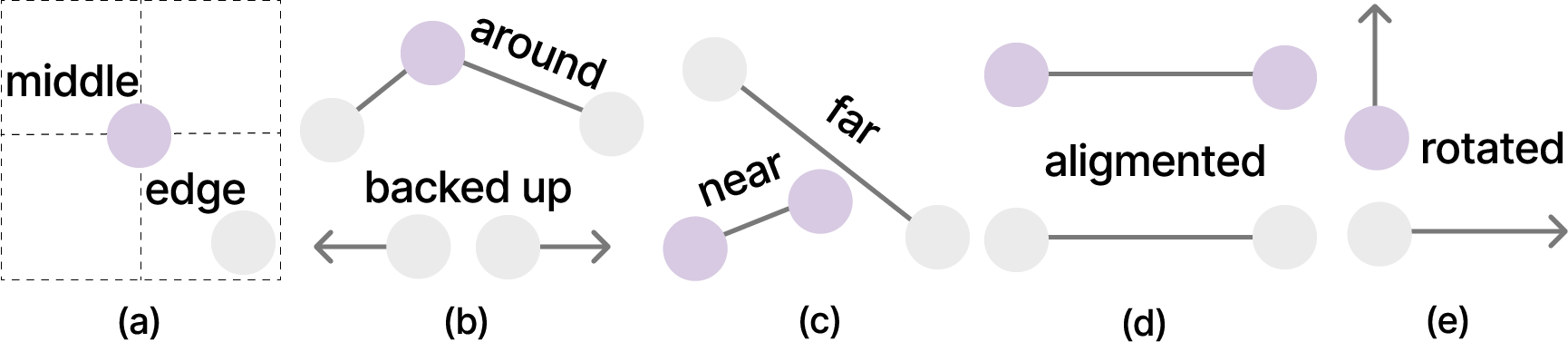
Figure 2: The five semantic constraint categories used in asset arrangement: global, position, distance, alignment, and rotation.
Depth-first search is employed in the placement optimization phase, enumerating arrangements that minimize the sum of aesthetic and logical constraint losses while ensuring non-collision and correct area assignment.
The GardenVerse Dataset
A significant contribution is the introduction of the GardenVerse dataset, comprising 132 high-fidelity 3D assets with detailed expert annotations. The asset taxonomy includes architecture, plants, rocks, and composite forms relevant to Jiangnan style. The annotation schema adopts both objective (class, size, placement bounds) and subjective (aesthetic, cultural, and functional intent) metadata.
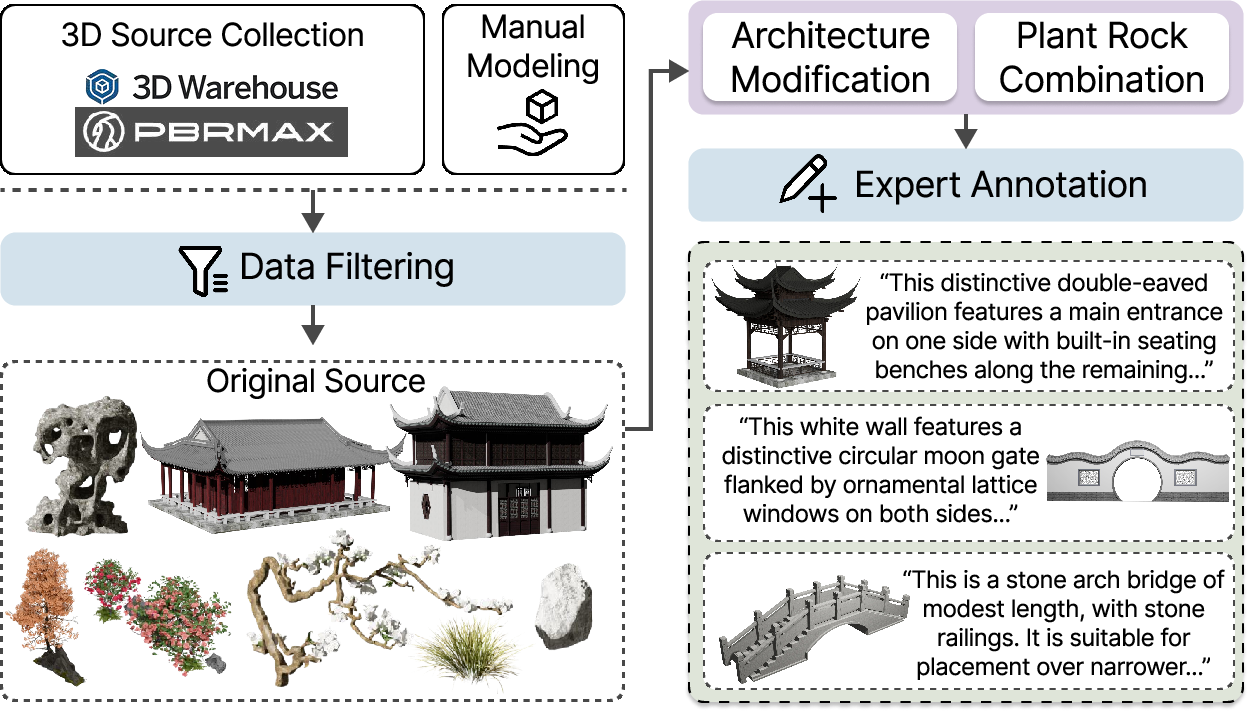
Figure 3: The pipeline of GardenVerse, where objects are curated, modeled, and annotated in collaboration with domain experts for semantic and aesthetic fidelity.
This dataset supports the knowledge retrieval agent and functions beyond naive asset banks, enabling computational reasoning about cultural motifs and semantic correctness.
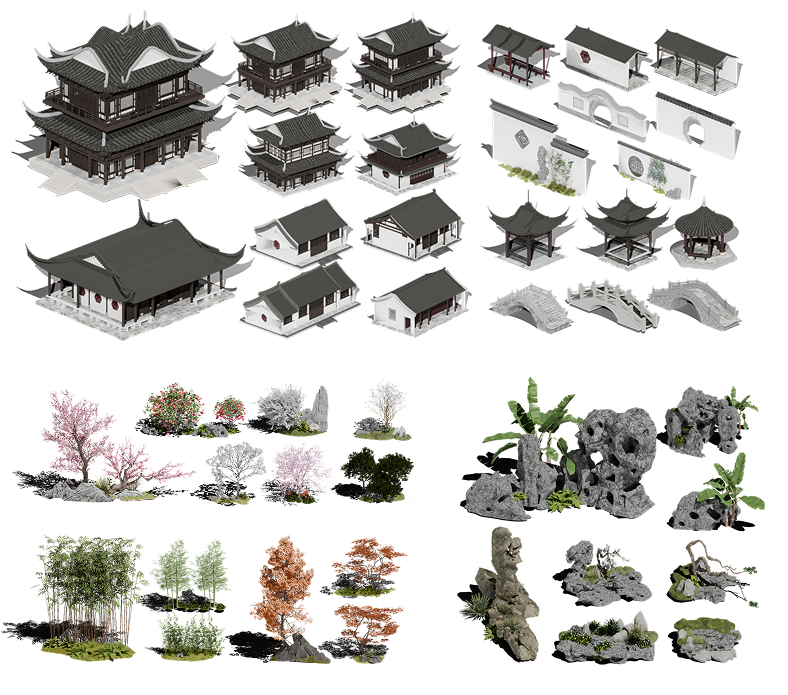
Figure 4: Asset examples in GardenVerse demonstrating breadth and fine-grained categorization (architecture, structures, plants, rocks, and combinations).
Experimental Evaluation
Metrics and Baselines
Physical plausibility and semantic appropriateness are assessed via a collection of custom metrics:
- Pathway Score (Path-S): Coverage and accessibility of major assets;
- Class Diversity (Class-Div): Asset class entropy per garden;
- Fractal Dimension (FD): Spatial complexity, benchmarked against real Jiangnan datasets [sun2024interpret];
- CLIP Scores: Semantic and aesthetic image-language correspondence;
- VLM and QA-based metrics: Automatic evaluation by large vision-LLMs.
GardenDesigner is compared to procedural and LLM-based scene synthesis baselines (e.g., Conlan et al.), variants using curated or generic asset datasets, and ablations removing the knowledge-embedded arrangement.
Quantitative and Qualitative Results
GardenDesigner establishes superior Path-S (8.1 versus 0), substantially higher class diversity (68.3 vs. 21.8), and reaches an FD of 1.36, closely matching expert analyses of real-world Jiangnan gardens (1.123–1.329). Vision-language and QA-based metrics also substantiate a consistent gain in aesthetic and cultural fidelity.
Ablation studies confirm that the removal of knowledge-embedded arrangement and individual optimization losses produces significant drops in structure complexity and VLM-assessed quality.
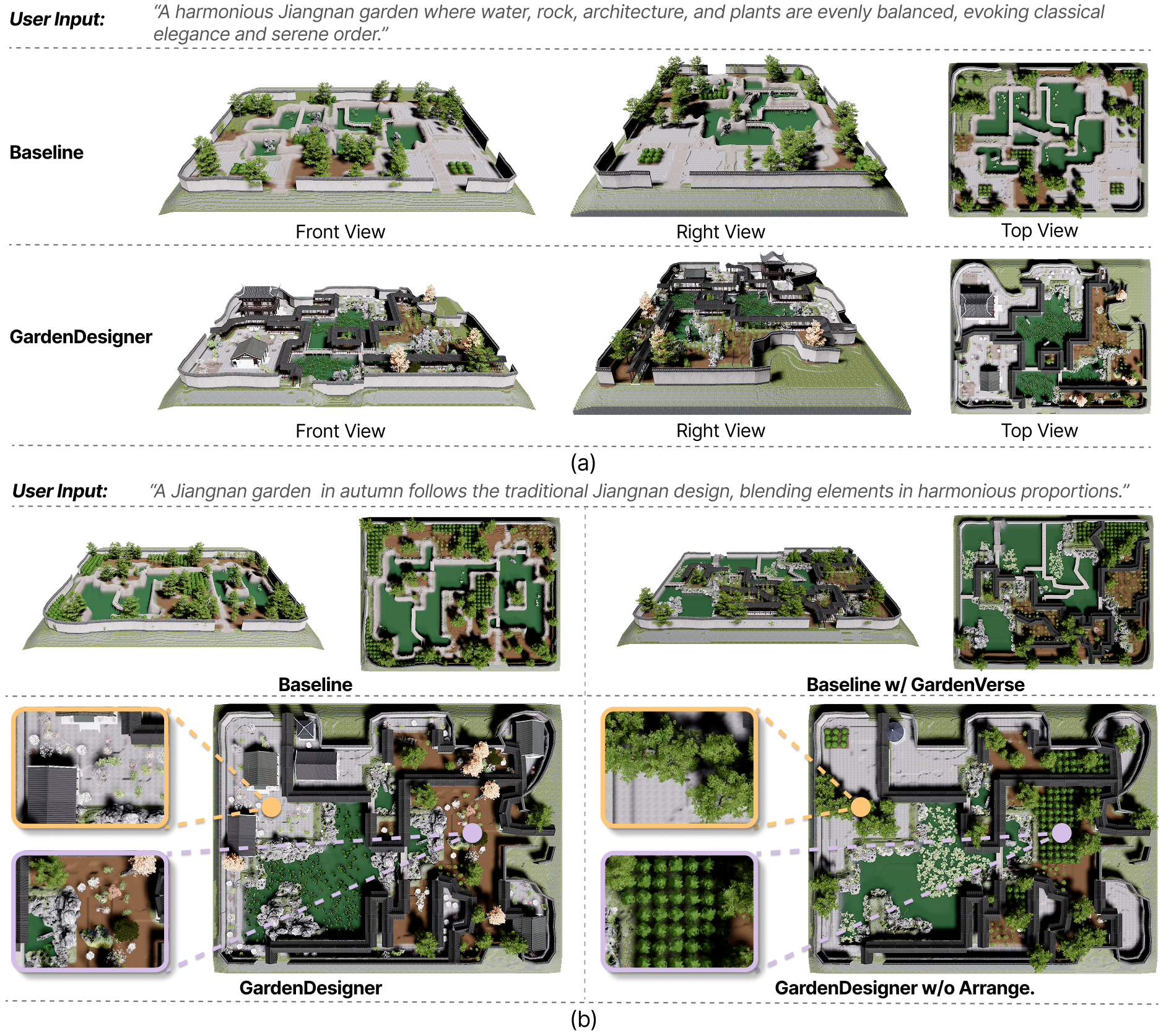
Figure 5: Qualitative analysis: direct comparison shows GardenDesigner generating more coherent, water-centric, and compositionally rich layouts than baseline models.
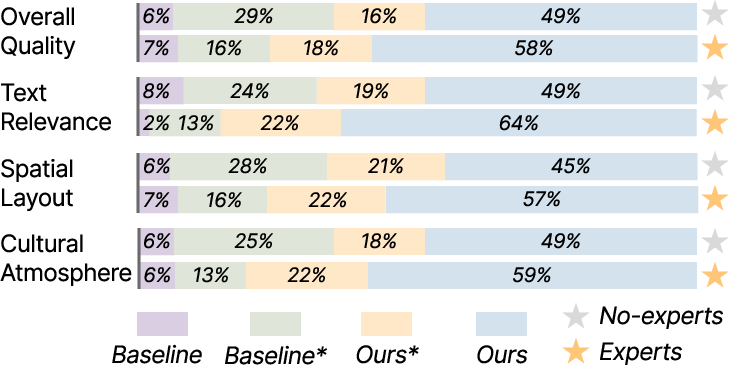
Figure 6: User study preference ratios across overall quality, semantic relevance, spatial layout, and cultural atmosphere, confirming stronger human preference for GardenDesigner outputs.
Human Evaluation and Analysis
User studies involving both experts and lay users validate the computational metrics: GardenDesigner is preferred in 50–74% of cases across all tested garden archetypes, with particularly high expert agreement on cultural atmosphere and compositional rationality.
Crucially, both the use of the GardenVerse dataset and the explicit knowledge-embedding mechanism are shown to strongly enhance perceived spatial logic and cultural fidelity.
Applications
The GardenDesigner system is integrated into an interactive Unity pipeline, allowing non-experts to synthesize Jiangnan gardens via text in under one minute. Outputs are applicable for 2D layout planning for real garden construction, VR/AR scene creation, and educational or entertainment applications (Figure 7).
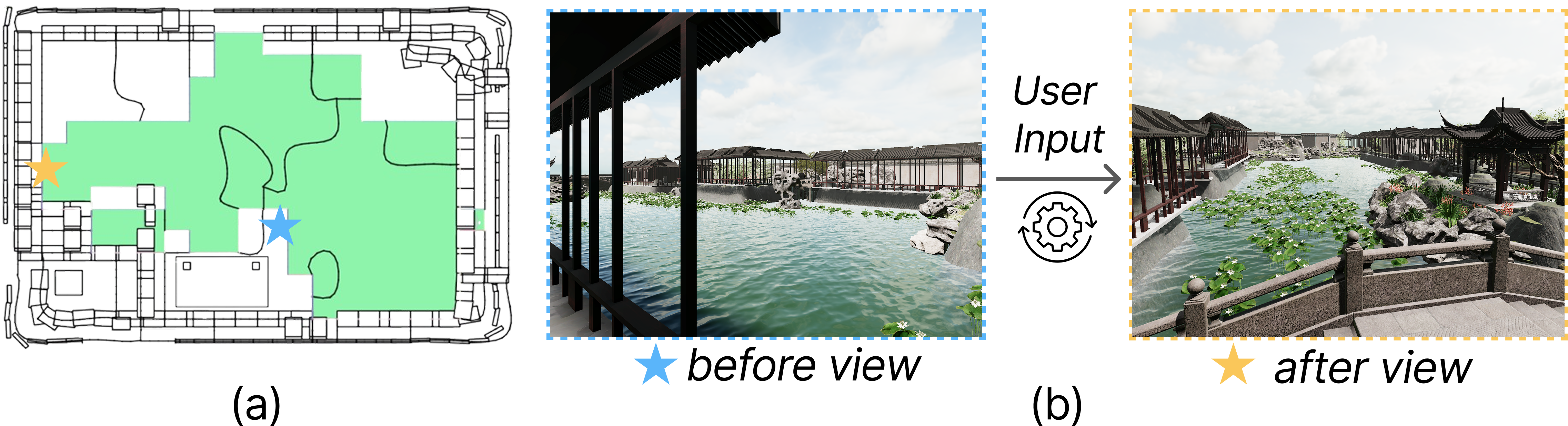
Figure 7: Example applications: (a) 2D layout generation for physical construction; (b) navigation to features of interest driven by user instruction.
Implications and Future Prospects
The formalization and encoding of implicit, expert-driven aesthetic rules as actionable computational modules represent a step forward in procedural scene generation. By bridging procedural generation with LLM-based reasoning and knowledge retrieval, the framework provides a generalizable architecture potentially extensible to other cultural or artistic scene domains—e.g., European formal gardens with different constraint grammars.
GardenVerse itself will likely serve as a crucial testbed for future studies on AI-driven cultural scene composition, transfer learning in structured 3D environments, and multimodal asset curation.
Anticipated extensions include interactive VR tools for heritage education, personalized landscape design advisors leveraging further user interaction, and porting the agent chain to other styles with minimal retraining via text-based rule encoding.
Conclusion
GardenDesigner operationalizes the synthesis of culturally coherent, aesthetically principled Jiangnan gardens through a sequential agent pipeline grounded in expert-driven constraints and dataset innovation. Comprehensive human and automatic evaluation validate the effectiveness of chain-of-agents reasoning and knowledge-embedded asset arrangement. The implications span digital heritage preservation, procedural content generation for media, and the formal study of cultural aesthetics in AI-driven design systems.
Reference:
"GardenDesigner: Encoding Aesthetic Principles into Jiangnan Garden Construction via a Chain of Agents" (2604.01777)