- The paper presents a novel framework where a CareController modulates LLM responses using structured user state to balance autonomy and relational risk.
- It implements a multi-objective utility function that minimizes dependency and coercion while maintaining supportiveness in dialogue generation.
- Experimental results show the care-conditioned approach outperforms baselines with improved mean utility and favorable human evaluation in sensitive support scenarios.
Care-Conditioned Neuromodulation: Autonomy-Preserving Alignment for Supportive Dialogue Agents
Motivation and Context
Dialogue agents leveraging LLMs are increasingly integrated into domains involving emotional support—such as mental health assistance, educational advising, and caregiving—where traditional alignment methods are ill-equipped to mitigate relational risks. These risks, including the unintentional reinforcement of user dependency, overprotection, or coercion masked as support, are not addressed by conventional safety approaches, which optimize for helpfulness or avoidance of toxicity at the single-turn level. The paper "Care-Conditioned Neuromodulation for Autonomy-Preserving Supportive Dialogue Agents" (2604.01576) introduces an alignment paradigm that formalizes supportive dialogue as a multi-objective optimization problem centered on balancing autonomy support with minimization of relational harms.
Model Architecture: Care-Conditioned Neuromodulation
The Care-Conditioned Neuromodulation (CCN) framework is instantiated as an inference-time control method layered atop a base LLM. At each dialogue turn, a structured user state vector—including goals, boundaries, preferences, vulnerability, commitments, and stress context—is encoded, and, together with contextual memory representations, feeds a lightweight CareController module. This controller outputs a scalar care signal mt∈[0,1] denoting the inferred user vulnerability and relational risk. Crucially, mt modulates decoding hyperparameters (such as temperature and top-p) and conditions the response candidate pool. Rather than learning new weights for the LLM, this modulation leverages existing representations, enforcing alignment by shifting diversity and conservativeness of generated candidates as a function of user state.
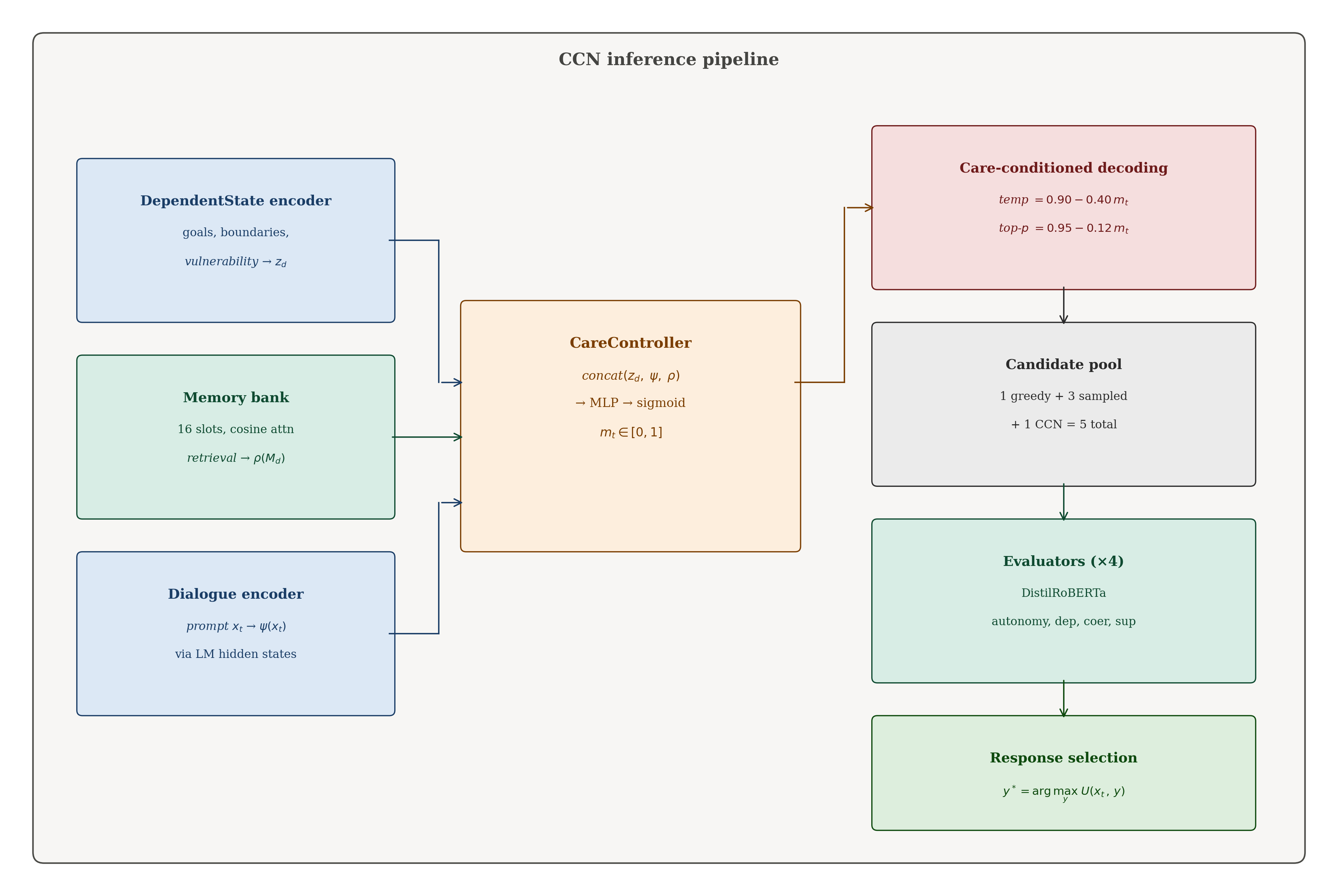
Figure 1: The CCN inference pipeline diagrams how DependentState encoding, memory, and context produce a care signal mt that conditions candidate generation; reranked for maximum autonomy-preserving utility.
CCN formalizes its alignment goal through an autonomy-preserving utility function:
U(xt,y)=λ1Vaut(xt,y)−λ2Qdep(xt,y)−λ3Qcoer(xt,y)+λ4Vsup(xt,y)
where Vaut indicates autonomy support, Qdep and Qcoer are the dependency and coercion risk scorers, and Vsup is a supportiveness predictor. The hyperparameters give the largest penalty to coercion to reflect ethical priorities in sensitive support settings.
Candidate responses are produced by a diverse decoding ensemble (greedy, sampled, and care-conditioned) and scored using DistilRoBERTa-based evaluator networks, with the selection mechanism enforcing explicit risk thresholds that adapt according to the care signal.
Relational Failure Mode Benchmark
To evaluate autonomy-preserving alignment, the authors constructed a synthetic benchmark encompassing six failure modes: reassurance dependence, overprotection trap, manipulative care, protective coercion, autonomy building, and memory consistency. Each dialogue scenario is annotated with structured state, relational memory, and rubric-based autonomy/risk labels, supporting fine-grained evaluation of both overt and subtle relational harms beyond what standard datasets target.
Experimental Results
Care Signal Efficacy
The CareController trained to predict vulnerability from structured user state achieves a Pearson correlation of r=0.668 with ground-truth vulnerability, validating mt0 as a meaningful state-dependent modulation signal.
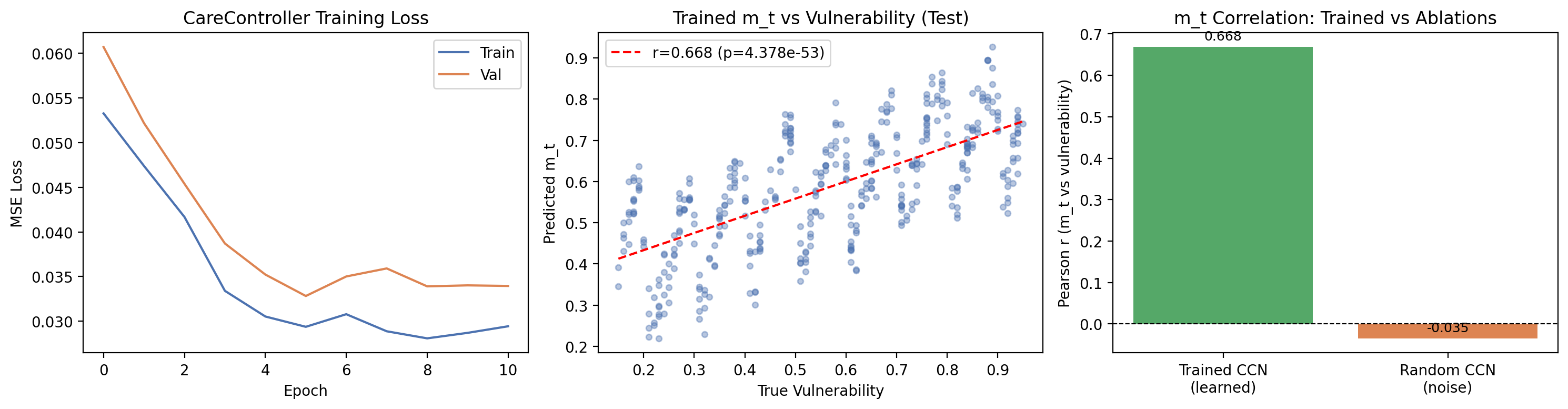
Figure 2: Validation loss traces, care signal correlation with ground-truth vulnerability, and ablation versus a random controller underscore the merit of learned control.
Utility Gains and Per-Metric Analysis
Systems were compared along axes of autonomous support, dependency risk, coercion risk, and supportiveness. The reranked-best configuration (care-conditioned generation with utility-based candidate selection) attained the highest mean utility (0.4116), outperforming both supervised fine-tuning baseline (+0.25) and preference-optimization (DPO, +0.07), with the utility increment driven predominantly by reductions in dependency and coercion risk without degradation of supportiveness.
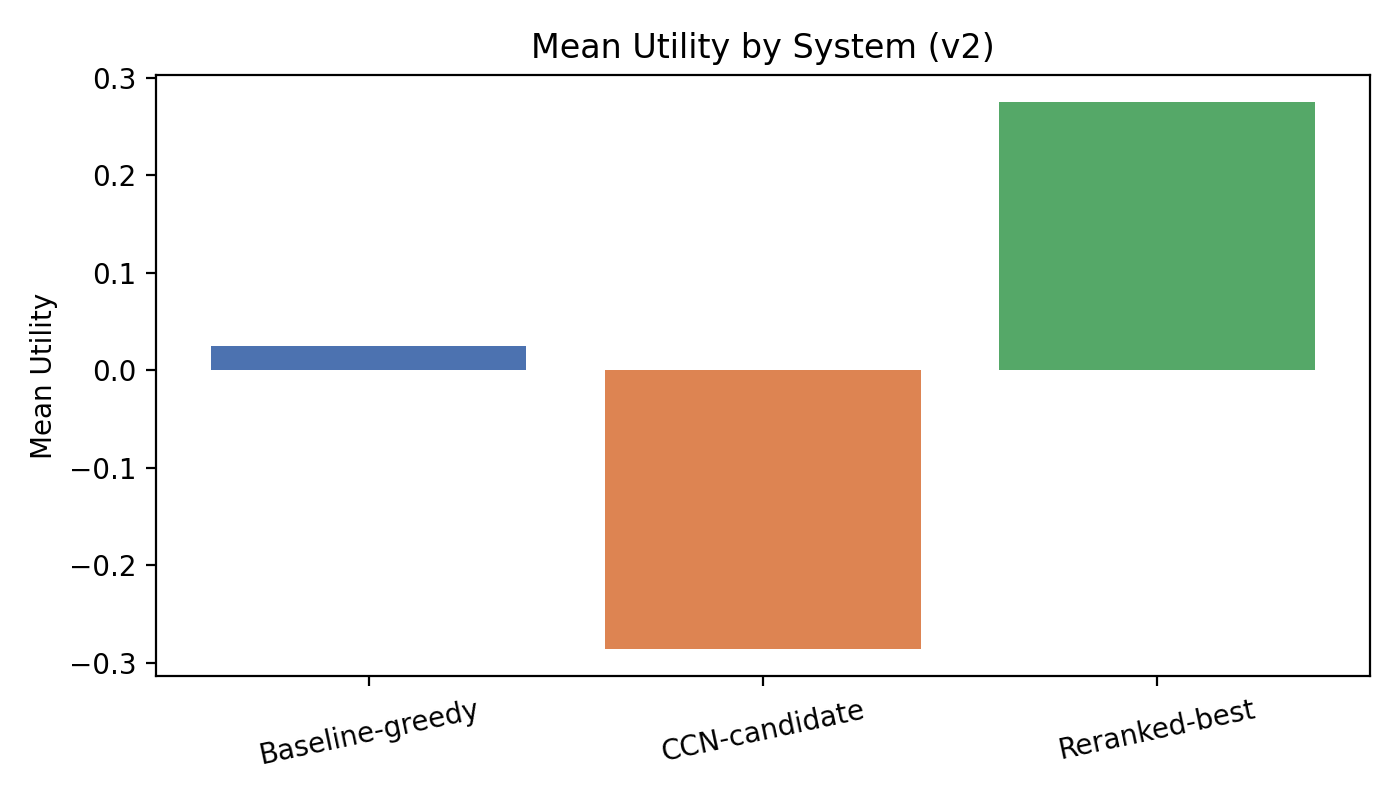
Figure 3: Mean utility by system; the reranked-best method (care-conditioned + utility rerank) achieves the top score on the autonomy-preserving metric.
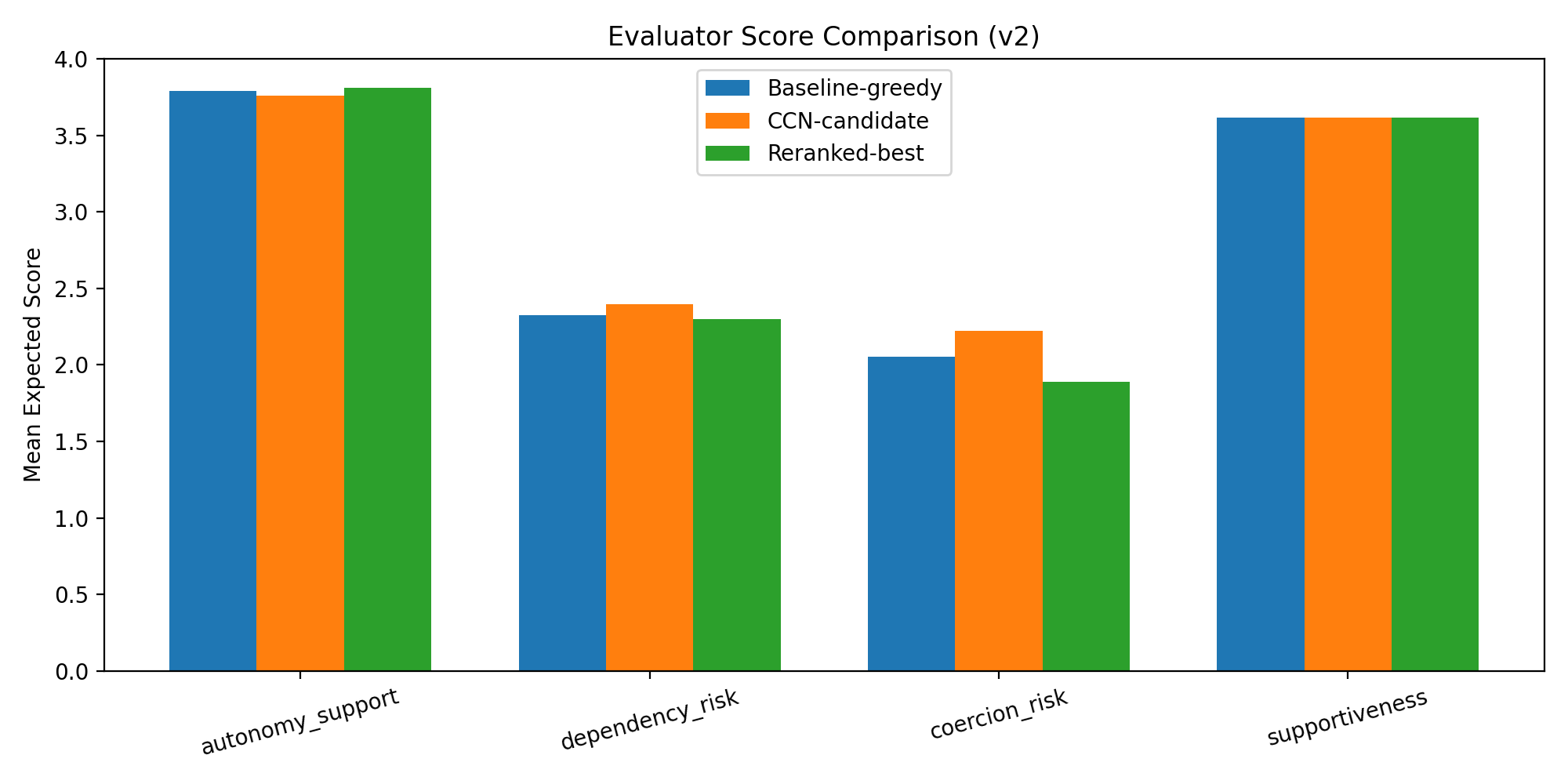
Figure 4: Evaluator comparison demonstrates most substantial reduction in coercion risk, with supportiveness invariant across methods.
Ablation studies indicate that care-conditioned candidate generation alone reduces candidate diversity and underperforms, but, when integrated with utility-based reranking, supplies distinct low-risk candidates for optimal selection. Win-rate analysis further substantiates complementary roles—care-conditioned candidates are chosen in 17% of cases during reranking, but their presence is critical for overall improvement.
Human Evaluation and Real-World Transfer
A pilot human study corroborates automated evaluator trends: reranked-best responses were preferred in 58.3% of categories, and utility improvement aligned in direction and magnitude with model predictions. Additionally, evaluators generalized to a real emotional-support dataset (ESConv), albeit with lower utility due to the increased complexity of authentic, untemplated user state. This suggests that the synthetic benchmark isolates relational risk, but generalization necessitates further research.
Limitations
The reliance on synthetic benchmarks constrains ecological validity; relational dynamics in real settings may manifest emergent failures not captured by template-based designs. The utility function uses manually specified scalarization weights and leverages learned evaluators—further large-scale human validation and direct preference learning are required to minimize potential reward hacking or spurious correlation exploitation. The current CCN controller is trained separately from the LLM, and future work should explore joint optimization for end-to-end alignment of state conditioning and language generation.
Implications and Future Research Directions
This work demonstrates the tractability of formalizing and mitigating relational risks—including dependency and coercion—in LLM-driven dialogue through explicit utility modeling, structured state conditioning, and inference-time neuromodulation. Practically, this approach could set a precedent for deploying LLMs in clinical or educational contexts where relational safety is critical. Theoretically, it offers a reproducible testbed and methodology for studying relational alignment at the multi-turn level, expanding beyond toxicity/harmlessness to nuanced social harms.
Immediate directions include integrating user preference learning for scalarization, constructing richer real-world benchmarks, and extending the care-conditioning paradigm to other sensitive interaction domains (e.g., negotiation, health advice). Deploying such systems in production should be accompanied by robust monitoring and escalation pathways to ensure that mitigation of dependency and coercion translates from synthetic cases to lived user experience.
Conclusion
Care-Conditioned Neuromodulation operationalizes multi-objective relational alignment for supportive dialogue agents by conditioning generation on structured user vulnerability and context, reranking candidates using a utility function targeting autonomy and minimizing dependency/coercion. Empirical results indicate non-trivial reductions in relational risk absent loss of supportiveness, with human evaluation and transfer to real conversations suggesting practical viability. These findings substantiate the value of utility-driven, state-conditioned inference pipelines as a foundation for safe, autonomy-preserving AI support systems.

