- The paper introduces a novel framework that extends traditional IQCs by incorporating higher-order polynomial constraints to improve robustness analysis in nonlinear systems.
- It leverages both analytical methods (using Taylor and Padé approximations) and numerical optimization for synthesizing tight constraints that reduce conservatism.
- The approach is validated on benchmark examples, demonstrating ROA improvements of up to 16× compared to classical sector bounding techniques.
Polynomial Constraints for Robustness Analysis of Nonlinear Systems
Introduction
This work introduces a comprehensive framework for incorporating polynomial constraints into the robustness analysis of nonlinear dynamical systems, targeting classes of models with uncertain or non-polynomial nonlinearities. Classical robustness techniques based on Integral Quadratic Constraints (IQCs) are generalized, enabling the characterization of nonlinearities with higher-order polynomial constraints. This approach leverages the expressive power of polynomial optimization and sum-of-squares (SOS) programming to analyze dynamical systems inaccessible to traditional quadratic constraint methods. Theoretical developments are paired with numerical algorithms for synthesizing tight polynomial constraints—both analytically (via Taylor and Padé approximations) and numerically. The efficacy of the approach is validated on non-polynomial systems, demonstrating substantial gains in certified region of attraction (ROA) estimates compared to classical conservative IQC/sector-bounded methodologies.
Polynomial Constraints: Generalization of IQCs
Polynomial constraints represent a natural and technically rigorous generalization of the IQC formalism. An operator Δ is said to satisfy an Integral Polynomial Constraint (IPC) defined by a polynomial dynamical system filter Ψ when
∫0Tz(t)dt≥0,∀T≥0,v∈L2e,w=Δ(v)
where z(t) evolves according to the polynomial filter driven by v and w.
A particularly important subclass is the pointwise static polynomial constraint, i.e., p(v(t),w(t))≥0 for all t, where p is a bivariate or multivariate polynomial. This subsumes sector- and slope-boundings but offers expressiveness to capture nonlinearity asymptotics (e.g., saturation).
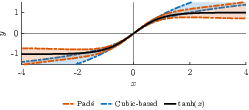
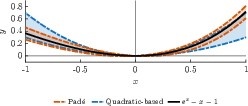
Figure 1: Constraints for tanh(x)—polynomial and Padé-based constraints provide tighter local and global bounds than quadratic sector constraints, especially away from the origin.
The IPC framework admits classical IQCs as a special case (quadratic polynomials) but extends fluently to arbitrary-degree constraints. The paper provides formal results for transforming classical IQCs via polynomial graph transformations, enabling construction of non-conservative higher-order polynomial constraints from existing IQC templates.
Synthesis of Polynomial Constraints
The authors propose several methodologies for constraint synthesis:
- Analytical construction: Via Taylor or Padé approximants of the target nonlinearity (e.g., Ψ0 or Ψ1 minus its affine part), polynomial constraints can be engineered to bound the nonlinearity across a prescribed input domain. These approximants can be systematically embedded into polynomial inequalities for SOS enforcement.
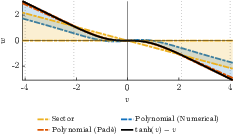
Figure 2: Triple integrator example—local polynomial and Padé-based constraints capture Ψ2 more accurately and on larger domains than sector bounds. The shaded nonnegativity region encodes the admissibility of the constraint.
- Numerical optimization: For challenging nonlinearities or application-specific regions, the paper presents a direct nonlinear programming approach (using, e.g., MATLAB's fmincon) to synthesize tight polynomial constraints given a finite sampling of the nonlinearity. These numerically constructed polynomials can strictly dominate analytical ones in critical subregions—as exemplified on saturated and exponential systems.
This dual analytic/numeric approach ensures flexibility: analytic constraints establish guaranteed admissibility, while numerically synthesized constraints exploit domain-specific structure for reduced conservatism.
ROA Computation via SOS Programming
A central application of the proposed framework is the computation of inner approximations of regions of attraction for nonlinear or uncertain systems, even when nonlinearities are not of polynomial type. The general approach is:
- Abstract non-polynomial parts using polynomial constraints.
- Formulate ROA estimation as an SOS program with polynomial (and possibly several) constraint certifications.
- Employ an alternating algorithm (between constraint fixing and Lyapunov function shaping) to maximize the ROA volume certified by the available constraints.
The authors provide explicit SOS formulations and describe practical considerations, such as bilinear alternation, degree selection, and sub-level set inclusion constraints to ensure validity of each certificate.
Numerical Results
Two representative nonlinear systems are employed to benchmark the methodology: a triple integrator with Ψ3 saturation nonlinearity and a two-state system with an exponential nonlinearity.
Triple Integrator Example
Polynomial constraints (analytically and numerically synthesized) enable correct nonlinearity bounding within Ψ4, substantially outperforming sector bounds (which are valid only for Ψ5). When used as admissibility certificates within the SOS ROA algorithm, the certified ROA volume is increased by a factor of nearly Ψ6 compared to the sector case.
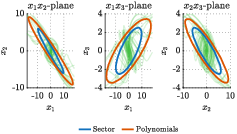
Figure 3: Regions of attraction (ROAs) computed for the triple integrator under different nonlinearity constraints, visualized on coordinate planes. Trajectories (green) illustrate convergence within the certified ROA.
Exponential System Example
For the non-polynomial, asymmetric nonlinearity Ψ7, a 6th-degree polynomial constraint is synthesized, valid for a wide domain. The resulting certified ROA volumes are significantly larger than those certified using local sector bounds, which are only valid for small input intervals.
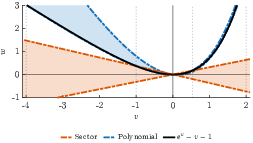
Figure 4: Local constraints for Ψ8—the polynomial constraint achieves tight nonnegativity over a large region, key for bounding the nonlinearity in ROA analysis.
The computational results show successive improvement in certified ROA with iteration and constraint complexity:
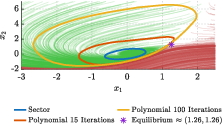
Figure 5: Inner estimates of the ROA for the exponential system—polynomial constraints enable much larger invariant sets (blue and green), with trajectories evidencing forward invariance.
Notably, after 100 SOS iterations, the certified ROA volume is Ψ9 larger than that obtained by sector constraints, with the boundary accurately tracking the true region of attraction.
Theoretical and Practical Implications
The results demonstrate that higher-order polynomial constraints can yield less conservative (and sometimes dramatically less conservative) robustness and stability certificates in nonlinear systems where classical methods fail or provide little performance guarantee. Key technical strengths include:
- Systematic construction and compositional transformation of polynomial constraints from IQCs or data.
- Flexible domain adaptation, leveraging both symbolic and numeric constraint synthesis.
- Practical scalability, illustrated on multidimensional SOS programs with moderate computational requirements.
The ability to address non-polynomial and highly nonlinear uncertainties is critical in modern robust control, especially as system complexity, actuation limits, and computation-aided controller synthesis increase in prominence.
Future Directions
The paper opens several directions for future work:
- Automated constraint generation: Enhanced optimization-based methods for constraint discovery and adaption to high-dimensional nonlinearities.
- Tighter compositionality: Leveraging system decomposition and composite constraints for large-scale nonlinear networks.
- Extension to robust performance bounds: Beyond stability, polynomial constraints could inform ∫0Tz(t)dt≥0,∀T≥0,v∈L2e,w=Δ(v)0 or input-output gain analyses.
Sophisticated SOS and SDP solvers may further enable the analysis of uncertain and data-driven models with limited analytic nonlinear description.
Conclusion
This work systematically extends the IQC paradigm to higher-order polynomial constraints, provides effective methods for constructing tight polynomial certificates, and demonstrates substantial improvements in robustness analysis of nonlinear systems, particularly in estimating regions of attraction for systems with saturating and non-polynomial nonlinearities. The presented framework enhances both the theoretical toolkit and the practical reach of nonlinear and uncertain system analysis, supporting robust control design for challenging modern systems (2604.01198).