SMASH: Mastering Scalable Whole-Body Skills for Humanoid Ping-Pong with Egocentric Vision
Abstract: Existing humanoid table tennis systems remain limited by their reliance on external sensing and their inability to achieve agile whole-body coordination for precise task execution. These limitations stem from two core challenges: achieving low-latency and robust onboard egocentric perception under fast robot motion, and obtaining sufficiently diverse task-aligned strike motions for learning precise yet natural whole-body behaviors. In this work, we present \methodname, a modular system for agile humanoid table tennis that unifies scalable whole-body skill learning with onboard egocentric perception, eliminating the need for external cameras during deployment. Our work advances prior humanoid table-tennis systems in three key aspects. First, we achieve agile and precise ball interaction with tightly coordinated whole-body control, rather than relying on decoupled upper- and lower-body behaviors. This enables the system to exhibit diverse strike motions, including explosive whole-body smashes and low crouching shots. Second, by augmenting and diversifying strike motions with a generative model, our framework benefits from scalable motion priors and produces natural, robust striking behaviors across a wide workspace. Third, to the best of our knowledge, we demonstrate the first humanoid table-tennis system capable of consecutive strikes using onboard sensing alone, despite the challenges of low-latency perception, ego-motion-induced instability, and limited field of view. Extensive real-world experiments demonstrate stable and precise ball exchanges under high-speed conditions, validating scalable, perception-driven whole-body skill learning for dynamic humanoid interaction tasks.
Paper Prompts
Sign up for free to create and run prompts on this paper using GPT-5.
Top Community Prompts
Explain it Like I'm 14
Overview
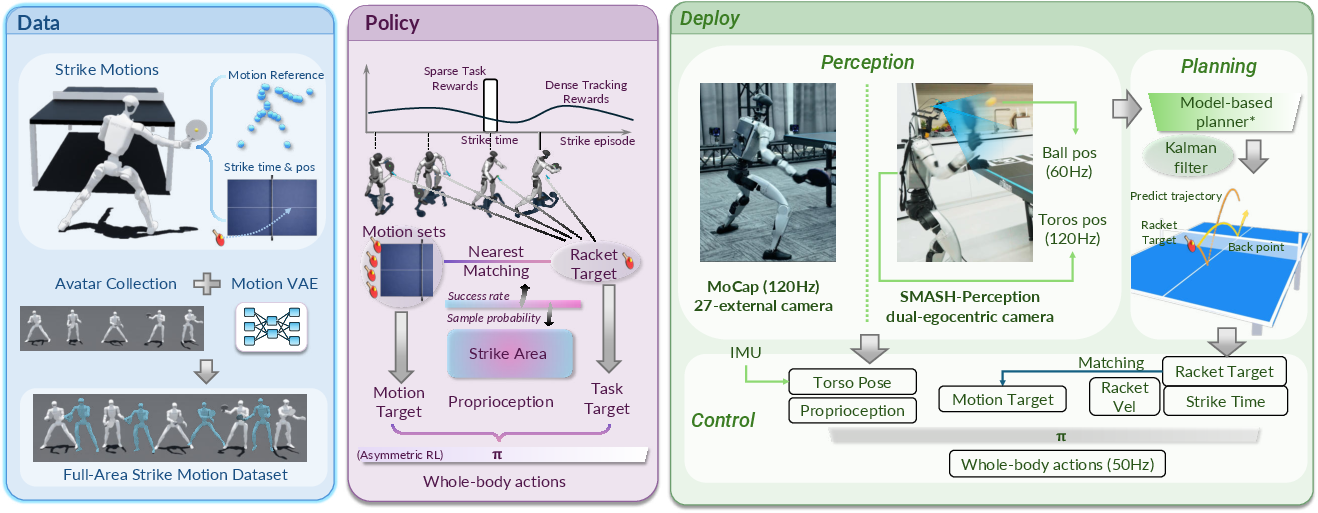
This paper introduces SMASH, a system that teaches a humanoid robot to play ping-pong using only its own cameras as “eyes.” The robot doesn’t just swing its arm—it uses its entire body in a coordinated way to make fast, accurate, and powerful shots, including dramatic smashes and low, crouching hits. The big idea is to combine smart vision, a large library of human-like moves, and a controller that picks the right move at the right moment.
Goals and Questions
In simple terms, the researchers wanted to answer:
- How can a robot reliably see and track a tiny, fast-moving ping-pong ball using only cameras on itself, even while it’s moving and shaking?
- How can a robot learn a wide variety of natural, whole-body strike motions (not just simple forehand/backhand) and choose the best one for where the ball will be?
- How can we tie the robot’s seeing and moving together so it can hit the ball again and again—without relying on external tracking systems or special lab equipment?
Methods in Simple Terms
The system brings together three main parts. Think of it like how a human learns a sport: you use your eyes, you have a set of moves you can perform, and you choose and execute the right move at the right time.
1) Egocentric Vision: The robot uses its own “eyes”
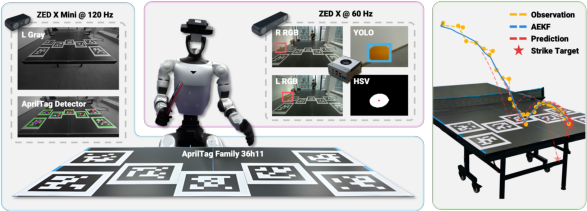
- The robot has two cameras: one looks forward to spot the ball; another looks down to help figure out where the robot is relative to the table.
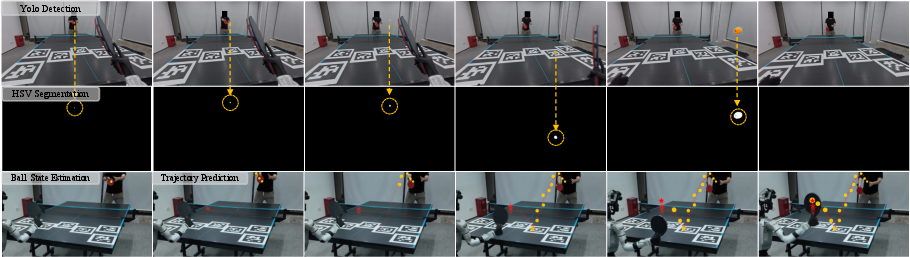
- It detects the ball using a fast object detector (like a keen-eyed friend pointing out the ball) and estimates the robot’s position using AprilTags (special visual markers on the table that act like road signs).
- To handle noisy measurements and bounces, it uses an Adaptive Extended Kalman Filter. You can think of this filter like a smart “guess-and-check” system: it predicts the ball’s path using physics (gravity, air resistance, and bounces) and then adjusts the prediction based on what the cameras actually see.
- With these predictions, it plans when and where to hit the ball (the “time-to-strike” and the target spot and speed for the racket).
2) Scalable Motion Library: A big, human-like move set
- The team recorded about 400 human strike motions (using motion capture), including the moments before, during, and after contact.
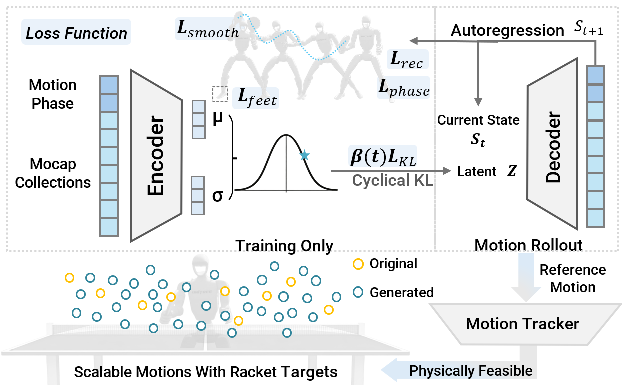
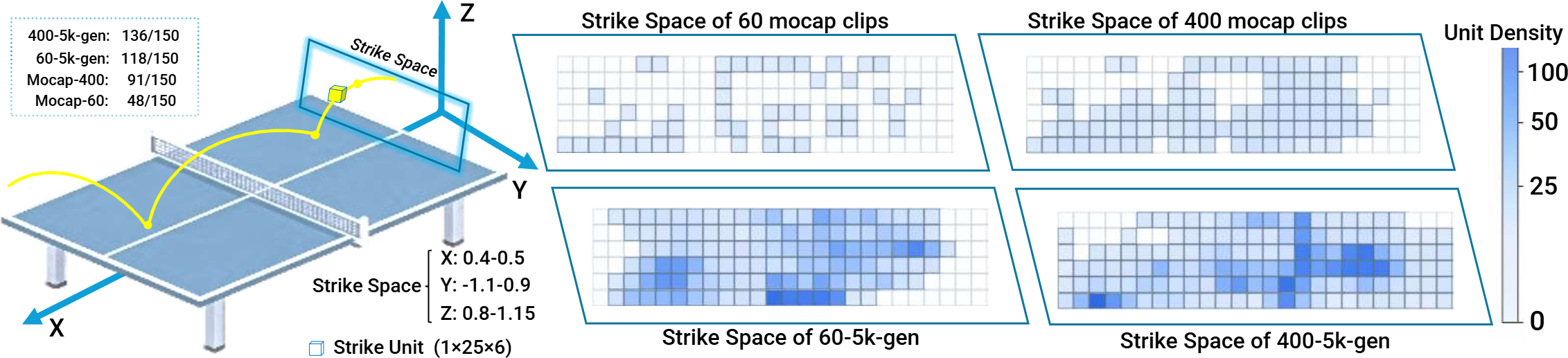
- To cover more of the table and more styles, they trained a motion generator (a Motion-VAE—think of it as an “imagination engine”) that creates new, realistic strike motions based on the target you want to hit.
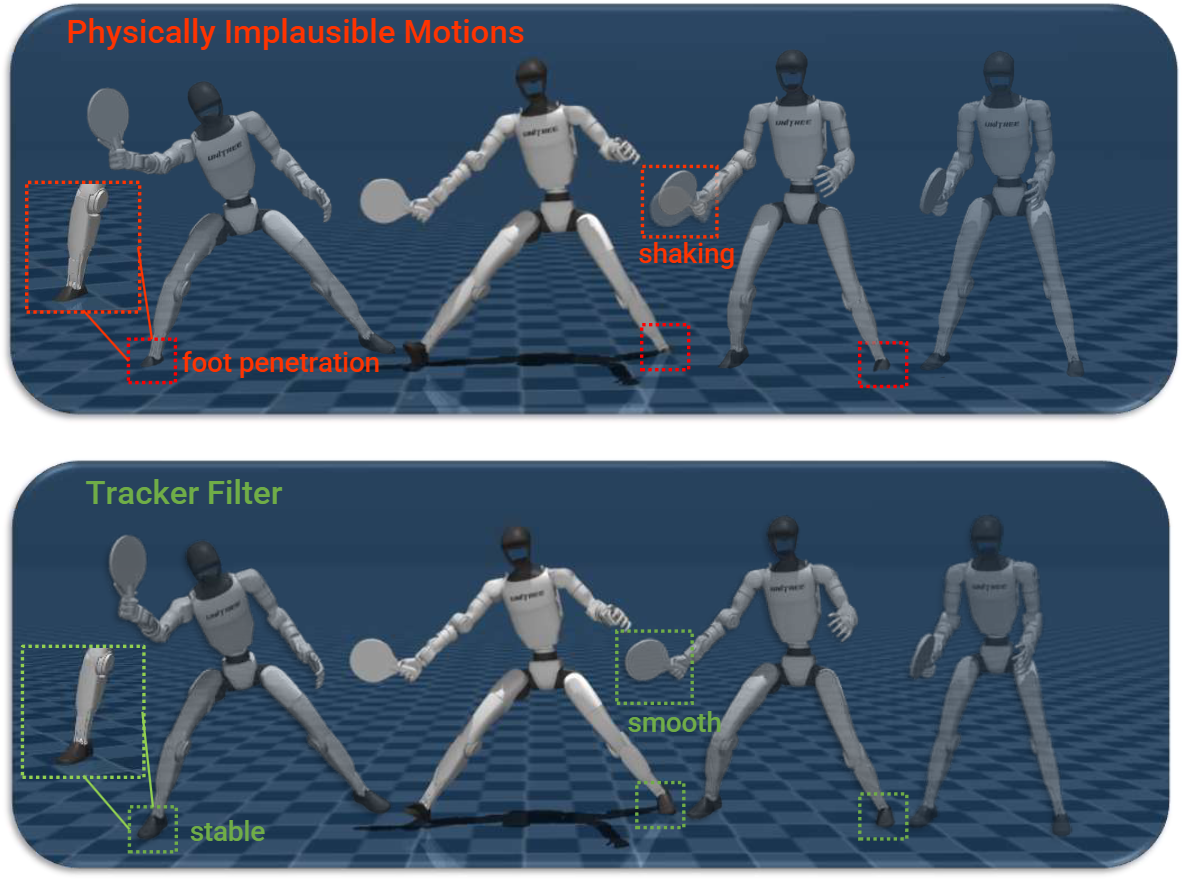
- Not every generated motion is practical, so they test each one with a tracking controller and keep only the motions that the robot can actually perform smoothly. This creates a large, diverse library of strike motions that cover many positions on the table.
3) Task-Aligned Control: Picking and executing the right move
- When the robot decides where and when to hit, it searches the motion library for the strike motion that best matches the planned hit point (nearest-neighbor “motion matching”).
- A reinforcement learning controller (you can think of it like a player trained through lots of practice with feedback) uses this matched motion as guidance and controls the whole body to:
- Put the racket at the right place at the right time,
- Swing with the right speed,
- Align the racket face correctly for the shot.
- During training, they add realistic noise and random disturbances (like practicing in windy conditions or with shaky cameras) so the robot becomes more robust in the real world.
Main Findings and Why They Matter
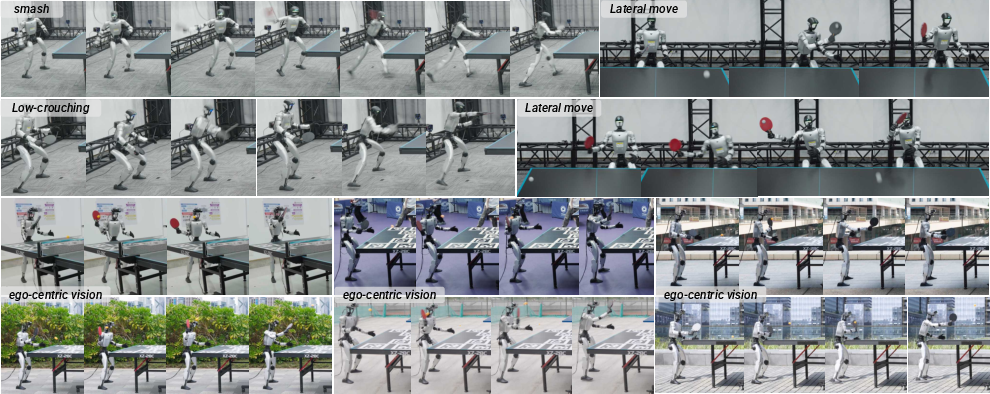
- First outdoor humanoid ping-pong without external cameras: The robot can rally using only its own cameras and onboard processing, which is a big step toward real-world autonomy.
- Whole-body agility and diversity: It performs coordinated full-body strikes, including powerful smashes, low crouching shots, and wide lateral moves—not just simple arm swings.
- Accurate, fast interaction: The system handles high-speed rallies and keeps hitting the ball precisely.
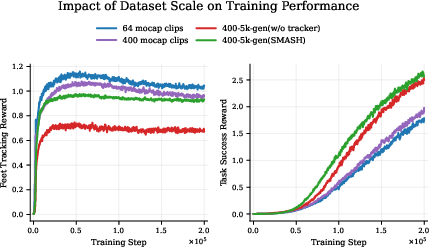
- Scalable, natural motion learning: By combining human motion capture with a motion generator, they build a large, task-aligned library that improves training speed, coverage across the table, and the natural look of the robot’s movements.
In short, SMASH proves that a humanoid robot can play ping-pong in a lively, human-like way using only what it sees itself, and it can do so repeatedly.
Why This Matters
This research is a step toward robots that can move and react naturally in dynamic, unpredictable environments—like sports, factory floors, or home settings where objects move fast and timing is tight. The approach of:
- using onboard vision to perceive and predict,
- building scalable, human-like motion libraries with generative models,
- and matching the right move to the task,
can be applied to other sports (tennis, badminton, soccer) and to tasks like catching, throwing, or manipulating moving objects. Ultimately, it helps move humanoid robots closer to being helpful, agile partners in the real world.
Knowledge Gaps
Knowledge gaps, limitations, and open questions
Below is a single, concrete list of what remains missing, uncertain, or unexplored, framed to guide follow‑up research.
- Ball physics fidelity: The AEKF and trajectory predictor omit spin/Magnus effects, spin‑dependent bounce, and table friction anisotropy; how do these omissions limit return accuracy, especially for topspin/backspin and oblique bounces, and how should spin be estimated onboard (e.g., from visual blur cues) and integrated into the model?
- Return strategy: The planner defaults to returning to the opponent table center; no mechanism exists for target selection, placement diversity, or tactical adaptation (e.g., angles, depth, speed); how to jointly learn/intend landing point, speed, and spin under onboard constraints?
- Contact modeling and control: The task reward supervises racket pose/velocity near impact but does not model post‑impact ball response; how to learn or identify a contact model (including spin transfer and coefficient variations) to meet commanded landing targets robustly?
- Velocity/phase in motion retrieval: Nearest‑neighbor matching uses only relative strike position; the selection ignores desired strike velocity, racket orientation, and time‑to‑strike; would conditioning retrieval on or full contact pose improve alignment and precision?
- Library scaling vs. realtime latency: Nearest‑neighbor search over an expanding motion library is not analyzed for latency on the Jetson; what indexing/ANN methods and feature designs keep retrieval within strict control deadlines as the library scales?
- Generated motion validity bounds: The Motion‑VAE is filtered by a motion tracker in sim, but there is no quantitative assessment of dynamic feasibility margins (e.g., torque, velocity, contact forces) on hardware; what thresholds guarantee safe/trackable references on the real robot?
- Coverage quantification: The paper asserts broader workspace coverage with generation, but provides no measurement of strike‑point density/coverage vs. success (e.g., occupancy heatmaps, coverage–performance curves); how much coverage is needed for a given precision target?
- Style and controllability: The Motion‑VAE lacks explicit controls for strike “style” (e.g., smash vs. loop, crouching vs. upright); how to condition generation on style labels or latent attributes while preserving task alignment and trackability?
- Domain shift and OOD handling: How robust is the Motion‑VAE to query targets outside mocap distributions (extreme reaches/angles)? What is the failure mode when no close reference exists, and can fallback controllers handle such cases?
- Sim‑to‑real gap sources: Domain randomization covers IMU noise, friction, pushes, but real‑world issues like actuator delays, backlash, thermal derating, joint compliance, and sensor time‑stamping/rolling‑shutter effects are not modeled; which gaps dominate miss errors and how to randomize/compensate for them?
- Whole‑body planning of foot placement: The controller coordinates whole body but does not explicitly plan steps/footholds when repositioning for far strikes; how to integrate footstep and COM planning with motion priors under tight time budgets?
- Table and net interaction safety: No explicit constraints prevent racket–table/net collisions during aggressive smashes/crouches; how to add geometric safety envelopes and fast swept‑volume checks without missing hits?
- End‑to‑end latency budget: There is no measured breakdown (detection → triangulation → filtering → prediction → planning → control) and its impact on hit timing error; what is the maximum tolerable latency for specified ball speeds, and where are the bottlenecks?
- Perception under motion blur and occlusions: YOLO+HSV+stereo may fail under head motion, self‑occlusion by the racket/arm, specular lighting, or background clutter; what are detection/triangulation recall/precision and error vs. shutter speed, exposure, and ego‑motion?
- Field‑of‑view limits: The paper does not address reacquisition when the ball exits the head camera FOV or is briefly lost; what predictive gating and search strategies minimize re‑detection time and strike misses?
- Markerless table/pose estimation: Ego‑localization relies on AprilTags on the table; how to remove fiducials (e.g., use table geometry, net line detection, or VIO/SLAM) and maintain accuracy outdoors and under partial views?
- Wind and outdoor disturbances: The drag model lacks wind; what is the impact of gusts on trajectory prediction outdoors, and can onboard anemometry or adaptive drag estimation reduce error?
- Adaptive noise scheduling: Task‑command noise decreases with time‑to‑strike, but no principled schedule or ablation is provided; what schedules best mimic deployment errors and maximize robustness?
- Robust bounce/return event detection: AEKF resets use heuristic thresholds; how robust are these resets to measurement noise, net hits, edge bounces, or grazing trajectories, and can change‑point detection or learned classifiers improve reliability?
- Calibration drift: The system assumes fixed extrinsics and stereo calibration; how to detect and correct online drift due to impacts/vibration (e.g., self‑calibration, fiducial sanity checks)?
- Camera–IMU fusion: The pipeline does not fuse IMU and vision for deblurring/pose stabilization; would VIO and motion‑compensated feature tracking materially improve ball localization during fast head motion?
- Energy/thermal constraints: Sustained smashes and rapid lateral motions may heat actuators; what are the thermal/energy budgets and their effect on repeatability over long rallies?
- Generalization across platforms: Motions are retargeted to Unitree G1; how portable are the priors and policies to other humanoids (different kinematics, masses, racket geometry), and what minimal retargeting/calibration is needed?
- Opponent modeling: The system ignores opponent behavior; how to integrate opponent position/intent sensing and adapt return targets/strike timing accordingly?
- Multi‑objective learning: The policy balances task error and motion realism, but weight selection and stability trade‑offs are not analyzed; can automated reward tuning (e.g., Lagrangian or curriculum methods) improve precision without sacrificing naturalness?
- Recovery behaviors: Post‑miss or off‑balance recovery is not discussed; what fallback strategies and state machines are needed to quickly re‑engage rallies?
- Failure analysis and benchmarks: Claims of “extensive real‑world experiments” lack standardized metrics (rally length distributions, success rate vs. ball speed/spin, placement error, perception dropouts) and comparisons to external‑sensing baselines; comprehensive benchmarks are needed.
- Robustness to ball/table variations: Different ball colors, seam patterns, table textures, and lighting spectra may degrade HSV/YOLO performance; what training data augmentation and detectors ensure cross‑domain robustness?
- Compute budget and scheduling: The Jetson Orin pipeline’s CPU/GPU utilization and contention between perception and control are unreported; what scheduling/prioritization ensures deterministic timing at peak loads?
- Safety and contact forces: There is no monitoring of racket–ball impact forces or joint loads during smashes; what sensing/limits are required to protect hardware while maintaining performance?
- Extending beyond ping‑pong: The modularity to other fast ball sports (badminton/tennis) is claimed implicitly; which components transfer, and what changes to motion priors and perception are necessary for different projectile aerodynamics and contact mechanics?
- Continual/adaptive learning: The system does not adapt online to new lighting, camera drift, or opponent styles; how to incorporate safe real‑world data collection and continual learning without destabilizing performance?
- Library–planner coupling: The strike planner selects a single time‑to‑hit and target, while motion matching provides a fixed reference; can joint optimization (e.g., MPC with motion primitives) yield better feasibility under uncertainty?
- Wrist control vs. whole‑body prior: Wrist joints are excluded from motion tracking to allow task adaptation, but the optimal division of labor between wrist and proximal joints is not studied; does explicit impedance or orientation control at the wrist improve return consistency?
- Handling edge cases: Net/grazing hits, edge bounces, or very low/high trajectories are not addressed; what special policies or constraints are needed to safely and effectively handle these rare but critical cases?
Practical Applications
Immediate Applications
Below are actionable applications that can be deployed now or with minimal integration effort, leveraging the paper’s egocentric perception pipeline, task-aligned whole-body control, and scalable motion generation/matching.
- Humanoid table-tennis demonstrator and attraction (Sectors: robotics, entertainment, sports tech)
- What: Deploy a rally-capable humanoid as an event attraction, trade-show demo, or brand activation showcasing dynamic whole-body skills.
- Tools/workflows: Onboard dual-camera setup (ZED X + ZED X Mini), YOLO+HSV+stereo ball detection, AEKF with drag/bounce, strike planner, task-aligned motion matching policy running on Unitree G1 or similar.
- Assumptions/dependencies: Safety barriers and supervision; pre-calibrated table frame (AprilTags or equivalent); sufficient compute (Jetson-class); tuned reward/latency; ball color and lighting suitable for HSV.
- Egocentric dynamic object tracking SDK for small, fast objects (Sectors: software, embedded CV, sports analytics, drones/robotics)
- What: Package the YOLO+HSV+stereo + AEKF (with bounce-aware dynamics) as a plug-in module for ROS/ROS 2 and edge AI platforms for real-time 3D state estimation of balls/shuttles.
- Tools/products: “Ego-Track” SDK with camera calibration utilities, distance-adaptive noise models, drag/restitution models, and APIs for trajectory prediction.
- Assumptions/dependencies: Stereo calibration; ball-like objects (near-spherical); adequate frame rate and baseline; lighting stable enough for color-seg refinement.
- Task-aligned motion library augmentation workflow (Sectors: software, robotics R&D)
- What: Use the Motion-VAE with phase/foot constraints and tracker-based filtering to expand sparse mocap into a workspace-covering library for dynamic skills (e.g., strikes, kicks, evasive steps).
- Tools/products: “Skill Library Builder” pipeline (mocap → retarget → Motion-VAE → physics-tracking filter → library), with evaluation metrics for workspace coverage.
- Assumptions/dependencies: Access to seed demonstrations; realistic simulator and tracker; robot-specific kinematic retargeting (e.g., GMR); compute for training.
- Task-conditioned motion matching controller (Sectors: robotics, software)
- What: Integrate nearest-neighbor motion retrieval in the “strike target space” (position/velocity/time) into whole-body controllers to improve naturalness and precision in other contact tasks (e.g., batting, blocking, goalkeeping).
- Tools/workflows: Lightweight retrieval index, motion command encodings, asymmetric actor–critic with PPO, domain randomization recipes.
- Assumptions/dependencies: A compatible motion library with target annotations; stable low-level whole-body control; task target estimator.
- Research benchmark and training recipe for perception-driven whole-body skills (Sectors: academia)
- What: Reproduce and extend SMASH as a reference system to study imitation+RL with task-aligned priors, egocentric state estimation under ego-motion, and sim-to-real for high-speed interaction.
- Tools/workflows: Modular pipeline (perception → planner → motion matching → policy), adaptive region sampling, phase-dependent task noise, gated strike-window rewards.
- Assumptions/dependencies: Access to a mid-scale humanoid or simulation; reproducible calibration; motion data or generated library.
- Sports analytics for table tennis and similar sports (Sectors: sports tech, coaching)
- What: Deploy the AEKF + bounce/drag model to estimate accurate ball trajectories and bounce events using stereo cameras (not necessarily mounted on a robot).
- Tools/products: Portable dual-camera rigs, coaching dashboards for trajectory, timing, and contact analytics.
- Assumptions/dependencies: Visibility of ball; calibration; acceptable lighting; known table geometry; trained detector.
- Rapid prototyping for other robot sports skills (e.g., robotic goalkeeper, legged badminton returns) (Sectors: robotics, sports tech)
- What: Reuse the perception stack, target-conditioned retrieval, and strike-window reward design to prototype other interception tasks.
- Tools/workflows: Replace racket geometry, re-annotate targets, adjust dynamics model (e.g., shuttlecock vs. ball).
- Assumptions/dependencies: New motion library and dynamics model per sport; sensor placement/latency tuning.
- Educational kits for vision-based control and human–robot interaction (Sectors: education)
- What: Course modules demonstrating end-to-end egocentric perception-to-control on dynamic tasks with reproducible labs.
- Tools/products: Open lab scripts, recorded datasets, calibration exercises, ablation assignments (e.g., without motion matching, without AEKF).
- Assumptions/dependencies: Student-accessible sensors; simulator; mid-cost platforms or virtual labs.
Long-Term Applications
The following applications require further research, scaling, or product engineering to meet robustness, safety, and generalization needs.
- General dynamic whole-body manipulation and interception (Sectors: manufacturing, logistics, service robotics)
- What: Intercept/redirect moving items (falling parts, conveyor offloads), dynamic handovers, or emergency interception (e.g., catching dropped tools) using task-aligned priors and egocentric tracking.
- Potential products: “Dynamic Interception Module” for collaborative robots; warehouse safety interceptors.
- Assumptions/dependencies: Industrial-grade reliability; broader object classes and shapes; safety certification; vision under clutter/occlusions; robust grasp/contact strategies beyond racket-like contacts.
- Multi-sport humanoid skill packs (tennis, badminton, squash, baseball batting) (Sectors: sports tech, consumer robotics)
- What: Extend SMASH to a family of dynamic sports skills with shared perception/control backbone and sport-specific motion libraries/dynamics.
- Potential products: “Humanoid Sports Suite” for training, entertainment, and interactive coaching.
- Assumptions/dependencies: High-diversity motion data per sport; domain-specific aerodynamics and contact models; faster actuation and compliance for high-impact sports.
- Assistive rehabilitation and exergaming via safe whole-body interaction (Sectors: healthcare)
- What: Gamified therapy where a humanoid engages patients in low-intensity rally-like activities with adaptive difficulty and safe contact behaviors.
- Potential products: Rehab robots with graded force limits, clinician interfaces, patient monitoring/analytics.
- Assumptions/dependencies: Medical-grade safety, compliance, and explainability; rigorous clinical validation; cost reduction.
- Human–robot collaboration with dynamic handovers (Sectors: manufacturing, service, hospitality)
- What: Time-critical handovers (tools, parts, props) using time-to-contact estimation and target-conditioned motion matching for natural body coordination.
- Potential products: Handover planner integrated with egocentric perception; predictive intent models.
- Assumptions/dependencies: Human intent prediction; standardized safety envelopes; tactile/force sensing; insurance and liability frameworks.
- Infrastructure-free field autonomy for dynamic tasks (Sectors: field robotics, public safety)
- What: Onboard-only perception/control for intercepting or tracking fast objects outdoors (e.g., stray drones/balls in stadiums, debris interception).
- Potential products: Rapid-deployment egocentric perception kits; ruggedized compute and sensing stacks.
- Assumptions/dependencies: Robustness to weather/lighting; long-range sensing; edge compute and power; public safety certification.
- Standardization and policy benchmarks for dynamic humanoid interaction (Sectors: policy, standards bodies)
- What: Define test protocols for latency, perception reliability, and safe dynamic interaction (e.g., strike/catch envelopes, fail-safes) based on SMASH-like tasks.
- Potential tools: Benchmark suites, certification procedures, conformance tests.
- Assumptions/dependencies: Multi-stakeholder consensus; reproducible testbeds; incident reporting frameworks.
- Consumer humanoids as interactive sports companions (Sectors: consumer robotics)
- What: Home robots capable of casual rallies, coaching cues, and exergaming through onboard perception and skill libraries.
- Potential products: Subscription “skill packs,” personalization via motion-prior adaptation.
- Assumptions/dependencies: Cost, reliability, noise/safety considerations; simplified hardware; minimal environment setup without fiducials.
- Simulation-to-real skill authoring as a service (Sectors: software, platforms)
- What: Cloud or on-prem pipelines that transform small mocap sets into deployable skill libraries using Motion-VAE augmentation and tracker filtering, with target-conditioned retrieval APIs.
- Potential products: “SkillOps” platform for data → model → library → deployment lifecycle.
- Assumptions/dependencies: IP/licensing for mocap; diverse robot morphology support; secure data/tooling; MLOps maturity.
- Robot sports broadcasting and analytics (Sectors: media, analytics)
- What: Use bounce- and drag-aware AEKF with egocentric cameras to generate real-time visualizations (trajectory, spin proxies, contact timing) during robot–human or robot–robot matches.
- Potential products: Broadcast overlays, coaching insights, fan engagement apps.
- Assumptions/dependencies: Stable vision in crowded venues; integration with broadcast pipelines; data rights.
Cross-cutting assumptions and dependencies affecting feasibility
- Sensing and compute
- High-FPS stereo sensing and edge AI (Jetson-class) are assumed; generalization to low-light/high-glare outdoors requires robust HDR and color-invariant detection beyond HSV.
- Calibration stability and low-latency pipelines are critical; dropped frames degrade time-to-strike estimates.
- Environment setup
- Current ego-localization assumes known field-of-play (e.g., AprilTags on table). Tagless operation would require reliable SLAM or visual odometry tied to the playfield geometry.
- Data and models
- Motion-VAE needs seed demonstrations with strike-phase annotations; generative motions must pass tracker-based filtering to ensure executability.
- Sport- or task-specific aerodynamics and restitution parameters must be identified (drag, spin effects, surface bounces).
- Hardware and safety
- Actuator speed/torque and mechanical compliance limit maximal dynamics and contact safety; external safety infrastructure (nets, barriers) often required.
- Certification, liability, and human factors (startle, proximity) are gatekeepers for public and clinical deployments.
- Scalability and robustness
- Domain randomization and adaptive training improve robustness but do not replace exhaustive real-world edge-case testing.
- Transfer across robots/morphologies requires re-retargeting and partial retraining of policies and motion libraries.
Glossary
- Adaptive Extended Kalman Filter (AEKF): A state estimator that extends the Kalman filter to nonlinear dynamics and adapts measurement noise or process parameters online to handle varying conditions (e.g., bounces, distance-dependent noise). "We design an Adaptive Extended Kalman Filter (AEKF) that fuses position observations with a physics-based motion model to jointly estimate ball position and velocity, while robustly handling bounce events."
- Adversarial Motion Priors (AMP): A technique that uses adversarial learning to encourage policies to generate realistic motions by comparing them against a reference motion distribution. "Adversarial Motion Priors (AMP)~\cite{ren2025goalkeeper, wang2025physhsi} typically rely on a single motion distribution and enforce motion realism through adversarial rewards, often resulting in loose task alignment and limited motion diversity."
- AprilTag: A visual fiducial system of 2D tags used for precise pose estimation in vision-based localization. "Our perception pipeline combines YOLO-based ball detection, AprilTag-based robot localization, and adaptive Kalman filtering for state estimation."
- Asymmetric actor--critic framework: An RL setup where the actor and critic receive different information (e.g., actor gets noisy/partial observations, critic gets privileged/clean observations) to improve learning stability and transfer. "Our whole-body controller is trained with PPO under an asymmetric actor--critic framework."
- Cyclical annealing schedule: A training strategy for VAEs that periodically increases the KL weight to prevent posterior collapse while still learning meaningful latents. "To prevent posterior collapse throughout VAE training, we adopt a cyclical annealing schedule for the KL weight ."
- Domain randomization: A sim-to-real technique that randomizes simulation parameters (e.g., sensors, friction, perturbations) to make policies robust to real-world variations. "the critic uses additional privileged information during training, and domain randomization is applied to reduce the sim-to-real gap."
- Egocentric onboard perception: A perception setup that uses only sensors mounted on the robot to interpret the environment from the robot’s own viewpoint in real time. "we develop an egocentric onboard perception pipeline for real-time humanoid table tennis."
- Homogeneous matrices: 4×4 matrices that represent 3D rigid transformations (rotation and translation) in a unified form for coordinate frame conversions. "All transformations are represented as homogeneous matrices."
- Motion Capture (MoCap): A sensing system that tracks 3D positions of markers or rigid bodies to capture motion data at high frequency and accuracy. "Motion Capture (MoCap) mode"
- Motion matching: A retrieval method that selects reference motion clips by finding the closest match in a feature space to current task or state conditions. "we use a simple motion matching scheme over our enhanced strike motion library."
- Motion priors: Pre-collected or learned motion datasets/models that constrain or regularize policy behavior toward natural, human-like movement. "our framework benefits from scalable motion priors and produces natural, robust striking behaviors across a wide workspace."
- Motion retargeting: The process of adapting human motion data to a robot’s kinematic structure while preserving key movement characteristics. "These human demonstrations are then retargeted to the Unitree G1 kinematics via GMR."
- Motion-VAE: A variational autoencoder specialized for motion data, used here to generate strike motions that preserve temporal structure and physical plausibility. "Motion-VAE for scalable strike motion generation."
- Nearest-neighbor search: A retrieval technique that selects the closest item(s) in a feature space; here used to pick reference motions matching desired strike targets. "we retrieve the reference motion by nearest-neighbor search in a task-conditioned feature space"
- Partially Observable Markov Decision Process (POMDP): A framework for decision-making under uncertainty where the agent receives incomplete observations of the true state. "They are typically formulated as a Partially Observable Markov Decision Process (POMDP), where the actor observes deployment-feasible inputs such as motion commands and proprioception..."
- Perspective-n-Point (PnP): A computer vision method to estimate camera pose from known 3D points and their 2D projections. "Detected tag corners are aggregated into a unified Perspective-n-Point (PnP) problem"
- Posterior collapse: A VAE failure mode where the decoder ignores the latent variables, causing the learned posterior to match the prior and carry little information. "To prevent posterior collapse throughout VAE training, we adopt a cyclical annealing schedule for the KL weight ."
- PPO: Proximal Policy Optimization, a reinforcement learning algorithm that stabilizes policy updates via clipped objectives. "The policy is then optimized with PPO."
- Proprioception: Internal sensing of the robot’s own body state (e.g., joint positions/velocities, base motion) used for closed-loop control. "the actor observes deployment-feasible inputs such as motion commands and proprioception"
- Quadratic aerodynamic drag model: A physics model where drag force scales with the square of velocity, used to predict ball flight. "The ball's flight dynamics follow a quadratic aerodynamic drag model:"
- RANSAC-PnP: A robust pose estimation method that combines RANSAC with PnP to handle outliers in 2D–3D correspondences. "and ${}^{\mathcal{C}_2}T_{\mathcal{T}$ is estimated using RANSAC-PnP."
- Reparameterization trick: A VAE technique to enable backpropagation through stochastic nodes by expressing sampling as a deterministic function of noise. "the latent variable is obtained via the reparameterization trick: "
- Restitution coefficients: Parameters that model energy loss at impacts; here separate horizontal and vertical coefficients for ball bounces. "The post-impact state uses horizontal restitution and vertical restitution "
- Rigid-body tracker: A MoCap-attached tracked object whose pose represents the rigid motion of a robot link or body. "A rigid-body tracker mounted on the robot provides ${}^{\mathcal{W}T_{\mathrm{Tracker}}$."
- Sim-to-real gap: The performance discrepancy between simulation and the real world due to unmodeled differences. "domain randomization is applied to reduce the sim-to-real gap."
- Stereo triangulation: Computing 3D positions by triangulating corresponding points from two camera views with known geometry. "A ZED\,X stereo camera mounted on the robot head detects the ball at 60\,Hz via stereo triangulation."
- Task-conditioned feature space: A representation that incorporates task variables (e.g., desired strike target) so retrieval or control aligns with task goals. "by nearest-neighbor search in a task-conditioned feature space"
- Variational Autoencoder (VAE): A generative model that learns latent-variable representations via variational inference with a reconstruction and KL objective. "motions augmented by a motion variational autoencoder (VAE)"
- YOLO: A real-time object detection framework used here for fast ball detection in images. "A YOLO detector trained on standard yellow balls predicts bounding boxes in the left and right RGB images"
Collections
Sign up for free to add this paper to one or more collections.

