Electromagnetic form factors of heavy-light pseudoscalar mesons
Abstract: We report calculations of space-like electromagnetic form factors and charge radii of pseudoscalar mesons, covering both light and heavy-light flavour sectors within a flavour-dependent Bethe-Salpeter framework.
- Exploring the flavor content of light and heavy-light pseudoscalars (2021)
- In-medium electromagnetic form factors of pseudoscalar mesons from the quark model (2024)
- Electric, Magnetic and Quadrupole Form Factors and Charge Radii of Vector Mesons: From Light to Heavy Sector in a Contact Interaction (2024)
- Heavy-light Pseudoscalar Mesons: Light-Front Wave Functions and Generalized Parton Distributions (2024)
- Electromagnetic and two-photon transition form factors of the pseudoscalar mesons: An algebraic model computation (2024)
- The electromagnetic form factors of heavy-light pseudo-scalar and vector mesons (2024)
- Analysis of the electromagnetic form factors and the radiative decays of the vector heavy-light mesons (2024)
- Electromagnetic Form Factors and Charge Radii of Pseudoscalar and Scalar Mesons: A Comprehensive Contact Interaction Analysis (2023)
- The Electromagnetic Form Factors of Pseudoscalar Mesons within the Light-Front Quark Model (2025)
- Electromagnetic properties of heavy-light mesons (2025)
Summary
- The paper presents a detailed Bethe-Salpeter study showing that the flavor-dependent SDE/BSE framework accurately computes space-like electromagnetic form factors for both light and heavy-light pseudoscalar mesons.
- It employs nonperturbative QCD methods by solving coupled Schwinger-Dyson and Bethe-Salpeter equations to obtain quark propagators, meson amplitudes, and dressed quark-photon vertices while preserving gauge invariance.
- The study benchmarks its numerical predictions against experimental and lattice QCD results, offering critical insights for extracting charge radii and probing meson structure in precision flavor physics.
Electromagnetic Form Factors of Heavy-Light Pseudoscalar Mesons: A Bethe-Salpeter Study
Introduction
Electromagnetic form factors (EFFs) provide a crucial probe into the internal dynamics of mesons by characterizing their response to electromagnetic currents in terms of nonperturbative QCD interactions. The accurate computation of EFFs, especially in the heavy-light sector, poses unique challenges due to the strong flavor asymmetry between constituent quarks. The paper "Electromagnetic form factors of heavy-light pseudoscalar mesons" (2604.00974) undertakes a comprehensive calculation of space-like EFFs and charge radii for both light and heavy-light pseudoscalar mesons using a flavor-dependent Bethe-Salpeter equation (BSE) framework, constructed upon nonperturbative input from Schwinger-Dyson equations (SDEs).
Methodology
The utilized formalism is anchored in functional methods, specifically the coupled SDE/BSE approach, which enables a self-consistent determination of the relevant Green's functions: quark propagators, Bethe-Salpeter amplitudes (BSAs), and the fully-dressed quark-photon vertex. Three major dynamical components are central to the computation:
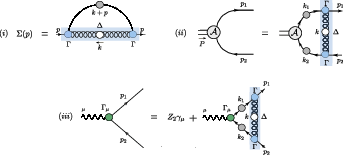
Figure 1: Diagrammatic representation of the main dynamical components: (i) quark self-energy, (ii) the meson Bethe-Salpeter amplitude, (iii) the SDE for the quark-photon vertex.
- Quark self-energy and propagator encode nonperturbative mass functions and wave-function renormalization through the solutions of the quark SDE.
- Bethe-Salpeter amplitude describes the bound state structure and satisfies a two-body integral equation in a flavor-dependent interaction kernel.
- Quark-photon vertex incorporates the full momentum dependence, maintaining vector Ward-Takahashi identity (VWTI) compliance (essential for universality of charge and current conservation) and nontrivial transverse dynamics.
The meson current matrix element is constructed by integrating over the product of BSAs, dressed quark propagators, and quark-photon vertices, with kinematics adjusted for stability, particularly in the presence of a heavy-light mass hierarchy. The effective flavor-dependent interaction kernel contains beyond-Taylor vertex dressing, parameterized as α~T(q2).
Numerical Results
Light Sector: Pions and Kaons
The computed electromagnetic form factors for π± and K± mesons are benchmarked against experimental data and other functional methods.
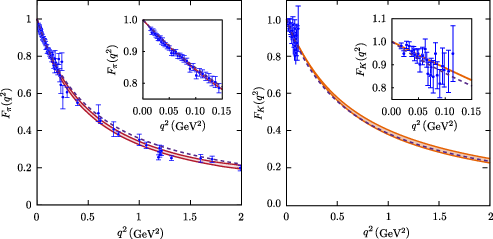
Figure 2: Pion (left) and kaon (right) electromagnetic form factors for a space-like photon; shaded bands reflect uncertainties in the effective coupling, with experimental data overlaid.
Quantitative agreement is observed for the pion, both in the normalization and the Q2 evolution of Fπ(Q2). The kaon results are consistent at low to intermediate momentum transfer, capturing experimental uncertainties and aligning with both SDE and lattice QCD studies.
Heavy-Light Sector: D, Ds, B, Bc Systems
The D, π±0, and π±1 meson form factors and charge radii are systematically computed, alongside neutral sector analogs (e.g., π±2, π±3, π±4, π±5) and single-quark contributions in the π±6 and π±7.
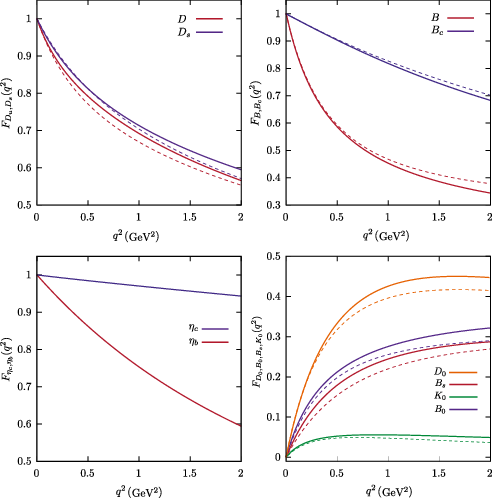
Figure 3: Meson electromagnetic form factors for a space-like photon, including heavy-light states; neutral form factors vanish at π±8 due to charge conservation.
For charged heavy-light states, the π±9 dependence is consistent with the expected scale hierarchy. The K±0 and K±1 form factors display similar slopes due to the relatively moderate mass difference between the charm and strange constituent quarks. For K±2 and K±3 mesons, the form factors illustrate more localized charge distributions, as evidenced by their smaller charge radii compared to lighter states.
A notable technical aspect is that the position of the neutral meson form factors at the origin vanishes, in full accord with gauge invariance and the VWTI.
Charge Radii: Comparison and Implications
Charge radii are extracted from the slope of the form factor at K±4, and are systematically collated against experimental, lattice (LQCD), rainbow-ladder (RL), and light-front (LF) model determinations. Pion and kaon radii align with experiment and LQCD within uncertainties (e.g., K±5 fmK±6 vs. experiment K±7 fmK±8). In the heavy-light sector, theoretical consistency is maintained, although no experimental data exist for direct comparison.
The results confirm the validity of the flavor-dependent SDE/BSE kernel in reproducing both normalization and slope of the form factors in the full mass spectrum from the light to the K±9 sector.
Theoretical and Practical Implications
This work consolidates the SDE/BSE approach as a competitive framework for precision hadron structure phenomenology. The flavor-dependent treatment of the kernel is essential for accounting for large mass asymmetry in heavy-light mesons, enhancing numerical stability and physical reliability.
From a practical perspective, these form factor predictions provide benchmarks for forthcoming experimental and lattice investigations in the heavy-light regime. The robustness of the formalism across the full light-to-heavy flavor spectrum indicates suitability for probing rare decays, radiative transitions, and form factor-sensitive observables in precision flavor physics.
On the theoretical front, the results highlight the necessity of incorporating beyond-ladder kernel corrections and transverse vector vertex structures to match experiment, particularly evident in the pion and kaon sectors. The demonstrated sensitivity of the form factors to the functional form of the effective coupling underscores the utility of such observables for constraining QCD kernel modeling.
Future Directions
Further advances will require systematic inclusion of two-body current contributions, analysis beyond the impulse approximation, and quantification of uncertainties stemming from parameter choices in the effective coupling. Higher Q20 behavior and analytic continuation towards the time-like region remain open directions, with implications for resonance phenomenology and rare processes.
Developments in lattice QCD and improvements in experimental measurements, especially in the Q21 and Q22 sector, will enable stringent validation of the computed form factors and associated charge radii.
Conclusion
The presented BSE/SDE study offers a quantitatively accurate and theoretically consistent determination of space-like electromagnetic form factors and charge radii for both light and heavy-light pseudoscalar mesons. The framework's flavor dependence and nonperturbative input allow for unified treatment across the full quark mass spectrum and underscore the predictive power of functional approaches for hadronic structure phenomenology.
Paper to Video (Beta)
No one has generated a video about this paper yet.
Whiteboard
No one has generated a whiteboard explanation for this paper yet.
Paper Prompts
Sign up for free to create and run prompts on this paper.
Top Community Prompts
Open Problems
We're still in the process of identifying open problems mentioned in this paper. Please check back in a few minutes.
Continue Learning
- How does the flavor-dependent kernel improve the accuracy of heavy-light meson form factor calculations?
- What role do Schwinger-Dyson and Bethe-Salpeter equations play in ensuring gauge invariance in this study?
- How do the computed charge radii for light mesons compare with experimental and lattice QCD data?
- What are the potential challenges in extending this approach to time-like momentum regions and rare meson decays?
- Find recent papers about heavy-light meson form factors.
Tweets
Sign up for free to view the 1 tweet with 0 likes about this paper.