- The paper introduces an adaptive polynomial filtered subspace iteration (AdaPolySI) that leverages Chebyshev expansion with Lanczos damping to robustly compute interior eigenvalues.
- It provides rigorous convergence analysis with error bounds that guide adaptive polynomial degree selection and efficiently suppress Gibbs oscillations.
- Numerical experiments on quantum chemistry Hamiltonians demonstrate up to 25.9× speedups over conventional methods while reducing computational cost and improving scalability.
Adaptive Polynomial Filtering for Hermitian Interior Eigenproblems: Convergence Analysis
Problem Context and Motivation
Interior eigenvalue problems for large-scale sparse Hermitian matrices underpin critical applications in electronic structure theory, quantum many-body systems, and physics-based simulations. Conventional direct methods are infeasible at scale due to the prohibitive cost of matrix factorizations. While projection methods such as (Chebyshev)-filtered subspace iteration, shift-and-invert, and (rational) contour-integral filtering are state-of-the-art, polynomial filtering offers a natural path to high scalability, replacing direct linear system solves by sparse matrix–vector or matrix–matrix operations. However, robust polynomial filters, especially for interior spectra, require careful degree selection, damping to suppress Gibbs oscillations, and accurate detection of spurious and converged components.
Adaptive Polynomial Filtered Subspace Iteration
This work introduces an Adaptive Polynomial Filtered Subspace Iteration method (AdaPolySI) for Hermitian interior eigenproblems, in which the polynomial filter, based on Chebyshev expansion of a step function, is adaptively updated during the iteration. The method leverages advanced polynomial filtering, enhanced convergence analysis, and efficient parallel implementation to address computational bottlenecks and numerical robustness.
The adaptive filter employs the Chebyshev expansion of a step function with exponent-m Lanczos damping, in contrast to prior approaches such as the Jackson-damped CJ-FEAST filter. By controlling the exponent m, the method balances sharpness of the spectral filter and suppression of Gibbs oscillations. Importantly, the filter degree is dynamically adjusted during the iteration, guided by a contraction criterion based on the current Ritz value estimates and a user-specified threshold τa. This reduces both the overall computational cost and unnecessary filter applications.
The filtered subspace iteration framework (Algorithm 1) integrates this adaptive polynomial filter and locks converged Ritz vectors, supported by robust residual-based spurious eigenpair detection. Throughout, the extraction of approximate invariant subspaces and Ritz value computation follows classical Rayleigh–Ritz principles, orthogonalized via Cholesky QR for parallel scalability.
Convergence Theory and Error Bounds
A major contribution of this study is the rigorous derivation of pointwise error bounds for both undamped and damped polynomial filters using Chebyshev expansions. The analysis quantifies the decay of the filter error as a function of the polynomial degree k, the location in the spectrum, and the damping control:
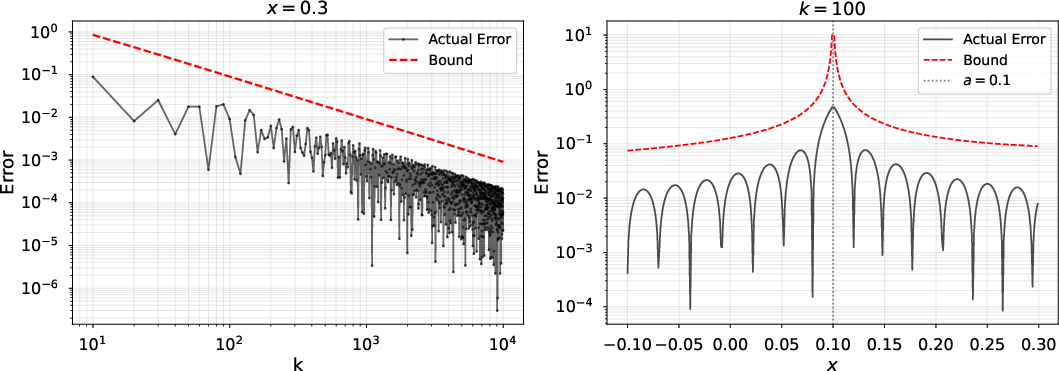
Figure 1: Error and theoretical error bounds for the damped Chebyshev polynomial filter as a function of degree, illustrating the tightness and the dependence on proximity to interval endpoints.
The damped filter error bound (Theorem 3.4) demonstrates that the filter error is O(J(θ)/k), where J(θ) captures the proximity to spectral interval boundaries—a sharp characterization of the impact of the Gibbs phenomenon. When the evaluation point is far from filter discontinuities, the filter converges rapidly; otherwise, error decays only inversely with proximity to the discontinuity. The theoretical framework also prescribes how to choose the polynomial degree adaptively, ensuring the contraction of spurious components in the filtered subspace iteration.
A global spectral projector error bound is deduced, showing that for well-chosen degree and damping, the adaptive polynomial filter can match the step function projector up to any desired tolerance, supporting theoretical guarantees for subspace convergence.
The efficacy of polynomial filtered subspace methods hinges on efficient sparse matrix-dense matrix multiplication (SpMM) and robust detection of converged and spurious eigenpairs. The proposed implementation builds on the MaSpMM microkernel, which optimizes for memory locality and SIMD utilization by employing a row-segmented data layout for the dense operand and a column-segmented sparse structure, outperforming classical CSR-based and J-Stream SpMM approaches:
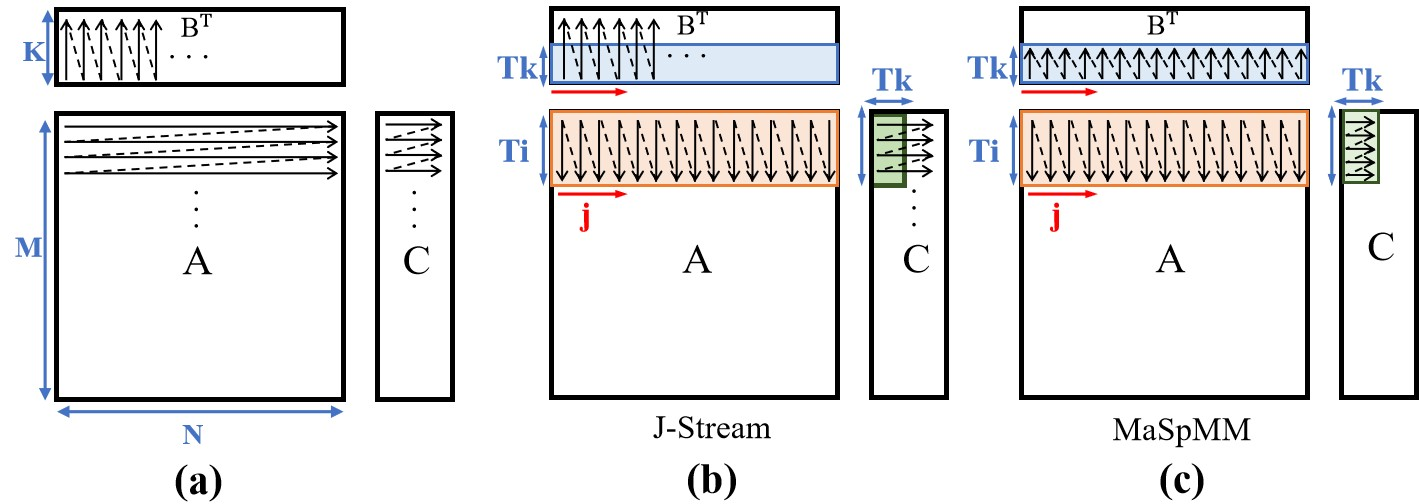
Figure 2: Comparison of conventional CSR SpMM, J-Stream, and the MaSpMM workflow, highlighting improved tile locality and cache performance for block computations.
Implicit deflation of converged invariant subspace vectors and residual-based cutoff for spurious Ritz values are incorporated. The latter is crucial: relying solely on interval inclusion of unconverged Ritz values can stall convergence in practice due to persistent spurious pairs with large residuals near the interval boundary. Instead, AdaPolySI employs a dynamic threshold based on the minimum distance to the filter interval to robustly identify genuine interior eigenvalues.
Numerical Results and Parameter Sensitivity
Comprehensive experiments on large quantum chemistry Hamiltonians (with n∼105–3×10⁵) from SuiteSparse demonstrate that AdaPolySI consistently achieves significant speedups (up to 25.9×) over EVSL’s Chebyshev-filtered subspace iteration and over 2× against CJ-FEAST, while maintaining high-quality residuals (m0). Average polynomial degree is consistently reduced compared to fixed-degree or non-adaptive approaches, without sacrificing robustness.
Notably, adaptive filtering leads to up to m1 reduction in the number of SpMMs by tailoring the degree to the current spectral landscape, while the MaSpMM core sustains efficient dense dimension scaling.
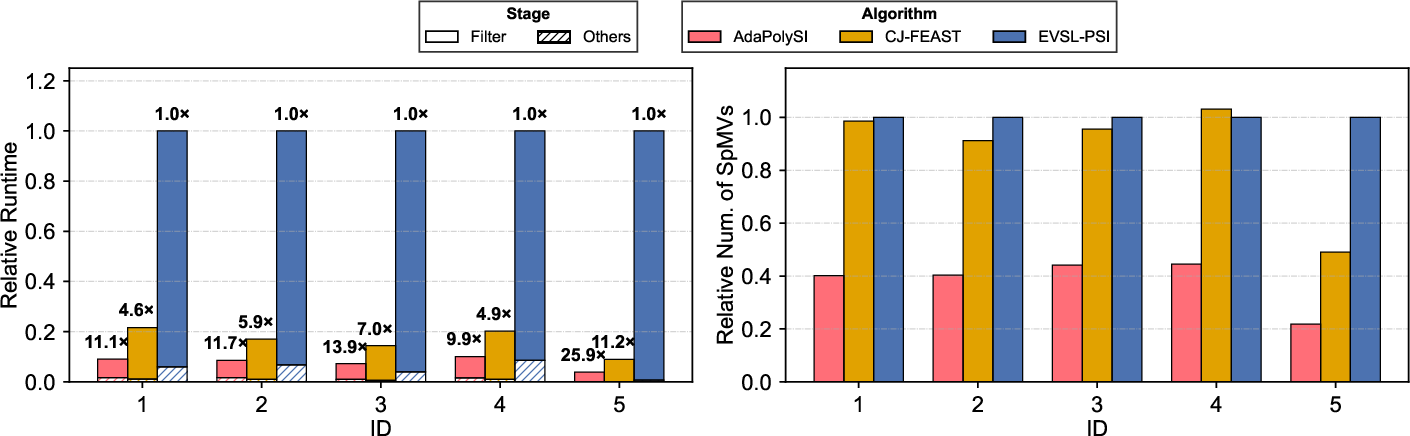
Figure 3: Relative runtime and SpMV counts of AdaPolySI and CJ-FEAST as compared to EVSL for several challenging Hermitian interior eigenproblems.
Extensive parameter sweep analysis shows that moderate values for the Lanczos damping exponent (m2), adaptive threshold (m3), and degree oversampling lead to stable and insensitive performance:
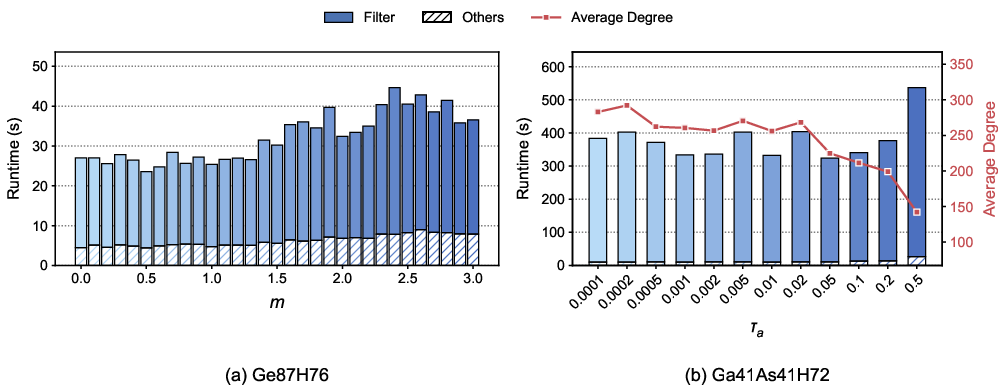
Figure 4: Runtime and average polynomial degree as functions of the damping parameter m4 and threshold m5, confirming insensitivity to moderate parameter variations.
The method also demonstrates robustness to the initial polynomial degree selection, a traditional weakness in fixed-degree approaches. Adaptive updating makes performance largely invariant to over- or underestimation of the degree:
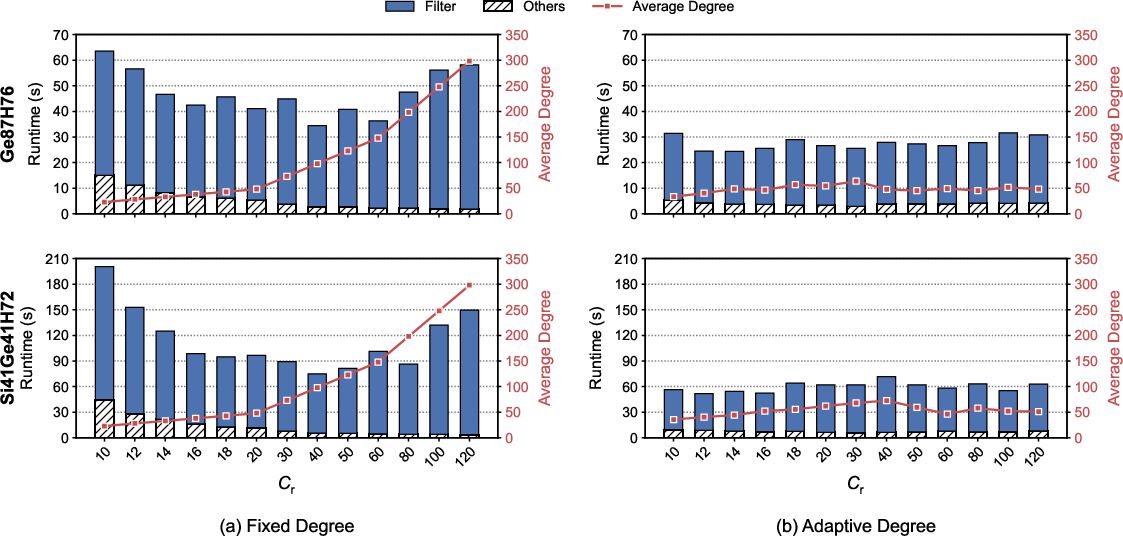
Figure 5: Runtime and average degree for varying initial polynomial degree oversampling, confirming that AdaPolySI’s adaptivity mitigates parameter mis-specification.
Implications and Future Directions
Practically, AdaPolySI enables scalable, robust computation of interior eigenvalues for sparse Hermitian systems in high-performance computing environments. Theoretical advances in adaptive filter error bounds inform degree selection and guide future algorithmic enhancements. The integration of memory-aware SpMM and robust eigenpair locking makes the approach relevant for hybrid and distributed-memory systems.
Theoretically, the convergence analysis highlights the critical interplay between filter construction (degree and damping), spectral interval geometry, and spurious detection for interior eigenproblems. These insights generalize readily to filtered Lanczos, block Krylov, and even rational filter frameworks.
Future work will likely extend adaptive polynomial filtering to spectrum-slicing, non-Hermitian and nonlinear eigenproblems, and further optimize the interaction of filter selection with parallel subspace algorithms.
Conclusion
AdaPolySI advances polynomial filtered subspace iteration for large sparse Hermitian interior eigenproblems via an adaptive Chebyshev-based filtering mechanism with rigorous convergence guarantees and robust spurious eigenpair detection. By integrating a high-performance SpMM kernel and dynamic filter adaptation, the approach achieves substantial practical acceleration and broad applicability. The theoretical framework and implementation strategies set a foundation for future algorithmic extensions in interior eigenvalue computation.