- The paper demonstrates that staggered sublattice nonlinearities induce novel topological phase transitions and incomplete, looped energy bands.
- It employs a self-consistent field method and Bloch ansatz to reveal parameter-dependent band evolution, gap closures, and emergence of wave-packet states.
- The work highlights that controlled edge state manipulation and the persistence of delocalized solutions have practical implications for photonic and quantum applications.
The Impact of Sublattice-Dependent Nonlinearity on the SSH Model
Introduction
This study systematically analyzes the Su-Schrieffer-Heeger (SSH) model under sublattice-dependent onsite nonlinearities, introducing independent nonlinear coefficients gA and gB for the two sublattices. The standard SSH model, foundational in the context of 1D topological systems, captures the essential features of topological phase transitions and edge state formation in a minimal lattice. While its topological character is well classified by bulk invariants such as the Zak phase, it inherently describes a non-interacting system. Exploration of nonlinear extensions, motivated by effective mean-field descriptions of interacting systems or implementations with intrinsic nonlinear physical effects such as photonic Kerr media, provides both practical and theoretical insights. This work extends uniform nonlinear SSH studies by allowing for staggered nonlinearities, resulting in a broader phenomenology and a richer parameter space.
The model is governed by a nonlinear, state-dependent tight-binding Hamiltonian defined as: H(ψ)=m=1∑N−1(2J2σ+⊗∣m⟩⟨m+1∣+h.c.)+m=1∑N[J1σx+(gA∣ψA,m∣20 0gB∣ψB,m∣2)+vσz]⊗∣m⟩⟨m∣
where J1, J2 are intra- and inter-cell hopping amplitudes, v an onsite potential, and gA, gB are the sublattice-dependent nonlinearities.
The study addresses both periodic boundary conditions (PBC, Bloch solutions) and open boundary conditions (OBC, numerically determined spatial profiles) to elucidate bulk and edge physics. Analytical reductions are performed under the Bloch ansatz; general solutions employ a self-consistent field (SCF) iterative method.
Energy Band Structure and Incomplete Bands
Under the Bloch ansatz, the nonlinear eigenproblem reduces to a self-consistency problem for effective Bloch spinors. The spectrum for each quasimomentum k is determined by numerically solving a quartic equation for relevant projectors; physical roots are used to reconstruct the energy bands. As nonlinearity strength increases, the number of real solutions varies, leading to incomplete energy bands that form closed loop structures in the E–gB0 plane. These phenomena are not present in linear systems and signal the breakdown of the conventional band structure concept.
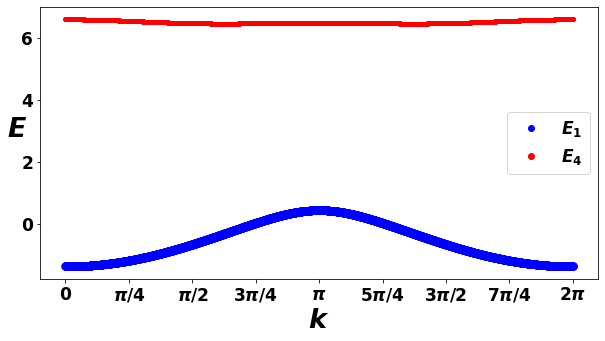
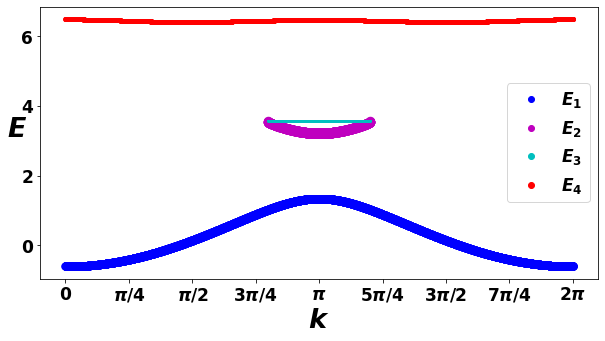
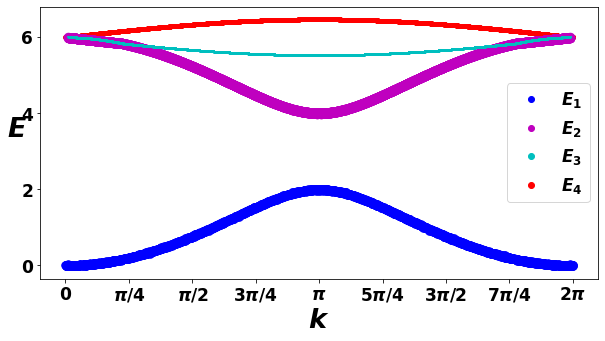
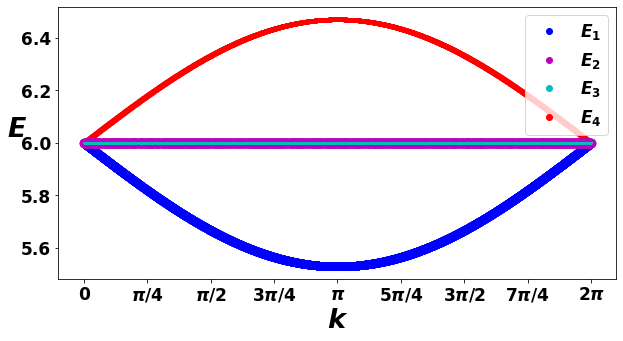
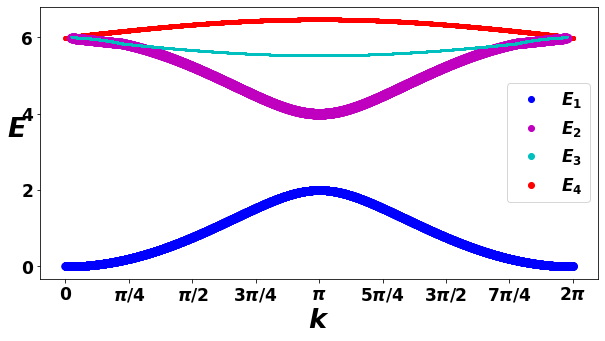
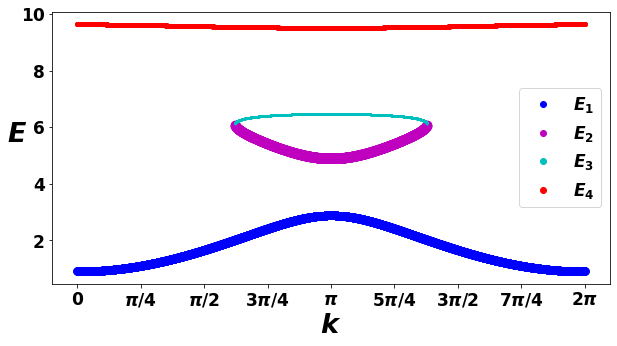
Figure 2: Nonlinear energy band evolution versus quasimomentum for increasing gB1 at fixed gB2; emergence and expansion of loop-like band segments are apparent.
The region supporting four real energy bands expands with nonlinearity until, above a critical value, all gB3 points admit four solutions. At special values, the upper three bands merge, and a gap closure occurs, indicating a topological phase transition driven by nonlinearity rather than single-particle Hamiltonian tuning.
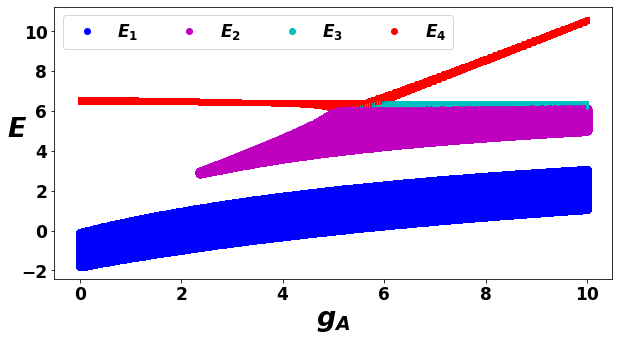
Figure 4: Energy spectrum versus gB4 at fixed gB5, all gB6; phase transition is marked by a closure of the upper bands.
Nonlinear Zak Phase and Topological Characterization
To characterize topology in the presence of nonlinearity, a generalized Zak phase expression is derived, incorporating state-dependent geometric contributions. This nonlinear Zak phase, unlike the conventional (linear) Zak phase, encodes properly the geometric and topological features in the presence of mean-field nonlinear corrections. Numerical evaluation shows that the nonlinear Zak phase exhibits discontinuous jumps at the nonlinear critical points—the hallmark of a topological phase transition.
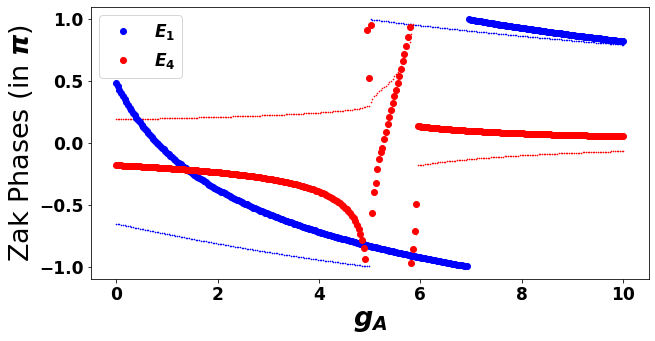
Figure 1: Nonlinear (thick curves) and conventional (thin curves) Zak phases versus gB7; both display discrete jumps at the transition but only the nonlinear Zak phase retains quantization and physical meaning in the nonlinear regime.
This formalism confirms that nonlinearity modifies the location and even existence of topological phase transitions, and that only the nonlinear Zak phase tracks these transitions accurately in the generalized SSH model.
Dynamical Stability
The stability of the nonlinear eigenstates is assessed via linearization of the nonlinear eigenproblem (Bogoliubov-de Gennes analysis), yielding a non-Hermitian stability matrix gB8 whose spectrum determines dynamical stability. The analysis finds that conventional (outer) bands are generically dynamically stable, while bands associated with loop structures are unstable. Instability also emerges in the vicinity of the nonlinear-induced transition points, particularly near regions of band touching, further emphasizing the nontrivial impact of nonlinearity on both spectral and dynamical properties.
Real Space Results: Edge States, Band Touching, and Delocalized Solutions
Under OBC and direct diagonalization via SCF, the localization properties of energy eigenstates are mapped as parameters gB9 and H(ψ)=m=1∑N−1(2J2σ+⊗∣m⟩⟨m+1∣+h.c.)+m=1∑N[J1σx+(gA∣ψA,m∣20 0gB∣ψB,m∣2)+vσz]⊗∣m⟩⟨m∣0 are varied independently. Notably, edge states' energies remain highly sensitive only to the nonlinearity on their own sublattice; for large H(ψ)=m=1∑N−1(2J2σ+⊗∣m⟩⟨m+1∣+h.c.)+m=1∑N[J1σx+(gA∣ψA,m∣20 0gB∣ψB,m∣2)+vσz]⊗∣m⟩⟨m∣1, the left edge state's energy is unaffected by H(ψ)=m=1∑N−1(2J2σ+⊗∣m⟩⟨m+1∣+h.c.)+m=1∑N[J1σx+(gA∣ψA,m∣20 0gB∣ψB,m∣2)+vσz]⊗∣m⟩⟨m∣2 and vice versa. This suggests potential utility for localized state manipulation or quantum information applications leveraging spatially resolved nonlinear controls.
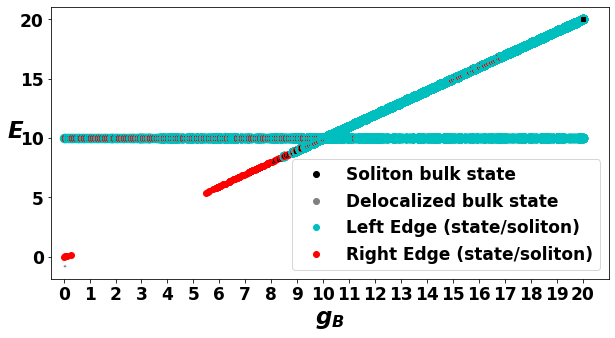
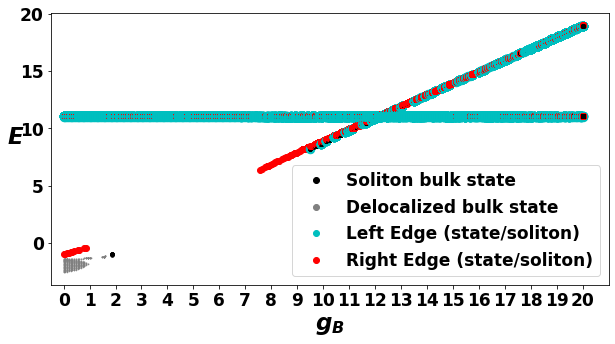
Figure 3: Real space energy spectrum versus H(ψ)=m=1∑N−1(2J2σ+⊗∣m⟩⟨m+1∣+h.c.)+m=1∑N[J1σx+(gA∣ψA,m∣20 0gB∣ψB,m∣2)+vσz]⊗∣m⟩⟨m∣3, illustrating robust behavior of edge state energies.
A further crucial finding concerns the persistence and shifting of gapless band-touching points (nodal points) under strong staggered nonlinearity, which only shift (not annihilate) under symmetry-breaking perturbations (H(ψ)=m=1∑N−1(2J2σ+⊗∣m⟩⟨m+1∣+h.c.)+m=1∑N[J1σx+(gA∣ψA,m∣20 0gB∣ψB,m∣2)+vσz]⊗∣m⟩⟨m∣4): these are reminiscent of the Weyl points in semimetals, indicating a form of momentum-space topology induced and stabilized by nonlinearity.
Delocalized solutions can surprisingly survive for extremely large nonlinearity amplitudes when H(ψ)=m=1∑N−1(2J2σ+⊗∣m⟩⟨m+1∣+h.c.)+m=1∑N[J1σx+(gA∣ψA,m∣20 0gB∣ψB,m∣2)+vσz]⊗∣m⟩⟨m∣5 and H(ψ)=m=1∑N−1(2J2σ+⊗∣m⟩⟨m+1∣+h.c.)+m=1∑N[J1σx+(gA∣ψA,m∣20 0gB∣ψB,m∣2)+vσz]⊗∣m⟩⟨m∣6 have opposite signs and similar magnitudes, a sharply contrasting behavior to the uniform nonlinearity case. This demonstrates that the nonlinear interplay between attractive and repulsive interactions on the lattice can maintain extended states in regimes where all states become solitonic in the uniform case.
Wave-Packet State and Bulk-Edge Correspondence Modification
At large nonlinearity strengths, highly oscillatory states—here termed "wave-packet" (WP) solutions—emerge. These evolve from linear bulk Bloch states and localize near edges or create effective "nonlinear edges" in the system, dependent on the effective nonlinear potential landscape induced by their own profile. Such WP states exist in both topologically trivial and nontrivial regimes and exhibit sensitivity to the parameters H(ψ)=m=1∑N−1(2J2σ+⊗∣m⟩⟨m+1∣+h.c.)+m=1∑N[J1σx+(gA∣ψA,m∣20 0gB∣ψB,m∣2)+vσz]⊗∣m⟩⟨m∣7, H(ψ)=m=1∑N−1(2J2σ+⊗∣m⟩⟨m+1∣+h.c.)+m=1∑N[J1σx+(gA∣ψA,m∣20 0gB∣ψB,m∣2)+vσz]⊗∣m⟩⟨m∣8, and H(ψ)=m=1∑N−1(2J2σ+⊗∣m⟩⟨m+1∣+h.c.)+m=1∑N[J1σx+(gA∣ψA,m∣20 0gB∣ψB,m∣2)+vσz]⊗∣m⟩⟨m∣9.
Implications and Future Directions
This study establishes that sublattice-dependent nonlinearity in the SSH model fundamentally alters the landscape of band topology, edge state formation, and the stability/robustness of states. Nonlinearity redefines the phase diagram, drives topological phase transitions inaccessible in the linear regime, and enables new control protocols for edge states via local nonlinear parameter variation. The results point toward the capacity for engineering topologically protected, stable, or manipulable localized states in nonlinear photonic, acoustic, or cold atom realizations where such SSH-type arrangements are feasible.
Open theoretical avenues include:
- Nonlinear bulk-boundary correspondence and its failure/modification in the strong nonlinear limit.
- Existence and interpretation of higher-order nonlinear nodal points.
- Extensions to higher dimensions, synergy with non-Hermitian and Floquet (time-periodic) effects as methods to further enrich the nonlinear topological phases.
- The practical implementation of localized state control for quantum information tasks.
Conclusion
The introduction of sublattice-dependent, staggered nonlinearity into the SSH model generates a myriad of novel phenomena including incomplete/looped energy bands, nonlinear-induced topological phase transitions, parameter-selective edge state manipulation, and the persistence of delocalized solutions under extreme nonlinearity. The nonlinear Zak phase provides the correct invariant for distinguishing nontrivial topology in these systems. The interplay between topology and nonlinearity fundamentally enriches the SSH phase diagram, promising avenues for both fundamental condensed matter investigations and technology applications in nonlinear metamaterials and waveguide arrays.