- The paper refines pre-solar chronologies by integrating updated short-lived radionuclide data with advanced galactic chemical evolution models.
- It compares isolation and partial mixing scenarios, constraining pre-solar molecular cloud lifetimes to approximately 9–14 Myr.
- It identifies inconsistencies in steady-state assumptions for very short-lived and r-process SLRs, supporting local stellar injection as a key process.
An Updated SLR-Constrained Chronology for Pre-Solar History and the Sun’s Birth
Short-Lived Radionuclides as Probes of Pre-Solar Evolution
This paper provides a systematically revised analysis of short-lived radionuclides (SLRs, 0.1–100 Myr half-lives) in the early Solar System (ESS), employing updated abundance measurements, galactic chemical evolution (GCE) models, and stellar nucleosynthetic yields. The work refines the use of SLRs as chronometers for the isolation and mixing history of the pre-solar molecular cloud, as well as diagnostics for massive star environments preceding the proto-Sun’s formation.
The traditional approach relates SLR abundances to steady-state equilibrium in the interstellar medium (ISM), scaling observed meteoritic SLR-to-stable isotope ratios by predicted stellar production ratios. Crucially, this study addresses several sources of systematic error often neglected: uncertainties in the galactic abundances and production ratios, stochastic variations in SLR event injection, and the decoupling in time and/or space between the ISM and the material that formed the Solar System.
Methodological Framework and Model Advances
The paper articulates two key scenarios that modify steady-state inheritance of SLRs in the pre-solar GMC:
- Free Decay (Isolation) Scenario: The GMC is treated as isolated from the ISM for a time tiso, with SLR abundances decaying exponentially prior to Solar System formation. This parameterizes delay between SLR production and ESS incorporation.
- Partial Mixing Scenario: The GMC remains partially mixed with the ISM on a mixing timescale tmix, moderating SLR decay according to mass exchange rates.
Both cases correct steady-state predictions using updated stellar yields, metallicity-dependent GCE, and “K-factors” encoding galactic evolution uncertainties (star formation rate, efficiency, star/gas ratio). SLRs with rare or stochastic production events and those lacking stable reference isotopes (e.g., several r-process nuclei) are specifically highlighted as exceptions to the steady-state assumption.
The analysis uniquely integrates the latest stellar modeling for all major SLR channels:
Results: Consistency Constraints and Inferred Timescales
SLR Isotopic Families and Chronometry
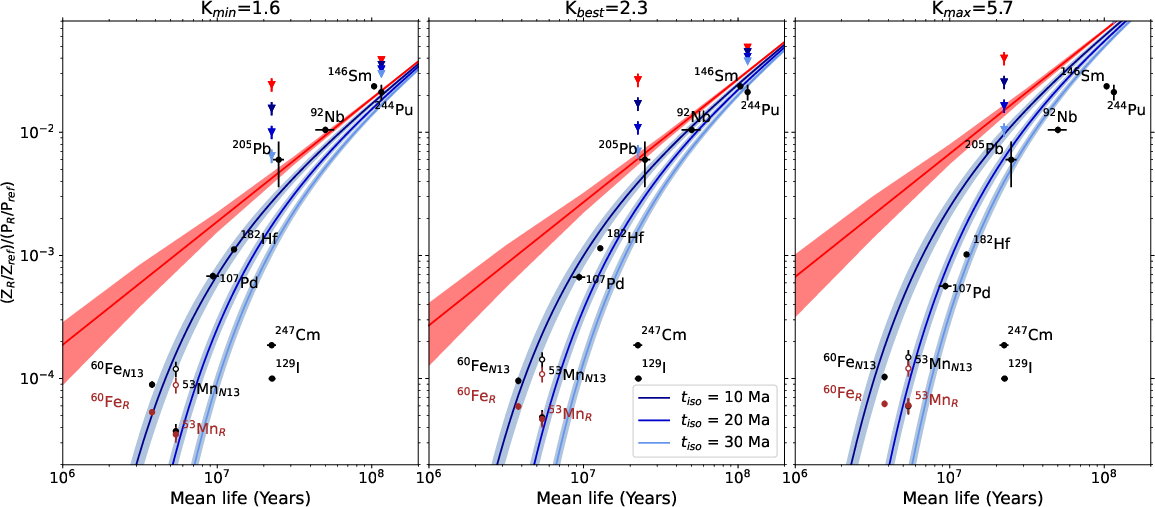
Cross-model comparison reveals that the ESS abundances of s-process (\iso{107}Pd, \iso{182}Hf, \iso{205}Pb) and certain explosive SLRs (\iso{53}Mn, \iso{60}Fe) can be simultaneously reproduced via ISM inheritance and plausible isolation or mixing intervals. Consistent fits require:
- For isolation, tiso∼9–12 Myr (for tmix0; co-varying with galactic evolution uncertainties)
- For mixing, tmix1–14 Myr (or up to tmix238 Myr for maximal tmix3)
These timescales are robust across different modern CCSN/SNIa yield models and across GCE systematics (see Figure 1, right and middle panels). In all steady-state-compatible configurations, consistent timescales must also eliminate substantial SNIa \iso{53}Mn contributions—implying a gap over tens of Myr since the last SNIa polluting the proto-solar ISM.
Outliers and Non-Steady-State SLRs
Several SLR measurements are systematically inconsistent with any steady-state or exponentially decayed inheritance from the ISM:
- Very Short-Lived SLRs (\iso{26}Al, \iso{36}Cl, \iso{41}Ca): ESS abundances orders-of-magnitude above the predictions of both ISM inheritance and GCE, requiring direct seeding by massive star winds local to the pre-solar cloud, not by ISM steady-state (Figure 2).
- tmix4-process SLRs (\iso{129}I, \iso{244}Pu, \iso{247}Cm): Measured ESS abundances far below GCE equilibrium, implying origin from rare last events prior to Solar System formation rather than continuous galactic input, in agreement with prior findings.
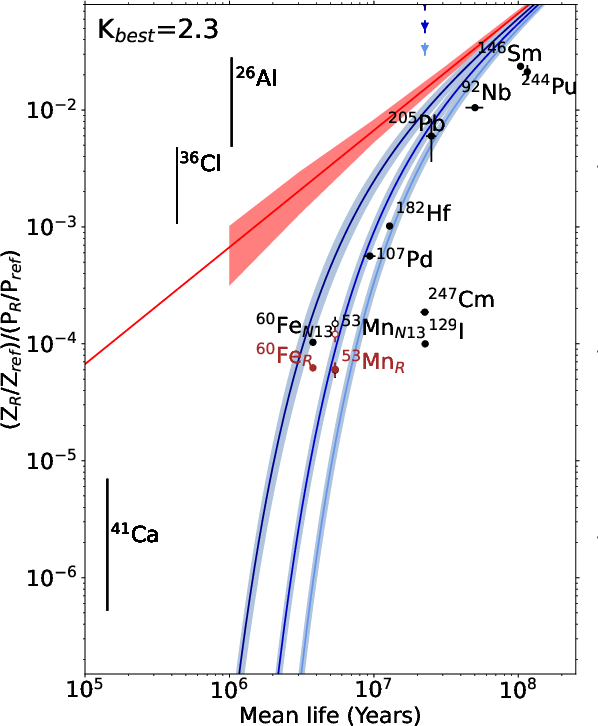
Figure 2: Extension of Figure 1 to very short-lived SLRs, underlining the failure of steady-state or isolation models to match ESS \iso{26}Al, \iso{36}Cl, and \iso{41}Ca—necessitating local massive star sources.
tmix5-process SLRs and Uncertainties
The tmix6-process SLRs \iso{92}Nb and \iso{146}Sm are only mutually consistent and compatible with the above timescales under selected tmix7 values and for the lowest currently measured \iso{146}Sm half-lives. Stellar origin systematics and half-life uncertainties for \iso{146}Sm remain a leading unsolved issue.
Mixing Scenario and Molecular Cloud Lifetime
Investigating the quadratic attenuation through ISM-molecular cloud mixing (as in Figure 3) finds that tmix8 values required for SLR concordance are similar to observed/expected GMC lifetimes (10–30 Myr), supporting their astrophysical plausibility. However, longer mixing timescales (tmix940 Myr) inferred only for certain parameter regimes greatly exceed characteristic GMC dispersal times, questioning their viability.
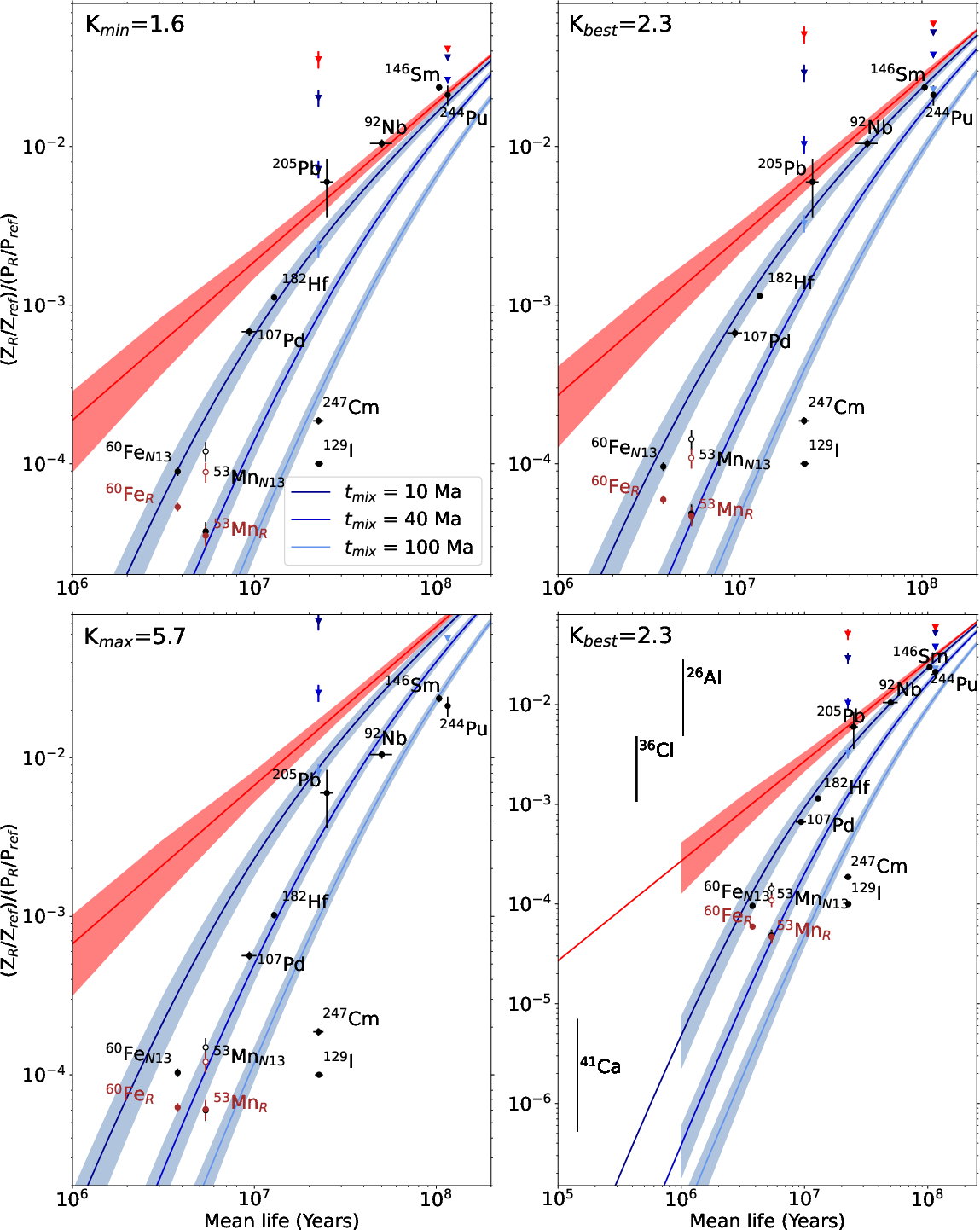
Figure 3: SLR ratio fits employing the mixing scenario, confirming that primary SLRs collectively point to mixing timescales consistent with expected GMC lifetimes only for moderate galactic histories.
Implications for Pre-Solar History and Solar Birth Environment
The principal outcome is that meteoritic SLRs support a scenario where the solar progenitor molecular cloud was isolated or only partly mixed with the ISM for K09–14 Myr immediately prior to Solar System formation. This aligns with the lifetime of molecular clouds and matches the timescales required for the evolution and supernovae of stars more massive than K115–20 MK2. Accordingly, short-lived SLRs indicative of direct stellar winds point to contamination from stars K3 that evolved within the pre-solar cloud’s lifetime, consistent with the rapid late-stage massive star feedback in GMCs.
Nucleosynthetic Event Frequency and ISM Inheritance
- The matching of SLRs from K4- and explosive processes—given the requirement of no recent SNIa for \iso{53}Mn—further constrains the timing and frequency of major nucleosynthetic events in the Solar neighborhood.
- The mismatch for K5- and very short-lived SLRs substantiates the need for stochastic, non-equilibrium nucleosynthetic injection, either preceding isolation or through prompt local stellar sources.
Limitations and Directions for Future Work
The principal systematic uncertainties concern:
- Stellar yield variations, especially for Type Ia SNe, nova contributions, and AGB evolution physics
- Half-life and production uncertainties for K6-nuclei, especially \iso{146}Sm
- The precise mapping between galactic evolutionary parameters (K7), molecular cloud mixing times, and the chronology of the pre-solar environment
Further constraints await improved modeling of K8-nucleus yields (including CCSN/Type Ia contributions), tighter experimental constraints on SLR half-lives, and refined GCE frameworks for rare event contributions.
Conclusion
This work provides an up-to-date, comprehensive SLR-based chronological framework for the isolation and mixing history of the pre-solar GMC. The analysis strengthens the evidence for a K910 Myr isolation/mixing timescale and highlights the necessity of local high-mass stellar sources for the injection of very short-lived SLRs. It also underscores the non-applicability of GCE steady-state models to certain r0- and r1-process SLRs, underlining persistent gaps in the galactic chronology and nucleosynthetic pathway determination. These results collectively inform constraints on both the prehistory of the Solar System's material and the stellar environment of the Sun’s birth, and motivate targeted GCE modeling and laboratory measurements for further progress.
References
- “An updated picture of pre-solar history from short-lived radioactive isotopes and inferences on the birth of the Sun” (2604.00719)