Topological magnetotransport in modified-Haldane systems
Published 1 Apr 2026 in cond-mat.mes-hall | (2604.00705v1)
Abstract: We present a theoretical study of quantum magneto-transport and magneto-optical (M-O) properties in modified-Haldane model; which is applicable to diverse classes of two-dimensional (2D) quantum materials such as buckled Xene monolayers and transition metal dichalcogenide (TMDC) monolayers. By varying the staggered sublattice potential and intrinsic spin-orbit coupling, we identify distinct topological regimes and analyze their manifestations in the emergence of Landau levels, the evolution of the density of states, and the characteristics of M-O absorption spectra. Using the Kubo formalism, we compute the longitudinal and Hall M-O conductivities and show that inter-Landau-level (inter-LL) transitions produce characteristic resonance features that provide optical signatures of the underlying topological phases. Within this framework, we demonstrate electrically tunable topological phase transitions in buckled silicene. Extending our study to monolayer TMDCs, we show that inspite of large band gap, the spin-valley coupling provides a powerful tool for tailoring M-O absorption features across wide range of 2D materials. Collectively, these results underscore modified-Haldane-model materials as an ideal testbed for engineering quantum transport, with promising applications in topological photonics, valleytronic devices, and next-generation optoelectronics.
The paper demonstrates the modified-Haldane model's ability to capture simultaneous time-reversal and inversion symmetry breaking in 2D Dirac materials.
The paper derives analytical expressions for unequally spaced Landau levels and magneto-optical conductivities that serve as clear fingerprints of topological phase transitions.
The paper shows that tuning parameters in Xenes and TMDCs can electrically control topological phases, providing insights for valleytronic and optoelectronic device design.
Topological Magnetotransport in Modified-Haldane Systems
Introduction and Theoretical Framework
This work provides a systematic and rigorous analysis of topological quantum magnetotransport and magneto-optical (M-O) phenomena within the modified-Haldane Hamiltonian framework, with extensive application to 2D hexagonal materials including Xenes (e.g., silicene, germanene, stanene) and transition metal dichalcogenide (TMDC) monolayers. The study capitalizes on the flexibility of the modified-Haldane model, unifying multiple symmetry-breaking mechanisms—staggered sublattice potential, intrinsic and Rashba SOC, valley-dependent mass terms—relevant for real materials.
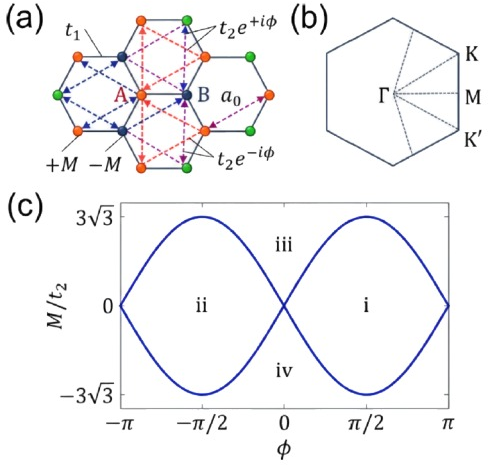
The generic Hamiltonian encompasses both time-reversal (TRS) and inversion symmetry (IS) breaking, with nearest-neighbor (t1) and complex next-nearest neighbor (t2eiϕ) hopping amplitudes, and a staggered potential M distinguishing the A/B sublattices:
Figure 1: Schematic of the modified-Haldane model highlighting A/B sublattices, NN and complex NNN hoppings, and sublattice potential.
The crucial distinction from the Kane-Mele and original Haldane models is that the modified-Haldane Hamiltonian admits simultaneous TRS and IS breaking, generating richer topological phase diagrams including valley-dependent Chern numbers and valley-selective Berry curvature. Both the phase ϕ (Haldane mass) and M (Semenoff mass) control the sign and magnitude of Dirac mass, setting the TI regime threshold.
Landau Level Structure and Density of States
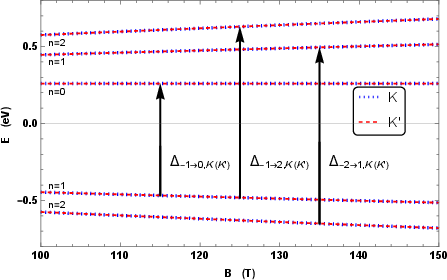
Applying a perpendicular magnetic field, the spectrum quantizes into unequally spaced Landau levels (LLs), scaling as nB, with distinct valley and spin selectivity depending on parameter regimes. Analytical expressions for eigenenergies across trivial (large t2eiϕ0, real t2eiϕ1) and topological (t2eiϕ2, complex t2eiϕ3) domains are provided, exhibiting band inversion and valley/spin-polarized LLLs.
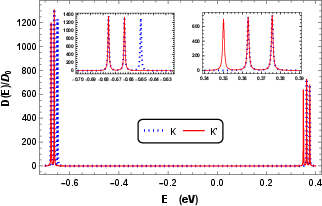
Figure 2: Band structure and DOS for trivial (upper) and TI (lower) phases, showing LLL position, valley splitting, and redistribution of spectral weight.
The formation of LLLs and their energetic positioning in valence/conduction bands is highly sensitive to the competition between t2eiϕ4 and the imaginary part of t2eiϕ5. In the trivial BI regime, the LLL appears in the valence (conduction) band for t2eiϕ6 (t2eiϕ7), while in the TI regime, both LLLs shift to the conduction band with higher LLs remaining valley-degenerate.
Magneto-Optical Conductivity and Topological Fingerprints
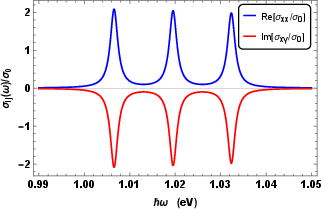
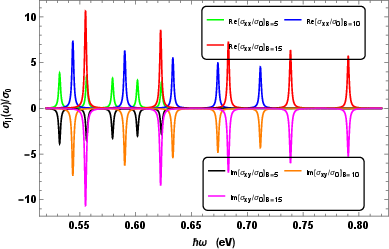
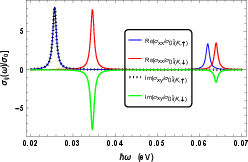
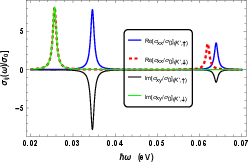
The Kubo formalism is deployed to derive analytic expressions for longitudinal and Hall M-O conductivities. Selection rules restrict optically active transitions to those consistent with sublattice symmetry, spin, and harmonic oscillator ladder operator algebra. The absorptive part of t2eiϕ8 and t2eiϕ9 features pronounced Lorentzian resonances at magneto-excitation energies, with clear Pauli-blocking whenever transitions are forbidden by occupation.
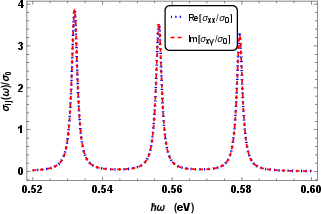
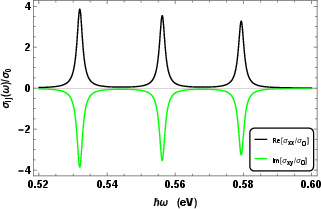
Figure 3: M-O conductivities in the trivial and TI regimes—identical in trivial phase, valley-asymmetric and suppressed transitions in the TI regime.
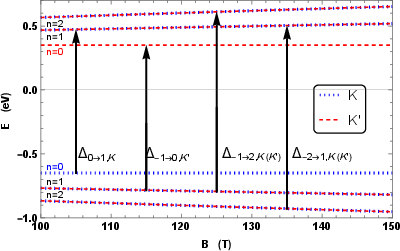
Figure 4: Schematic of allowed and Pauli-blocked transitions in trivial and TI phases, demarcating the effect of LLL inversion.
The position of Lorentzian peaks in the conductivity is a direct fingerprint of the underlying topology: in the trivial regime, both M0 and M1 are allowed in one valley each; in the TI regime, only M2 is allowed in both valleys, with M3 fully Pauli-blocked. This behavior is robust under variations in magnetic field and scattering rate, as confirmed by systematic sweep analyses.
Electrically Tunable Topological Phase Transitions in Xenes
The unified model accommodates Xenes by mapping material-specific SOC and sublattice potential parameters onto Haldane model variables. For silicene:
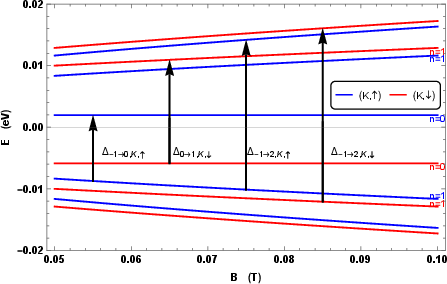
Figure 5: LL spectrum of silicene in the QSHI phase, with valley-spin polarized LLLs.
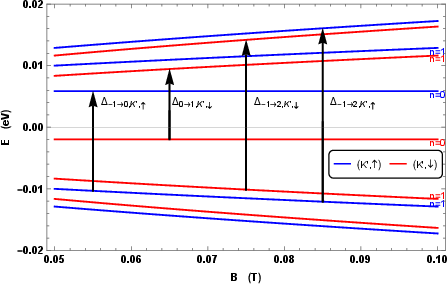
Figure 6: LL spectrum for the VSPM phase, showing massless Dirac cones for selective spin-valley combinations.
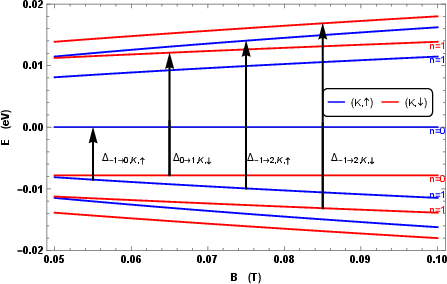
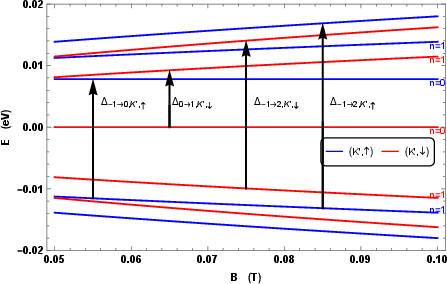
Figure 7: LL spectrum for the BI phase with complete band gap opening and no band inversion.
By tuning M4 and M5, the system is driven through trivial, quantum spin Hall insulator (QSHI), valley-spin polarized metal (VSPM), and back to trivial BI phases. The location of LLL for the M6 and M7 sectors switches as the band inversion crosses M8: this is manifest as a switch in the valley or spin in which the lowest optical transition remains active. These phase borders are sharply observed in the spin-valley resolved DOS and conductivities.
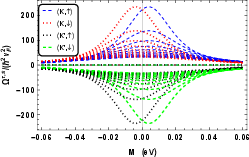
Theoretical Berry curvature calculations further illuminate the valley and spin polarization patterns, with sharply antisymmetric behavior under TRS/IS breaking.
Figure 8: Berry curvature as a function of tunable M9, showing combined valley and spin polarization.
Comprehensive M-O spectra for QSHI, VSPM, and BI phases clearly differentiate the allowed transitions, their energetic locations, and their dependence on the topological regime.
Figure 9: M-O conductivities for differing topological phases, resolved by valley and spin channels.
Figure 10: Allowed LL transitions per valley and spin channel across QSHI, VSPM, and BI regimes.
Applications to Transition Metal Dichalcogenides (TMDCs)
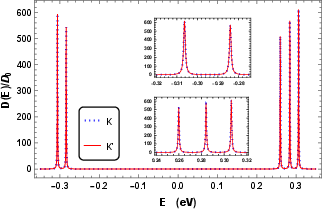
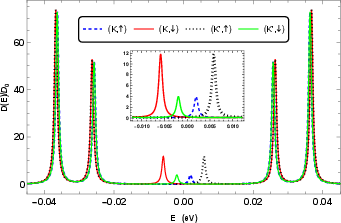
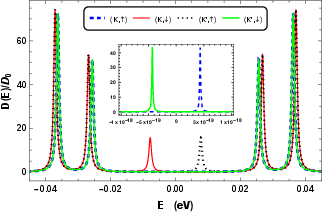
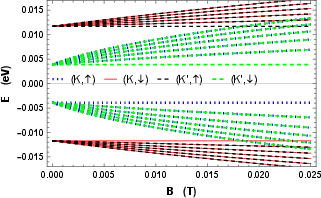
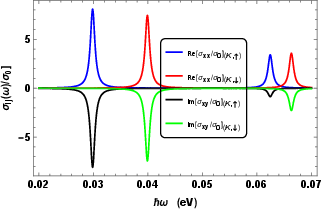
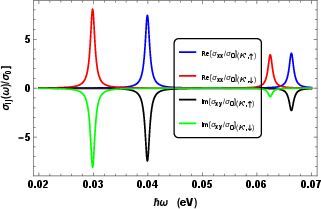
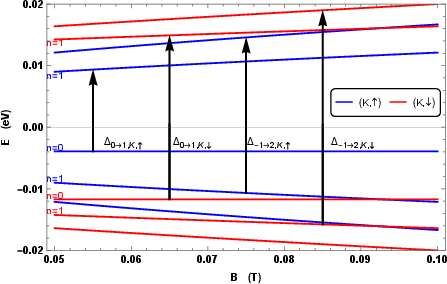
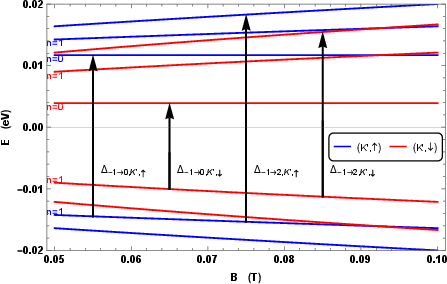
The framework is extended to monolayer TMDCs by incorporating material-dependent mass terms and valley-asymmetric SOC. TMDCs are characterized by large direct band gaps and strong valley-spin coupling, resulting in LLLs that are uniquely valley and spin polarized—e.g., only present in the conduction band at A0 and valence band at A1.
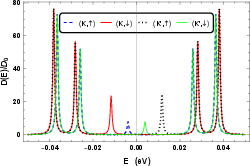
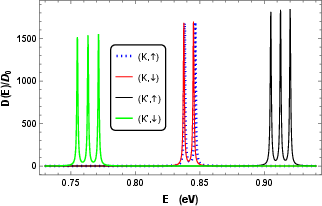
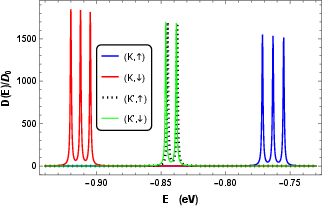
Figure 11: LL spectrum and DOS for TMDC, with explicit spin-valley LLL polarization and nearly degenerate higher LLs.
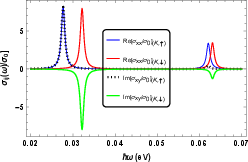
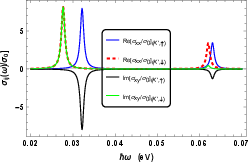
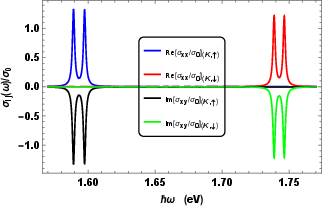
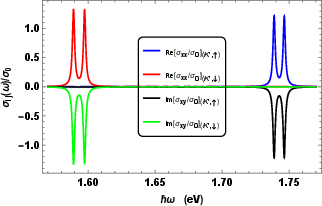
The M-O conductivity in TMDCs shows valley-polarized, spin-selective activation of magneto-excitonic peaks, with the LLL transition allowed only for one spin-valley sector per photon energy.
Figure 12: M-O conductivity in A2 and A3 valleys; first peaks correlate with transitions involving only spin-polarized LLLs.
Implications, Theoretical Significance, and Outlook
This analysis demonstrates that the modified-Haldane model, unified via material parameter mapping, acts as a diagnostic platform for topological and trivial regime identification through M-O transport spectroscopy. The presence, intensity, and location of certain inter-LL transitions—especially those involving the LLL—are unambiguous fingerprints of the underlying Chern and A4 topology. These M-O resonances can be electrically manipulated in buckled Xenes, offering direct means of controlling and reading out topological phase transitions in device architectures.
Practical implications include direct proposal for all-optical detection of topological phase transitions, engineering of robust valleytronic and spintronic devices with tunable transport properties, and design of reconfigurable quantum photonic structures. The theoretical framework can be generalized further to periodically driven (Floquet) systems, systems with additional proximity or substrate-induced symmetry breaking, and engineering of protected interface modes.
Conclusion
The study rigorously establishes the modified-Haldane model as a generic, tunable platform for capturing and unifying quantum magnetotransport and M-O responses across a broad class of 2D Dirac materials. Explicit analytical connection to experimentally accessible M-O conductivities and robust optical signatures of TI phase transitions underscores the predictive power of the framework, with multiple avenues open for valleytronic, photonic, and optoelectronic applications in next-generation nanodevices.