- The paper presents a unified mDF-based framework that combines ab initio DFT with many-body CI methods to study magnetoexcitonic behavior in TMDCs.
- It derives explicit magneto-optical selection rules and Landau level structures that clarify valley- and spin-dependent optical transitions.
- The study quantifies exciton and trion binding energies along with spectral shifts under high magnetic fields, providing benchmarks for quantum Hall experiments.
Magnetoexcitons and Massive Dirac Fermions in Monolayer TMDCs under High Magnetic Field
Introduction and Physical System
This paper presents a comprehensive ab initio-based theoretical study of magnetoexcitons and massive Dirac fermion (mDF) physics in monolayer transition metal dichalcogenides (TMDCs), with a focus on MoS2 in the presence of a perpendicular high magnetic field. The analysis integrates density functional theory (DFT) for realistic band parameters, an mDF model appropriately tailored for TMDC-specific orbital physics, and many-body calculations that address excitonic and trionic correlated states in the quantum Hall regime.
The prototypical system is a MoS2 monolayer encapsulated in hexagonal boron nitride (hBN), electrostatically gated for charge density tunability. Structural parameters, valley, spin–orbit, and Zeeman effects are all extracted quantitatively (Figure 1). The model faithfully includes the unique band edge orbital composition and strong spin-valley coupling endemic to group-VI dichalcogenides.
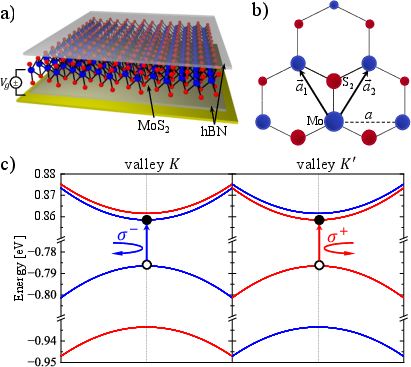
Figure 1: Geometry and electronic properties of a MoS2 monolayer: (a) device layout; (b) top-view crystal structure; (c) spin- and valley-resolved band structure within the mDF model, with optical selection rules.
Massive Dirac Fermion Model and Landau Level Structure
The effective two-band Hamiltonian captures the low-energy conduction and valence band edges at the K/K′ valleys, incorporating spin–orbit coupling (SOC) and valley-dependent terms. In contrast to graphene Dirac fermions, mDFs in TMDCs possess a sizable bandgap and band-specific SOC, parametrized via DFT.
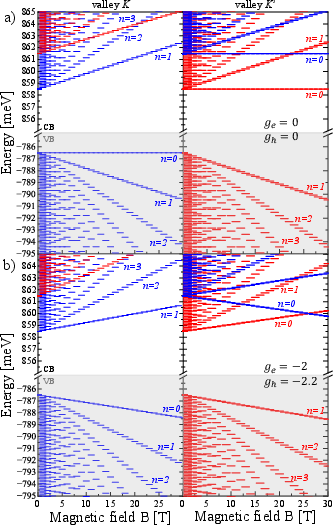
An applied perpendicular magnetic field leads to Landau quantization. The constructed mDF model with Zeeman and orbital magnetic terms yields explicit analytic forms for the Landau levels (LLs) and their valley, spin, and band dependence. Noteworthy features include:
This model landscape unambiguously displays the competition between spin, valley, and magnetic effects and their manifestation in LL fan diagrams.
Magneto-Optical Selection Rules and Optical Response
The selection rules for optical interband transitions are derived using the time-dependent perturbation associated with circularly polarized excitation. The transition rates are computed explicitly within the LL-spinor basis, revealing:
- Optical selection rules are fully valley and polarization resolved: transitions in the K valley are allowed only for σ− polarization and involve LL number n′=n+1, while in K′ only σ+ with n′=n−1.
- These strict selection rules are a direct consequence of inversion and time-reversal symmetry breaking under B, and the n-shifted LL structure, ensuring optically active (“bright”) and inactive (“dark”) transitions with characteristic valley-contrasting selection.
This yields a concrete microscopic basis for interpreting magneto-optical experiments and valley-chiral light-matter coupling in TMDCs.
Correlated Many-Body States: Excitons, Trions, and the Quantum Hall Regime
Many-body correlation effects are addressed via configuration interaction (CI)-based numerical exact diagonalization, utilizing the single-particle LL basis (including degeneracy, band, valley, and spin indices) and full Coulomb matrix elements. Several key results stand out:
Neutral Magnetoexcitons (X0):
- The Bethe-Salpeter equation (BSE) is solved for the interacting electron–hole complex.
- The inclusion of self-energy, direct/vertex, and full correlation contributions results in an excitonic spectrum with pronounced blueshifts due to valence band exchange, followed by redshifts from electron–hole binding.
- The computed X0 binding energy is EbX0≈47 meV at B=10 T, compared to ∼0.3 eV at B=0; this quantifies the B-induced screening and LL quantization effects.
- The exciton states form a broad, nearly linear energy band, with strong valley selectivity.
Negatively Charged Magnetoexcitons (Trions, X−):
- Adding one electron yields X− configurations exhibiting a larger number of low-energy accessible states due to additional electronic degrees of freedom within degenerate LLs.
- The correlated trion energy spectrum is substantially flatter, and the main emission line is redshifted relative to X0 due to enhanced correlation and electron–electron exchange.
- At finite temperature (T=5 K), trion emission broadens via thermal occupation of low-lying excited states—contrasting with the much sharper X0 line.
Excitonic Complexes and Filling Factors:
- Systematically incorporating additional conduction band electrons (mimicking a gate-induced 2DEG) reveals further restructuring of the optical spectrum due to complex exchange and vertex corrections.
- The methodology isolates the interplay between filling factor, LL degeneracy, and many-body interactions, with explicit implications for magneto-optical features such as shakeup processes, Fermi-edge singularities, and quantum Hall-induced emission lines.
Theoretical and Experimental Implications
The presented mDF-based formalism and many-body approach quantitatively connect ab initio electronic structure, mDF LL physics, and correlated excitation spectra within an experimentally realistic device context. Several significant implications arise:
- The explicit calculation of optical selection rules and their dependence on valley, spin, and LL index provides direct signatures for interpreting polarized magnetoabsorption and photoluminescence spectra.
- The predicted shifts, broadenings, and valley-polarized emission lines enable unambiguous identification of excitonic, trionic, and complex quantum Hall states in magneto-optical experiments on monolayer TMDCs.
- The analytic tractability of the mDF LL structure and the modular CI approach to correlation effects are extendable to other 2D materials with similar lattice symmetry and SOC.
- The theoretical framework is suitable for exploring further effects, including disorder, intervalley scattering, strain, dielectric engineering, and quantum geometry/flat band phenomena.
The numerical values obtained for gap sizes, g-factors, and binding energies provide benchmarks for both state-of-the-art experiments and future computational work, particularly in high-field and valleytronic device regimes.
Future Directions
The methods and insights developed herein open several avenues, including:
- Extension to nonzero-phonon and disorder regimes, enabling the theory of temperature-dependent linewidths and lifetime broadening.
- Hierarchical CI/Bethe-Salpeter treatments for larger clusters, including fractional quantum Hall and multiexciton physics.
- Exploration of the impact of strong electron–electron repulsion and screening environment (e.g., via additional gates or heterostructures).
- Valley coherence and manipulation of dark/bright exciton population under combined electric and magnetic fields.
Conclusion
This work delivers a unified picture of mDF-driven LL physics, optical selection rules, and correlated excitonic complexes in monolayer TMDCs in high magnetic fields. The synergy of ab initio input, analytically tractable mDF modeling, and rigorous many-body computation provides a platform for quantitative prediction and interpretation of magneto-optical phenomena, confirming and extending the fundamental role of Dirac-like quantization and correlation in the quantum Hall regime of 2D semiconductors.