- The paper identifies a persistent ~40° misalignment between the continuous jet and discrete ejecta, challenging conventional jet-launching models.
- VLBI and VLA imaging during flaring events provide precise position angle measurements, with discrete ejecta moving at an unusually low intrinsic velocity of ~0.35c.
- A warped and torn disk model driven by external torque is proposed, linking disk perturbations to the transient reorientation of jet ejections.
Large Jet Misalignment in GRS 1915+105 During Its Obscured Phase
Introduction
The microquasar GRS 1915+105, a black hole low-mass X-ray binary (BH LMXB), is distinguished by persistent jet activity and dramatic variability in both X-ray and radio bands. Decades of VLBI and VLA monitoring have consistently shown the continuous (steady) and discrete (transient) radio jets in this system to be closely aligned along a ∼147∘ position angle (PA), associated with the presumed black hole spin axis and accretion disk angular momentum. This study uses high-resolution and time-resolved VLBI (EAVN) and VLA observations during major 2023 radio flare events to identify a large and persistent misalignment between the continuous and discrete jet components that fundamentally challenges the canonical view of jet-launching geometry and disk-jet coupling in GRS 1915+105.
Jet Morphologies and Position Angle Measurements
Simultaneous or near-simultaneous VLBI imaging at 6.7 and 43 GHz captures both a compact, central continuous jet core as well as two-sided, optically thin discrete ejecta on AU scales. Quasi-simultaneous 10 GHz VLA imaging provides complementary data on somewhat larger angular and physical scales.
The 43 GHz EAVN component—the continuous jet—exhibits a PA of 146∘–158∘, precisely aligned with three decades of historical jet monitoring. In contrast, the downstream, two-sided ejecta at 6.7 GHz are aligned at PA ∼188∘, a ∼40∘ offset. This recurrent misalignment persists during two major flaring events in April and September 2023, the latter independently reported with similar offsets by other groups.
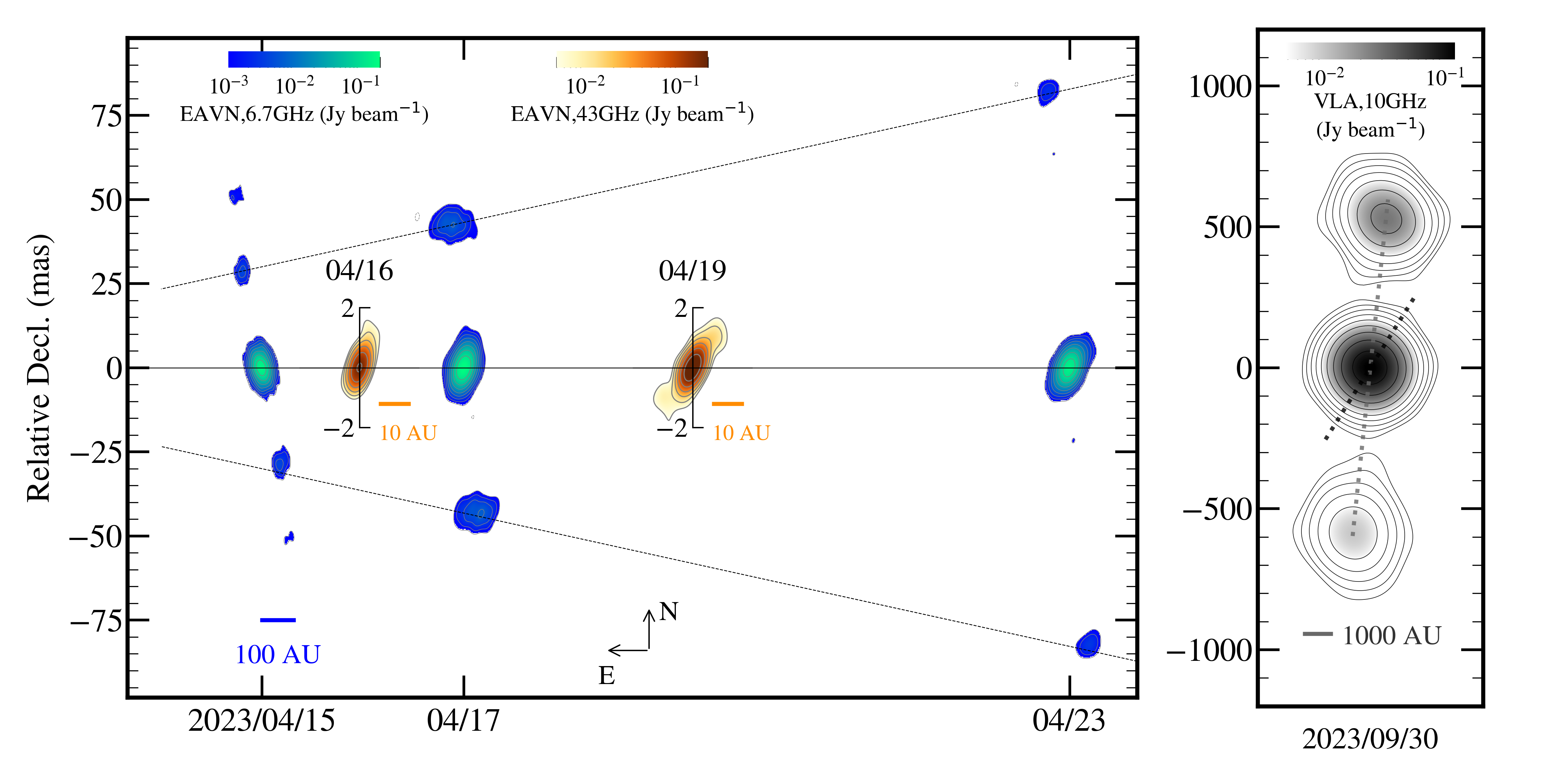
Figure 1: Large misalignment of position angles between continuous jets and discrete ejecta in GRS 1915+105 as revealed by EAVN (left) and VLA (right) images.
Further analysis reveals that the discrete ejecta exhibit a total orientation change ΔΦT of 46∘±7∘, with an associated jet viewing angle that is nearly edge-on (87∘–89∘). This orientation is notably distinct from prior flare ejecta, which maintained PAs commensurate with the steady jet.
Kinematic Properties: Intrinsic Velocity and Ballisticity
Measured proper motions of the discrete ejecta indicate unusually slow apparent speeds, ∼6.5 mas d146∘0, corresponding to an intrinsic velocity of 146∘1 at a distance of 9.4 kpc and for the measured viewing angle. This is the lowest intrinsic velocity ever reported for ejecta in GRS 1915+105, substantially below the typical values exceeding 146∘2 found in previous decades.
The ballistic motion of both the receding and approaching components, coupled with their temporal and spatial alignment, rules out simple non-ballistic deflection scenarios such as local ISM or wind interactions.
Physical Interpretation: Warped/Torn Disk Model
The observations coincided with the so-called “obscured phase” of GRS 1915+105, defined by heavy, rapidly variable X-ray absorption (146∘3–146∘4 cm146∘5), edge-on jet inclination, and persistent radio/IR activity. The authors attribute the anomalous jet geometry to the presence of a highly inclined and warped accretion disk, likely modulated by an external torque. GRMHD simulations predict that strong warping or disk tearing (e.g., due to a tertiary companion or flyby) induces distinct, transient sub-disk segments that realign the local angular momentum and temporarily reorient jet-launching directions [Nixon et al., 2013; Liska et al., 2018, 2021].
The inner accretion flow, meanwhile, rapidly realigns with the black hole spin axis via the Bardeen-Petterson effect and/or magneto-spin alignment, maintaining the historical jet PA and launching the steady, central jet. Discrete ejecta, on the other hand, originate in the outer, unstable disk segments and are thus emitted along anomalous, time-variable axes (Figure 2).
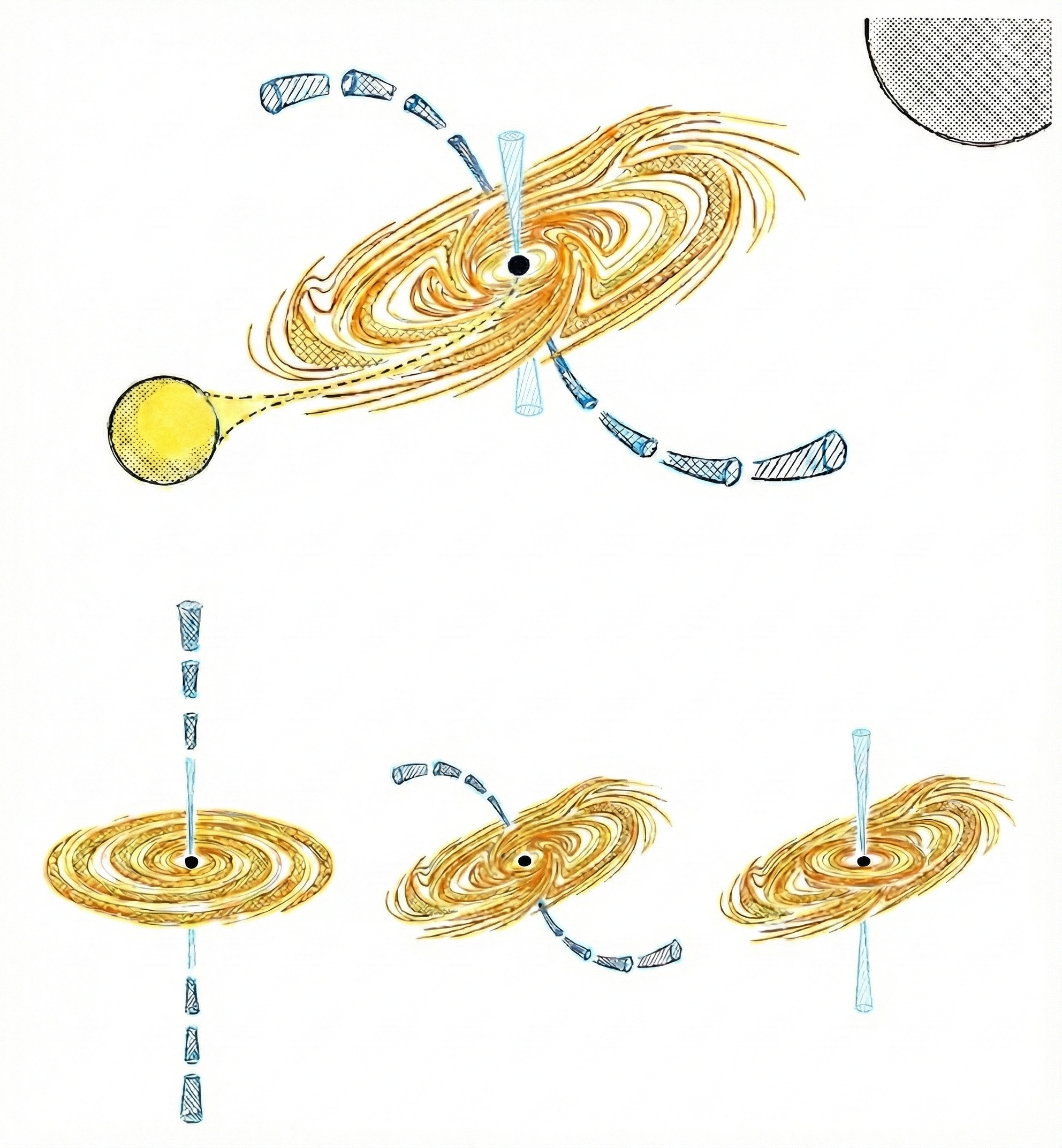
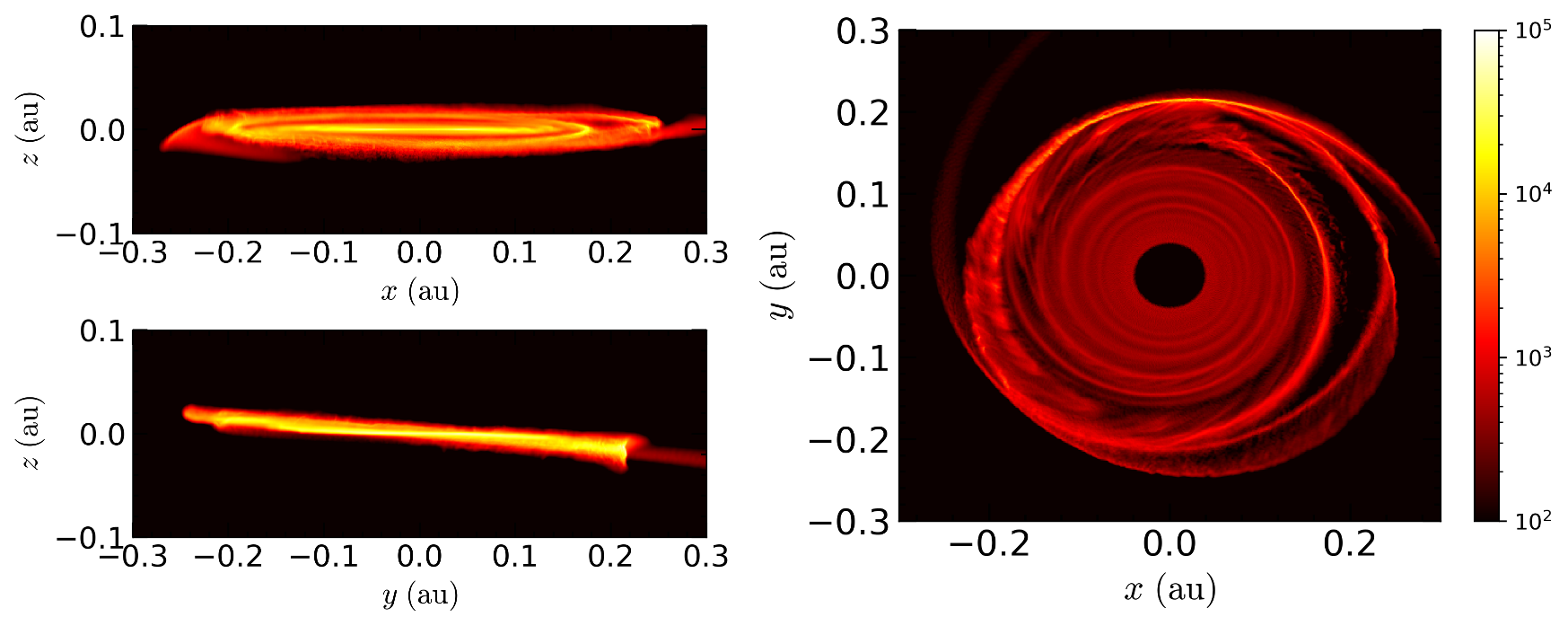
Figure 2: (Top) Schematic of warped disk and coexisting jets/ejecta; (bottom) SPH simulation showing strong disk warping driven by a parabolic flyby object.
Complementary SPH simulations demonstrate that a close flyby of a tertiary mass can induce a large, transient warp in the outer accretion disk, with the amplitude and propagation timescales consistent with observed jet orientation changes. While disk tearing amplitude in simulations is 146∘6, the non-linear coupling to jet launch conditions can feasibly produce even larger misalignments.
Implications for Jet Launch Mechanisms and Disk-Jet Coupling
These results provide direct evidence that continuous and discrete jets in BHXRBs do not always share a common launching geometry or physical origin, with continuous jets anchored to the (realigned) inner disk/BH spin and transient ejecta reflecting stochastic outer disk structure. The highly variable and slow-moving discrete ejecta in GRS 1915+105 corroborate the broader statistical trend that lower-velocity, direction-varying ejecta are more likely to be disk- than spin-aligned [Fender & Motta, 2025].
The study draws analogies with systems such as V404 Cyg, where spin-orbit misalignment drives both precessing ejecta and variable X-ray continuum absorption, and with changing-look AGN where obscuration and jet reorientation events are likely tied to transient accretion flow distortions on larger mass scales.
Alternative Explanatory Pathways
While warped-disk/tearing scenarios provide the most natural explanation, the paper briefly considers alternative interpretations. Dense, clumpy disk winds could, in principle, rapidly obscure the X-ray continuum and interact dynamically with jets; however, the largely ballistic nature and persistent PA offset of the discrete ejecta strongly disfavor wind-driven jet deflection models.
Phase-Referenced Astrometry
The authors include phase-referenced 6.7 GHz EAVN imaging across multiple epochs, confirming the spatial coincidence of the central core component with proper-motion extrapolated coordinates (Figure 3).
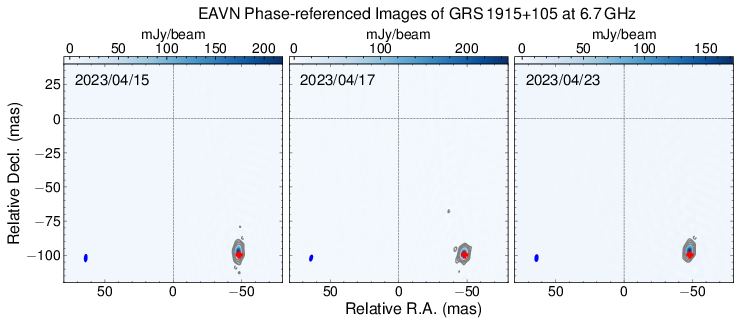
Figure 3: Phase-referenced EAVN images confirm the bright, compact central core coinciding with GRS 1915+105's expected black hole position.
Theoretical and Practical Outlook
This study demonstrates that direct, high-angular-resolution multi-epoch VLBI imaging is essential to disambiguate jet launching geometry and its connection to disk structure in X-ray binaries. The rare, abrupt onset and persistence of jet misalignment in GRS 1915+105 underscores the importance of external perturbations—such as triple/tertiary interactions—in the evolution and transient phenomenology of accreting black hole systems. These results motivate systematic searches for variable radio jet axes in other obscured BHXRBs and in AGN, and argue for coordinated multi-wavelength monitoring of accretion/jet geometry during major state transitions.
Conclusion
The discovery of persistent, large-angle misalignment between continuous jet and discrete ejecta in GRS 1915+105 during its obscured phase constitutes unambiguous evidence for time-variable jet launching geometry controlled by strong, warping perturbations to the accretion disk. The stable orientation of the continuous jet, even during episodes of dramatic disk re-orientation, reinforces the paradigm that steady jets are fundamentally anchored to the BH spin axis, while discrete ejections can reflect stochastic dynamics and angular momentum distribution of the outer disk. This work provides a framework for interpreting rare jet reorientation events observed in both Galactic binaries and AGN, constraining theoretical models of jet-disk coupling, and establishing observational diagnostics for multi-phase jet activity in accreting compact objects (2604.00357).