- The paper identifies a novel four-gate compliance pathway that transforms DERs from passive net load modifiers to active, accredited capacity.
- It exposes structural mismatches in traditional RA frameworks, highlighting fragmented protocols and outdated planning assumptions as major barriers.
- The study combines multi-jurisdictional empirical analysis with reform proposals to enable dynamic, risk-responsive resource adequacy products.
Distributed Energy Resources in Resource Adequacy: Structural Barriers and Compliance Architecture
Introduction
The paper "From Net Load Modifiers to Firm Capacity: The Role of Distributed Energy Resources in Resource Adequacy" (2604.00287) presents a comprehensive and analytically rigorous synthesis of the challenges inherent in integrating DERs (including rooftop PV, BTM storage, controllable loads, and DR) into resource adequacy (RA) frameworks as firm, accredited capacity. The analysis forefronts the limitations of current RA structures, framed not as simple technical gaps but as structural misalignments—primarily rooted in compliance architecture and institutional interdependencies. Through a novel four-gate compliance pathway, the work systematically identifies stages and mechanisms where potential DER value is lost, and explicates why piecemeal, gate-level reforms have consistently failed to achieve scalable DER participation.
Traditional Resource Adequacy Frameworks
RA is historically grounded in processes designed for centralized, dispatchable generation and passive loads. It follows a cyclic, multi-stage logic: net load projections feed reliability targets, which in turn determine capacity requirements, resource-specific capacity valuation, and ultimately procurement and enforcement through CRM or bilateral contracts.
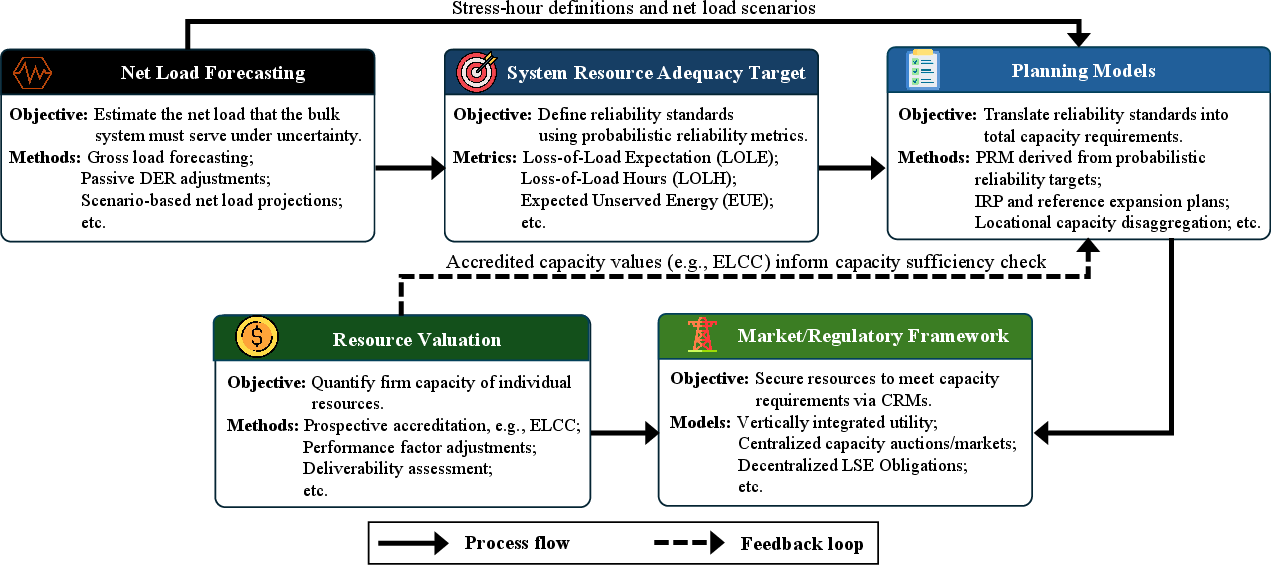
Figure 1: Five-component RA cycle translating net load, reliability targets, and planning models into accredited resources and procurement.
While advances in probabilistic reliability assessment (e.g., LOLE-centric planning, ELCC methodologies for VRE and storage) have improved metrics, the underlying compliance architecture remains largely unchanged. Entry barriers for DERs have shifted from technical feasibility (demonstrated in literature on VPPs and DER control) to institutional misalignments: registration protocols, telemetry standards, accreditation, and enforceable obligations continue to be tuned for the characteristics of centralized assets. These rigidities are amplified in restructured markets and explicit CRMs.
The Dual Role of DERs in Adequacy and Four-Gate Compliance Pathways
DERs function in two analytically distinct ways: as passive net load modifiers (affecting the net load baseline through uncredited BTM generation/efficiency) and as active RA contributors (accredited resources with performance obligations).
The paper’s central innovation is the explicit structuring of DER integration through a four-gate compliance pathway—from entry/classification, to metering/verification, to accreditation/firmness, and to obligations/enforcement. A planning and forecasting layer (Gate 0) forms the upstream context, determining the net load and stress-hour definitions critical for downstream RA assessments.
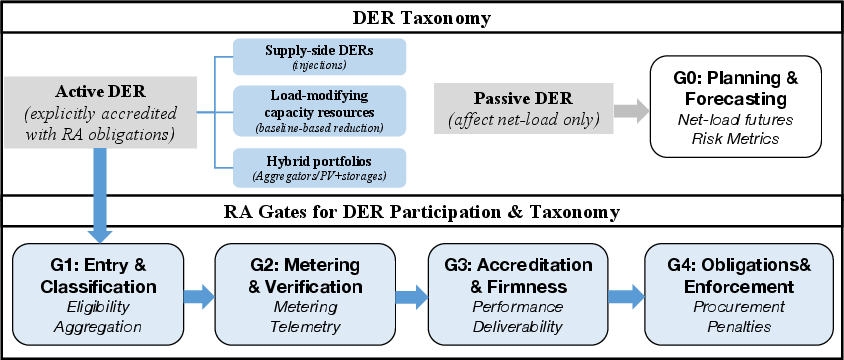
Figure 2: Sequential four-gate compliance pathway that DERs must traverse to be converted from net load modifiers to firm, enforceable RA resources.
Failure to successfully traverse any given gate precludes a DER from being considered enforceable RA capacity; its system impacts are relegated to ‘passive’ adjustments of forecasted net load, not ‘active’ capacity meeting resource adequacy requirements.
Gate-by-Gate Analysis and Key Structural Barriers
Gate 0: Planning and Forecasting
Forecasts of net load often lag actual DER deployment, resulting in misaligned procurement targets and stress-hour definitions. Especially with rapid BTM solar or EV diffusion, planning assumptions may quickly become obsolete, causing downstream gates to accredit and enforce capacity against outdated risk profiles. The lack of robust, versioned forecast refresh protocols exacerbates this misalignment.
Gate 1: Entry and Classification
Entry is dominated by fragmented and sequential approvals from ISOs, DSOs, and regulators, resulting in process bottlenecks and systemic under-utilization of DER portfolios. Minimum aggregation thresholds, rigid classification into legacy categories (supply/demand-side), and incompatibility with hybrid or VPP resources create substantial structural lock-in, especially for portfolios combining heterogeneously operated assets. Resultant categories often define obligation structures that are fundamentally mismatched to actual DER capabilities.
Gate 2: Metering and Verification
DER visibility is implemented via tiered metering—ranging from SCADA exemption for smaller DERs to sampled or baseline-driven verification for most BTM assets. Granular telemetry is often not economically justified relative to RA value, especially for mass-market, low-value DERs. Furthermore, privacy regulations and data governance fragment verification authority, substantially limiting the ability to audit or reconcile DER performance across entities.
Gate 3: Accreditation and Firmness
Class-based or device-aggregated accreditation regimes—centered on ELCC for generation/storage and static baseline methods for demand response—fail to adequately capture portfolio effects, distribution-level deliverability limits, and state-dependent (fatigue, rebound) availability of load-modifying assets. Major variant: Portfolio-level capabilities (e.g., in hybrid or VPP constructs) are systematically misvalued by independent derating of constituent assets, leading to over- or under-accreditation in the presence of correlated availability constraints.
Gate 4: Obligations and Enforcement
Performance obligations and settlements rarely account for multi-program participation, overlapping obligations, or network-driven curtailments. The absence of unified obligation registries or priority rules leads to either double-counting of DER capacity or ambiguous shortfall attribution. Distribution-level curtailments and non-firm access complicate enforcement, as system-level performance assessments cannot reliably distinguish performance failures from network-driven delivery constraints.
Cross-Gate Structural Dependencies and Coordination Failures
The paper demonstrates that apparent gate-level problems are actually manifestations of deeper cross-gate coupling, most notably:
- Classification/Obligation Coupling (G1–G4): Category assignments at entry rigidly constrain performance obligations and enforcement structures, creating regulatory lock-in across jurisdictional boundaries (e.g., state/local vs. wholesale authority).
- Verification/Accreditation Coupling (G2–G3): The granularity of capacity accreditation is limited by what can be statistically inferred with available measurement, but current methodologies (especially class-averaged ELCC) make higher-fidelity telemetry irrelevant from a financial perspective, removing incentives to invest in better verifiability.
- Forecast/Enforcement Coupling (G0–G3/4): Divergence of realized net load from planning assumptions means that resources are accredited for, and enforced against, temporally mismatched scarcity intervals, structurally disconnecting capacity value from actual system reliability contributions.
These couplings explain why isolated technical or regulatory reforms have not produced scalable DER contributions to RA—institutional changes at one gate cannot propagate if not mirrored by upstream/downstream reforms.
Empirical Scope and Cross-Jurisdictional Generality
The analysis is empirically grounded in a cross-comparison of five jurisdictions: CAISO/CPUC (California), PJM, ISO-NE (US), Great Britain, and Ireland—spanning both centralized and decentralized CRM constructs, and multiple aggregation/participation models. The persistence of barriers across diverse market/procurement schemes underscores the argument that the underlying issues are inherent to institutional architecture, not jurisdiction or technology-specific implementation details.
The authors propose three general coordination principles for scalable DER integration:
- Explicit Specification of Inter-institutional Interfaces: Formalized protocols and standardization for information sharing and process synchronization across DSOs, ISOs, and regulators.
- Graded Compliance Options: Introduction of differentiated accreditation and enforcement pathways, explicitly tied to verification granularity, enabling flexible participation (e.g., probabilistic/statistical auditing for mass-market DERs) without diluting system reliability.
- Adaptive Refresh Mechanisms: Binding administrative triggers and workflows for updating stress-hour definitions, accreditation factors, and procurement targets based on observed deviation in DER deployment or load evolution.
Theoretical Implications
The work demonstrates that realizing the theoretical potential of DERs in adequacy is not primarily a function of improved stochastic modeling or advanced device-level telemetry, but instead of addressing fundamental architectural mismatches—by reconstructing compliance pathways to be robust to resource heterogeneity, fragmented governance, and rapidly evolving system conditions.
Practical Implications and Future Outlook
The proposed compliance restructuring would enable scalable DER integration and more dynamic, risk-responsive RA products, avoiding unnecessary firm capacity procurement or over-crediting. The absence of these redesigns will likely increase the structural gap between DER technical advancement and system-level reliability accounting, a risk exacerbated by the accelerating pace of DER adoption. Empirical work on the efficacy and cost of statistical vs. deterministic verification, and investigation into administrative triggers for adaptive realignment, represent promising frontiers.
Conclusion
This paper reframes the DER-RA integration debate from a collection of isolated technical/market barriers to a question of structural compliance architecture. The four-gate compliance pathway exposes how and why DER resource value is systematically lost at institutional interfaces, rather than through physical limitation. Properly addressing these issues will require holistic, cross-gate, and cross-jurisdictional coordination reforms, rather than incremental, gate-specific technical improvements. The implications extend well beyond the sampled jurisdictions, offering a foundational framework for future design of adequacy protocols under increasing DER proliferation.