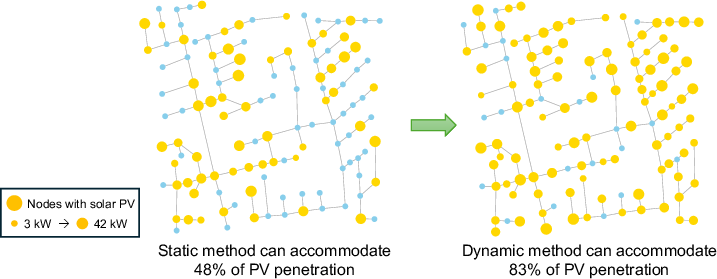
- The paper demonstrates that dynamic coordination significantly expands grid hosting capacity—from 48% to 83% for PV—using iterative and stochastic optimization methods.
- The methodology leverages multiperiod AC-OPF, two-stage stochastic programming, and Monte Carlo analysis to jointly optimize DER siting, sizing, and dispatch.
- The study reveals that coordinated operations of PV, battery storage, and heat pumps enhance grid flexibility while effectively managing voltage, current, and operational risks.
Dynamic Resource Coordination for Enhanced Grid Hosting Capacity
Introduction
The paper "Dynamic resource coordination can increase grid hosting capacity to support more renewables, storage, and electrified load growth" (2604.02170) presents a comprehensive analytic and optimization framework addressing one of the central technical bottlenecks in power system decarbonization: the limited hosting capacity (HC) of distribution grids in integrating distributed energy resources (DERs) such as photovoltaics (PV), battery storage (BS), electric vehicles (EVs), and heat pumps (HPs). Rather than evaluating or planning for DER integration under static and conservative operational assumptions, the authors formulate and solve dynamic coordination and optimization problems that capture DER complementarities and their potential for grid flexibility.
This approach is substantiated by detailed simulations on a modified IEEE 123-node feeder with realistic data and stochastic scenario modeling, contributing both novel methodological advances and quantitative insights on the interplay between grid flexibility, renewables, and electrified loads.
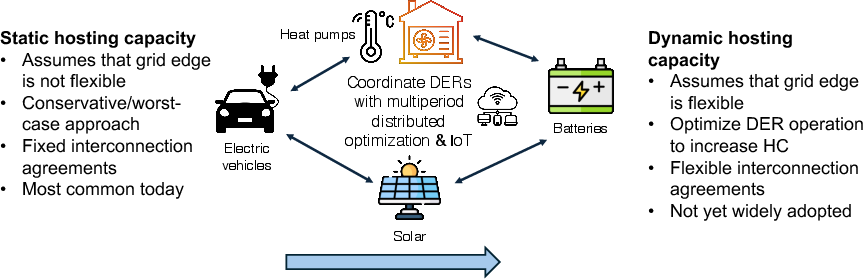
Figure 1: Overview of how dynamic resource coordination increases hosting capacity by leveraging DER complementarities.
Methodology: Deterministic and Stochastic Hosting Capacity Analysis
The paper critiques traditional static HC analyses, which determine DER integration limits via worst-case non-flexible operation, and extends these with dynamic, optimization-based paradigms:
- Deterministic Iterative Approach: Incremental increase in DER penetrations (primarily PV, with/without storage and flexible loads) subject to AC power flow feasibility under both static and coordinated operation.
- Two-stage Stochastic Programming (2-SSP): Joint optimization of DER siting, sizing, and dispatch considering input uncertainties (loads, prices, weather, DER availability) using scenario-based mixed integer SOCPs, with scenario reduction and warm starts for tractability.
- Monte Carlo-based Sensitivity Analysis: Uses random sampling to assess distribution of hosting capacity and system metrics under both static and dynamic schemes.
Dynamic cases deploy multiperiod AC-OPF with coordinated DER dispatch, including explicit modeling of device-level constraints and flexibilities (e.g., SOC constraints, binary charge/discharge states, thermal dynamics for HPs), iteratively coupled to system-level constraints (e.g., voltages, line loadings, and substation limits).
Numerical Results: Impact of Dynamic Coordination
Photovoltaic (PV) Hosting Capacity
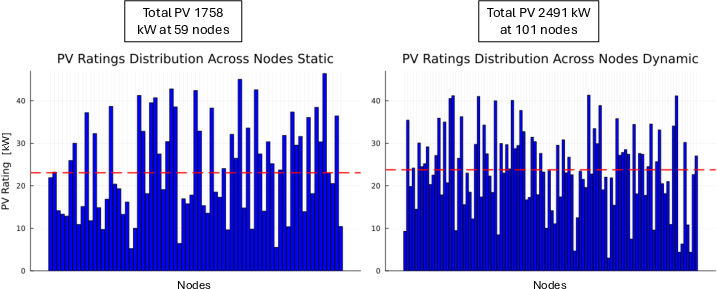
Figure 2: Node-level PV hosting distributions for static and dynamic scenarios.
Dynamic resource coordination yields a transformative expansion in the feasible PV HC:
Power Quality and Network Utilization
Dynamic coordination maintains voltages closer to nominal and keeps both mean/median line currents lower relative to static operation for high DER penetrations, despite similar worst-case values. Notably, even as PV penetration increases, the system experiences less overall network congestion due to the redistribution of power flows and self-consumption at flexible nodes.
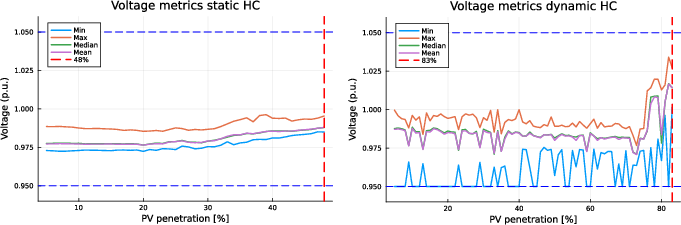
Figure 4: Comparison of voltage metrics between static and dynamic cases as PV penetration increases.
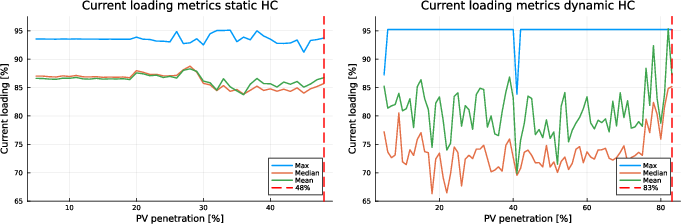
Figure 5: Comparison of current metrics between static and dynamic cases. Dynamic coordination reduces median network currents.
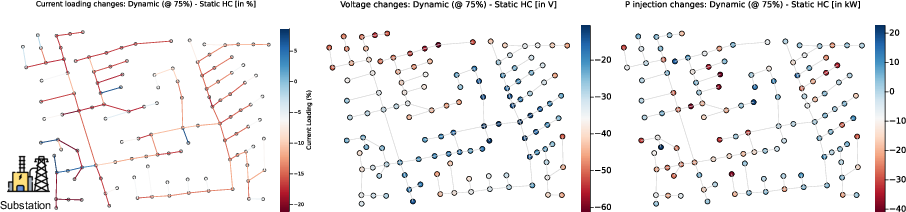
Figure 6: Network-level metric changes from static 48% to dynamic 75% PV (overvoltage and current loading).
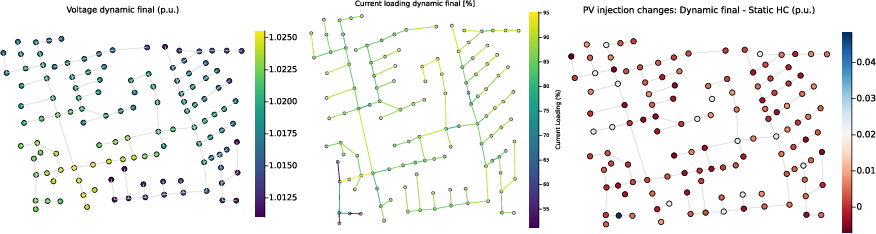
Figure 7: The network state at 83% PV penetration, dynamically coordinated, at peak solar output.
Synergies between Storage, Heat Pumps, and PV
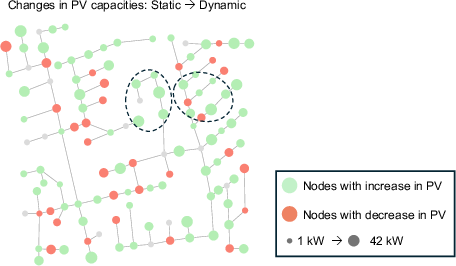
Figure 8: Node-level PV size increase via dynamic coordination.
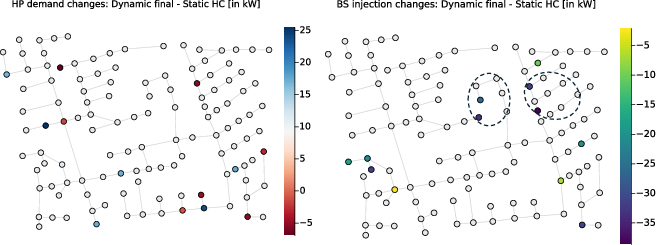
Figure 9: Both heat pumps and batteries enable increased hosting capacity by shifting/absorbing flexible demand.
Storage (BS) is identified as the most potent enabler for increasing PV HC, followed by HPs. Their dynamic operation allows load absorption and strategic charging during peak PV hours, mitigating both voltage rise and reverse power flows. In contrast, static or myopic device operation can exacerbate local congestion and curtailment.
Electrification of Heating: Impact on Load Hosting
Dynamic resource coordination substantially improves HP HC:
- Static: Max HP penetration is 9%.
- Dynamic: Max HP penetration increases to 55% under coordinated multi-DER flexibility, with system constraints enforced (e.g., thermal comfort, device ramping, system voltages).
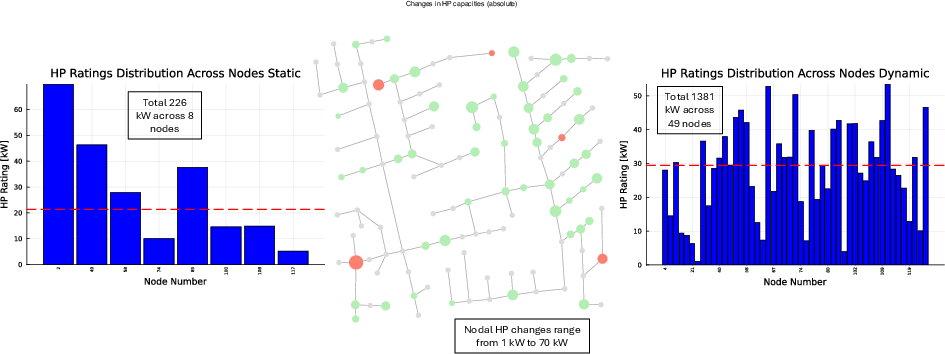
Figure 10: Increase in HP hosting capacity with dynamic approach.
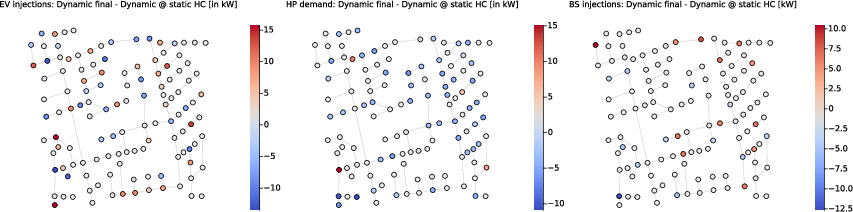
Figure 11: DER injection changes supporting increased HP load at a representative peak hour.
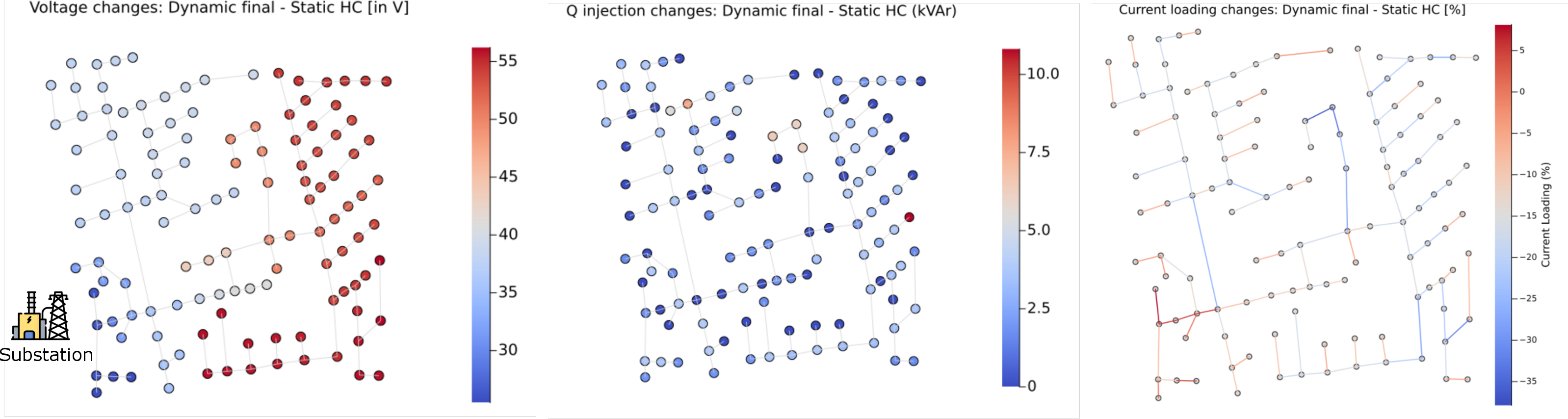
Figure 12: Improved voltage and current profiles due to coordinated HP hosting during peak demand.
Complementarity, Siting Optimization, and Multi-DER Tradeoffs
Using the stochastic 2-SSP, the paper demonstrates:
- Colocation of DERs (PV + BS + HP) at individual nodes is an emergent optimal solution, not an explicit design constraint. This results in more self-sufficiency and reduced local grid stress.
- Synergistic effects: Dynamic coordination expands the joint feasible space for simultaneous penetration of PV, BS, and HP by a factor of 22 compared to static approaches, with PV hosting up to 200%, BS to 100%, and HP to 90% of feeder peak load.
- Pairwise correlations: Strong positive dependencies arise between PV-BS, PV-HP, and BS-HP, reflecting temporal and operational complementarity.
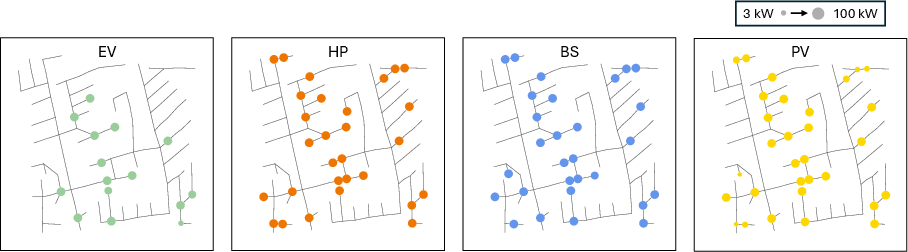
Figure 13: Distribution of DER installations and sizing across nodes in stochastic optimization.
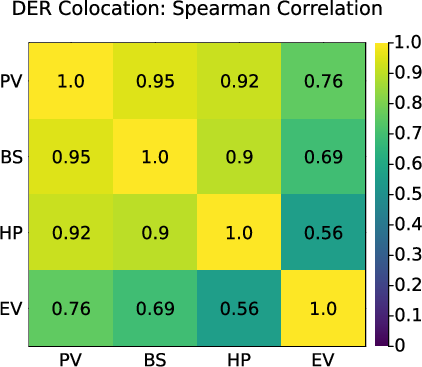
Figure 14: Correlation matrix quantifying multi-DER colocation under dynamic coordination.
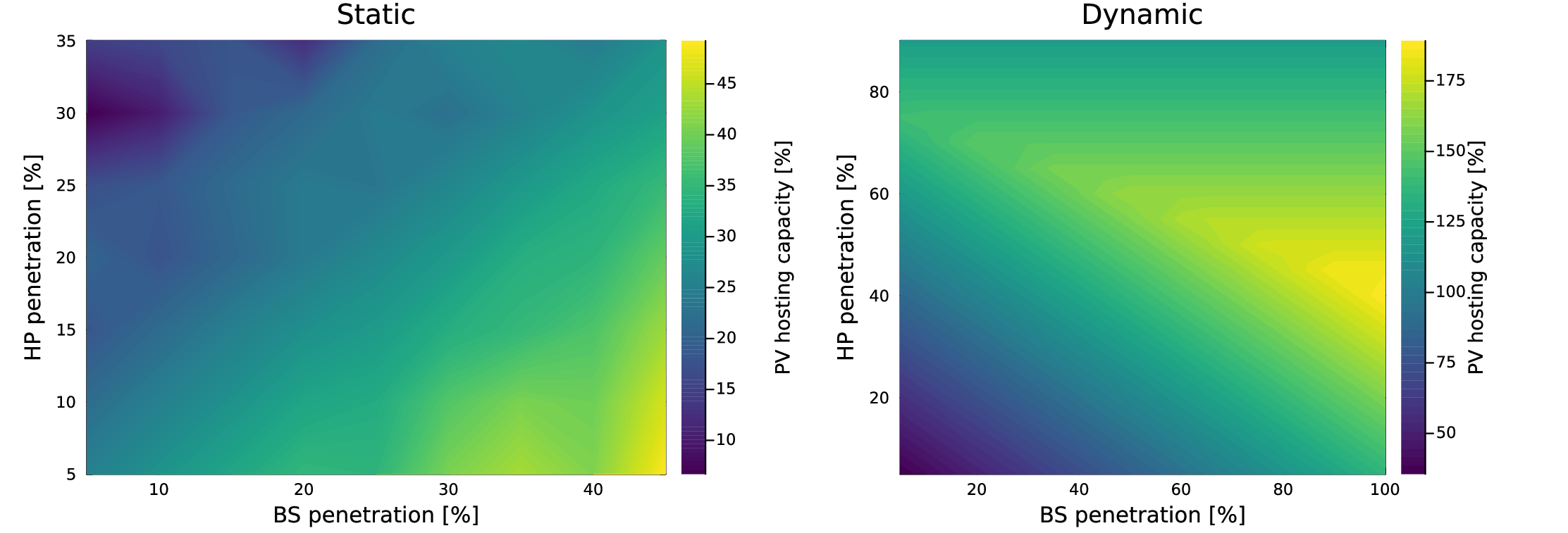
Figure 15: Surface plots showing relationships among HP, BS, and PV hosting capacities under static and dynamic optimization. Dynamic coordination expands feasible region by 22×.
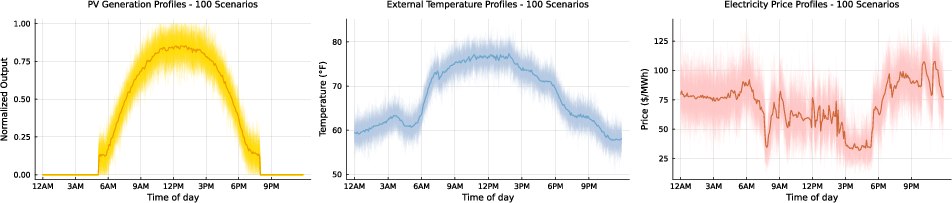
Figure 16: Temporal complementarity among DERs, electricity prices, and weather conditions.
Minimum and maximum voltage and current surfaces across DER penetration spaces confirm the mitigating impact of storage and HPs on grid constraints.
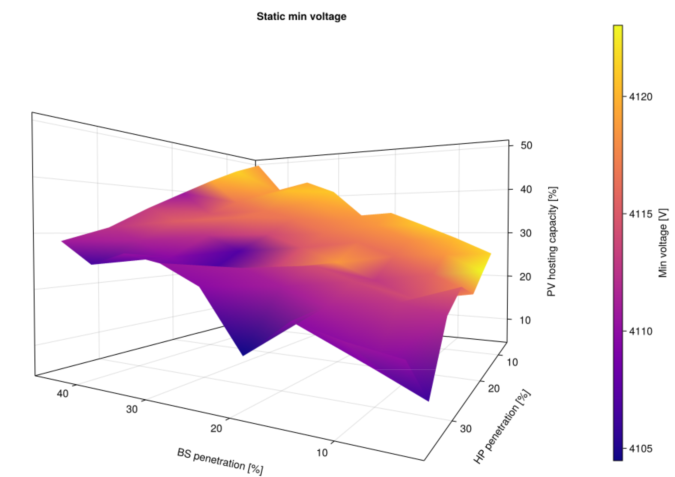
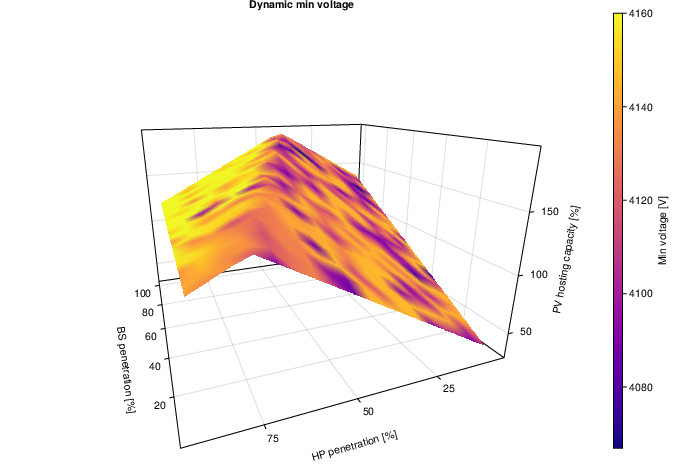
Figure 17: Static case minimum voltage as a function of DER penetrations.
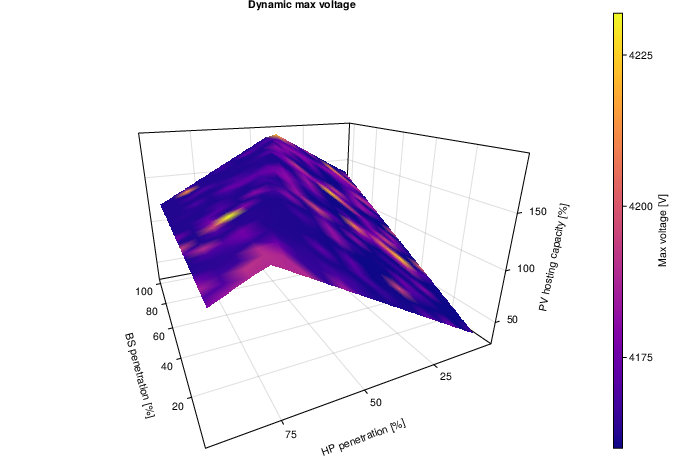
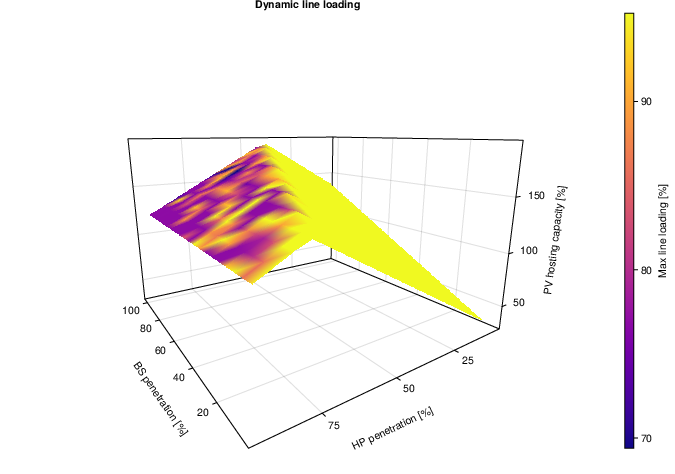
Figure 18: Dynamic case maximum voltage. Voltages remain well controlled for a wide range of penetrations in the dynamic case.
Uncertainty Quantification and Operational Risk
The stochastic iterative approach elucidates how DER and load uncertainty affect HC and grid metrics:
- Dynamic coordination not only increases mean PV HC (from 51% static to 83.6% dynamic), but also increases volatility (SD rises from 2.4% to 3.4%), raising operational risk—a crucial consideration for planners.
- Distributional effects are evident on voltages and current metrics. Dynamic optimization propagates input uncertainty into a wider range of system outcomes, highlighting a trade-off between aggressive utilization of flexibility and risk of constraint violation under uncertainty.
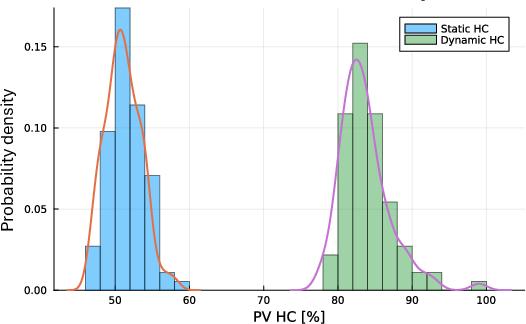
Figure 19: Probability distributions and KDEs for PV hosting capacity under stochastic iterative scenarios.
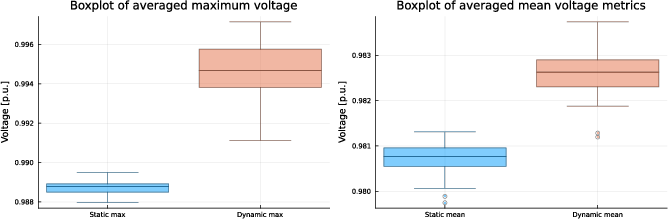
Figure 20: Distribution of maximum/mean voltages from stochastic iterative simulations.
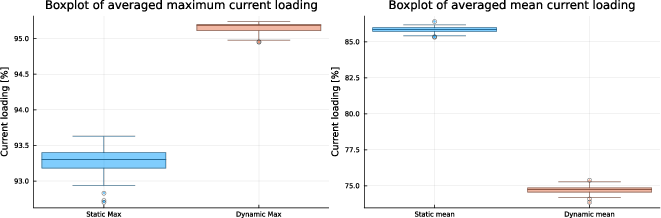
Figure 21: Distribution of current metrics; mean currents are reduced in dynamic cases, even as maximums are slightly increased.
Computational Strategies and Practical Implementations
To address the computational intractability of large-scale stochastic programming, scenario reduction (e.g., k-means clustering) and warm-start techniques are leveraged:
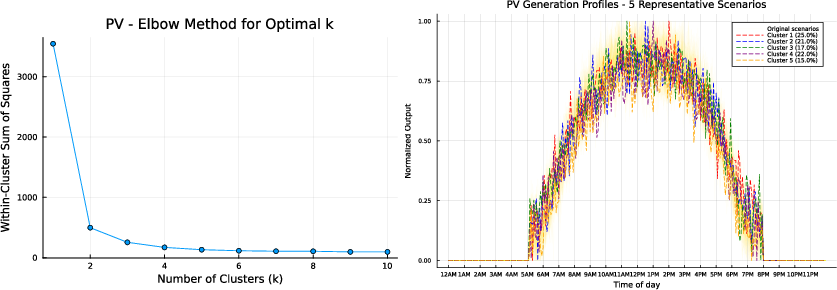
Figure 22: Scenario reduction workflow to accelerate stochastic optimization.
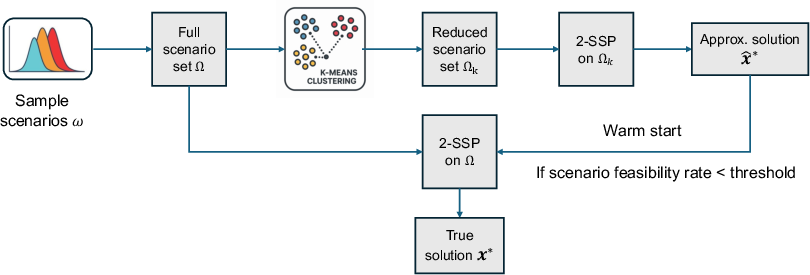
Figure 23: Accelerated 2-SSP workflow combining reduced scenario analysis and solution refinement.
Such methods permit tractable joint siting and dispatch optimization for medium-sized feeders, and motivate further development of customized decomposition algorithms for scaling to real-world grids.
Practical and Theoretical Implications
The implications of this work are substantial for both research and power system operations:
- Operational perspective: Dynamic resource coordination enables distribution feeders to reliably host far greater levels of renewables and electrified loads, deferring capital upgrade expenditure and minimizing curtailment and network stress.
- Planning and markets: Siting and sizing decisions for decentralized resources must jointly optimize across device types, exploiting complementarities; this prescribes a departure from single-DER or static planning paradigms.
- Risk management: Increased flexibility introduces higher volatility in state trajectories; regulatory reliability standards will need to balance flexibility exploitation and robust adherence to operational limits.
- Scalability and computational tractability: The results affirm feasibility for medium-scale feeders, and underscore the need for advanced stochastic optimization and decomposition approaches for large-scale deployment.
Theoretical developments suggested include:
- Extensions to unbalanced, meshed, or multi-phase distribution grids;
- Incorporation of probabilistic and robust constraints in AC-OPF formulations;
- Integration with retail markets or demand response frameworks for real-world deployment;
- Exploration of multi-period, multi-stage stochastic programming and agent-based optimization for massive-scale, heterogeneous grids.
Conclusion
This work establishes that dynamic, optimization-based coordination of heterogeneous DERs, directly modeling device interplay and system constraints, can expand the feasible hosting capacity of distribution networks by large factors relative to conventional static analyses. The explicit quantification of DER complementarities and stochastic risk provides actionable guidance for utilities, regulators, and market designers aiming to accelerate decarbonization amidst load growth and renewable integration. The paper sets a foundation for future research into scalable, flexible, and resilient operation of electrified distribution systems under uncertainty, bridging engineering, economics, and computation (2604.02170).