- The paper recasts MLE as coupled particle dynamics using Wasserstein gradient flows, offering a new perspective on latent-variable energy models.
- It derives overdamped Langevin dynamics for both conditional latent states and joint configurations, achieving tighter ELBO bounds.
- Empirical results in 2D/3D reconstructions validate the method's stability, convergence, and superior performance against traditional approaches.
Particle Dynamics for Latent-Variable Energy-Based Models
Introduction and Contribution
The paper "Particle Dynamics for Latent-Variable Energy-Based Models" investigates a novel theoretical framework, integrating particle dynamics into latent-variable energy-based models (LV-EBMs). LV-EBMs have shown potential in encapsulating complex, hidden structures within data by utilizing a single normalized energy function over observed and latent variables. The approach presented in this paper reshapes maximum likelihood estimation (MLE) as a saddle problem on latent and joint manifolds, employing the mathematical foundation of Wasserstein gradient flows. This eliminates the necessity for discriminative networks or auxiliary models, a departure from traditional energy-based models (EBMs) which often necessitate these components (2510.15447).
The authors articulate several key theoretical advancements in this context:
- Recasting MLE as Coupled Dynamics: Employing Wasserstein gradient flows for latent states and joint configurations, the paper formulates the training process for LV-EBMs as a set of differential flows in probability space. This includes deriving overdamped Langevin dynamics for both conditional latents and joint negative samples, ultimately providing a rigorous probabilistic grounding for the learning algorithm.
- Tighter Bounds on Evidence Lower Bound (ELBO): By reframing the target objective through these flows, an ELBO tighter than standard variational bounds is achieved, enhancing the evaluation and control of learning progress.
- Convergence and Stability: Theoretical guarantees for these flows are demonstrated, ensuring both existence and stability under modest assumptions of regularity and dissipativity. These findings are validated through decay rates in both KL divergence and Wasserstein-2 metric.
Theoretical Framework
The utilization of EBMs traditionally enables learning by defining densities via energy functions without constraints on decoder parameterizations, differing fundamentally from approaches like VAEs and normalizing flows. In this framework, latent-variable models score pairwise combinations of observed data and latent variables, pθ(x,z)∝exp{−Eθ(x,z)}, integrating over latent variables to formulate the marginal distribution pθ(x). This paper's innovation lies in employing a fully particle-based methodology, which inherently aligns with maximum likelihood setups devoid of approximation errors common in variational-inference-generated posteriors.
Particle Dynamics Approach: The paper outlines a systematic method to implement its theoretical constructs, detailing a practical algorithm (Algorithm 1 in the paper) that interchanges between conditional latent updates and joint sample refreshes, followed by stochastic ascent steps in the model parameters θ. This approach negates the limitations of restrictive variational families, promoting expressiveness through non-parametric measures, thus representing the target distributions with greater fidelity.
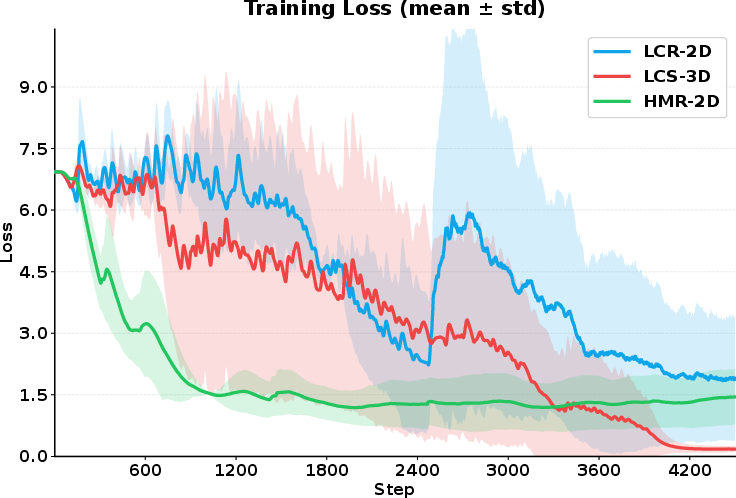
Figure 1: Training loss vs. step (up to 4500) for three scenarios. Solid lines depict the mean over three runs; shaded regions show ±1 standard deviation.
Empirical Evaluation
Extensive empirical evaluation in simulated physics environments demonstrates the superior performance of the proposed method across various generative and reconstructive tasks. The benchmarks against VAEs, Non-Amortized VI, and Hard EM (Expectation-Maximization) methods yield significant quantitative improvements in several metrics, including ELBO, RMSE, MMD, and Wasserstein distances.
Scenario-Based Insights:
- 2D and 3D Reconstructions: The algorithm displays robust capabilities in accurately reconstructing structural geometries and aligning generated distributions with empirical data, thereby outperforming traditional variational and expectation-maximization strategies.
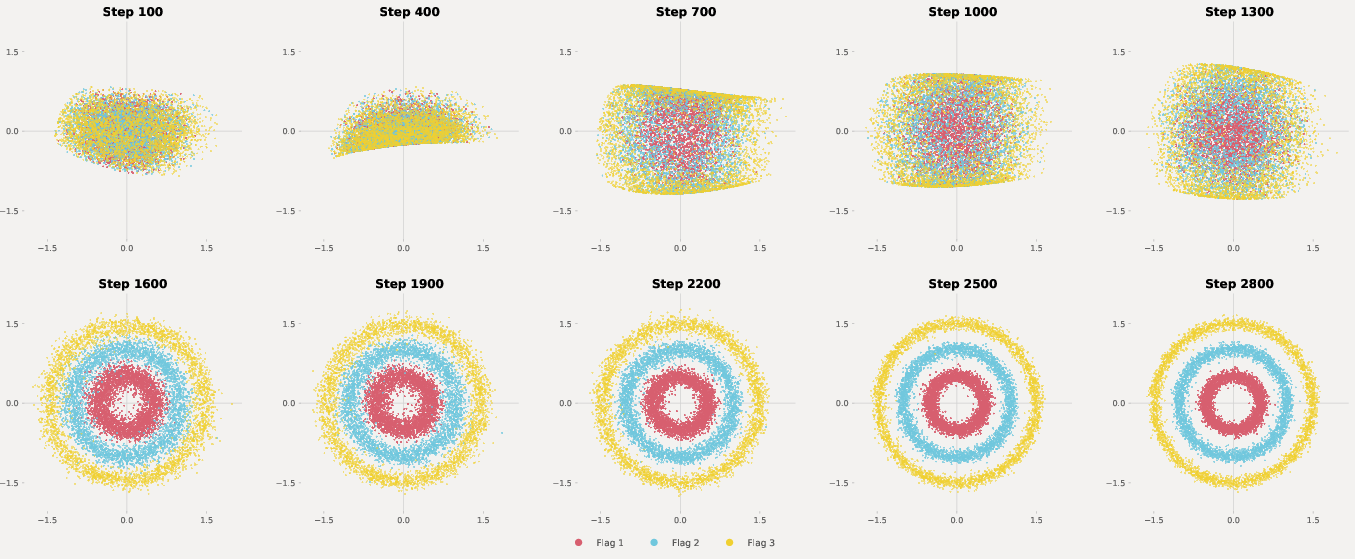
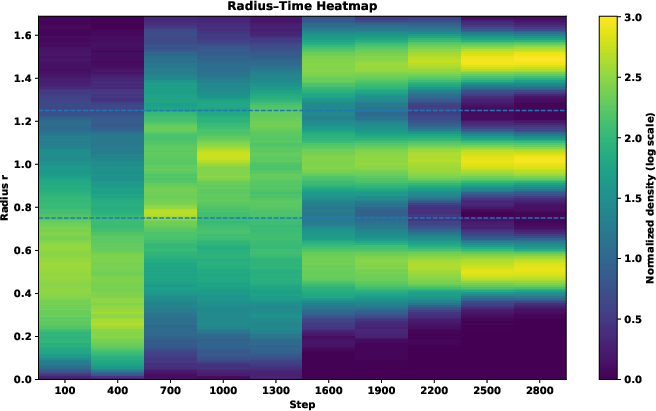
Figure 2: Left: Ten snapshots of LCR-2D reconstructions across training steps; Colors denote ground-truth radial classes. Right: Radiusâstep heatmap computed from the same reconstructions. The color intensity encodes the per-step normalized radial density.
Implications and Future Directions
The implications of this research are far-reaching in both theoretical and applied domains. In practical terms, the absence of auxiliary discriminative or decoder networks simplifies architecture and potentially reduces computational overhead. Theoretically, the substantiation of convergence in Wasserstein space reaffirms the efficacy of this approach for complex latent-variable modeling.
In future work, the approach could be extended to higher-dimensional data and real-world applications, such as image processing or natural language understanding, where capturing intricate dependencies and structures is quintessential. Enhancements could include integrating advanced parameterizations for energy functions and exploring interactions with other generative paradigms, like flows or diffusion models.
Conclusion
This paper represents a significant stride toward scalable and flexible LV-EBMs through a rigorous introduction of particle-based dynamics. By circumventing the typical pitfalls of variational approximations, this research sets a new precedent for precision and stability in generative modeling. As computational methodologies evolve, the integration of these techniques could transform the applicability of EBMs across domains that require capturing deep structural relationships (2510.15447).