- The paper introduces a nonperturbative framework based on quasi-local horizons to define black hole entropy without relying on event horizons.
- It rigorously generalizes the first and second laws of thermodynamics to encompass highly dynamic, non-equilibrium processes via local fluxes.
- The study enables real-time tracking of horizon properties, offering practical applications in numerical relativity and quantum gravity research.
Black Hole Thermodynamics Beyond Perturbation Theory: Quasi-local Horizons and Finite Processes
Introduction and Motivation
The classical laws of black hole mechanics, particularly as formalized by Bardeen, Carter, and Hawking (BCH), established a profound analogy between the dynamics of black holes (BHs) and the laws of thermodynamics. While this paradigm has anchored much of quantum gravity research, it inherently relies on the global and teleological structure of event horizons (EHs), which are inadequate for generic, dynamical astrophysical scenarios. This inadequacy stems primarily from the global, teleological nature of EHs, as well as their practical inaccessibility in dynamical evolutions or spacetimes without well-behaved asymptotics.
This paper systematically develops a comprehensive thermodynamic framework for dynamical black holes that does not rely on event horizons or perturbations of stationary solutions. Instead, the entire structure is built upon quasi-local horizons (QLHs)—notably dynamical horizon segments (DHSs) and isolated horizon segments (IHSs). The main technical achievement is the nonperturbative, process-based generalization of the first and second laws of black hole mechanics to the case where horizons are highly dynamical and may be arbitrarily far from equilibrium.
Limitations of Event Horizons and the BCH Paradigm
The dependence of the BCH laws on EHs raises several intractable problems. Key among them is the teleological nature illustrated by the Vaidya spacetime:
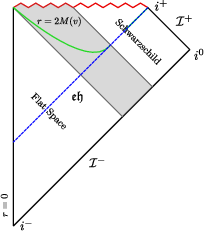
Figure 1: Vaidya space-time demonstrating EH growth in a flat region, highlighting the teleological and unphysical nature of EH area increase in dynamical collapse.
As shown, the EH can begin expanding in entirely flat spacetime, "anticipating" future collapse. This behavior invalidates both the practical assignment of entropy to EH area in dynamical contexts and the use of EHs for causal or thermodynamic modeling.
Furthermore, the global nature of EHs renders them useless for local or numerical detection and tracking during processes such as mergers. Global quantities like ADM mass and angular momentum, which feature in the classic first law, are conserved, making them unsuitable for process-dependent thermodynamics where one requires the horizon mass (excluding the exterior "universe" contributions).
Quasi-local Horizons: Definitions and Their Dynamical Structure
QLHs are 3-manifolds locally foliated by marginally trapped surfaces (MTSs)—surfaces with vanishing expansion for one null normal. Their existence is ascertainable from the geometry in the immediate vicinity, free from reference to future null infinity (I+) or any global data.
The dynamical structure of QLHs is illustrated in the double collapse Vaidya scenario:
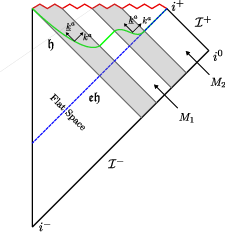
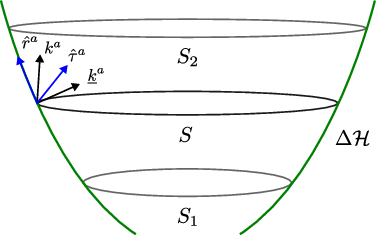
Figure 2: Left: Double Vaidya collapse showing the EH (teleological) and the QLH (dynamically responsive). Right: DHS defined as a segment foliated by MTSs with nonvanishing energy flux.
A QLH may transition between space-like DHSs (characterized by non-trivial fluxes of energy and angular momentum), null isolated horizon segments (IHSs, equilibrium phases), or time-like segments (especially relevant for certain collapse or evaporation scenarios).
The crucial feature for thermodynamics is that changes in area and associated quantities on QLHs are driven by locally computable physical fluxes—matter and gravitational waves—traversing the horizon, not by nonlocal or teleological effects.
Thermodynamic Laws on Quasi-local Horizons
The Zeroth and First Laws for IHSs
IHSs represent equilibrium segments of QLHs, admitting a symmetry (null) generator whose surface gravity is constant—a generalization of the zeroth law. Angular momentum and mass ("horizon charges") are defined entirely in terms of intrinsic horizon data, leveraging phase space or Komar integrals without reference to infinity.
Defining the horizon "intensive" parameters (surface gravity κ, angular velocity Ω) on IHSs, the paper argues—using the BH uniqueness theorems—that one can project any IHS to a corresponding Kerr solution with the same values of horizon area and angular momentum. This projection provides a canonical identification of κ and Ω, thus establishing a strict analogy to equilibrium thermodynamics.
The first law then takes the form
δMIH=8πGκδA+ΩδJ,
where MIH, A, J are the mass, area, and angular momentum defined on the IHS. This law strictly involves only horizon quantities and applies to transitions between equilibrium segments. Unlike the BCH version, it does not reference spatial infinity.
The Physical-Process First Law for DHSs
The paper's technical centerpiece is the generalization of the first law to DHSs—capturing fully dynamical, non-equilibrium evolution. By systematically developing the phase space and balance laws, the authors prove that for any segment of a DHS between two MTSs S1 and κ0,
κ1
where κ2 denotes finite changes due to fluxes across the segment, not infinitesimal passive displacements. Crucially, the horizon "temperatures" (κ3, κ4) are now time-dependent (or more precisely, slice-dependent), as determined by the aforementioned Kerr-projection of instantaneous area and angular momentum.
The corresponding flux law quantifies the inflow of energy and angular momentum via matter and gravitational waves, yielding an exact, nonperturbative account of entropy increase for any dynamical process.
Illustration via Projection Maps
The construction of intensive parameters in dynamical settings is generalized through a canonical "projection map" κ5 from the infinite-dimensional space κ6 of nonequilibrium horizon states (each characterized by horizon data on a MTS) to the 2D Kerr parameter space κ7 of equilibrium states:
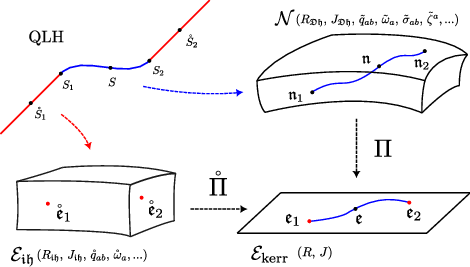
Figure 3: Projection maps from the infinite-dimensional spaces of isolated and dynamical horizons to the 2-parameter Kerr family, allowing time-dependent assignment of intensive parameters along the dynamical evolution of the black hole.
This map single-handedly allows assignment of instantaneous κ8 and κ9 at each MTS along the DHS, thus providing the necessary data for a time-dependent, process-based thermodynamic law.
The Second Law: A Quantitative Relation
On DHSs, the second law becomes a sharp quantitative equality relating area increase to the influx of "horizon energy": for a suitably chosen smearing function in the constraint equations,
Ω0
This is manifestly local—area increase corresponds only to the energy traversing the given DHS segment, with the teleological pathologies of the EH excised.
Comparison with Perturbative and Null Methods
The process-based, quasi-local framework developed here goes well beyond previous perturbative or null-horizon approaches, which have only established generalized first laws for small deviations off stationary backgrounds. Notably, the identification of dynamical black hole entropy with the area of marginally trapped surfaces inside the EH (rather than the EH area itself) resolves a standing contradiction in the literature concerning the location and meaning of entropy in dynamical black holes [hollands2024entropydynamicalblackholes, visser2025dynamicalentropychargedblack].
The analysis also demonstrates that the well-known teleological term in the perturbative entropy formula is, in the quasi-local approach, naturally interpreted as the difference in area of MTSs inside the EH, reaffirming the physical irrelevance of the EH for dynamical entropy production.
Time-like DHSs: Classical Collapse and Quantum Evaporation
The formalism accommodates time-like DHSs, encountered, for example, in homogeneous collapse (Oppenheimer-Snyder) or quantum evaporation phases in semi-classical gravity:
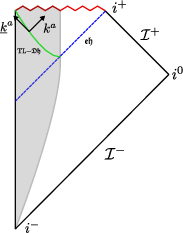
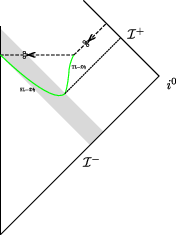
Figure 4: Left: Oppenheimer-Snyder collapse with time-like DHS. Right: Semi-classical black hole evaporation, with the horizon becoming time-like during negative energy influx.
In these regimes, the area of the horizon can decrease, corresponding to the violation of the dominant energy condition (e.g., Hawking radiation), with the same flux laws applying (with modified sign conventions due to the causal structure). Thus, quasi-local horizon thermodynamics incorporates known quantum gravitational processes within the same formalism.
Implications and Directions for Future Work
Theoretical Implications
The main implication is a shift from the EH to quasi-local horizons as the fundamental carriers of black hole entropy and thermodynamic behavior in dynamical, generic settings. This has consequences for black hole statistical mechanics, quantum gravity, and information loss discussions, as the identification of relevant degrees of freedom and entropy is now tied to locally-defined marginally trapped surfaces rather than globally-defined EHs.
The techniques developed here enable direct application to numerical relativity and gravitational wave data analysis, as quasi-local horizons and their area/angular momentum can be located and tracked on the fly. This is particularly timely for post-merger dynamics, ringdown, and potential quantum gravity corrections during evaporation.
Practical Implications
- Numerical Gravitational Wave Physics: The ability to define and track dynamical entropy, energy, and angular momentum during mergers and ringdown in numerically simulated spacetimes is invaluable for waveform modeling and testing general relativity.
- Quantum Gravity/Black Hole Information: The assignment of entropy to quasi-local (DHS/IHS) cross-sections underpins modern approaches to black hole microstates in loop quantum gravity and potentially string theory, as it clarifies which geometrical structures should be quantized.
Future Directions
- Extension to alternative gravity theories by generalizing the constraint-balance approach.
- Systematic study of the uniqueness and selection of DHSs and MTSs in generic, highly dynamical evolutions and their implications for black hole identity and information.
- Precise connection between quantum gravitational entropy constructions and the quasi-local areas identified in this framework.
- Exploration of the symplectic and charge algebra structures induced on the quasi-local horizon phase space for potential holographic and statistical mechanical applications.
Conclusion
This paper establishes a robust, nonperturbative thermodynamic theory for dynamical black holes based on quasi-local horizons. By severing reliance on event horizons and global charges, and instead employing marginally trapped surfaces and local dynamical horizons, all three thermodynamic laws are formulated in a way that responds directly to local physical processes. The central, bold claim—fully justified by technical results—is that the entropy of dynamical black holes is not given by the area of the event horizon, but by the area of quasi-local, marginally trapped surfaces inside it. This provides a template for both classical and quantum gravitational treatments of black hole thermodynamics applicable in general, highly dynamical spacetimes.

