- The paper demonstrates that dynamically evolving wormhole throats can survive a non-singular cosmological bounce if generalized throat and flare-out conditions are met.
- It analyzes the Kim and PRN solutions, showing that the Kim model has an upper mass bound for throat survival while the PRN model guarantees unconditional persistence.
- The study suggests that surviving wormholes could facilitate matter transfer and affect early-universe structure formation, implying observable cosmic signatures.
Survival of Wormhole Topologies Through Cosmological Bounces
Introduction
The persistence of nontrivial topological structures through non-singular cosmological bounces is a critical question in relativistic astrophysics and quantum cosmology. "Does a wormhole survive a cosmological bounce?" (2604.00134) addresses this in the context of dynamical wormholes embedded in cosmological FLRW backgrounds, focusing on the propagation of wormhole throats and associated energy conditions through a cosmic contraction, bounce, and subsequent expansion. The work scrutinizes the only known solutions of Einstein's field equations representing wormholes in a cosmological setting: the Kim solution and the Pérez-Raia Neto (PRN) solution. The analysis is executed within a broad class of phenomenological bouncing models, with particular attention to throat dynamics, the generalized flare-out condition, null energy condition (NEC) violation, and causal structure.
Dynamical Wormholes in Cosmological Spacetimes
Wormholes in asymptotically flat spacetimes are typified by the absence of event horizons and the presence of a throat satisfying the flare-out condition. The embedding of such structures into cosmological backgrounds yields nonstatic, dynamical throats whose properties are determined by both local geometry and cosmic expansion.
The Kim solution is constructed by introducing a time-dependent scale factor into the static Morris-Thorne line element, resulting in a spacetime that asymptotes to FLRW at large radii. The PRN solution generalizes this construction, permitting both radial and temporal dependence in the shape function, and can reduce to Kim’s solution or static wormholes depending on the choice of functions. Both solutions are nontrivial due to the presence of NEC-violating matter threading the throat, with the PRN solution characterized by a nonvanishing heat flux in the energy-momentum tensor.
Survival Criteria and Topology Conservation
The paper formalizes a survival condition for wormhole throats based on the existence of diffeomorphic, spacelike hypersurfaces foliating the spacetime across the bounce. If a throat exists on a contracting branch, diffeomorphic hypersurface evolution through the bounce (guaranteed in hole-free, causally compact models) forbids topological change or throat closure, consistent with the Borde theorem on topology change.
The identification of throats in dynamical, non-static geometries is performed via the vanishing of the expansion scalar for one of the radial null geodesic congruences on a two-surface, together with a sign condition on its derivative (generalized flare-out). These are parametrized in terms of cosmic time and are checked for completeness through the bounce epoch.
Kim Solution: Constraints on Throat Survival
For the Kim cosmological wormhole, the areal radius of the throat R− is governed by the cosmic scale factor and the Hubble expansion. The condition for throat existence is encoded in a function fc(t,M)=1−4b02H2a2(t), with the requirement fc≥0.
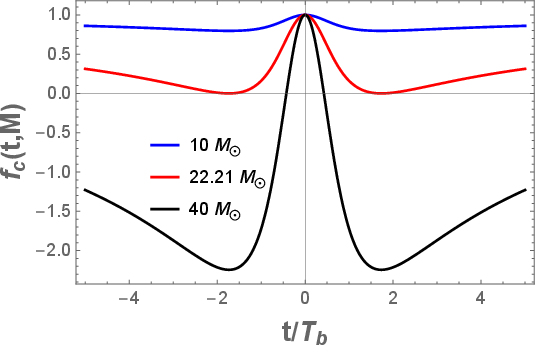
Figure 1: fc(t,M) versus cosmic time for various throat parameters, demarcating the domain of wormhole existence.
Numerical evaluation using physically reasonable bounce parameters yields a maximal allowed value for the throat parameter b0, corresponding to M∗≈22M⊙. For b0>M∗, either the throat ceases to exist for part of the evolution, or the flare-out condition is violated/non-real.
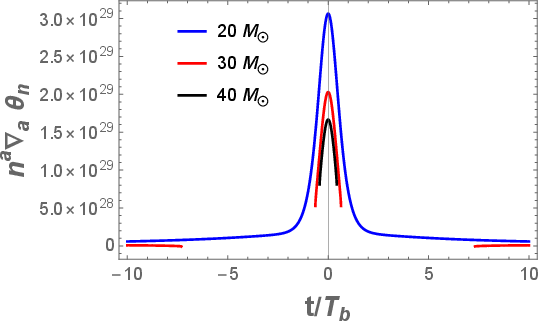
Figure 2: The generalized flare-out condition as a function of time; positive values indicate satisfaction of the necessary geometry for wormhole viability through the bounce.
The areal radius of the throat, R−, and the minimal areal radius Rmin are tracked through the bounce. Both coincide at the bounce epoch; away from the bounce, R−>Rmin.
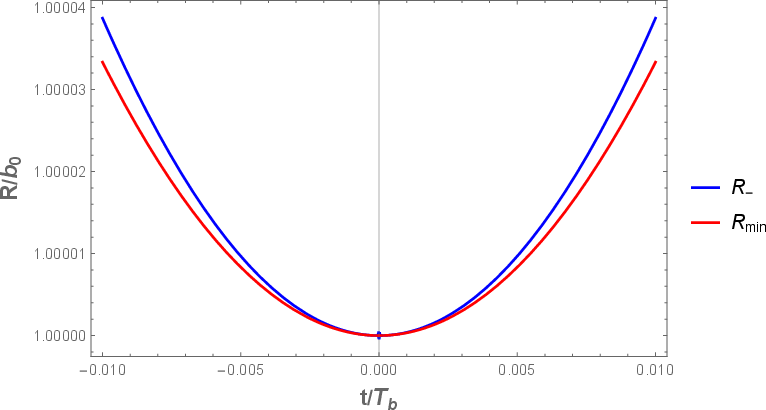
Figure 3: Areal radius of the Kim throat versus cosmic time, with comparison to the minimum allowed areal radius.
Causal structure analysis, using null geodesic integration, reveals that radial light rays remain confined to fc(t,M)=1−4b02H2a2(t)0 at all times, with the throat representing a true geometric and causal barrier.
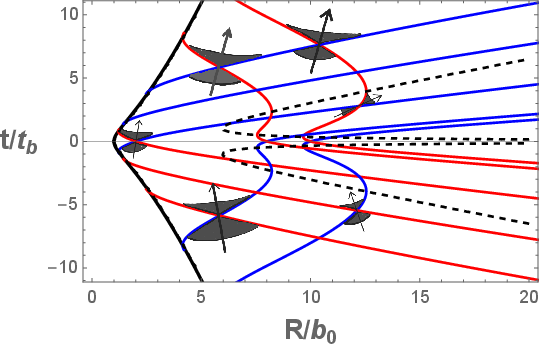
Figure 4: Causal structure for the Kim wormhole, depicting null ingoing and outgoing geodesics relative to the evolving throat and light cones.
Embedding diagrams show that the spatial geometry of the wormhole is contracted/expanded by the scale factor, while the intrinsic “waist” remains determined by cosmological evolution.

Figure 5: Embedding diagrams for the Kim wormhole at representative cosmic times, illustrating the evolution of the spatial slice geometry.
Pérez-Raia Neto Solution: Unconditional Survival
The PRN wormhole solution exhibits a throat at fixed areal radius fc(t,M)=1−4b02H2a2(t)1 for all cosmic times, and in isotropic coordinates its location scales with fc(t,M)=1−4b02H2a2(t)2. The generalized flare-out condition is always satisfied for any fc(t,M)=1−4b02H2a2(t)3, with no analog of the Kim solution's upper bound.
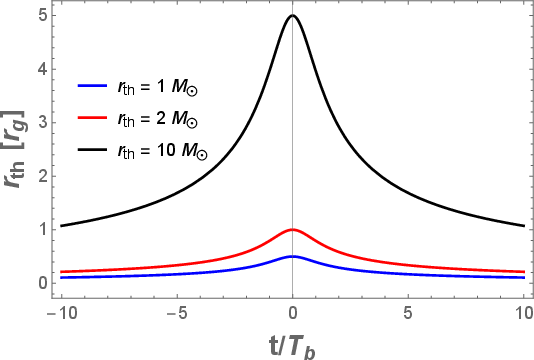
Figure 6: Throat radius for the PRN wormhole in isotropic coordinates as a function of cosmic time and various fc(t,M)=1−4b02H2a2(t)4.
Analysis of null geodesics shows the throat acts as a hard lower bound for causal propagation. The geometric properties remain regular, and the throat does not approach closure or singularity near the bounce.
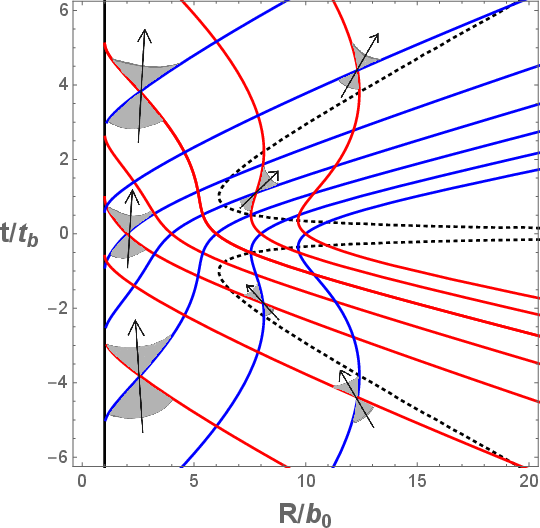
Figure 7: Causal structure for the PRN wormhole, including null geodesics, location of the throat, and signature of the bounce.
Embedding diagrams, distinct from the Kim case, show that while the throat's coordinate location evolves, the spatial geometry retains an open configuration through the bounce.
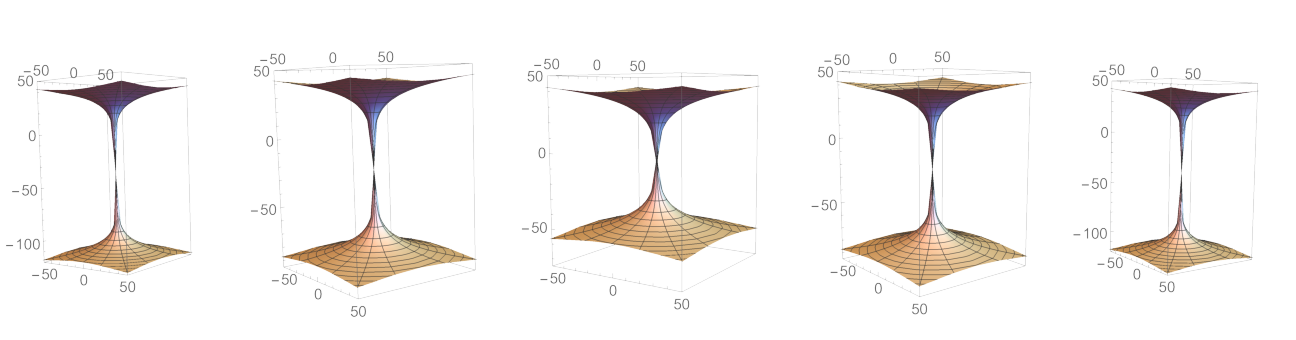
Figure 8: Embedding diagrams for the PRN wormhole at multiple cosmic epochs, tracking the spatial evolution of the throat and the external geometry.
Matter Content and NEC Violation
For both solutions, the matter threading the throat is exotic, and NEC violation is verified at all times—even at the bounce—using the appropriate conditions for imperfect fluids. The PRN solution, due to the inclusion of heat flux, exhibits nontrivial time-dependent energy flow near the throat.
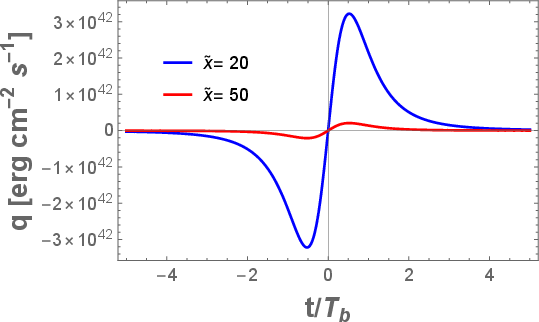
Figure 9: Temporal evolution of the heat flux at fixed radial locations in the PRN wormhole, showing the direction flips across the bounce.
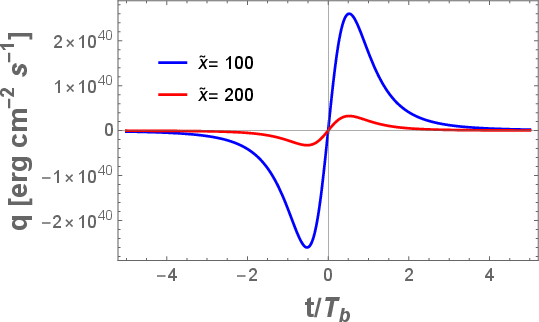
Figure 10: Long-time behavior of heat flux at larger isotropic radii; the flux approaches zero post-bounce.
Spatial profiles reveal a sharp local maximum in heat flux just exterior to the throat, with rapid decay at larger radii or late times.
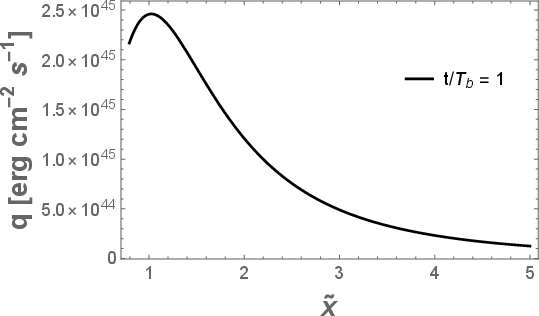
Figure 11: Heat flux at a fixed cosmic time as a function of the isotropic radius, demonstrating exponential suppression away from the throat.
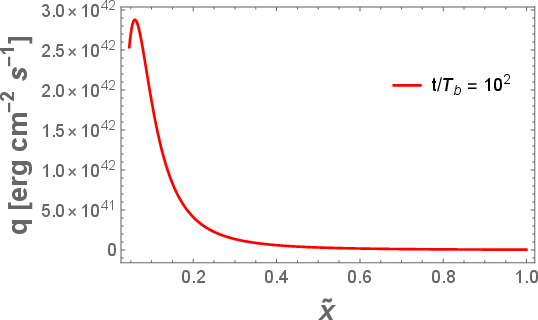
Figure 12: Heat flux spatial distribution at an intermediate post-bounce epoch.
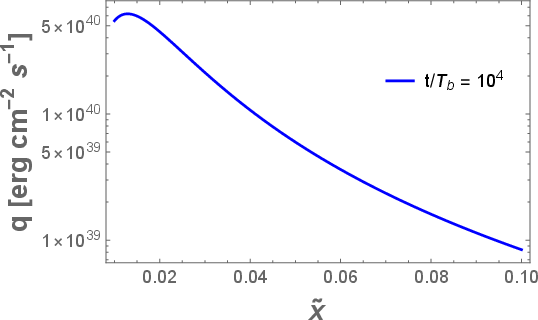
Figure 13: Heat flux spatial profile at very late times; the system settles into near-zero configuration away from the throat.
Physical Implications and Theoretical Consequences
The demonstration that dynamically evolving wormhole throats can persist through a cosmological bounce in the two known explicit solutions establishes that topology change is not generic in bouncing cosmologies with regular, causally compact slicing. This remains true even in the presence of a strongly time-dependent background, as long as the generalized throat and flare-out conditions are globally satisfied.
A notable claim is the non-existence of a universal upper bound for the throat parameter in the PRN solution, in contrast to the Kim geometry, where the mass parameter is strictly bounded for throat survival through the bounce.
The survival of such structures opens up the possibility of matter, radiation, and gravitational wave transfer across the bounce via wormholes, with speculative implications for early-universe structure formation and the stochastic gravitational wave background. Specifically, accretion phenomena onto bouncing-surviving wormholes could generate relativistic jets, potentially acting as agents of early cosmic reionization and perturbations leading to structure formation, as recently suggested by relativistic GRMHD simulations.
The general methodology outlined—parametrizing throat location and verifying dynamical flare-out—allows application to further cosmological wormhole solutions beyond the Kim and PRN families, including conformal evolutions and metrics inspired by modified gravity.
Conclusion
The analysis establishes, in a technically rigorous framework, that nontrivial Lorentzian wormhole topologies can survive a non-singular cosmological bounce, provided dynamical throat conditions are met. For the Kim solution, an upper mass bound arises, while for the PRN solution throat survival is unconditional. These results have significant implications for cosmic topology, the possible remnant effects from a prior contracting phase, and observational signatures (direct and indirect) in cosmology. Extensions to other dynamical wormhole geometries and underlying theories (including modifications of GR or quantum gravity bounces) will refine and potentially generalize these findings.