- The paper presents a four-scalar non-linear sigma model that reproduces arbitrary four-dimensional geometries, including dynamic wormhole solutions.
- The study shows that embedding wormholes in an expanding universe can restore key energy conditions when the throat exceeds the Hubble radius.
- It classifies future singularities and suggests wormhole traversal may allow access to non-singular regions despite conventional energy condition violations.
Wormhole Spacetimes in an Expanding Universe: Energy Conditions and Future Singularities
Four-Scalar Non-Linear Sigma Model and Arbitrary Geometry Realization
The paper develops a four-scalar non-linear σ model framework, where the target-space metric is identified with the spacetime Ricci tensor. This construction enables the realization of arbitrary four-dimensional geometries, including dynamical wormhole solutions, by associating the scalar fields with spacetime coordinates. The action includes Lagrange multipliers that impose constraints, effectively eliminating ghost degrees of freedom and ensuring stability even when conventional energy conditions are violated. The kinetic coefficients Aab(ϕ) are chosen to match the Ricci tensor, allowing the model to reproduce any desired geometry.
Dynamical Wormhole Solutions and Coordinate Regularization
The authors present a class of time-dependent wormhole metrics, generalizing the static Morris-Thorne geometry. By introducing a new radial coordinate χ related to the throat radius r0, the apparent singularity at the throat is removed, and the spacetime is shown to be regular across the wormhole. The dynamical extension involves a conformal factor e2N(τ,χ), where N is a function of time and space, enabling embedding into cosmological backgrounds. The explicit computation of Christoffel symbols and Ricci tensors for these metrics provides the necessary ingredients for constructing the corresponding σ model.
Energy Conditions: Violation and Restoration via Cosmological Embedding
The analysis of energy conditions (NEC, WEC, SEC, DEC) reveals that static wormhole solutions (N=0) universally violate all conditions due to vanishing energy density and negative radial pressure. However, when the wormhole is embedded in an expanding universe (N=N(τ)), the cosmological fluid modifies the effective energy density and pressure. For suitable choices of the expansion rate and throat radius, the energy conditions can be satisfied, particularly when the physical throat radius exceeds the Hubble radius. The explicit expressions for ρ, pradial, and pangular are derived in terms of the Hubble parameter and its derivatives, and the conditions for their positivity are discussed.
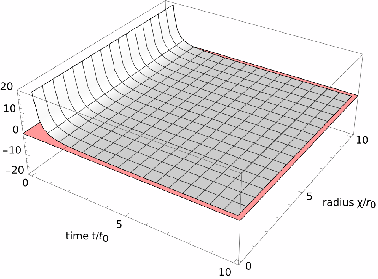
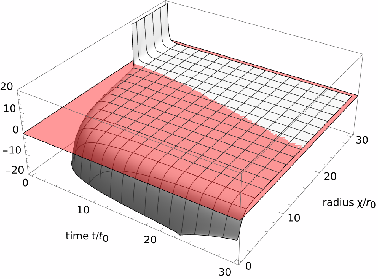
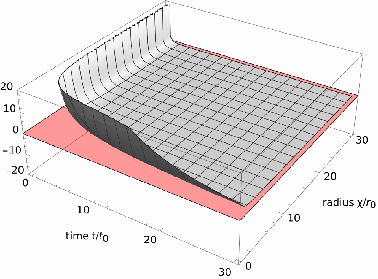
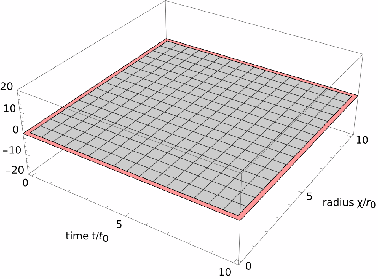
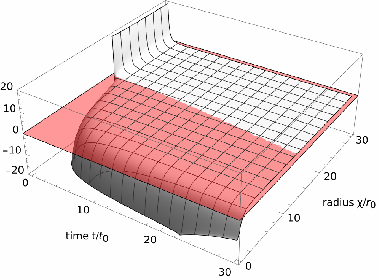
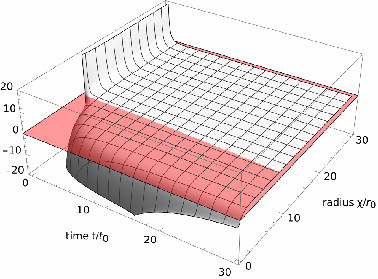
Figure 1: Plot of ρ normalized by κ2H02 for r0H0=10−2, w=−1/3, illustrating energy condition violation and late-time restoration.
Classification of Future Singularities and Wormhole Traversal
The paper reviews the taxonomy of finite-time cosmological singularities (Type I–V) in FLRW universes, characterized by the behavior of the scale factor, energy density, and pressure. By embedding the wormhole in a universe approaching a future singularity, the authors construct scenarios where the singularity is present in one universe but absent in the other connected via the wormhole. Near the throat, the singular hypersurface becomes timelike, allowing for trajectories that traverse to the non-singular universe before the singularity and return afterward. This is formalized through explicit choices of the conformal factor N(τ,χ), which controls the location and nature of the singularity.
Graphical Analysis of Energy Conditions for Various Equations of State
The energy conditions are analyzed for cosmological fluids with constant equation of state parameter w. Three regimes are considered: quintessence (−1<w≤−1/3), cosmological constant (w=−1), and phantom energy (w<−1). For w≥−1/3, all energy conditions except SEC can be restored at late times if the throat radius is sufficiently large. For w=−1, the conditions are asymptotically satisfied except SEC. In the phantom regime, all conditions remain violated. The dependence on the ratio r0H0 is highlighted, with larger throat radii favoring restoration of energy conditions.
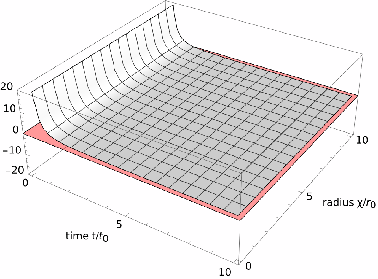
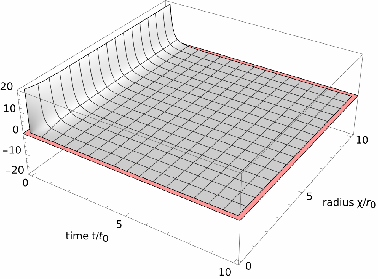
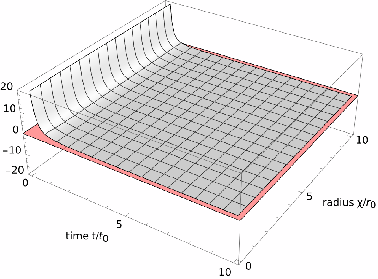
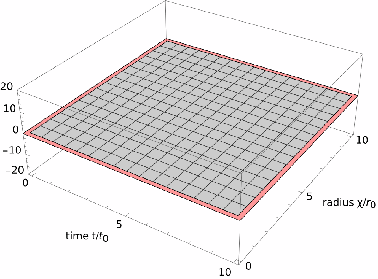
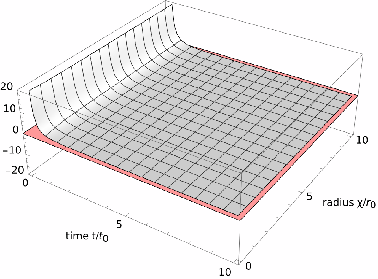
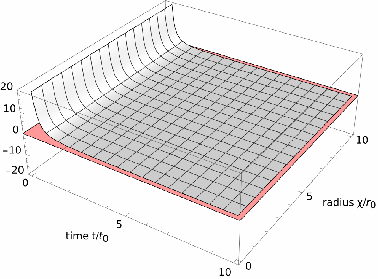
Figure 2: Plot of ρ+pradial normalized by κ2H02 for r0H0=10−2, w=−1/3, showing the impact of cosmological expansion on energy conditions.
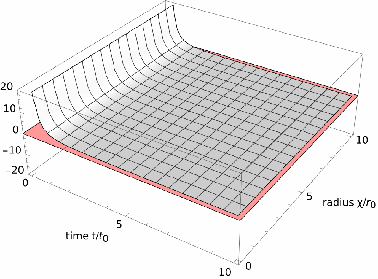
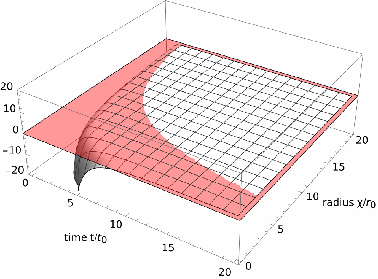
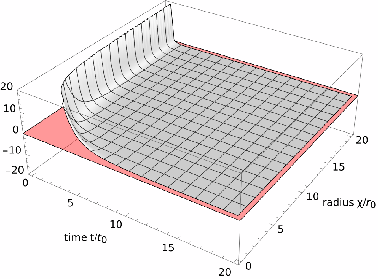
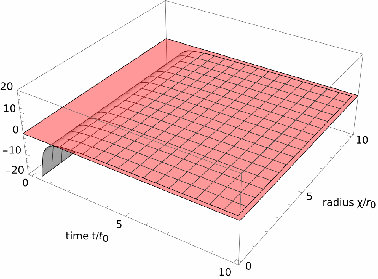
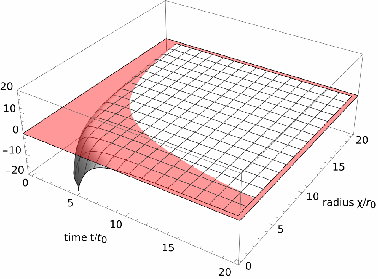
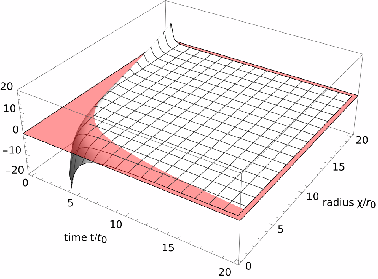
Figure 3: Plot of ρ normalized by κ2H02 for r0H0=100, w=−1/3, demonstrating energy condition satisfaction for large throat radii.
Wormholes with Dark Matter Halo Profiles
The authors extend their analysis to wormhole geometries motivated by galactic dark matter halo profiles, such as the Navarro-Frenk-White (NFW) profile. The corresponding wormhole metrics incorporate a shape function determined by the dark matter density, and the Einstein equations yield non-vanishing pressures, indicating that the supporting matter cannot be ordinary cold dark matter. The four-scalar σ model naturally realizes these exotic matter sources, providing a stable framework for such wormhole solutions without invoking actual dark matter.
Dynamical Transitions and Thermodynamic Considerations
The paper discusses spacetimes interpolating between black holes and wormholes, such as the Simpson-Visser metric, and the challenges associated with dynamical transitions (e.g., time-dependent throat radius a(t)). Such transitions generically introduce curvature singularities at the horizon, precluding regular evolution. The thermodynamic properties of wormholes are also addressed; the absence of horizons complicates the definition of temperature and entropy, with proposals based on entanglement entropy or minimal throat area lacking universal acceptance.
Conclusion
This work demonstrates that wormhole spacetimes embedded in expanding universes can, under appropriate conditions, satisfy all conventional energy conditions, particularly when the throat radius is comparable to or exceeds the Hubble radius. The four-scalar non-linear σ model provides a robust and stable framework for realizing arbitrary geometries, including those motivated by dark matter halo profiles. The analysis of future singularities reveals the possibility of traversing to non-singular universes via wormholes, with implications for cosmic censorship and the global structure of spacetime. The results suggest that the topology of the early universe may have been non-trivial, and that wormholes could play a role in the fate of cosmological singularities and the nature of exotic compact objects. Future work may focus on the quantum stability of these solutions, observational constraints on primordial wormholes, and the development of consistent thermodynamic descriptions for horizonless spacetimes.