- The paper demonstrates that the memory-burden effect significantly prolongs primordial black hole lifetimes, altering evaporation dynamics and particle spectra.
- It employs coupled Boltzmann equations and parameter space analysis to reveal bimodal, non-thermal velocity distributions in the produced dark matter.
- Observational implications include stringent Lyman-α constraints that restrict the viable parameter space for PBH-sourced non-cold dark matter.
Non-Cold Dark Matter from Memory-Burdened Primordial Black Holes: Technical Overview
Introduction
The paper "Non-Cold Dark Matter from Memory-Burdened Primordial Black Holes" (2604.00090) investigates the cosmological implications of the so-called memory-burden (MB) effect on the evaporation of primordial black holes (PBHs), with emphasis on the production and constraints of non-cold dark matter (NCDM). The MB effect, a theoretically motivated modification to the late-stage evaporation dynamics of quantum black holes, introduces an entropy-suppressed evaporation rate leading to an extended lifetime and nontrivial particle spectra. The resultant DM candidates from PBH evaporation, produced both in the conventional semi-classical (SC) and MB phases, exhibit distinctive velocity dispersions and thus can imprint observable signatures on structure formation, in particular through Lyman-α forest constraints.
Black Hole Evaporation Dynamics and the Memory-Burden Effect
The standard Hawking evaporation framework predicts a monotonic mass loss for PBHs, with the black hole temperature TBH inversely proportional to its mass. However, recent theoretical progress posits that after an appreciable fraction of the mass is radiated, the MB effect sets in, suppressing the evaporation rate by powers of the Bekenstein-Hawking entropy, S. This suppression is parameterized as a multiplicative factor S−k (1≤k≤3), greatly elongating PBH lifetimes and altering the energy spectrum of emitted radiation.
This modified evaporation history is split into an initial SC phase and a subsequent MB phase. The transition point is set by a fraction q of the original PBH mass. In the MB phase, two scenarios are considered: (1) a "no burst" regime, where the effective temperature remains constant post-SC phase, and (2) a "burst" regime, where the temperature continues to increase as the BH mass dwindles further.
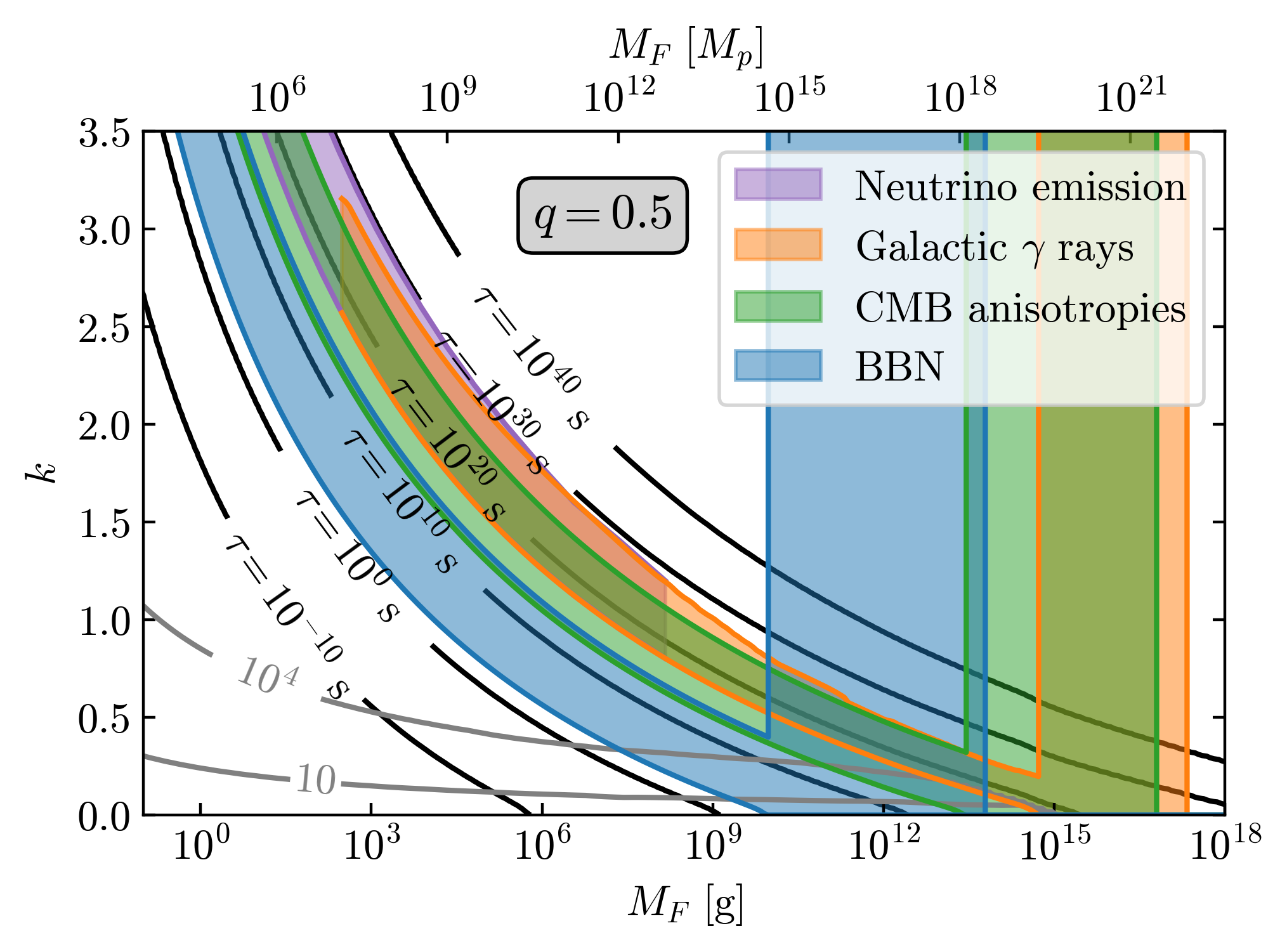
Figure 1: Case of BH evaporation with q=0.5 assuming an instantaneous transition (δ=0) without burst. Black contours represent constant lifetimes τ=tmb for PBHs subject to the MB effect.
The impact of the MB effect on existing observational constraints is significant; the consequence is a large region of parameter space where PBHs evade bounds from Big Bang Nucleosynthesis (BBN), CMB, and indirect detection.
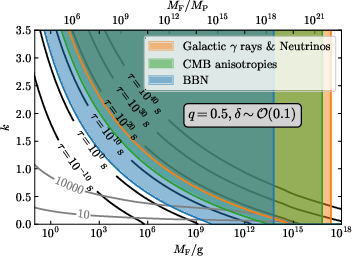
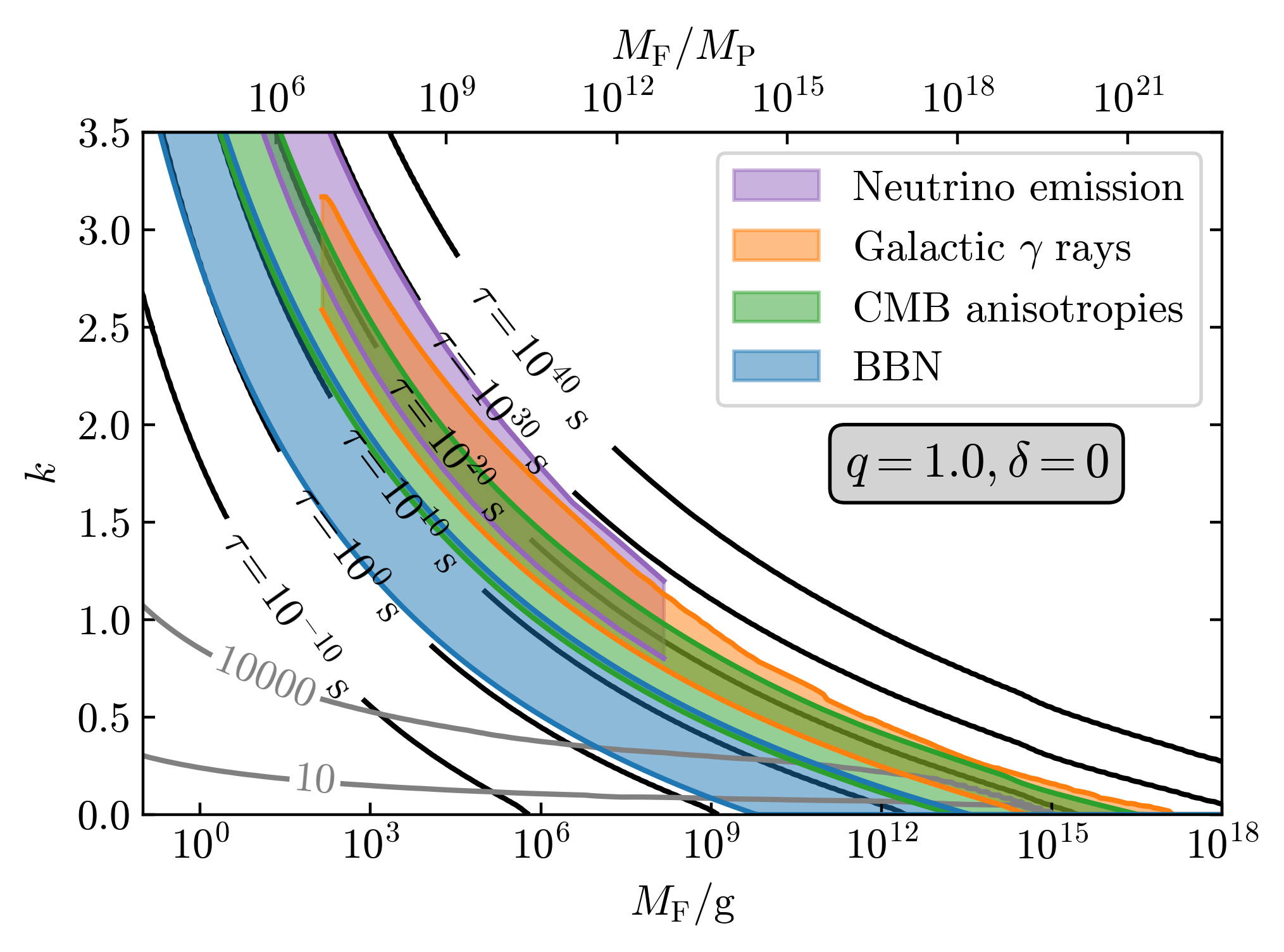
Figure 2: Illustration of the change in the constraints coverage of the parameter space when varying q or the transition smoothness TBH0.
Dark Matter Production and Abundance
PBH evaporation can generate a relic abundance of DM via direct emission of stable, weakly interacting particles. The produced DM population is a superposition of those sourced in the SC and MB phases, potentially leading to multimodal velocity distributions. The detailed time evolution is governed by coupled Boltzmann equations for radiation, DM, and PBH energy densities, incorporating the modified evaporation rates.
Key parameters determining the scenario are the initial PBH abundance (TBH1), the mass at formation (TBH2), the MB phase onset (TBH3), the entropy suppression exponent (TBH4), and the mass of the DM species (TBH5). The resulting DM abundance depends on whether PBHs dominate the cosmic energy budget before evaporating and whether evaporation completes before BBN.
Phase-Space Distributions and Velocity Structure
The DM produced by PBH evaporation is highly non-thermal. In the SC phase, the momentum distribution features a power-law high-energy tail, whereas MB-phase emission (particularly in “no burst” scenarios) yields a cutoff spectrum. Consequently, for sizable regions of parameter space, the final DM phase-space distribution is bimodal, with each component corresponding to a distinct evaporation epoch.
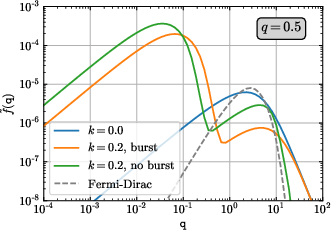
Figure 3: Rescaled momentum distributions as a function of the comoving momentum TBH6, displaying multimodal structure for MB scenarios.
Observationally, this results in a DM velocity dispersion today that is generally much larger than that of thermal WDM of similar mass. The velocity momenta, particularly TBH7, play a central role in translating these findings into constraints from small-scale structure.
Lyman-TBH8 Forest Constraints and Transfer Functions
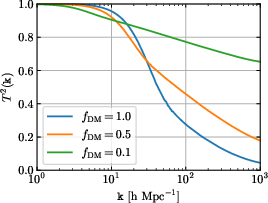
The suppression of small-scale power due to free-streaming NCDM can be measured via the Lyman-TBH9 forest. The paper recasts traditional WDM bounds using two complementary approaches:
The analysis includes scenarios where PBH evaporation contributes only a subdominant fraction of the total DM. The two-component nature of the final DM population is explicitly accounted for in the calculation of the transfer function and resultant constraints.
Comparison of the two constraint methods indicates that the area criterion is more conservative, notably for scenarios with significant CDM fractions.
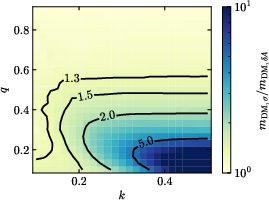
Figure 5: Ratio of the lower mass bound on NCDM from PBH evaporation derived from velocity dispersion versus area criterion in MB parameter space.
Parameter Space Analysis and Implications
A comprehensive scan of PBH and DM mass parameter space, as well as MB parameters (S2, S3), is presented. For S4 and S5, the viable DM parameter space is bounded below by inflation, above by BBN, and from the side by NCDM constraints. Increasing MB suppression (larger S6) or PBH abundance (S7) reduces the allowed DM parameter region, since late-time evaporation produces warmer DM forbidden by Lyman-S8 data.
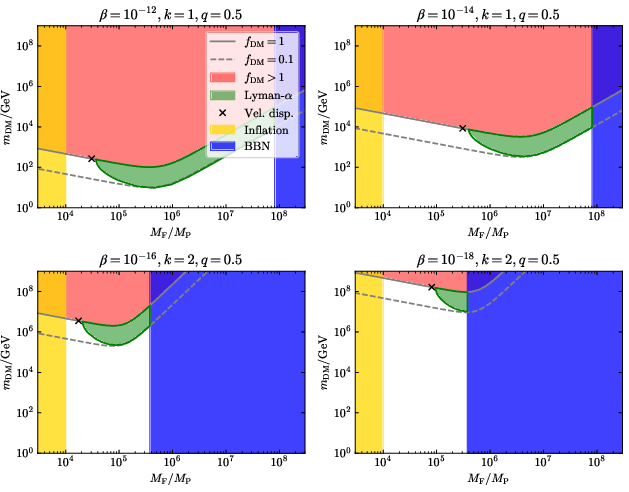
Figure 6: Allowed parameter space for DM production for S9 (top) and S−k0 (bottom); green regions are excluded by Lyman-S−k1 bounds.
A notable result is that the viable regions for achieving all of the DM abundance from PBH evaporation shrink significantly with increasing S−k2 and S−k3. In contrast, for sufficiently small S−k4, NCDM produced in the radiation-dominated era can still account for the total DM, consistent with previous findings in the absence of MB effects.
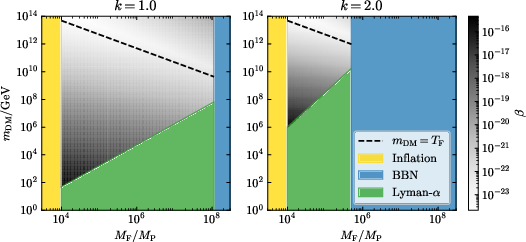
Figure 7: Parameter space illustrating the interplay between S−k5, PBH mass, and exclusion regions from inflation, BBN, and Lyman-S−k6.
Conclusion
This work demonstrates that the memory-burden effect on PBH evaporation significantly modifies the resulting dark matter phase-space properties, producing distinct multimodal and non-thermal velocity distributions in the DM sector. These modifications demand a careful reinterpretation of Lyman-S−k7 forest observations, especially when subdominant NCDM is present. The analysis shows that, even for subdominant NCDM components, stringent bounds emerge from structure-formation constraints; as a result, complete DM scenarios from PBH evaporation are only possible in early, non-dominant PBH epochs.
The explicit mapping of phase-space distributions and transfer functions provides a quantitative framework for future phenomenological studies. From a theoretical perspective, further elucidation of the precise onset and smoothness of the MB phase transition could refine the range of viable parameters. On the observational front, analyses leveraging full likelihood treatments of Lyman-S−k8 data with custom input spectra, or comparisons with other small-scale probes, will be critical to definitively constrain or rule out scenarios of PBH-sourced non-cold dark matter.
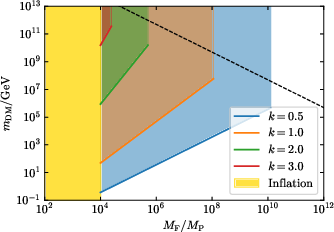
Figure 8: Allowed parameter space as a function of various S−k9 with 1≤k≤30, demonstrating the constraining power of Lyman-1≤k≤31, inflation, and BBN bounds across different MB regimes.