- The paper introduces uncertainty gating in post-hoc XAI by leveraging epistemic uncertainty as a low-cost proxy to determine explanation reliability.
- It validates the framework through experiments on multiple datasets and models, demonstrating a strong negative correlation between uncertainty and explanation stability.
- The methodology enables dynamic routing between fast and robust XAI methods, improving faithfulness while reducing computational costs.
Uncertainty Gating for Cost-Aware Explainable Artificial Intelligence
Introduction
This work systematically investigates the interplay between epistemic uncertainty and the reliability of post-hoc explanation methods, positioning epistemic uncertainty as a computationally efficient proxy for explanation reliability. The proposed framework enables dynamic allocation of explanatory resources, supporting two primary applications: (1) routing samples with high epistemic uncertainty to more expensive but reliable XAI methods, and (2) deferring or recalling explanation generation in high-uncertainty regions when under computational constraints. Experimental validation encompasses tabular data (four datasets), image classification (CNN on PlantVillage), five model families, and multiple explanation methods. The results robustly evidence a strong, monotonic negative correlation between epistemic uncertainty and explanation stability/faithfulness, confirming the viability of uncertainty-aware gating and cost control in post-hoc explainability.
Epistemic Uncertainty as a Proxy for XAI Reliability
The core motivation is to address the high and input-dependent computation cost of widely-used post-hoc explainers (e.g., SHAP, LIME, IG, SG). Traditional metrics for explanation stability and faithfulness require recomputation of explanations under perturbations, which is typically infeasible at inference time. The authors propose leveraging epistemic uncertainty estimates—readily obtained from ensemble variance (e.g., trees), MC Dropout, or surrogate models—as a prior signal for the expected reliability of explanations.
The formal epistemic gating framework routes samples based on their uncertainty, as visualized in Figure 1. In regions of low epistemic uncertainty, fast (possibly weak) explainers may suffice; high-uncertainty inputs are either routed to stronger XAI methods or explanation computation is deferred, depending on deployment constraints and application priorities.
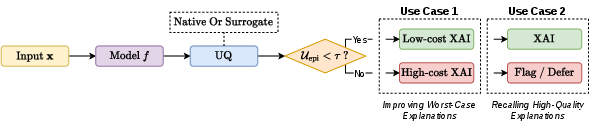
Figure 1: Epistemic uncertainty is used to gate explanation computation, either switching between cheap and expensive XAI or deferring unreliable ones under cost constraints.
The authors provide a cost-benefit model showing that for expensive explainers, even imperfect uncertainty gating yields substantial reductions in explanation overhead, as the cost of uncertainty estimation is typically orders of magnitude lower than post-hoc explanation for complex models.
Experimental Methodology
Datasets and Models
The evaluation covers the UCI Wine Quality, Dry Bean, Rice, and Ecoli tabular datasets, offering varied dimensionality, label structure, and noise profiles. For image data, a reduced PlantVillage subset is used. Models include logistic regression (bootstrap for UQ), random forests (tree variance), MLP with MC Dropout, LightGBM, CatBoost, and a VGG-like CNN for images. Surrogate UQ estimation (random forest) is used where models lack suitable native epistemic estimators.
Explanation and Stability Metrics
Compared explainers include SHAP (Tree/Kernel), LIME, IG, SG, and SIG. Explanation stability is captured by rank-based measures (Kendall's τ, Spearman's ρ) for tabular data and SSIM for images. Natural (Gaussian noise, missingness, permutation) and adversarial (gradient-based) perturbations are injected to test robustness.
Systematic Correlation Analysis
A central finding is the robust, strongly negative correlation between epistemic uncertainty and explanation stability across nearly all configurations, including model architectures, noise regimes, and explainer types. The authors introduce a systematic correlation score (XEC, Spearman ρ between epistemic growth and explanation degradation as perturbation intensity varies).
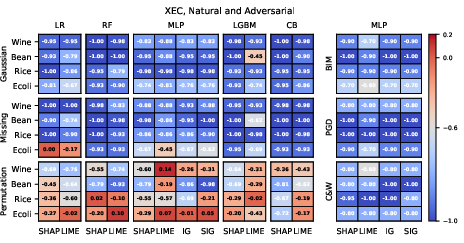
Figure 2: Heatmaps show universally strong negative XEC across datasets, models, explainers, and perturbation types, validating epistemic uncertainty as a broad predictor of XAI fragility.
Permutation-based perturbations yield weaker coupling, reflecting their tendency to break statistical dependencies rather than merely introduce noise. Noise-heavy or highly imbalanced datasets like Ecoli see reduced discriminative value in epistemic uncertainty.
Stratified and Sample-Level Reliability Validation
The effect holds at the individual sample level: when stratifying test samples by epistemic uncertainty, the low-uncertainty group consistently yields higher explanation stability under perturbation (measured by Kendall's τ, see Figure 3), while high-uncertainty samples degrade rapidly.
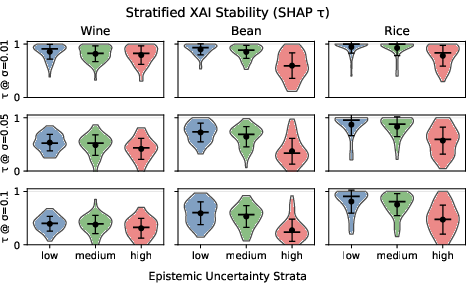
Figure 3: SHAP stability as measured by Kendall's τ is highest in low-epistemic bins and degrades as epistemic uncertainty increases, across datasets and noise strengths.
Practical Gating and Resource Allocation
Epistemic gating enables direct control of the quality–coverage–cost trade-off. At moderate to high deferral rates (e.g., skipping the top 50% most uncertain samples), nearly all retained explanations are highly stable, with cost savings from halving XAI computations and with mean explanation quality increasing with higher gating thresholds.
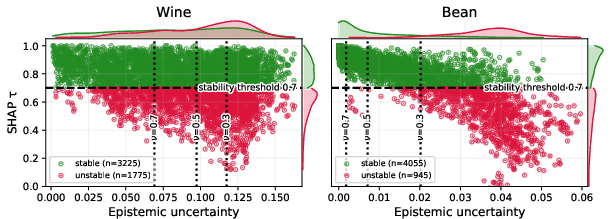
Figure 4: Epistemic uncertainty reliably separates stable (green) and unstable (red) explanations; increasing the deferral rate simplifies coverage–stability control.
The same monotonicity underpins method selection: high-cost explainers need only run on high-uncertainty inputs, maximizing XAI efficiency.
Faithfulness: Top-Feature Removal and Noise Attribution
Faithfulness experiments validate that epistemic gating does not merely reduce variance—it improves semantic correctness. Removing top-k SHAP-ranked features in low-epistemic samples results in maximal prediction shift (in log-odds MSE), confirming feature relevance and local explanation validity. In high-epistemic samples, feature removal yields little effect, indicating misleading or spurious attribution.
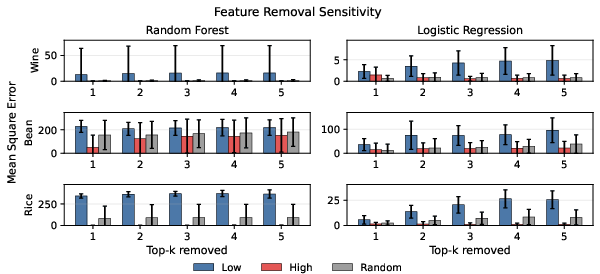
Figure 5: Faithfulness by prediction shift after feature removal; low-epistemic explanations induce stronger output change, reflecting higher attribution validity.
Further, attribution mass analysis (see Figure 6) demonstrates that low-epistemic explanations remain focused on signal rather than noise features, while high-epistemic cases drift toward noise, confirming the reliability of epistemic uncertainty as a faithfulness indicator.
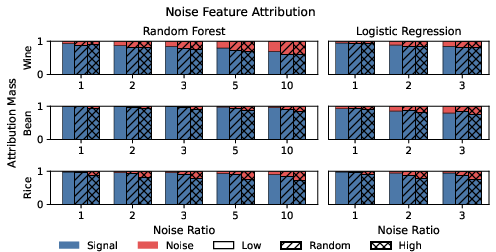
Figure 6: Attribution mass in low-epistemic bins remains highly concentrated on genuine signal features even as the noise-to-signal feature ratio grows.
Generalization to Vision
Validation on image classification (PlantVillage, CNN) corroborates the main findings: epistemic uncertainty (from MC Dropout) and explanation stability (SSIM on IG/SG saliency maps) show nearly perfect negative rank correlation under noise injection.
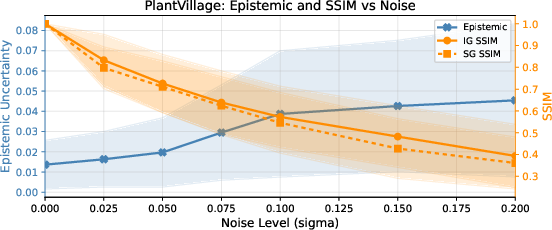
Figure 7: As input noise increases, epistemic uncertainty rises monotonically while IG/SG explanation stability (SSIM) falls, yielding ρ=−1.0.
Qualitative inspection of IG/SG maps (Figure 8) demonstrates that low-epistemic samples yield locally focused, semantically meaningful, and stable explanation maps. High-uncertainty samples produce diffuse, structurally unstable, and unreliable explanations.
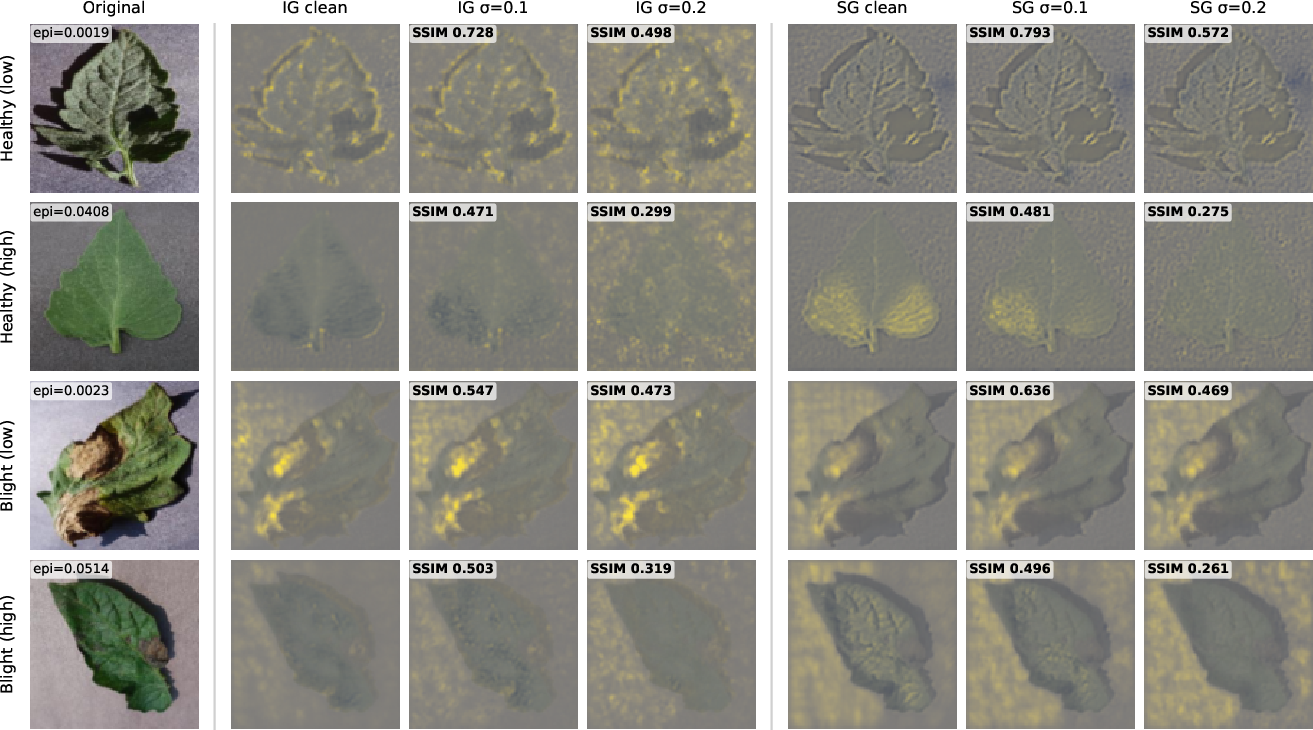
Figure 8: Low-epistemic examples show disease- and structure-focused, stable saliency, while high-epistemic samples yield noisy and degraded explanations.
Implications and Future Directions
Theoretical Implications:
The work provides empirical justification for using epistemic uncertainty—reflecting lack of model support, out-of-distribution effects, or proximity to ill-posed decision boundaries—as a stability and faithfulness criterion for XAI, establishing a more nuanced and actionable perspective than solely input-agnostic or a posteriori reliability checks. The findings concur with recent studies on the instability and manipulability of post-hoc XAI (Ribeiro et al., 2024, Alvarez-Melis et al., 2018) and provide a practical pipeline for uncertainty-aware deployment.
Practical Implications:
Epistemic gating is maximally impactful when XAI computation is costly (e.g., LIME, KernelSHAP), or when explanation coverage is optional (e.g., compliance auditing, trust calibration, or user-facing just-in-time explanations). For settings needing per-sample explanation quality or trust estimation, epistemic uncertainty serves as a reliability score that can be surfaced for human-AI decision support calibration.
Surrogate UQ estimation via random forests is shown to work effectively when native estimators are unavailable, although future work must address misalignment risks when the surrogate’s decision boundaries deviate from those of the target model.
Limitations and Future Work:
The stratification power of epistemic uncertainty is dataset-dependent; high label noise or weak model–data fit reduce its discriminative value. Extension to regression, structured prediction, or reinforcement learning remains open, as does theoretical analysis linking explanation stability/faithfulness and localized epistemic measures under more general conditions.
Conclusion
The paper demonstrates that epistemic uncertainty is an effective, low-cost gating signal for cost-aware and quality-aware explanation in post-hoc XAI. It consistently separates robust, semantically valid attributions from unstable and unfaithful ones, as validated by both stability and intervention (faithfulness) metrics. This supports both dynamic method selection and explanation deferral, providing practical tools for deploying explanation pipelines in large-scale, resource-constrained, or human-facing applications. The proposed methods generalize across models, explainers, datasets, and data modalities.
Epistemic gating should be incorporated as a principal component of any XAI pipeline where reliability and efficiency are required, and epistemic uncertainty surfaces should be exposed for human trust calibration and system auditing.
Reference:
"Uncertainty Gating for Cost-Aware Explainable Artificial Intelligence" (2603.29915)

