- The paper presents a novel framework that integrates dMRI and rs-fMRI by leveraging cell complexes to capture higher-order brain interactions.
- It employs Hodge decomposition to separate edge signals into gradient, curl, and harmonic components, mapping them onto biologically interpretable brain flows.
- Empirical analysis demonstrates robust mesoscale organization and significant brain-behavior correlations, suggesting new biomarkers for cognitive performance.
Topological Signal Processing for Multimodal Higher-Order Brain Networks
Introduction
The limitations of graph-based models in characterizing brain connectomics have motivated the deployment of topological approaches such as cell complexes that capture higher-order interactions (HOIs) and flows beyond dyadic relations. The paper "Multimodal Higher-Order Brain Networks: A Topological Signal Processing Perspective" (2603.29903) develops a principled framework using Topological Signal Processing (TSP) over data-driven brain complexes, integrating diffusion MRI (dMRI) and resting-state fMRI (rs-fMRI). Edge-centric functional signals are endowed with discrete vector calculus, supporting gradient (potential-driven), divergence (source-sink), and curl (circulatory) decompositions which can be directly mapped onto observed brain dynamics and higher-order motifs.
Topological Signal Processing on Cell Complexes
The core mathematical foundation extends GSP to cell complexes, enabling the explicit representation of non-dyadic, polygonal interactions and associated linear algebraic machinery (incidence, boundary operators, and Hodge Laplacians). This enables the decomposition of edge signals into mutually orthogonal subspaces: gradient (irrotational), curl (solenoidal/circulatory), and harmonic (cycle-based). Operators such as divergence and curl gain physical interpretability: divergence quantifies net flow into/out of nodes (markup of sources and sinks), and curl quantifies cyclic flows over polygonal faces.
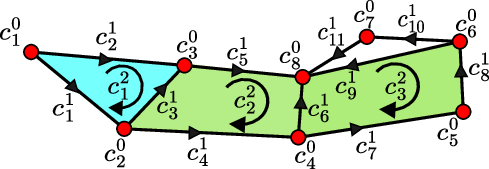
Figure 1: An example of a CC of order 2, illustrating nodes, edges, and polygonal faces with orientations enabling higher-order signal processing.
Crucially, the framework leverages cell complexes as opposed to simplicial complexes, allowing for general polygonal HOIs—triangles, quadrilaterals, pentagons—and avoiding restrictions to complete cliques or simplexes. The topological representation of fMRI-based functional flows with a structurally constrained, learned cell complex provides both computational efficiency and biological plausibility.
Multimodal Cell Complex Learning
The methodology involves three data-driven steps per subject:
- Statistical validation of dMRI-derived structural edges to define a sparse, admissible backbone.
- Extraction of time-resolved, phase-coherence-based functional edge signals from rs-fMRI on this backbone.
- Inferring higher-order polygons (HOIs) via sparse signal modeling, capturing the minimal 2-cell set that explains the observed edge dynamics using iterative joint optimization on signal circulations and spectral compactness.
Structural and functional modalities are thus integrated in complex learning, with Hodge-decomposition enabling downstream flow analyses.
Empirical Analysis: Individualization and Mesoscale Organization
Subject-specific brain 2-cell complexes inferred over 100 HCP subjects exhibit strong individualization at the node level, especially for HOIs of greater cardinality (pentagons and quadrilaterals), but reveal robust, reproducible mesoscale structure when aggregated by functional subsystem composition. Empirical HOI distributions significantly deviate from phase-randomized surrogates, indicating their statistical and biological specificity.
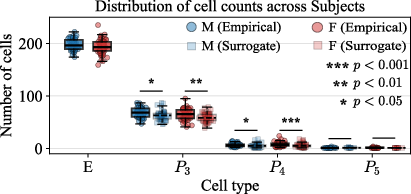
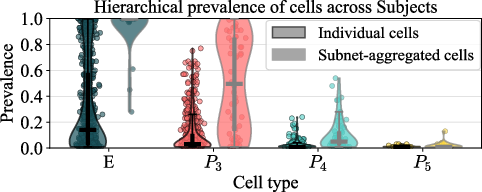
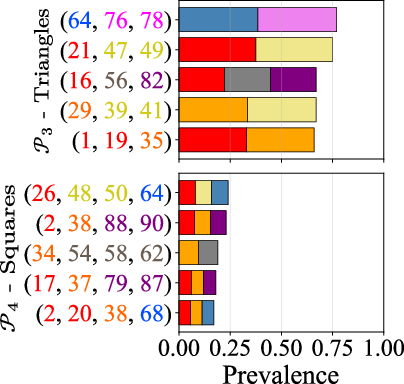
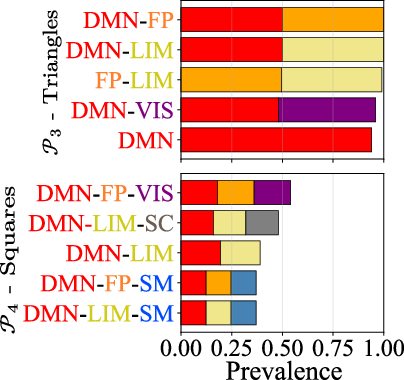
Figure 2: Distribution and recurrence of subject-specific edges and higher-order cells across subjects, and their aggregation into shared mesoscale functional motifs.
Pairwise (edge) Jaccard similarity is moderate across subjects, but HOI node-level similarity drops sharply, remaining low for triangles and near-zero for larger polygons. However, after functional-system aggregation, inter-subject similarity increases dramatically, demonstrating scale-dependence of higher-order brain topology: micro-level motifs are highly individualized, while mesoscale structures are robust.
Hodge Decomposition: Dominant Gradient and Rotational Flows
Discrete Hodge decomposition allows for direct separation and mapping of significant gradient and rotational flows underlying resting-state dynamics. Data-driven spectral filtering identifies and visualizes large-scale, DMN-centered potential flows (gradients), and localized, limbic-centered rotational flows (curls).
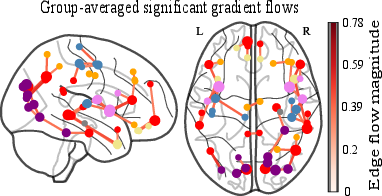
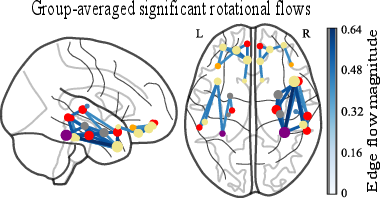
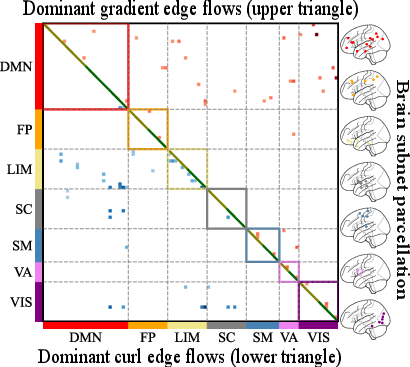
Figure 3: Dominant gradient and rotational flows: DMN-anchored integrative gradient backbones versus limbic-circuit mediated rotational motifs.
Gradient flows constitute a distributed integration scaffold between DMN and VIS/FP/LIM networks, consistent with macroscale cortical hierarchy theories and resting-state mode structure. Rotational flows instead localize within limbic, DMN, and subcortical circuits, inaccessible via graph-based models.
Divergence: Mesoscale Source-Sink Polarization and Behavioral Correlates
Divergence analysis at the functional-system level reveals strong, subsystem-dependent source-sink polarizations that significantly differ from null models. VA, VIS, and LIM subsystems consistently act as net sources, whereas DMN is a persistent sink. SC divergence is tightly centered near zero, implying a dynamically balanced mediating role.
Behaviorally, median limbic divergence correlates robustly (|R|>0.4, Bonferroni corrected) with fluid intelligence, while higher subcortical divergence is negatively associated with executive flexibility.
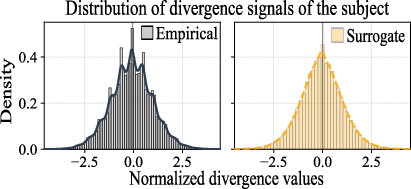
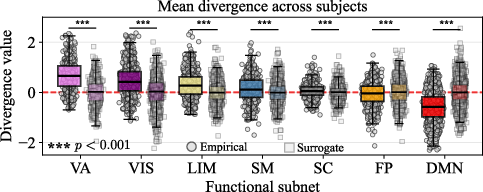
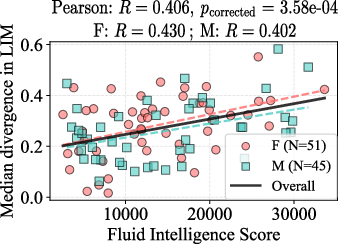
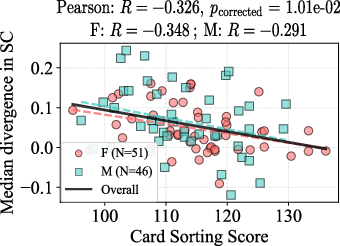
Figure 4: Mesoscale source-sink organizational polarity and significant associations between divergence patterns and cognitive performance.
Curl: Rotational Regimes, Occupancy, Dwell Times, and Behavioral Correlates
Curl-based analysis identifies three robust regimes in the z-scored circulation: strong (high-amplitude), predominant (modal), and conservative (near-zero). These regimes differentially occupy subsystem interfaces, with DMN-FP-LIM triangles exhibiting longest dwell-times and maximal occupancy in predominant and strong circulation modes. Null model comparison confirms the empirical specificity of these occupancy/dwell statistics.
Significant associations include: prolonged strong DMN-LIM regime dwell time with lower language comprehension, high FP-LIM predominant-regime occupancy with improved motor dexterity, and extended conservative DMN-LIM dwell linked to larger receptive vocabulary.
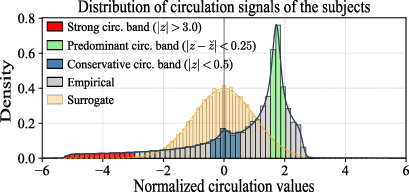
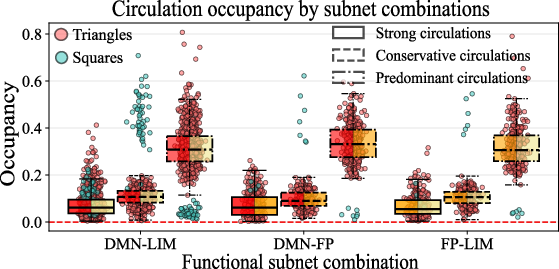
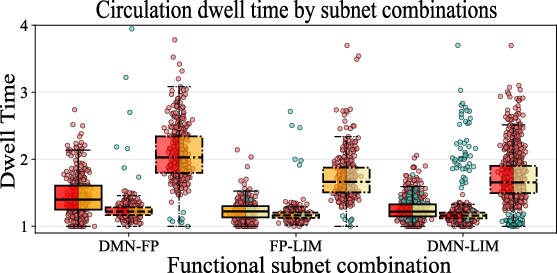

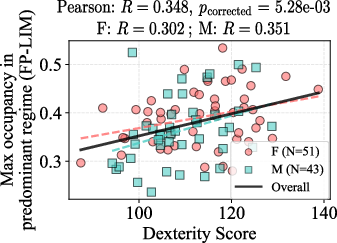
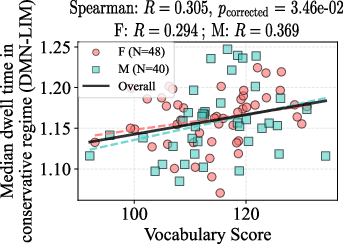
Figure 5: Mesoscale rotational regime distributions, occupancy, dwell times, and statistically significant brain-behavior associations at the subsystem interface level.
Implications and Outlook
By extending signal processing operators to cell complex-based brain models, this framework makes physically interpretable quantities (divergence, curl, gradient flows) directly measurable from multimodal neuroimaging. It establishes higher-order topological fingerprints for individual connectomics and behaviors, complementing classical network metrics and enabling the study of circulation-supported coordination not represented in graph models.
Practically, this permits the development of new biomarkers based on topological flow features, advancing individualized stratification, neurocognitive phenotyping, and the potential for more granular brain-behavior mapping. Theoretically, the strong scale dependence—individualized micro-level structure, robust mesoscale organization—has implications for model expressivity and interpretability.
Future extensions may target fine-grained temporal structure, integration with non-linear multivariate HOI statistics, embedding within deep topological learning architectures, or generalization to pathological cohorts and dynamic monitoring, aligning with the recent surge of interest in higher-order network models in computational neuroscience and AI.
Conclusion
This work delivers a comprehensive, multimodal TSP framework for structure-function modeling that goes beyond conventional connectomics through the explicit learning of brain cell complexes and direct characterization of higher-order flows. The deployment of Hodge theory provides an interpretable, physically grounded decomposition of complex brain dynamics, uncovers robust mesoscale organization atop highly individualized node-level topologies, and establishes direct links between topological features and cognition. The framework positions topological signal processing as a critical methodology for next-generation network neuroscience and lays the groundwork for future topological AI models sensitive to HOIs and the multiscale functional geometry of brain networks.