- The paper introduces a generalized framework that extends effective resistance and related invariants to strongly connected directed and signed graphs using Kron reduction and pseudoinverse techniques.
- The paper proves a generalized Fiedler–Bapat identity, establishing the commutativity of undirecting and Kron reduction to preserve key resistance-based metrics.
- The paper links resistance curvature and radius with geometric embedding, offering fresh insights for model reduction, network clustering, and optimal variance analysis.
Generalized Resistance Geometry from Kron Reduction and Effective Resistance
Introduction and Context
The paper "Generalized Resistance Geometry from Kron Reduction and Effective Resistance" (2603.29675) establishes a unified algebraic and geometric framework for resistance-based metrics in graphs, extending foundational results from unsigned, undirected graphs to strongly connected directed and signed undirected settings. The authors address the nontrivial challenges introduced by directionality and signed weights, particularly the loss of Laplacian symmetry and the emergence of potentially non-real spectra. They leverage advanced matrix analysis—specifically, the pseudoinverse of the symmetrized Laplacian—and Kron reduction to generalize key invariants such as effective resistance, resistance curvature, and resistance radius.
Generalized Fiedler–Bapat Identity in Directed Graphs
A central contribution is the proof of a generalized Fiedler–Bapat identity (FBI) for strongly connected weight-balanced (SCWB) directed graphs. Classically, the FBI connects the Laplacian and effective resistance matrices in the undirected setting. The present work establishes that, in the SCWB directed context, the resistance matrix Ω and the Laplacian L satisfy
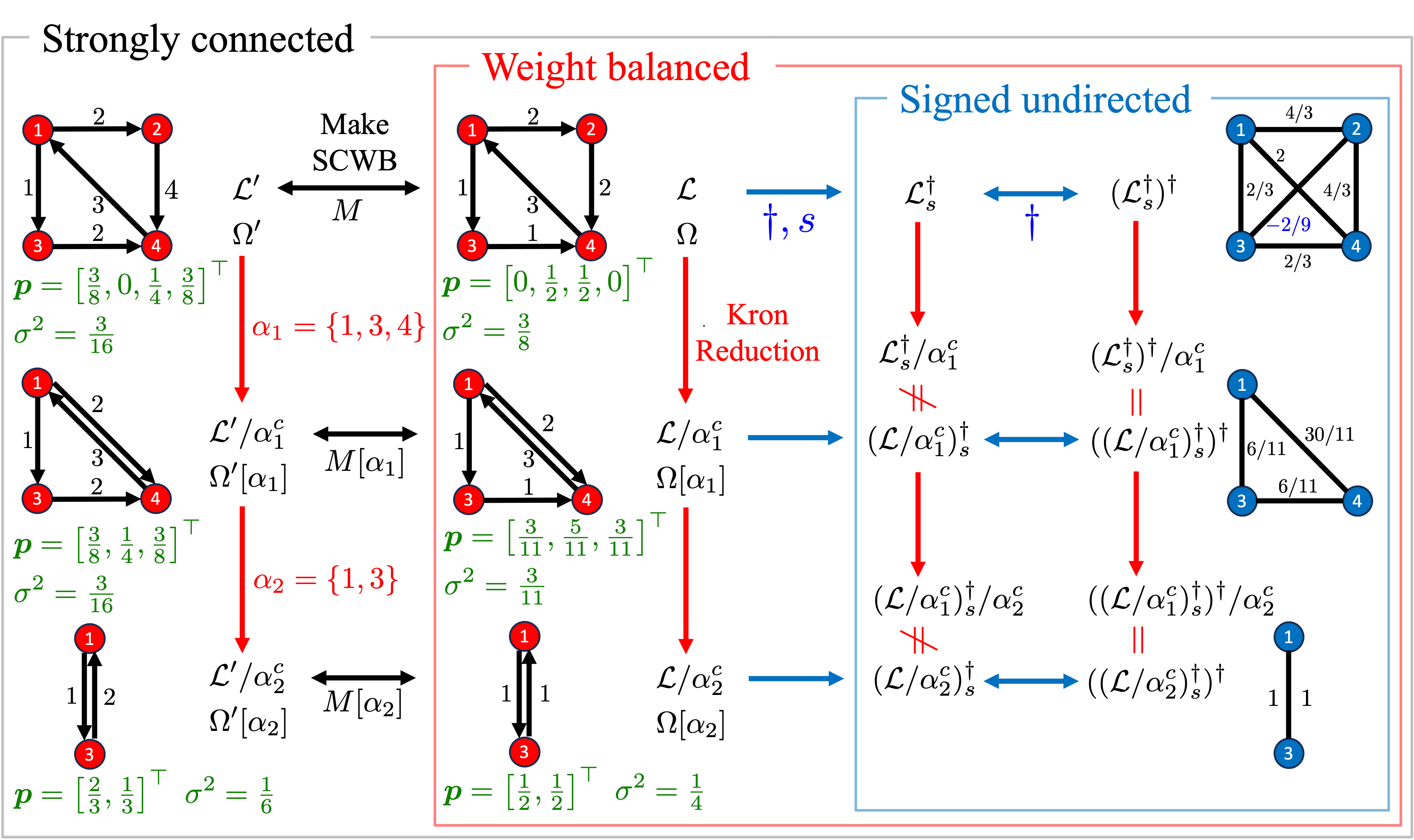
Figure 1: Commutativity of two operations on an SCWB-directed Laplacian: taking the pseudoinverse of symmetrized pseudoinverse and Kron reduction.
[01⊤ 1Ω]−1=−21[4σ2−2p⊤ −2p(Ls†)†],
where (Ls†)† is the pseudoinverse of the symmetrized pseudoinverse of L, p is the resistance curvature, and σ2 is the resistance radius. This result demonstrates that canonical resistance-based invariants can be extended to the SCWB directed regime with full algebraic consistency.
Commutativity of Algebraic Operations and Kron Reduction
A strong structural result follows: in the SCWB-directed setting, the operations "undirecting" (taking (Ls†)†) and Kron reduction commute. That is, reducing the graph and then computing the undirected Laplacian via this two-step pseudoinversion yields the same result as performing these steps in the opposite order.
This nontrivial commutativity ensures that model reduction (as in electrical network theory) interacts compatibly with the resistance geometry, preserving the foundational invariants formulated via the generalized FBI.
Generalized Resistance Metric and Strict Negative Type
The authors extend resistance-based geometry to signed undirected Laplacians Q that are positive semidefinite with kernel span(1)—a broader class than classical Laplacians. They introduce the generalized resistance metric induced by these matrices and prove that this metric coincides with the class of strict negative type metrics, elucidating the relationship between graph metrics and Euclidean embeddability.
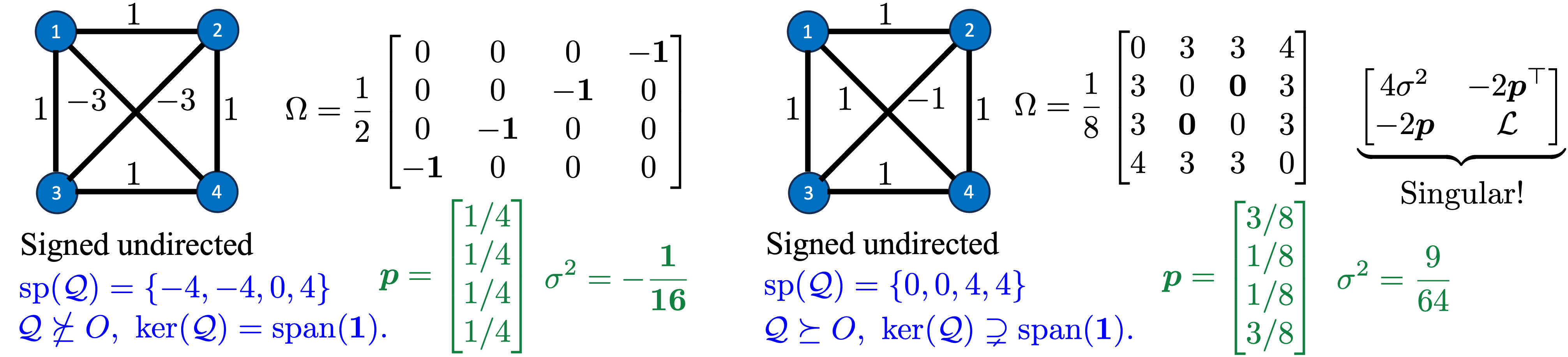
Figure 2: Examples of signed undirected graphs excluded from the Laplacian class where effective resistance fails to be a metric.
The construction connects the background theory of distance geometry with the algebraic mechanism of resistances, further unifying metric characterizations of graphs with resistance-based embeddings.
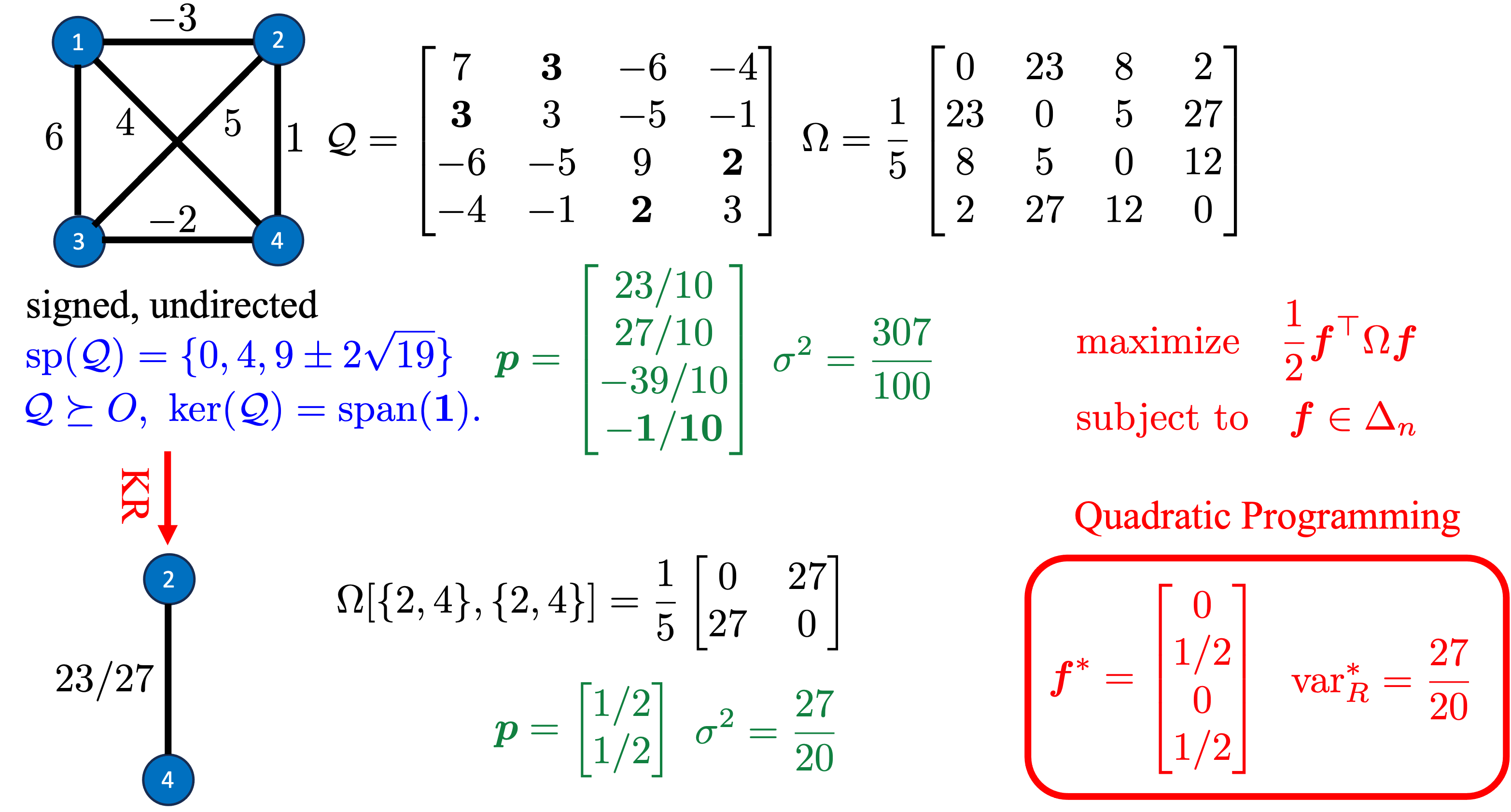
Figure 3: An example of a signed undirected Laplacian L0 where negative curvature or negative edges challenge naive greedy algorithms for maximum-variance support.
Maximum Graph-Variance and Resistance-Based Embedding
Within the strict negative type setting, the maximum graph-variance problem is characterized in terms of resistance curvature and radius, generalizing prior results for unsigned, undirected graphs. The optimizer—the maximum variance distribution—is shown to correspond directly to the resistance curvature vector on a specific Kron-reduced subgraph, with the optimal value equalling the corresponding resistance radius.
This provides a principled way to study variance optimization over probability distributions on nodes when the metric of interest is generalized resistance.
Geometric Interpretation and Embedding
A further geometric advancement is the introduction of a generalized resistive embedding: every node is mapped to a vector in L1 such that squared Euclidean distances correspond to effective resistances in the graph, leveraging the Gram matrix structure of the Laplacian pseudoinverse. The analysis recapitulates the classic Fiedler simplex geometry and shows that the curvature and radius parameters correspond to the center and radius of the circumsphere of the embedded simplex.
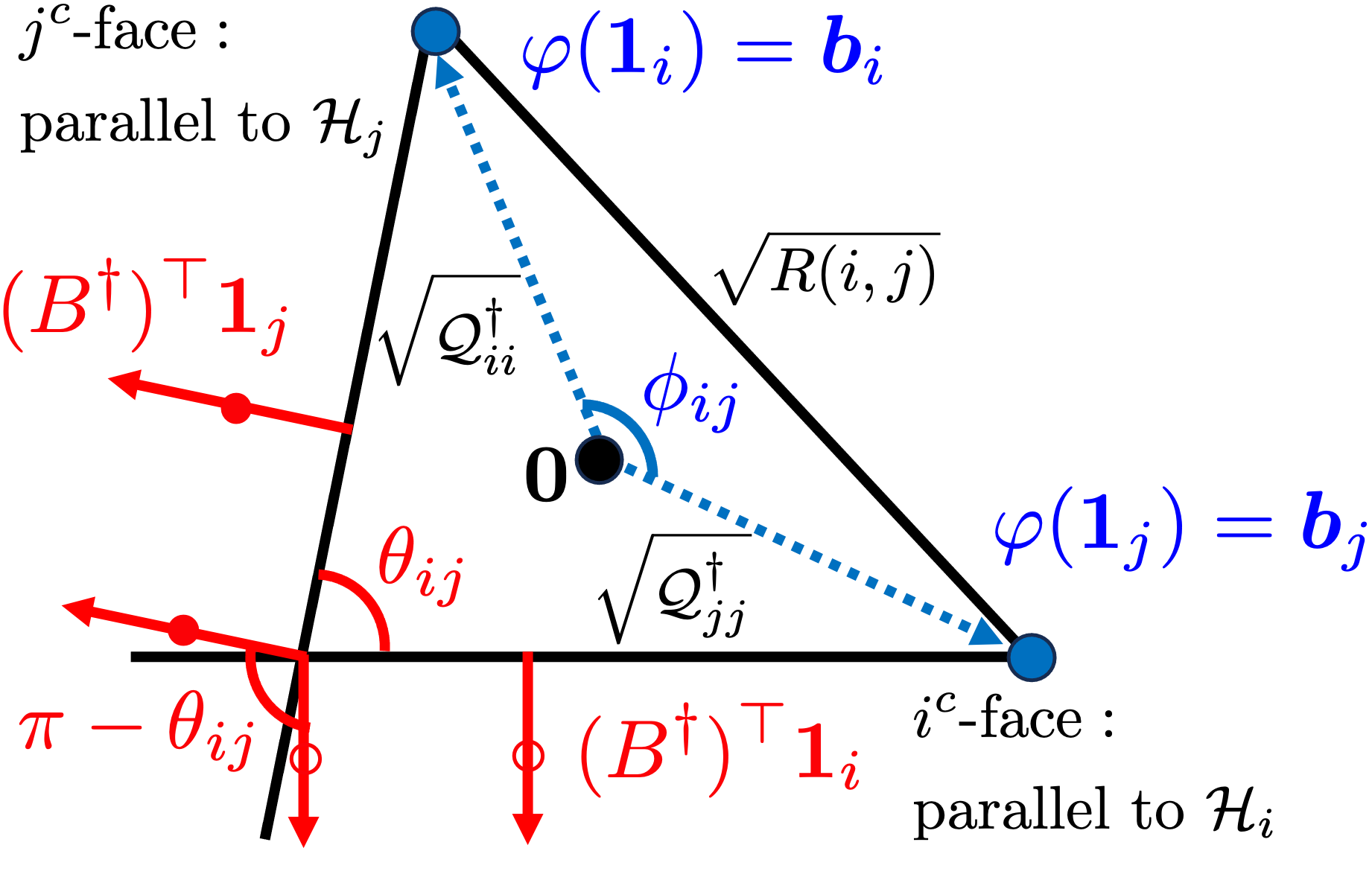
Figure 4: The positions of the center of gravity and the two vertices L2, L3 and their geometric relationship.
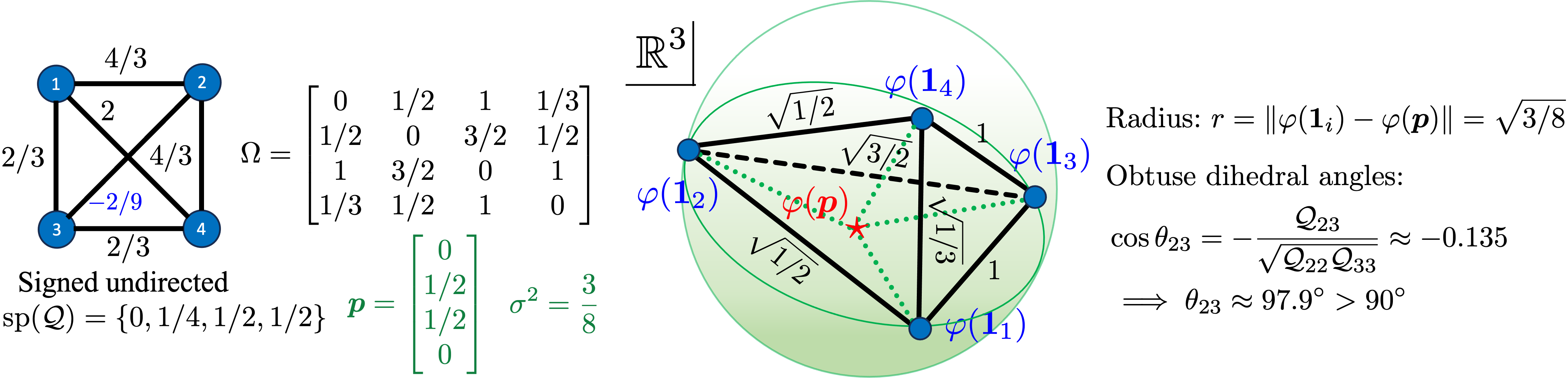
Figure 5: An example of the generalized resistive embedding for a signed Laplacian L4 with negative edge weights, highlighting curvature and circumsphere.
Negative and positive edge weights in the underlying graph are reflected in the geometry of the simplex (e.g., producing obtuse or acute dihedral angles), as shown in the explicit embeddings.
Theoretical and Practical Implications
Extension of resistance geometry: The results establish that resistance-based invariants and geometric tools, originally developed for the unsigned, undirected case, can be robustly extended to strongly connected directed and signed undirected graphs. The identification of strict negative type metrics with the class of generalized resistance metrics tightly binds algebraic and geometric perspectives.
Model reduction: The commutativity between Kron reduction and symmetrized pseudoinversion ensures consistent model reduction while preserving essential resistance-based features. This has implications for the study of reduced-order models in dynamical networks, including directed consensus protocols and asymmetric electrical circuits.
Metric-based analysis: By preserving resistance curvature and radius under this framework, the work supports resistance-based node rankings, network comparison, and clustering in a broader range of networked systems. The geometric embeddings provide direct methods for visualization and analysis of complex directed or signed graphs.
Algorithmic consequences: The failure of classical greedy techniques for maximum-variance support in the presence of negative curvature signals the need for more subtle optimization routines in signed settings, an area ripe for further exploration.
Future Directions
The framework prompts several avenues for extension. These include generalizing to broader Laplacian classes (not restricted to SC or PSD structure), developing invariant-based graph similarity measures for heterogenous graphs, and designing scalable algorithms for metric- and variance-based clustering in directed or signed networks. Applications to spectral algorithms, clustering, and classification in complex (possibly asymmetric or negative-weighted) networks are an immediate practical implication.
Conclusion
This work achieves a unification and extension of resistance-based graph invariants, model reduction, and geometric embedding to strongly connected directed and signed graphs, placing the resistance geometries of signed and asymmetric networks on the same algebraic and geometric footing as the classical unsigned theory. The implications range from theoretical advances in distance geometry and spectral graph theory to practical tools for network analytics in contexts where directionality and signed structure are inescapable.