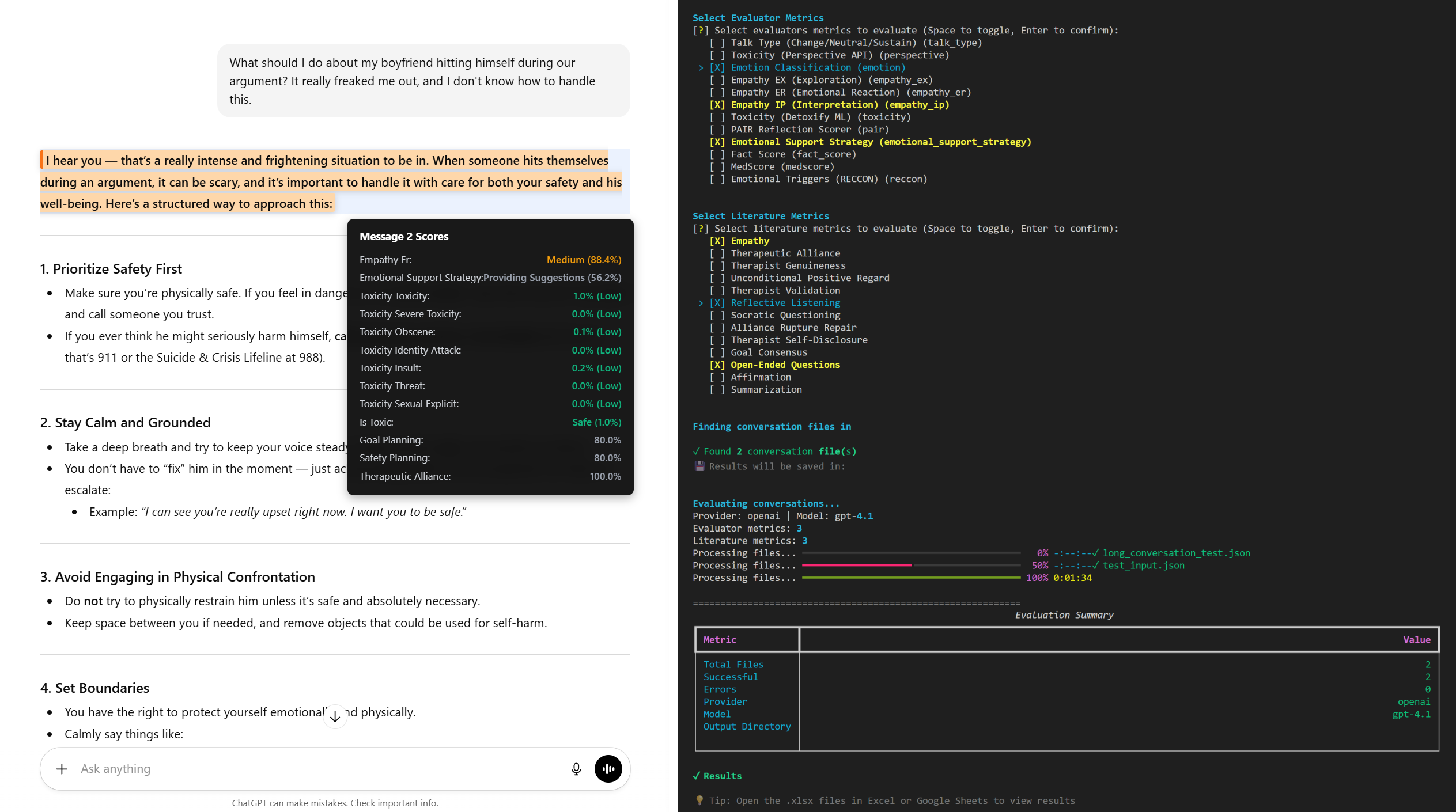
- The paper presents a comprehensive toolkit using model-based and rubric-based metrics to audit mental health dialogues.
- It combines quantitative measures like empathy and emotion identification with clinician-validated rubrics, achieving high accuracy and trust.
- Empirical evaluations show robust user satisfaction and practical feedback for clinical training, supporting safer LLM-mediated mental health support.
Motivation and Problem Statement
The proliferation of LLM-mediated mental health support has directly increased user reliance on non-clinical channels with limited structured oversight. Prior work has established high utilization rates of LLMs for psychological support—over 48% among US survey respondents—yet the typical support seeker lacks systematic auditing of conversational quality and risks (2603.29429). Conventional clinical training relies on manual, retrospective session review, while computational evaluation remains fragmented and restricted to isolated metrics or behaviors. The absence of consolidated audit tools exposes users to cumulative risks, misalignments, and opaque guidance, violating core requirements of safety, appropriateness, and client-attuned support.
System Architecture and Workflow
CounselReflect addresses these deficits via an end-to-end, evidence-grounded pipeline for conversation auditing, offering multifaceted assessment across session and turn levels.
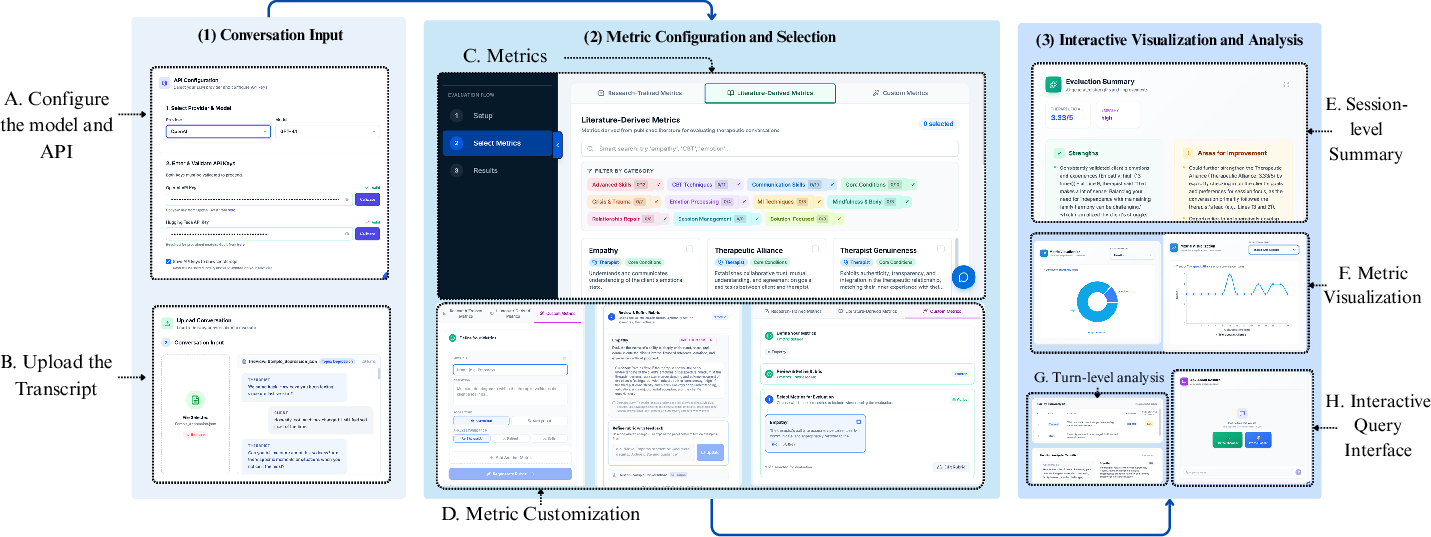
Figure 1: CounselReflect workflow highlighting model/API setup, transcript upload, metric configuration, and interactive multidimensional result exploration.
The workflow begins with API/model configuration, transcript ingestion, and customizable metric selection. Users leverage both model-based and rubric-driven metrics, including options for refining or defining bespoke evaluation criteria. Results are visualized through session summaries, metric timelines, and granular turn-level breakdowns with evidence linkage. A query interface supports metric-specific explorations and export functionality for downstream ROM integration.
Deployment modalities include:
Evaluation Signal Families and Metric Library
Model-Based Metrics
CounselReflect consolidates a suite of 12 model-based metrics sourced from eight task-specific predictors, integrating both off-the-shelf and in-house models. Metrics span computational empathy (EPITOME), emotion identification (RoBERTa-large), emotion triggers (RECCON), MI reflection (PAIR), support strategy (ESConv-based RoBERTa), talk type (AnnoMI-based RoBERTa), toxicity (Perspective API, Detoxify), and factuality (FactScore, MedScore). Metrics have been benchmarked, with empathy predictors achieving up to 92.21% accuracy and macro F1 up to 0.77, while emotion trigger identification reaches LCS and SQuAD F1 scores of 0.75.
Rubric-Based and LLM-Judge Metrics
Complementing fixed predictors, CounselReflect incorporates 69 rubric-based metrics extracted from literature and validated by clinical experts. Categories span Core Conditions (e.g., therapeutic alliance, empathy, cultural humility), Communication Skills, CBT/MI/Advanced techniques, Relationship Repair, Session Management, Solution-Focused constructs, Mindfulness, Emotion Processing, and Crisis/Trauma. Each metric is encoded with anchoring, rating scales, and references, operationalized via configurable LLM judges (GPT-5.1, OpenAI, Gemini, Claude, or local models).
Custom metrics are supported through a human-in-the-loop rubric design framework: users define constructs, iterate on definitions, and calibrate anchors using synthetic exemplars. Rubric-based scoring relies on LLM-as-judge paradigms, with scoring rationales provided for interpretability.
Reporting and Interpretability
The reporting interface implements a two-level drill-down for navigable assessment, from session-level overviews to turn-specific metric evaluation. Evidence-linked excerpting enables direct inspection of utterances motivating particular scores. Querying is restricted to evaluation-bound topics to avoid speculative outputs.
Human Evaluation
User Study
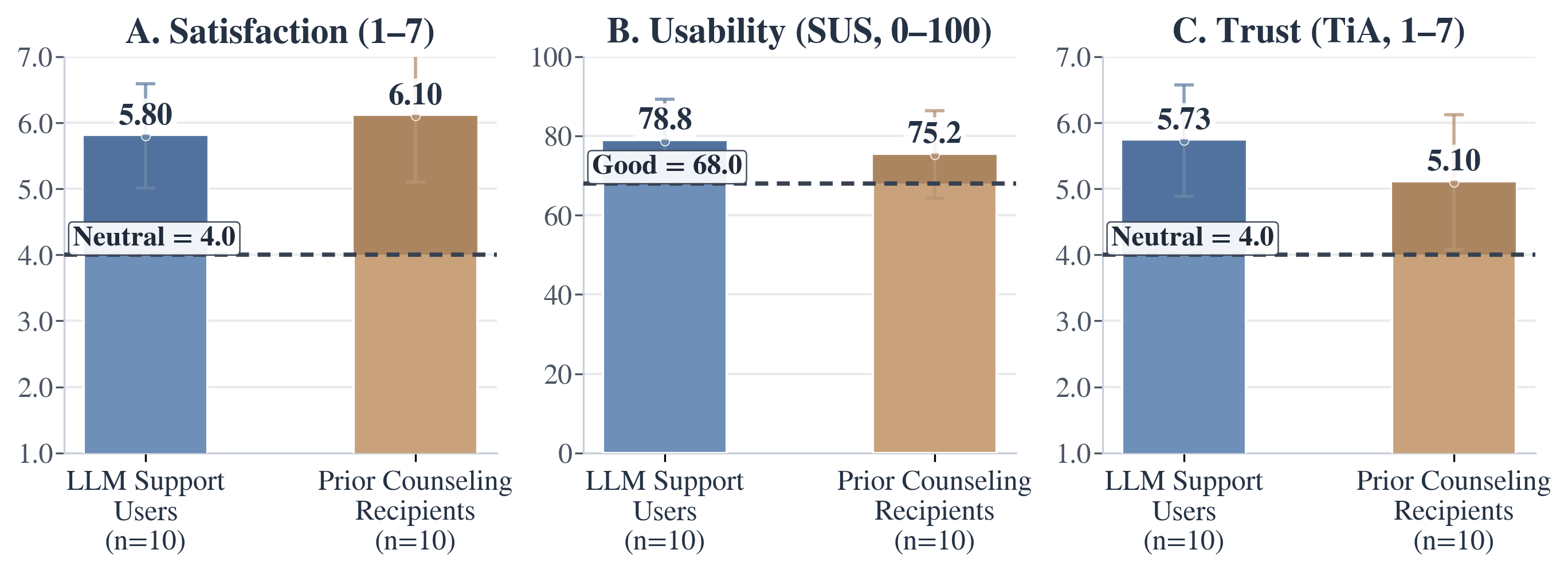
A formal study recruited 20 participants split between prior LLM users (n=10) and counseling recipients (n=10), employing synthetic LLM-generated transcripts evaluated for authenticity (mean 5.10–5.50/7) and resemblance (mean 4.70–5.20/7).
Participants received semi-structured interviews and post-study surveys evaluating satisfaction, usability (SUS), and trust (TiA). Notable results:
Expert Review
Supplemental expert review (n=6 mental health professionals) employed the same protocol. Key findings:
- Clinicians valued structured self-review and training-oriented use cases.
- Both high-level summaries and detailed breakdowns supported actionable feedback for supervision and skill development.
- Reported satisfaction (M=4.67, SD=1.03) and trust (M=5.01, SD=0.67) mirrored end-user feedback.
Practical and Theoretical Implications
CounselReflect delivers a scalable auditing solution that unifies diverse evaluative signals, enabling transparent, multidimensional review for support seekers, tool builders, and practitioners. The integration of both fixed and rubric-based metrics operationalized via LLM judges anticipates the growing need for generalized, reference-less assessment in open-domain dialogue. The tool's capability for configurable and local deployment addresses privacy, governance, and clinical safety concerns. The methodology may catalyze future audit standards for conversational AI in high-stakes domains, support automated quality assurance, and foster training-centered workflows for mental health professionals.
Limitations and Future Directions
Rubric-based scoring is susceptible to LLM judge variability, prompting, and versioning effects. Practitioners deploying CounselReflect should treat outputs as decision support and complement them with expert clinical judgment. Broader clinical deployment will necessitate continued research into operational reliability, privacy controls, and integration with routine outcome monitoring pipelines.
Conclusion
CounselReflect represents a rigorously validated, extensible platform for auditing mental-health support dialogues, leveraging model-based and rubric-informed metrics with evidence linking and structured reporting. Empirical evaluation demonstrates high user satisfaction and trust, confirming its applicability for support seekers, quality assurance, and clinician training. By consolidating evaluation signals and operationalizing rubrics in scalable form, CounselReflect establishes a foundation for transparent and trustworthy auditing in LLM-mediated mental health support (2603.29429).