- The paper introduces a novel self-consistency method for verifying LLM-generated motion trajectories via transformation invariance.
- It designs a hierarchy of Lie groups and invariant distance metrics to cluster diverse trajectories and identify the most consistent sample.
- Experimental results demonstrate 4–6% accuracy improvements and higher precision in verification compared to baseline LLM and VLM strategies.
Self-Consistency for LLM-Based Motion Trajectory Generation and Verification
This paper investigates the extension of self-consistency techniques to the visual domain, specifically the synthesis and verification of motion trajectories in graphics generated by LLMs (2603.29301). While self-consistency has proved effective for natural language reasoning—where consistency is defined as output identity or simple equivalence—the authors identify a more nuanced notion of consistency is required for geometric outputs, such as motion trajectories resulting from text prompts (e.g., "Move the circle in a spiral path").
The central insight is to formalize shape families as equivalence classes defined via prototype trajectories and parameterized transformation groups (rigid, similarity, affine, etc.), such that two trajectories are considered consistent if one can be transformed into the other by a permissible geometric warp. This allows the adaptation of self-consistency: instead of identity voting, the pipeline clusters LLM-generated samples by their geometric similarity under transformation invariance, then selects the largest cluster to represent the most probable prompt-consistent behavior.
Methodology
The approach relies on a hierarchy of Lie transformation groups reflecting common geometric invariances observed in motion graphics, including:
- Rigid (SE(2)): translation and rotation,
- Rigid + reflections (E(2)),
- Similarity (Sim+(2)): translation, rotation, uniform scaling,
- Similarity + reflections (Sim(2)),
- Affine (Aff(2)),
- Anisotropic similarity: translation, rotation, non-uniform scaling (no shear).
For each group, they derive an invariant distance metric, computed using a generalized iterative closest point (ICP) algorithm, to quantify shape consistency.
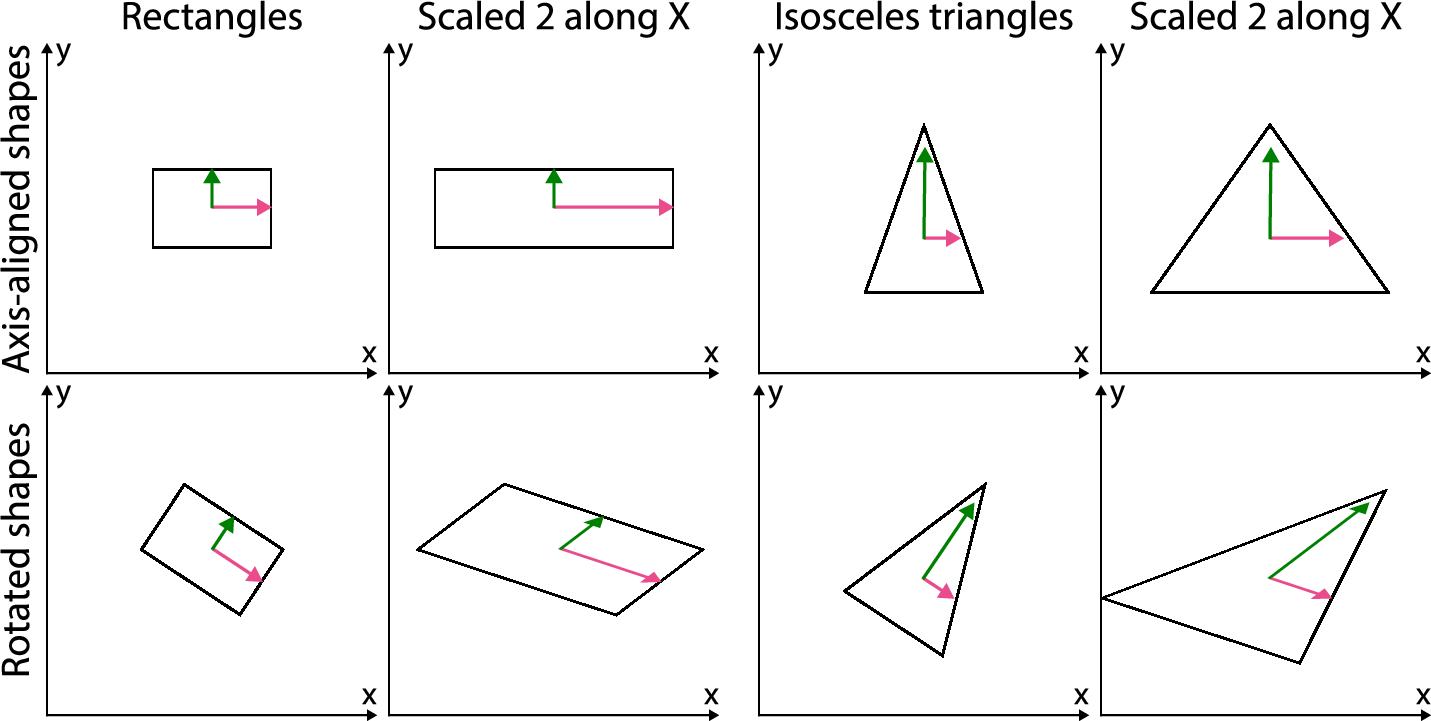
Figure 2: The impact of coordinate frame alignment on anisotropic scaling; misalignment introduces skew, moving shapes out of their prototype families.
Self-Consistent Sampling and Clustering
Given a prompt, the method samples a population of motion trajectories from an LLM using diversity-promoting prompts. For each transformation group in the hierarchy, the samples are clustered via DBSCAN on the corresponding invariant distance matrix. The central technical challenge is to select the appropriate transformation group for each prompt, addressed via two unsupervised decision strategies:
- Majority-Consensus: Ascend from restrictive (e.g., rigid) to permissive (e.g., affine) groups, selecting the least-permissive group for which the largest cluster is a strict majority of samples.
- Hierarchical-Consistency: Descend from the least to most restrictive group, identifying the most restrictive group wherein the largest previously-found cluster remains intact.
The centroid of the largest cluster under the optimal group is selected as the canonical self-consistent trajectory.
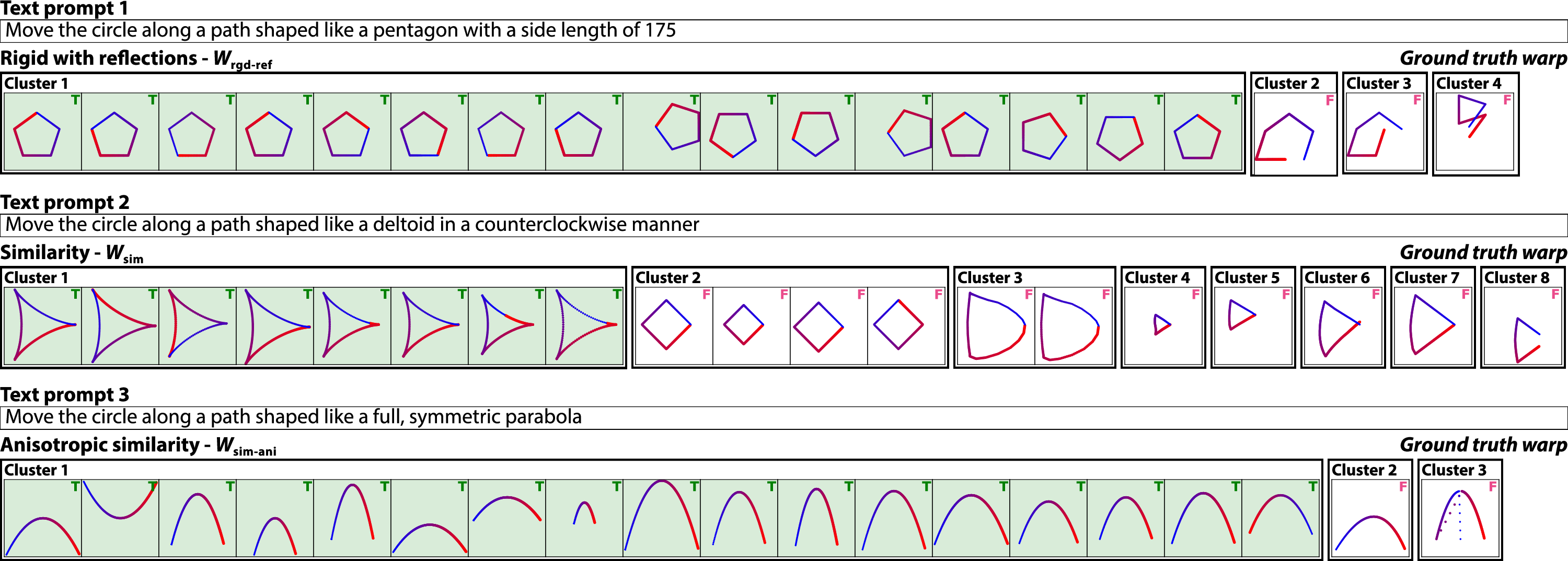
Figure 4: Clustering of LLM-generated trajectories from various prompts; largest clusters (green) typically correspond to correct geometric families.
Verification
To verify a query trajectory against a prompt, the system re-derives the shape family via self-consistency on LLM samples and checks if the candidate trajectory lies within the family (i.e., its distance to the prototype is below threshold). This approach is unsupervised and parameter-free aside from the sample size and DBSCAN threshold.
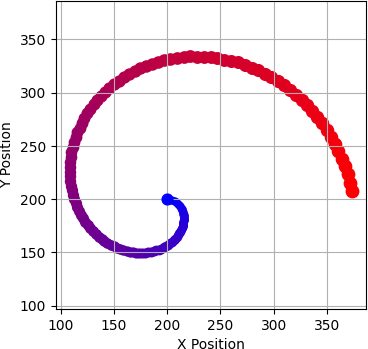
Figure 3: Representation of a trajectory in a scatter plot; temporal information is encoded as a color gradient, facilitating input to VLMs for baseline verification.
Experimental Evaluation
Benchmark Construction
A benchmark of 224 text prompts describing motion trajectories is curated, each paired with a ground-truth prototype and associated transformation group, spanning 35 geometric shape types with systematic variations. For verification tasks, 2,240 trajectories (10 per prompt) with labels (match/mismatch) are synthesized leveraging LLM sampling.
Generation Results
- Accuracy: The self-consistency approach yields absolute gains of 4–6% in generation accuracy over direct single-sample LLM decoding. Specifically, using GPT-4.1, accuracy rises from 62.1% (direct) to 68.0% (majority-consensus), and using GPT-5 from 79.1% to 83.3%. Oracle access to the ground-truth transformation group yields marginal further improvement.
The methods maintain competitive performance even when the correct transformation group is not known a priori, demonstrating the robustness of the clustering and decision criteria.
Verification Results
- Performance: In trajectory verification, self-consistency with majority-consensus achieves the highest precision (85.8%), while hierarchical-consistency attains the best F1 score (84.6%), surpassing visual LLM (VLM) baselines (e.g., GPT-4.1 F1 of 75.6, GPT-5 F1 of 79.0) by substantial margins.
- Parameter Sensitivity: Performance stabilizes with as few as 10 sample trajectories, and is relatively insensitive to the clustering threshold, which modulates the granularity of DBSCAN clusters.
Analysis, Practical and Theoretical Implications
This work demonstrates that self-consistency is extensible beyond textual reasoning, provided that domain-specific invariance and consistency criteria are established. The two decision strategies for transformation group selection present a trade-off: majority-consensus is precision-oriented (risking false negatives), whereas hierarchical-consistency provides better recall.
The advance here is in unsupervised, training-free verification of geometric properties—a crucial requirement for robust, trustworthy LLM-based content generation in vector graphics and motion design workflows. Additionally, the approach opens avenues for more general visual verification by abstracting and parameterizing perceptual similarity via transformation groups and invariant alignments.
Limitations include the inability to resolve under-specified or ambiguous prompts, and difficulty dealing with multi-prototype or non-geometric (semantic) shape families. Incorrect or insufficiently diverse LLM samples may also betray the underlying assumptions of self-consistency.
Future Directions
Further work may generalize the paradigm to:
- Domains requiring multi-prototype shape families or richer notions of structural equivalence;
- Broader classes of perceptual invariance for verification (e.g., shapes in hand-drawn or typographic data);
- Adaptive decision criteria for transformation group selection, possibly informed by interactive or downstream feedback;
- Integration with more capable multimodal LMs or vision-LLMs for initial sampling or post hoc filtering.
Conclusion
By framing geometric self-consistency in terms of Lie group-invariant distance metrics and embedding this into a scalable, unsupervised clustering pipeline, this paper delivers a practical and theoretically grounded method for robust LLM-based motion trajectory generation and verification. The approach achieves notable gains in both output fidelity and verification compared to baseline LLM and VLM strategies, providing a blueprint for domain-adaptive self-consistency paradigms in generative AI systems.

