- The paper proposes a novel SA-cGAN framework that integrates self-attention and KG-guided semantic extraction to balance distortion criticality and information representability.
- It formulates a mixed-objective discrete optimization problem to adapt semantic compression and reconstruction under dynamic SNR conditions, supported by rigorous dual methods.
- Empirical evaluations demonstrate that at high SNR, the framework achieves semantic similarity, accuracy, and completeness scores above 0.90, outperforming traditional JSCC methods.
Semantic Communication for 6G Networks: SA-cGAN Optimization of Distortion-Representability Trade-offs
Introduction and Context
Redefining communication for 6G, this work addresses the semantic communication (SemCom) paradigm, where the optimization focus shifts from symbol-level fidelity to end-to-end meaning preservation. Classical approaches, rooted in Shannon theory, are shown to be insufficient under the extreme data scaling, ultra-dense IoT, and stringent energy/bandwidth constraints anticipated in 6G deployments. This paper critiques existing deep joint source-channel coding (JSCC), attention-based, and GAN-based approaches for their incapacity to robustly control semantic trade-offs or adapt optimally under resource and channel limitations. It then proposes a novel framework: a self-attention conditional generative adversarial network (SA-cGAN) architecture augmented with knowledge graph (KG)-guided semantic extraction. The system is specifically designed to negotiate the fundamental trade-off between distortion criticality and information representability, which governs whether semantic content should be preserved, compressed, or reconstructed probabilistically given instantaneous network conditions.
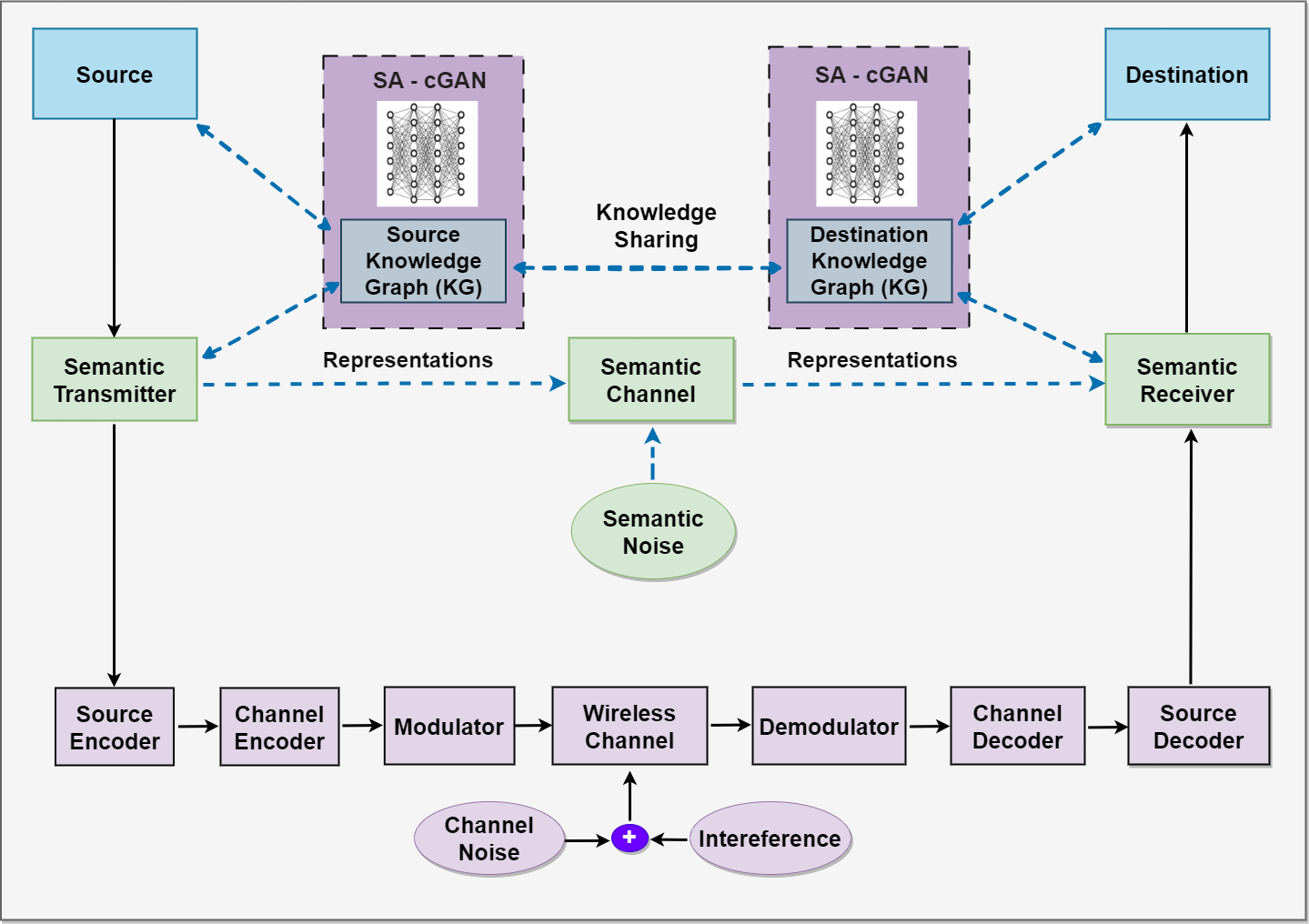
Figure 1: High-level block diagram for the proposed SA-cGAN enabled semantic communication system.
Model Architecture and System Workflow
The architecture employs an integrated pipeline: input text is tokenized; entities and inter-entity relationships are extracted using a KG construction module; self-attention is used for semantic importance ranking, with KG guidance ensuring structurally and contextually meaningful selection. Selected tokens are semantically grounded and encoded as latent representations, which are then mapped onto transmission symbols using a conditional GAN generator. The adversarially trained cGAN both regularizes these semantic encodings for semantic integrity under channel noise (Rayleigh fading, AWGN) and adaptively compresses or expands representations based on SNR and channel reliabilities. At the receiver, a matching KG-guided cGAN pipeline reconstructs the source meaning, with adaptive RA facilitated by feedback when distortion impairs semantic fidelity.
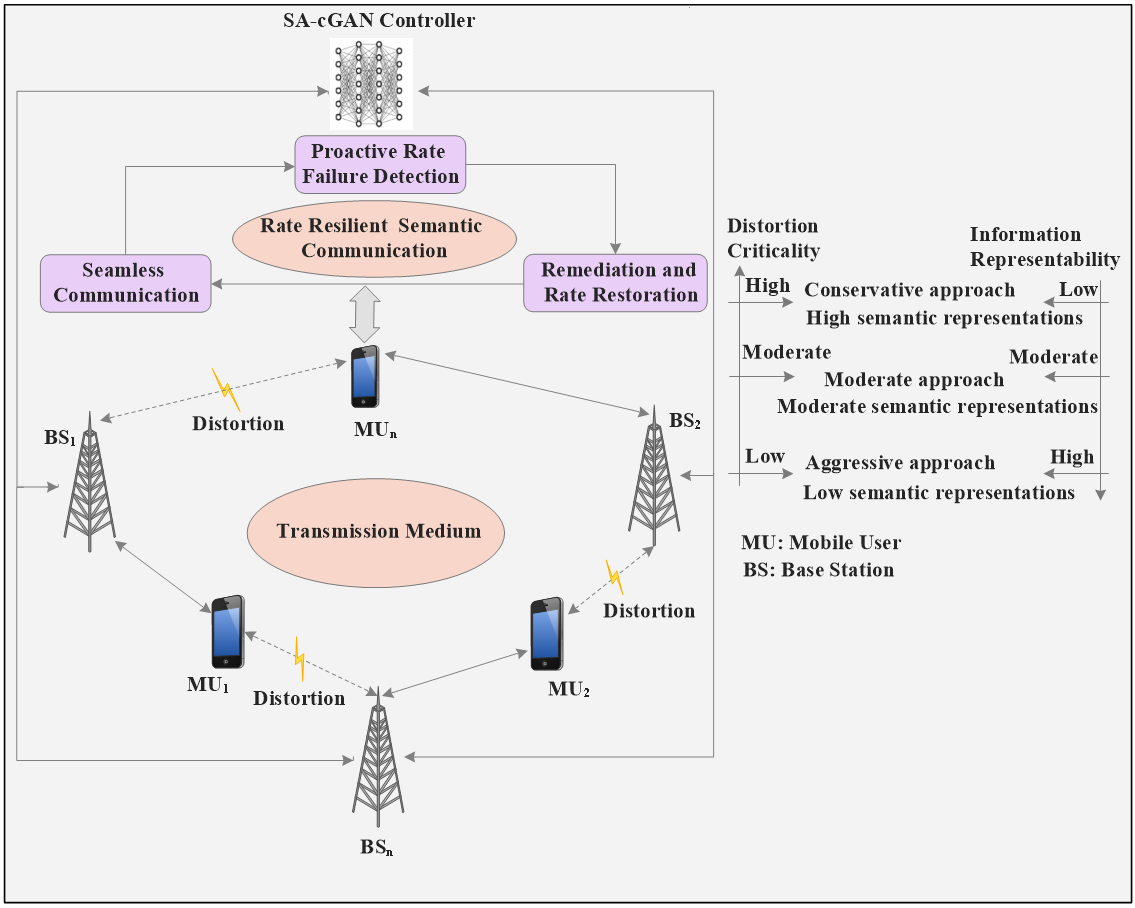
Figure 2: Overview of the SA-cGAN enabled 6G semantic communication model incorporating self-attention, KG extraction, and SNR-aware semantic adaptation.
Source text is converted to semantic triples (entity–relation–entity), forming a subgraph of the KG. The framework grounds each token through a dual mechanism: self-attention highlights semantic significance, while KG grounding prevents the generative model from hallucinating contextually inappropriate selections. The system can thus aggressively filter auxiliary, syntactic, or redundant tokens, optimizing both for semantic compression and downstream meaning recoverability.
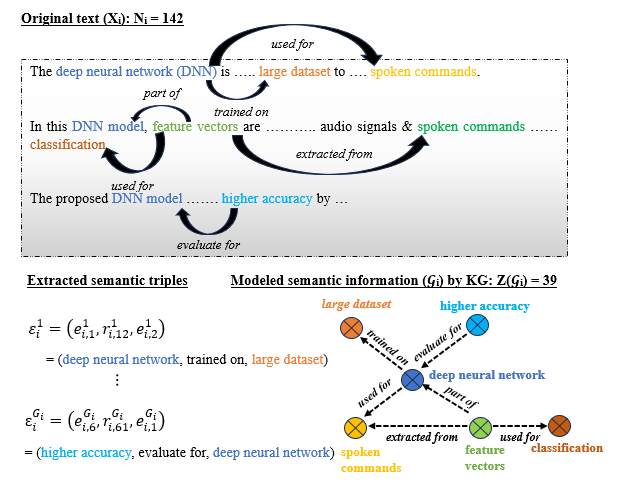
Figure 3: Example of raw text with highlighted entities/relations and resulting semantic abstraction for transmission.
Optimization Problem: Distortion-Representability Trade-off
The decision criterion is instantiated as a mixed-objective discrete optimization problem. The minimization goal is expressed as a weighted sum of (i) information representability loss, quantifying how well compressed token subsets still encode the source meaning (ℓ2 residuals in embedding space), and (ii) distortion criticality, which penalizes selections that are sensitive to channel impairments and adversarial reconstruction errors. Binary variables encode token inclusion; constraints enforce bandwidth limits, minimum SNR, cGAN reconstruction margin, KG structure coherence (via KL divergence on relational distributions), and semantic diversity (to prevent redundant selection).
Relaxation methods—continuous surrogates for binary variables, Lagrangian dual ascent, and KKT-based primal-dual updates—enable tractable solution for high-dimensional, complexly constrained selection. The formulation is provably submodular under reasonable conditions on embedding geometry and cost function separability, supporting efficient greedy or continuous greedy algorithms with (1−1/e) optimality guarantees.
Empirical Evaluation
Syntactic Versus Semantic Metrics
Performance is evaluated using BLEU (for syntactic n-gram overlap), semantic similarity (cosine over BERT sentence embeddings), semantic accuracy (token-level precision), and semantic completeness (token-level recall).
- At low SNR ($0$--$5$ dB), SA-cGAN's BLEU is modest (0.01–0.03), on par or below JSCC and classical channel codes; however, as SNR increases, BLEU improves rapidly, surpassing JSCC and rivals at high SNR (∼0.72 at 20 dB).
- Semantic-oriented metrics (similarity, accuracy, completeness) are consistently >0.90 at moderate/high SNR, demonstrating substantially improved meaning preservation over all baselines.
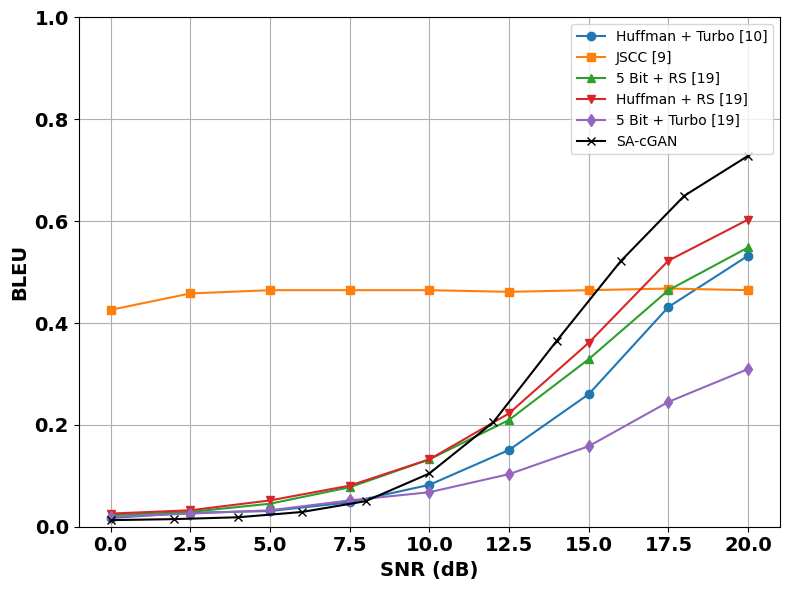
Figure 4: BLEU score evolution with SNR, showing SA-cGAN outperforms classic schemes as channel conditions improve.
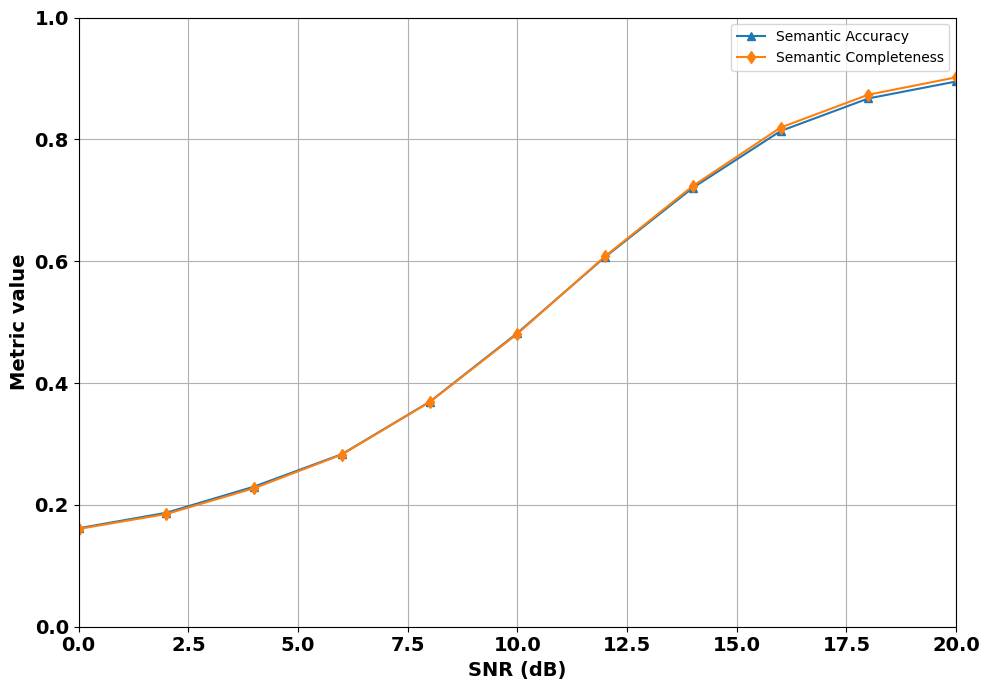
Figure 5: Trends of semantic accuracy and semantic completeness across SNR, demonstrating joint token-level precision and recall improvements.
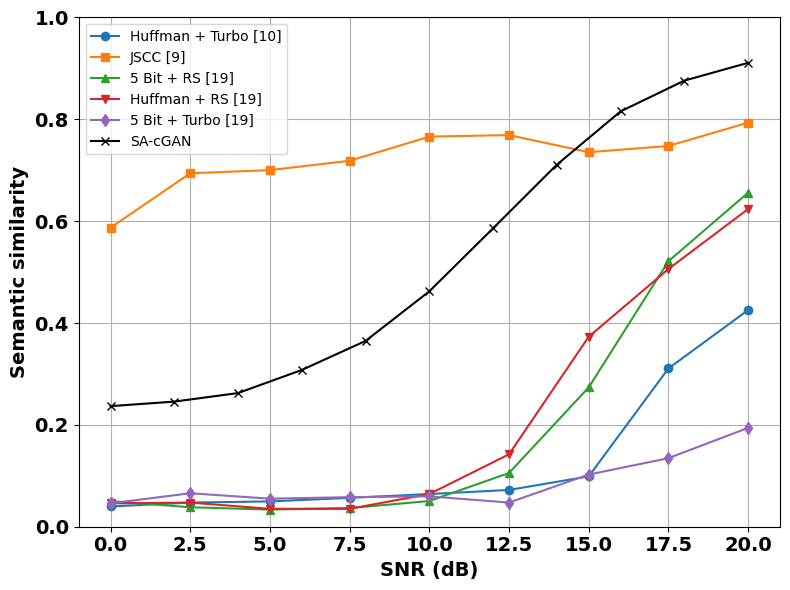
Figure 6: Semantic similarity (BERT-based) with SNR compared to classical, JSCC, and other semantic approaches.
Semantic Attention, Compression, and KG Impact
- The token importance heatmap reveals that self-attention selectively prioritizes a sparse set of information-dense tokens, discarding filler or less informative words without position bias.
- Histogram analysis of compression ratios shows that, for sentences with high distortion criticality, most tokens are retained, while sentences with higher information representability undergo aggressive compression (up to 40–60%).
- SNR-dependent component analysis illustrates that KG and attention are most valuable at low SNR (for error correction and meaning restoration); their contributions diminish as physical channel reliability increases.
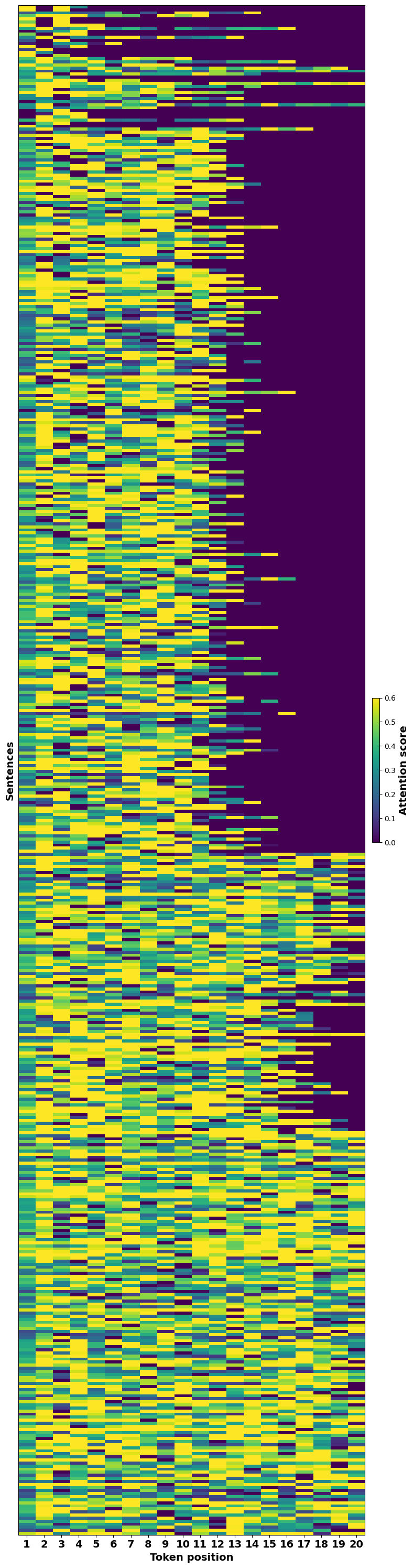
Figure 7: Self-attention token importance heatmap: high scores concentrated on semantically critical words.
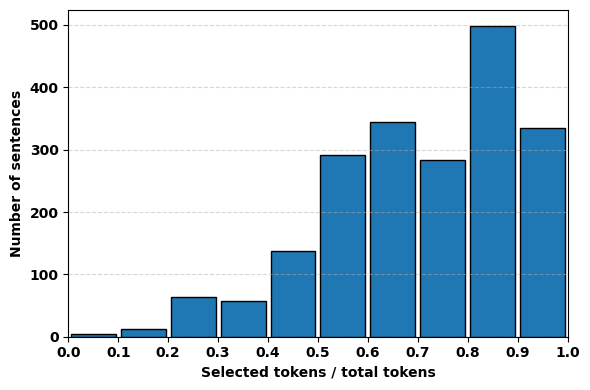
Figure 8: Distribution of achieved semantic compression ratios, with adaptive selection favoring high-fidelity or high-efficiency regimes depending on context.
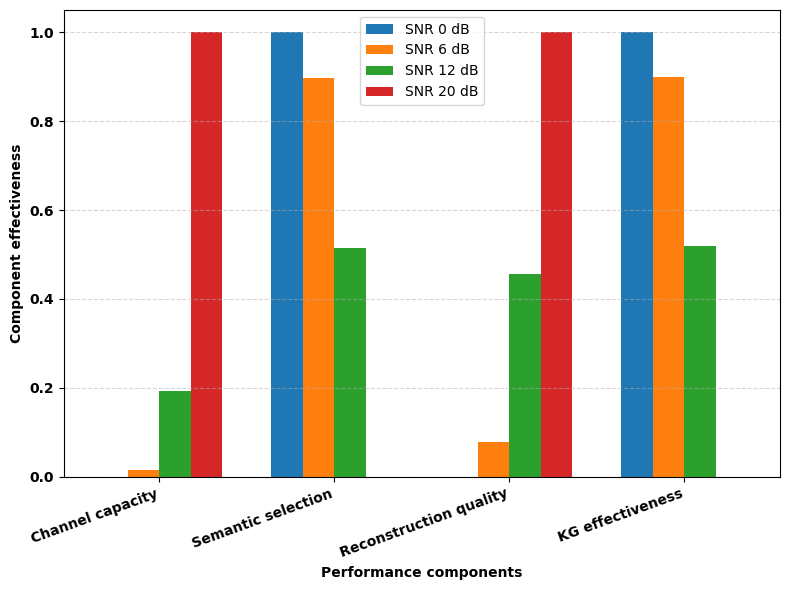
Figure 9: Relative effectiveness of different system modules (attention, KG, channel, adversarial reconstructor) under varying SNR.
Training Dynamics
The joint semantic-adversarial objective converges efficiently, demonstrating stable learning and cross-component alignment.
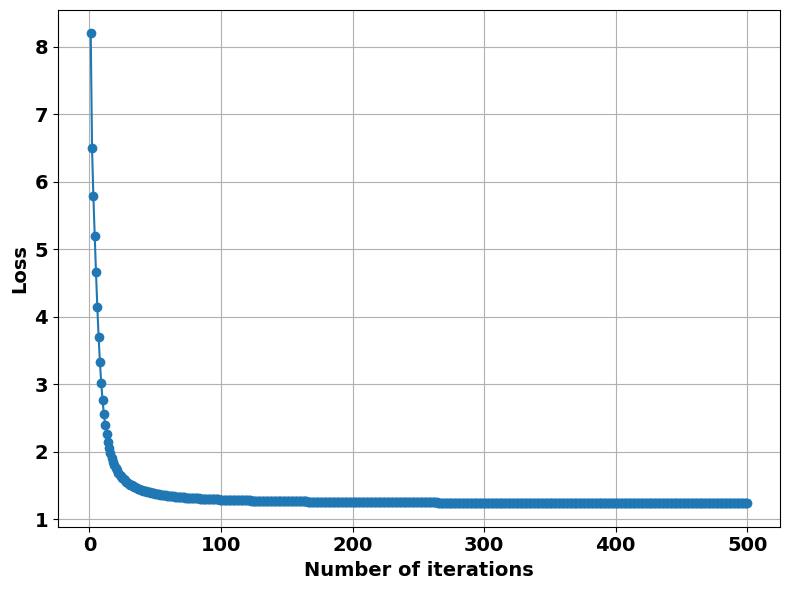
Figure 10: Training loss profile over 500 iterations shows rapid and stable convergence of the SA-cGAN framework.
Key Numerical Results and Claims
- At SNR = 20 dB, semantic similarity, accuracy, and completeness all exceed 0.90, while BLEU peaks at 0.72.
- Under aggressive semantic compression, meaning is retained without incurring hallucination or major semantic loss.
- The system exhibits strong, monotonic improvement in all semantics-oriented metrics with increasing SNR, even as syntactic BLEU lags. This supports the claim that meaning-focused optimization diverges from symbol-focused optimization under resource and channel constraints.
Practical and Theoretical Implications
The results validate the criticality of joint KG-grounded selection, adversarially regularized semantic embedding, and channel-driven adaptation in realizing robust meaning-centric communication. This architecture is explicitly resource-aware: aggressive compression is only deployed when channel reliability and information representability permit; in adversarial (low-SNR) cases, the system falls back on conservative expansion and KG-based semantic repair, adapting bandwidth and computational resources to context.
The theoretical contributions—submodular program formulation, matroid and knapsack constraint integration, and rigorous dual/KKT solution structure—are directly extensible to more general multi-modal, multi-resource, and multi-user SemCom tasks.
Future Directions
Possible extensions include:
- Extension to multi-user/multi-modal settings, with joint processing for text, vision, and sensor data streams.
- Deployment of online, reinforcement learning-based semantic selection and RA modules for dynamic adaptation under time-varying channel/resource profiles.
- Investigation of more complex KG integration (e.g., logic tensor networks, symbolic inference) for harder, hierarchically structured semantics.
Conclusion
This work establishes SA-cGAN as an efficient and robust approach for semantic transmission in 6G networks, explicitly balancing distortion sensitivity and information representability. The architecture's integration of self-attention, KG grounding, adversarial generative adaptation, and resource-aware optimization yields semantic-layer performance unachievable with symbol-centric baselines. The adoption of such approaches points the way toward practical meaning-aware communication stacks for future wireless networks, emphasizing the explicit modeling and handling of semantic uncertainty and contextual criticality to meet the evolving requirements of intelligent, scalable, and resource-constrained systems.
Reference: "Semantic Communication for 6G Networks: A Trade-off between Distortion Criticality and Information Representability" (2603.29293).