- The paper presents high-fidelity orbital solutions for three SB2 systems and one hierarchical triple, improving mass ratios and period determinations.
- It employs full spectrum fitting via a neural network and Generalized Lomb Scargle analysis to extract and model radial velocities accurately.
- The results enhance empirical statistics for B-type stellar multiplicity, offering new targets for dynamical studies and formation models.
Spectroscopic Analysis of Three SB2 Systems and a Hierarchical Triple with SALT Data
Scientific Context and Objectives
Spectroscopic binaries (SBs) and higher-order multiple star systems are essential for constraining stellar population synthesis models, evolutionary pathways, and star formation theories. Double-lined (SB2) and triple-lined (SB3) spectroscopic binaries permit model-independent mass determinations when complemented by inclination constraints. This paper leverages the Southern African Large Telescope (SALT) High Resolution Échelle Spectrograph (HRS) to analyze six candidate SB2 systems, confirming four (three SB2s and one SB3), and provides precise orbital solutions. This dataset is critical for expanding multiplicity statistics of B-type stars and exploring formation scenarios of hierarchical triples.
Observational Strategy and Analytical Approach
The SALT observations employed HRS in low resolution mode (R∼14,000), with 5–13 spectra per target between 2023 and 2024. Due to the spectral characteristics of the targets (hot stars), only the blue arm (3700–5500 Å) was used. Radial velocities (RVs) were extracted via full spectrum fitting using a neural network-trained spectral model derived from synthetic grids (GSSP). Systematic uncertainties were treated with conservative augmentation depending on rotational broadening characteristics.
The RVs were fit with Generalized Lomb Scargle (GLS) and Keplerian/circular models. For HD 56024, a SB3 system, hierarchical triple modeling was utilized, combining RV fits and spectral disentangling (FD3) to resolve component spectra and orbits.
Confirmed SB2 Systems and Orbital Solutions
HD 20784: Circular SB2 with Refined Parameters
The analysis confirms a circular orbit with a fixed period P=3.58221 days, consistent with prior FEROS/TESS results but offering substantial improvement in asini precision (9.735±0.038 R⊙ vs previous 9.7−3.2+3.6 R⊙). The mass ratio q=0.856±0.004 is slightly less than previous estimates. The RV data validates coherence across instruments.
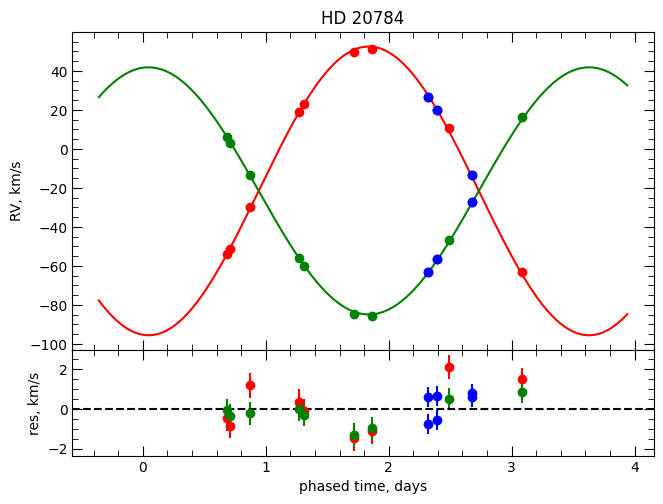
Figure 1: Circular orbit modeling for HD 20784; blue circles denote FEROS RVs superimposed for cross-validation.
HD 43519A: SB2 With Potential Triple Configuration
This SB2 has a period of P=8.188±0.001 days and mass ratio q=0.696±0.016. The secondary's RVs are well constrained due to lower rotational velocity. APOGEE measurements for HD 43519B, a nearby star, show RVs comparable to the systemic velocity, indicating this system is likely a wide hierarchical triple (a∼271 AU, e≈0.9).
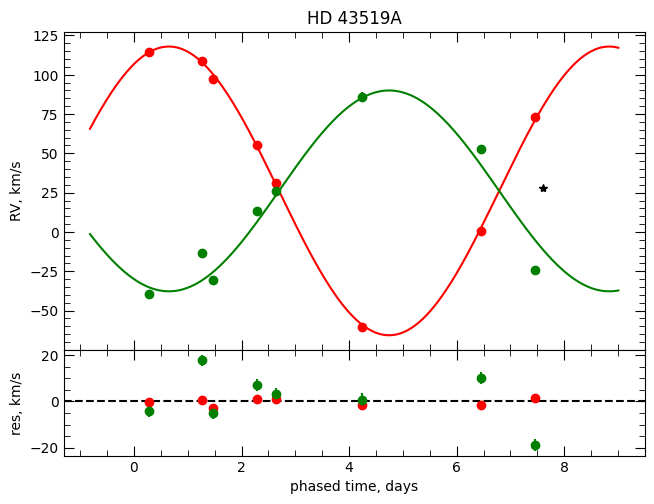
Figure 2: RV curve fitting for HD 43519A, with black asterisk marking APOGEE RV for HD 43519B, supporting its hierarchical triple nature.
HD 62153A: Matched Orbital and Rotational Periods
This SB2 exhibits a circular orbit with P=3.582210 days and P=3.582211, in excellent agreement with historic photometric and spectroscopic studies. Photospheric spot-induced variability matches the orbital period, supporting synchronous rotation.
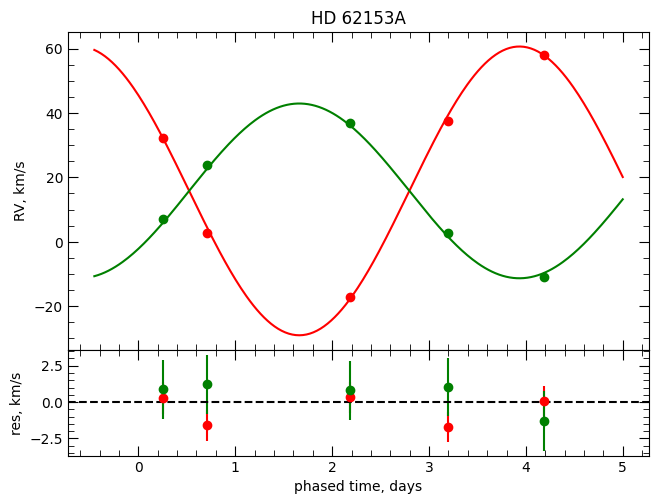
Figure 3: Circular orbit RV profile for HD 62153A, demonstrating narrow-line signatures and orbital stability.
HD 56024: Hierarchical Triple System (SB3)
The RV and spectral analysis revealed HD 56024 as a hierarchical triple (1+2): a bright, fast-rotating primary on an outer eccentric orbit (P=3.582212 days, P=3.582213) encircling an inner twin binary (P=3.582214 days, P=3.582215; P=3.582216). The mass ratio for the outer orbit P=3.582217 indicates the inner twin binary is more massive. Spectral disentangling confirmed three resolved components matching fitted parameters.
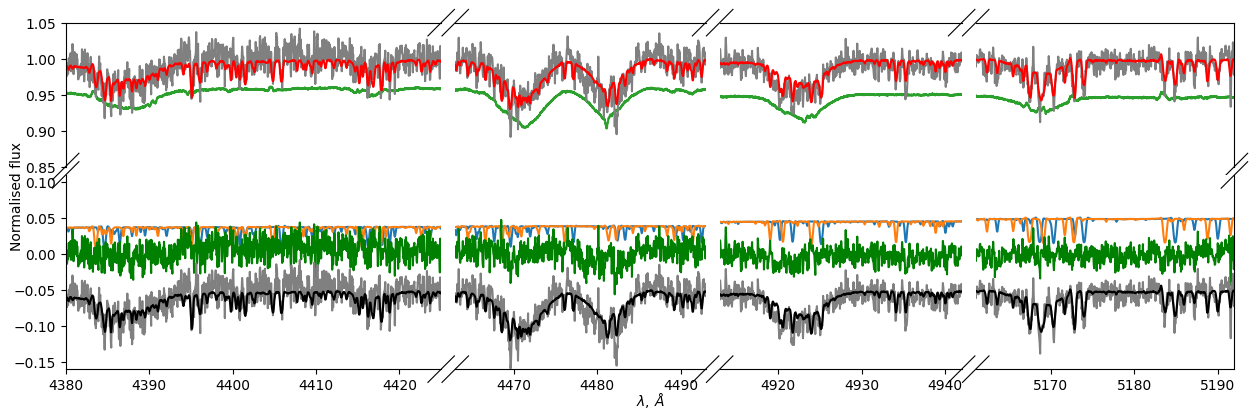
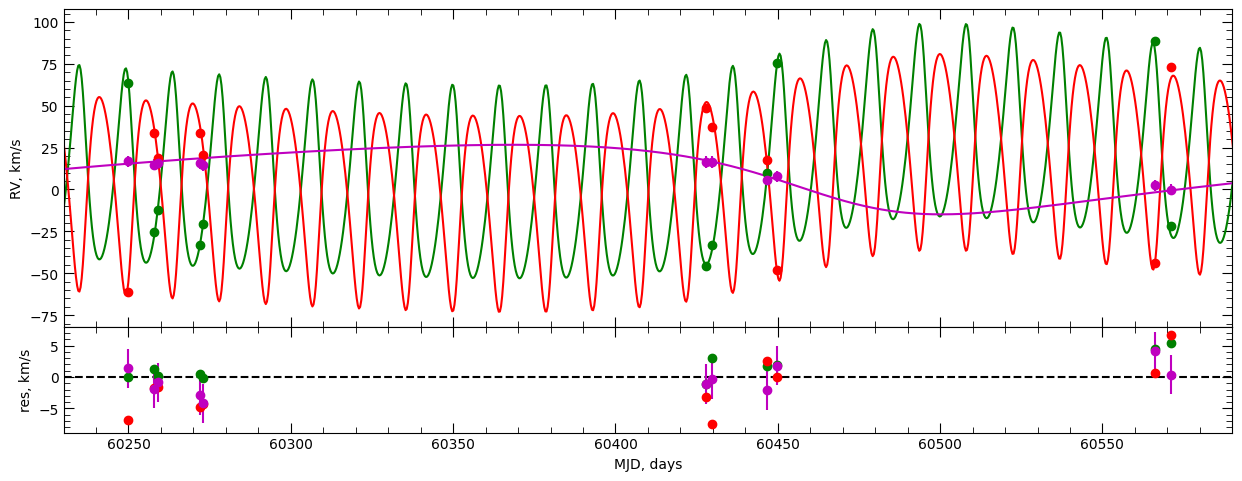
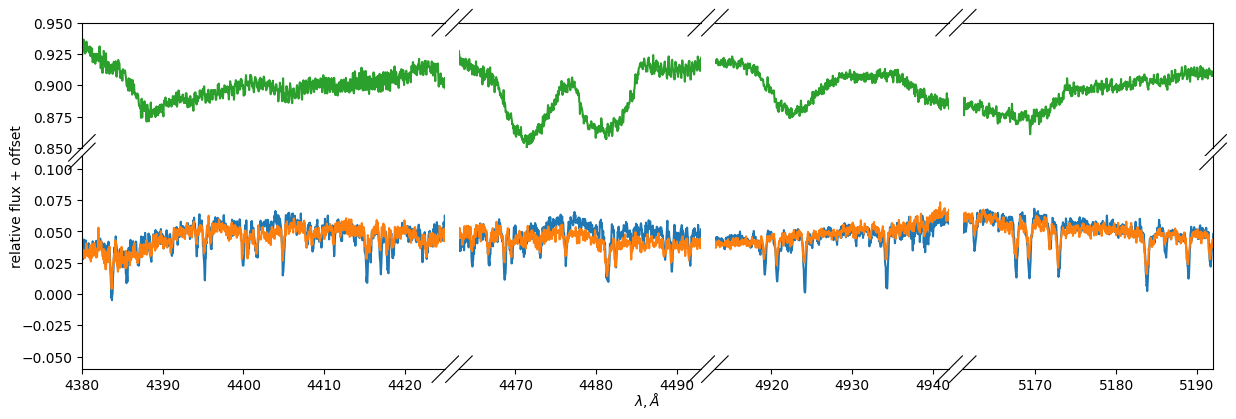
Figure 4: Panel (a) displays SB3 spectral component fitting; panel (b) demonstrates hierarchical triple orbital modeling; panel (c) shows spectral disentangling results.
Analysis of Candidate Systems: HD 198174 and HD 208433
HD 198174, a B8II giant, appears as SB1 in Gaia DR3 but RV data do not support the published orbital solution. Neither component's RV measurements cohere with expected phasing, though high RUWE suggests binarity or multiplicity. HD 208433, despite extensive RV monitoring, exhibits no statistically significant temporal RV variability. The analysis supports the hypothesis that HD 208433 is a chance alignment of two unrelated stars, with constant RVs for both components.
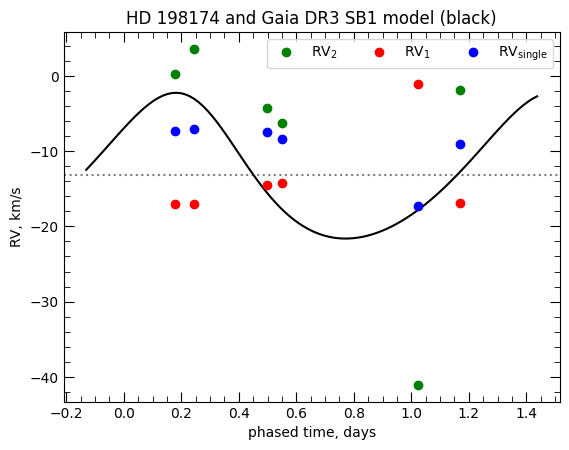
Figure 5: Gaia DR3 SB1 orbital solution (dotted line) and SALT RV data for HD 198174 reveal discrepancies and the need for updated modeling.
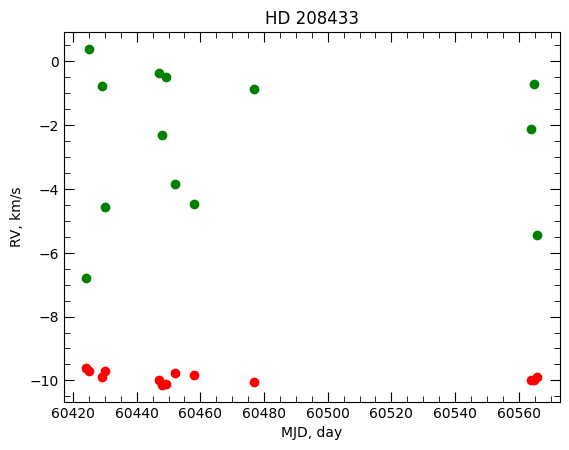
Figure 6: SALT RV measurements for HD 208433; absence of significant variability supports a non-binary classification.
Implications for Stellar Multiplicity and Future Work
The strong constraints on orbital parameters enhance the empirical foundation for B-type star multiplicity and hierarchical triple system statistics. The robust identification and modeling of HD 56024 as a hierarchical triple, with precision in inner/outer orbital periods and eccentricities, allows for investigation of formation scenarios, stability conditions (Kozai-Lidov cycles), and possible resonance (1:28 period ratio). The presence of photometric variability (low amplitude, P=3.582218 days) is linked to pulsations or spots, and light-time travel effect (LTTE) methods can disentangle component origin with high-cadence space photometry.
The methodology demonstrated for RV extraction and model fitting, particularly for rapid rotators and hierarchical triples, sets a benchmark for future spectroscopic surveys, including potential cross-calibration with historic datasets. The precision achieved in orbital elements for short-period SB2s and the complex SB3 will enable improved modeling of population synthesis and dynamical evolution.
Conclusion
This study presents high-fidelity SALT spectroscopic orbit solutions for three SB2 systems and one hierarchical triple, with robust period, eccentricity, and mass ratio determinations. The identification of a hierarchical triple (HD 56024) and potential wide hierarchical triple (HD 43519A/B) provides valuable targets for dynamical and evolutionary modeling. Two additional candidates are rejected as SB2s based on lack of RV variability. The results advance the empirical mapping of B-type star multiplicity and highlight the synergy between high-resolution spectroscopy and space-based photometry for future multiplicity studies.