- The paper introduces a modular system that decomposes POP text creation into profile building, draft generation, style rephrasing, and persona evaluation to boost text relevance.
- It leverages iterative, LLM-driven customer analysis and diversified rephrasing to enhance marketing copy quality with significant performance gains.
- Empirical results show human-guided selection outperforms full automation, emphasizing the need for expert oversight in non-expert marketing scenarios.
Modular LLM-Based POP Text Creation for Small Retail Retailers
System Overview
The paper "Customer Analysis and Text Generation for Small Retail Stores Using LLM-Generated Marketing Presence" (2603.29273) addresses the needs of small retail apparel stores in generating persuasive point-of-purchase (POP) marketing texts. Traditionally, high-quality POP creation requires marketing expertise, customer understanding, and advanced copywriting skills—competencies rarely found in small apparel retailers. Existing methods leveraging customer behavior data or extensive history are often not feasible due to limited data in such environments.
The proposed system decomposes the workflow into four modular components: Profile Builder (PB), Draft Generator (DG), Style Rephraser (SR), and Persona Evaluator (PE). Each module leverages LLMs, with a particular focus on GPT-4o mini, to facilitate human–AI collaborative POP creation. The system aims to support both customer analysis and expressive, audience-targeted POP text generation.
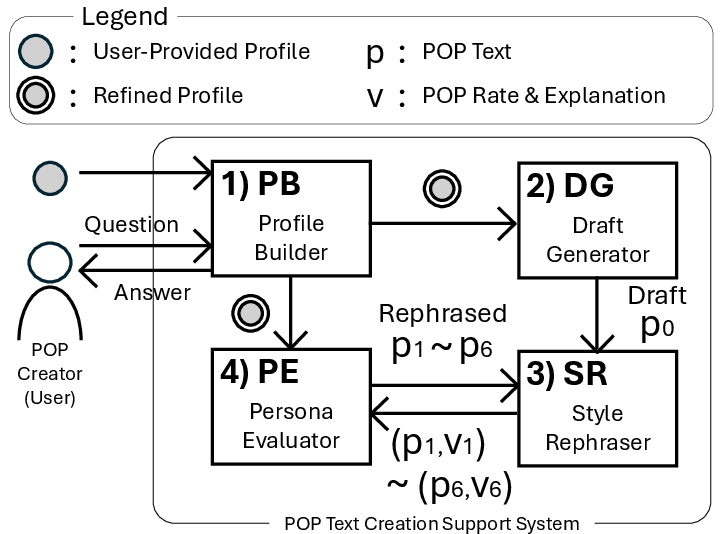
Figure 1: The end-to-end architecture of the POP Text Creation Support System, highlighting sequential LLM-driven modules for profile refinement, text drafting, style rephrasing, and persona-based evaluation.
Profile Builder: Interactive Customer and Product Analysis
The Profile Builder module interfaces directly with the POP creator, eliciting knowledge about the target product and intended customer segments through iterative, LLM-driven Yes/No questioning (see Figure 2).
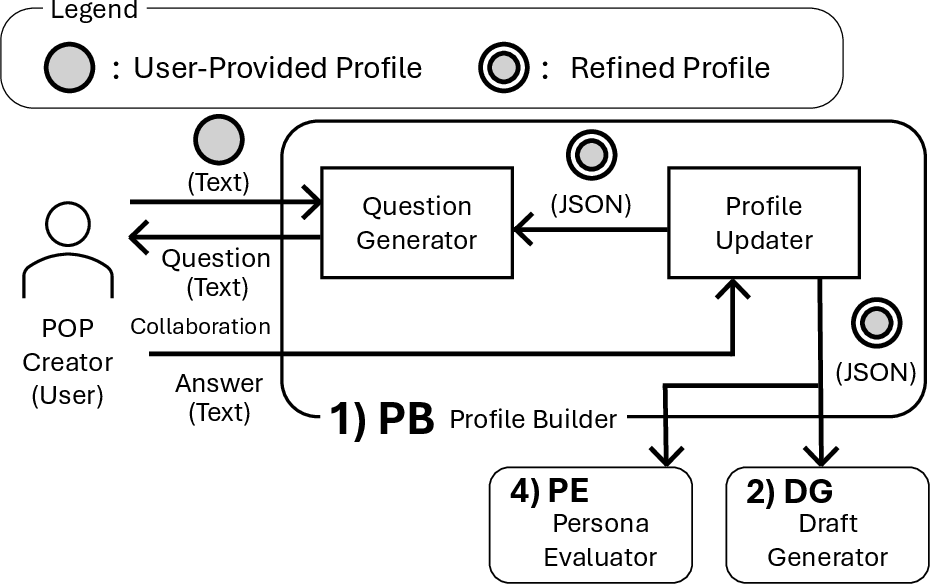
Figure 2: The Profile Builder System architecture, illustrating the iterative refinement loop between user responses, updated profiles, and generated questions.
This process incrementally refines the customer profile by dynamically adapting follow-up queries based on prior answers and free-form product information. The output—Refined Profiles—injects explicit audience attributes and product features into downstream POP text generation, thereby improving the relevance of subsequent drafts. The experimental analysis demonstrates that this structured segmentation notably enhances the specificity and persuasiveness of resulting POP copy compared to uninformed, free-form text attempts.
Structured Generation and Rephrasing Pipeline
The Draft Generator initializes the textual content using the enriched customer and product representations from PB. This step is critical for introducing an initial layer of audience fit and content relevance. However, LLM-based drafts exhibit constraints in capturing marketing nuances and diversity.
To mitigate template bias and encourage ideational variety, the Style Rephraser applies multiple rephrasing patterns (Figure 3), each associated with distinct apparel purchase motivations (appearance, trend, practicality/economy, reliability, social proof, and hybrid combinations).
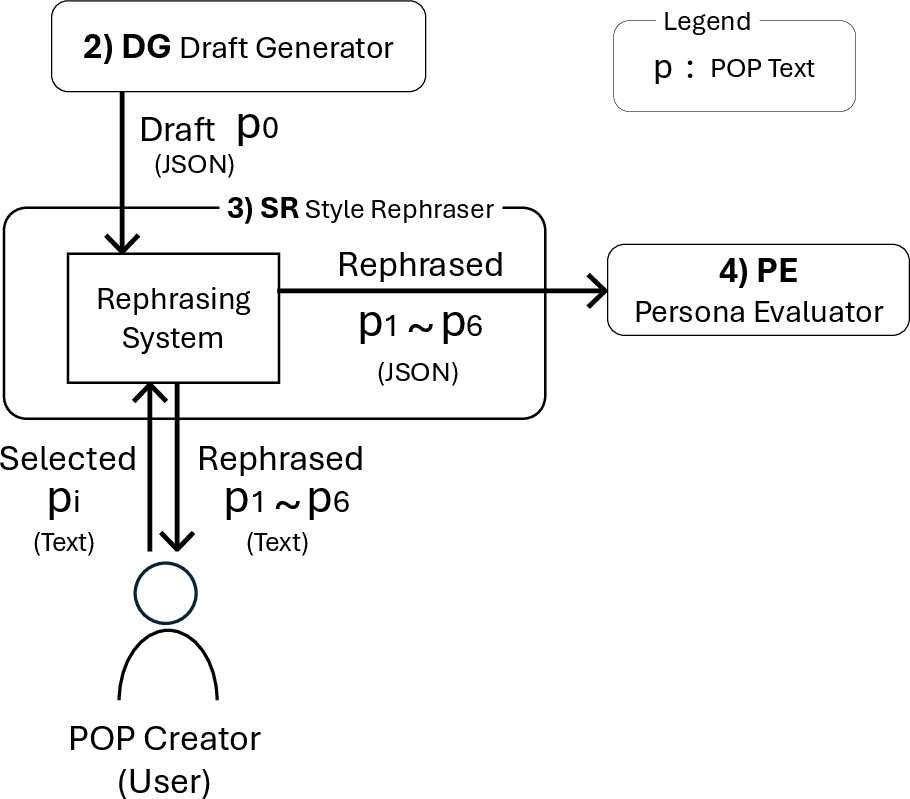
Figure 4: System architecture of the Style Rephraser (SR), which systematically generates stylistic variants according to different purchase incentives.
SR encourages exploration in the expression-search space by abstracting prompts, thus reducing deterministic phrasing and promoting diversity. Iterative application with user-in-the-loop enables granular refinement and selection of candidate POP texts prior to evaluation.
Persona-Based Multi-Perspective Evaluation
The Persona Evaluator module consists of a dynamic persona generator and a focused evaluator, both LLM-driven (Figure 5). Each persona encapsulates nuanced customer profiles (e.g., age, occupation, family structure, lifestyle, apparel needs, value drivers) inferred from the refined customer analysis.
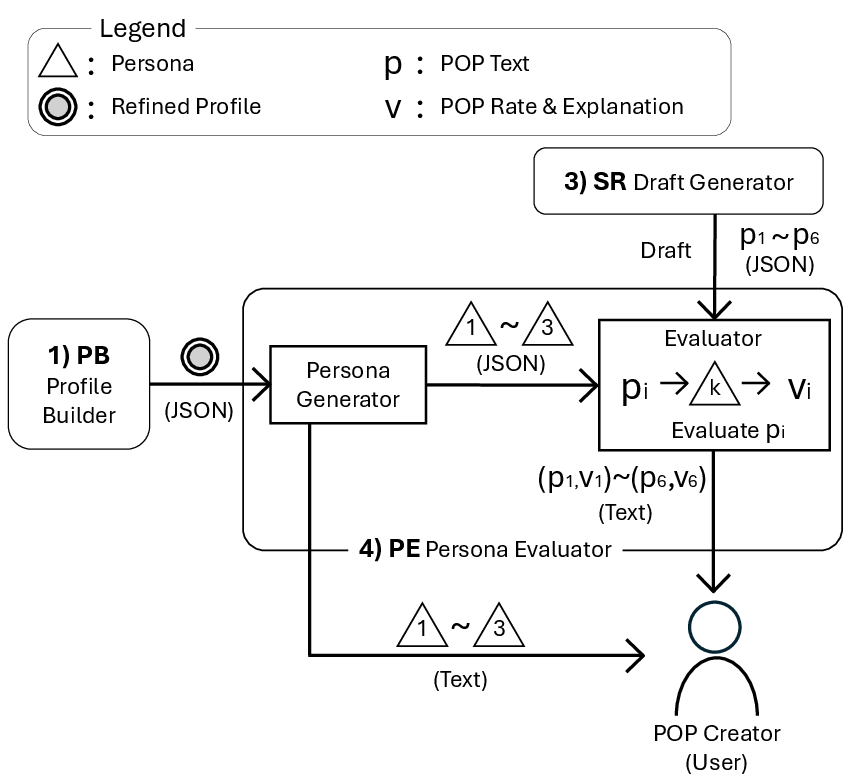
Figure 3: Persona Evaluator (PE) architecture leveraging LLMs for dynamic persona generation and persona-centric evaluative scoring.
This evaluator produces multi-dimensional assessments by mapping diverse personas to individual POP text variants, enabling comparative scoring and justification across consumer subtypes. In practice, each text is evaluated by three distinct, contextually generated personas, outputting explicit ratings and reasoning. This approach supports manual or automatic POP selection by surfacing rich, perspective-informed feedback as opposed to homogeneous, generic scoring.
Empirical Results and Analysis
A controlled evaluation was conducted comparing five system configurations: baseline (no support), analysis only (PB), draft and edit (PB + DG), all functions (manual selection), and all functions (automatic selection via PE scoring). Non-expert POP creators manually edited LLM-generated drafts, reflecting expected real-world semi-automated workflows.
Statistical results indicate strong improvements in text quality attributable to LLM-based system support. The "all functions (manual selection)" condition outperformed other baselines by an average of 2.37 points on a -3 to +3 evaluator-provided quality scale (Figure 6).
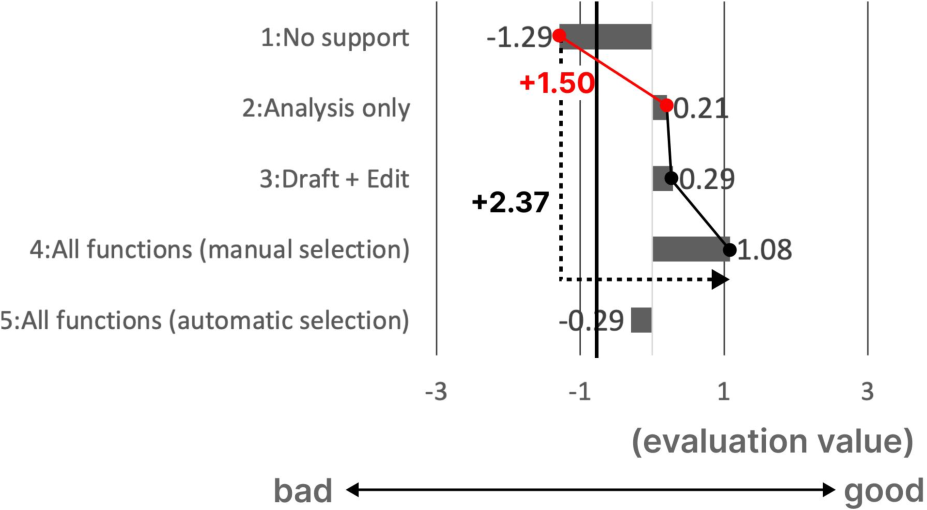
Figure 7: The average evaluation score for POP text creation methods, highlighting significant gains from modular system support and interactive selection strategies.
The PB module alone demonstrated clear effectiveness: analysis-driven POP drafts (without further LLM assistance) were judged superior to the baseline in 83.3% of comparisons. Notably, reliance on automatic persona-based selection was consistently inferior to guided human manual selection, underscoring the value of persona-based scores as an aid—rather than a sole decision driver—at this system's current maturity.
Limitations and Implications
While the system delivers robust improvements in audience alignment and expression diversity, several limitations were observed:
- Persona Faithfulness: Automatically generated personas sometimes incorporated speculative attributes not directly inferable from prior analysis, leading to misaligned evaluation priorities.
- Diversity vs. Structure Tradeoff: Abstract prompt engineering for SR facilitates expressive diversity but may reduce interpretability or actionable specificity in highly constrained domains.
- Full Automation Gap: Human-in-the-loop editing outperformed full automation, suggesting the continued necessity of expert oversight or user preference input for highest quality marketing copy.
Practically, this modular approach concretely extends possible marketing support for resource-constrained retailers, obviating the need for dedicated human marketing expertise while still enabling tailored, high-quality POP text. Theoretically, these findings reinforce the strength of decompositional LLM application pipelines and the utility of structured persona-based evaluation frameworks.
Future Directions
Future work should address persona–profile consistency, potentially through more constrained retrieval-augmented generation or enhanced alignment objectives during persona construction. Cross-domain adaptation (e.g., application outside of apparel, multilingual support) and further automation of human-guided selection (e.g., via preference modeling) are also recommended research trajectories. Increased sample sizes, expert evaluations, and real-world field tests would further validate generalizability and practical viability.
Conclusion
This paper demonstrates a modular, LLM-based support system for POP text generation, supporting non-expert users in small retail settings. By tightly integrating iterative profile refinement, structured draft and variant generation, and persona-driven evaluative feedback, the system achieves quantitatively significant improvements in POP text quality over traditional, unsupervised workflows. Persona-based evaluation, in particular, enhances multidimensional text assessment—though human guidance remains necessary for optimal selection. This work underscores both the immediate practical value and the promising research landscape for collaborative, LLM-centric retail marketing tools.