- The paper establishes a classification theorem stating that a function admits a positive geometry if its pseudogenus is zero.
- It demonstrates that open and closed string amplitudes can be represented as sums of canonical forms derived from infinite unions of intervals.
- It reveals that strict spectral constraints limit dense towers of states, thereby shaping the analytic structure of physical observables.
Functions Admitting a Positive Geometry: Classification, Constraints, and String Amplitude Realizations
Introduction: Positive Geometry and Physical Observables
The framework of positive geometry recasts various physical observables, especially scattering amplitudes, as canonical differential forms associated with geometric regions in kinematic space. Canonical forms extracted from these geometries have provided geometric insight into quantum field theory via constructions such as the amplituhedron and the ABHY associahedron. Notably, traditional positive geometry yields only rational canonical forms, limiting geometric interpretation for non-rational functions ubiquitous in modern physics, such as trigonometric or string-theoretic amplitudes.
Recent advances have generalized positive geometries to encompass infinite unions of polytopes or intervals, admitting canonical forms that can encode trigonometric and other transcendental functions. This expansion raises fundamental questions about the class of functions representable by positive geometry and the physical implications of such representations, especially as they pertain to the spectrum and analytic structure of scattering amplitudes, including those in string theory.
A central result is the precise classification, based on complex analysis and Nevanlinna theory, of which meromorphic functions can arise as canonical forms from one-dimensional positive geometries. The canonical form for a union of intervals is generically
Ω(A)=dlogf(z),
where f(z) encodes the product over interval endpoints, directly connecting geometric boundaries with the zeros and poles of the function.
The Hadamard factorization theorem regulates the convergence properties of such products, introducing the concept of the genus of a meromorphic function, which measures the minimal regularization needed for convergence. This paper introduces the pseudogenus, refining the notion to cases of non-absolute convergence (where specific orderings are imposed), allowing more functions to be captured—often exactly those arising from physical amplitude constructions.
A rigorous classification theorem is established: A function f can be realized as the canonical form of a (possibly weighted) one-dimensional positive geometry if and only if its pseudogenus is zero. This sharply restricts the analytic and spectral structure of physical observables amenable to positive geometry realization.
Implications for Towers of States in Amplitudes
Positive geometries with infinite unions of intervals encode amplitudes with infinite towers of physical states, such as those arising in string theory or Kaluza–Klein compactifications. The mathematical constraints on genus and pseudogenus translate physically to stringent requirements on the density of states contributing—specifically, the sum over inverse square moduli of pole locations must converge. As a consequence, only a sparse subset of possible towers may be representable: for example, the Hagedorn spectrum or dense high-dimensional Kaluza–Klein towers are, in general, excluded, as they would require higher pseudogenus.
Strong claim: For Kaluza–Klein towers with three or more compact directions, or for entire stringy towers, the vast majority of associated states cannot contribute to four-point amplitudes if the amplitude’s dlog is to admit a positive geometry.
The analytic structure and product representations of four-point open (Veneziano) and closed (Virasoro–Shapiro) string amplitudes are examined in detail. While gamma and beta functions involved have genus one, an intricate cancellation renders their combinations pseudogenus zero, making them amenable to positive geometry.
Open String (Veneziano) Amplitudes
For the color-ordered four-point amplitude, the logarithmic differential is expressible as a sum over canonical forms of intervals, each corresponding to a kinematic pole or zero. The explicit factorized representation provides direct correspondence to an infinite union of intervals in one-dimensional kinematic space.
Closed String (Virasoro–Shapiro) Amplitudes
Similarly, the closed string amplitude, formulated as a product of beta and gamma functions, can be written as a (weighted) infinite sum of intervals, with orientation flips encoding zeros and poles, and thus, its dlog canonical form is geometrically realizable within the positive geometry framework.
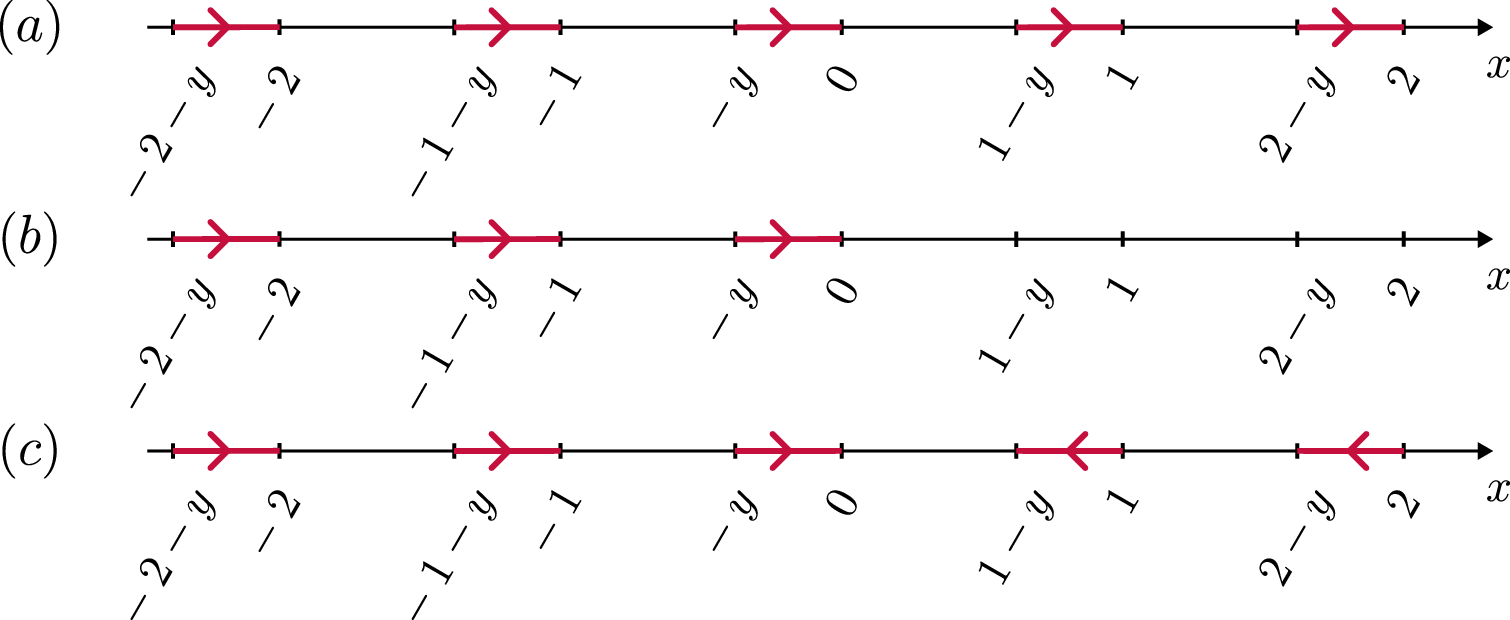 *Figure 1: The infinite geometries for four-point string amplitudes: (a) dlogAKLT(x,y) (equivalent to AKLT(−x,x+y)dx), (b) dlogAopen(x,y), (c) dlogAclosed(x,y). *
Geometric Interpretation of KLT Double Copy
The dlog of the inverse KLT kernel also admits a positive geometry, providing a fully geometric interpretation of the KLT double copy at four points. The interplay between the open, closed, and KLT geometries is manifested as explicit compositions and triangulations among their associated infinite interval unions, which can be visualized and algebraically mapped via their canonical forms.
Continuum Limit: Beyond Meromorphic Functions
Taking the continuum limit, where interval endpoints become a dense set or form a branch cut, further extends the framework. In this regime, canonical forms correspond to derivatives of Cauchy transforms of densities f(z)0:
f(z)1
This limit allows the description of observables with branch cuts—in particular, capturing a class of amplitude functions beyond rational or meromorphic examples, including those relevant to integrated loop amplitudes.
Necessary analytic conditions are also established: for the continuum canonical form to be interpretable as arising from a positive geometry, the spectral density must decay sufficiently fast at infinity, echoing the pseudogenus constraints of the discrete case.
Practical and Theoretical Implications
The derived constraints delimit which physical theories’ amplitudes can benefit from the positive-geometry reinterpretation, with direct implications for the study of string amplitudes, effective field theory expansions, and the double copy. Function representations by positive geometry inform both the possible analytic structures of consistent scattering amplitudes and the types of spectra that contribute meaningfully.
The geometric formalism also streamlines the identification of poles, zeros, and branch cuts in amplitude analytic structure, providing a blueprint for future amplitude construction and factorization methodologies.
Conclusion
This work rigorously characterizes the space of one-dimensional functions admitting a positive geometry through the notion of pseudogenus, establishing strong analytic and spectral constraints. Both open and closed four-point string amplitudes, as well as the KLT kernel, are found to possess suitable structure, enabling a unified geometric perspective on their analytic behavior and interrelations.
The continuum extension unlocks new applications, potentially encompassing observables with continuous spectra and branch cuts, as encountered in loop-level amplitudes. While the present focus is on one-dimensional cases, the approach motivates further investigations into multivariate positive geometries, higher-point amplitudes, and broader classes of analytic functions—theorizing future intersections between geometry and high-energy scattering.
Reference: "Which Functions Admit a Positive Geometry? From Branch Cuts to String Amplitudes" (2603.28543)

