- The paper demonstrates that positive genus arises in amplituhedra for k≥3, using explicit constructions and computed lower bounds.
- It employs advanced techniques such as the Lefschetz hyperplane theorem and spectral sequences to analyze complex residual arrangements.
- The results challenge the traditional equivalence between positive geometry and genus zero Hodge-theoretic pairs, suggesting the need for refined frameworks.
Positive Genus Pairs from Amplituhedra: A Technical Overview
Introduction and Context
The geometric structure of the amplituhedron An,k,m(Z), a central object in the modern formulation of scattering amplitudes in N=4 super-Yang–Mills theory, continues to drive both mathematical and physical investigations. Initiated by Arkani-Hamed and Trnka, the amplituhedron is constructed as the image of the totally nonnegative Grassmannian Gr(k,n)≥0 under a linear map defined by a matrix Z with strictly positive maximal minors. Its canonical form encodes the physical scattering amplitude, offering a bridge between combinatorial, algebro-geometric, and physical descriptions. Positive geometry, as formulated in [Arkani-Hamed, Bai, Lam], recasts this relation in terms of pairs (X,X≥0), admitting unique canonical forms with recursive residue compatibility.
Recent alternative proposals—most notably by Brown and Dupont—relate positive geometry to mixed Hodge theory, encoding properties in terms of the genus of algebraic pairs (X,Y), with vanishing genus serving as a central criterion. The relationship between these two frameworks and, crucially, the applicability of the Hodge-theoretic perspective to amplituhedra in general, is nontrivial and forms the focus of the present work.
Positive Geometry and Hodge-Theoretic Frameworks
The study sets up two parallel frameworks:
- Positive geometry in the sense of [Arkani-Hamed, Bai, Lam]: (X,X≥0), where X is a complex projective variety defined over R, X≥0 a semi-algebraic subset, and a canonical differential form Ω(X≥0) obeys strict residue and uniqueness axioms.
- Brown-Dupont Hodge-theoretic framework: A positive geometry is encoded as a pair (X,Y) of varieties (with X∖Y smooth), and positivity is tied to g(X,Y)=∑p>0hp,0(Hn(X,Y))=0. The central conjecture is that this “genus zero pair” property should align with the existence of a unique canonical form in the physical (positive geometry) sense.
Genus Zero Pairs in Known Cases
When k=1 (cyclic polytopes), k+m=n (nonnegative Grassmannians), and k=m=2, both frameworks agree: the pair (Gr(k,k+m),∂aAn,k,m(Z)) has genus zero, matching the established notion of positive geometry and guaranteeing the existence of a unique canonical form. For these cases, the Hodge structure on the pertinent relative (co-)homology groups is pure of Tate type, so all higher Hodge numbers vanish.
Positive (Nonzero) Genus: Breakdown for k≥3
When k≥3 and n is sufficiently large (n≥2(2k−1) for m=2; n≥4(4k−1) for m=4), the situation alters fundamentally. The authors demonstrate that the pair (Gr(k,k+m),∂aAn,k,m(Z)) generically acquires positive genus, i.e., g(Gr(k,k+m),∂aAn,k,m(Z))>0. The lower bound is computed explicitly—1+2k−3Ck in the m=2 case where Ck is the k-th Catalan number—arising from the genus of explicit residual arrangements/intersections among the Schubert divisors composing the algebraic boundary.
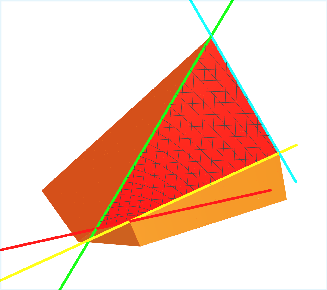
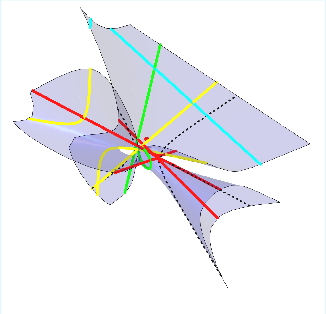
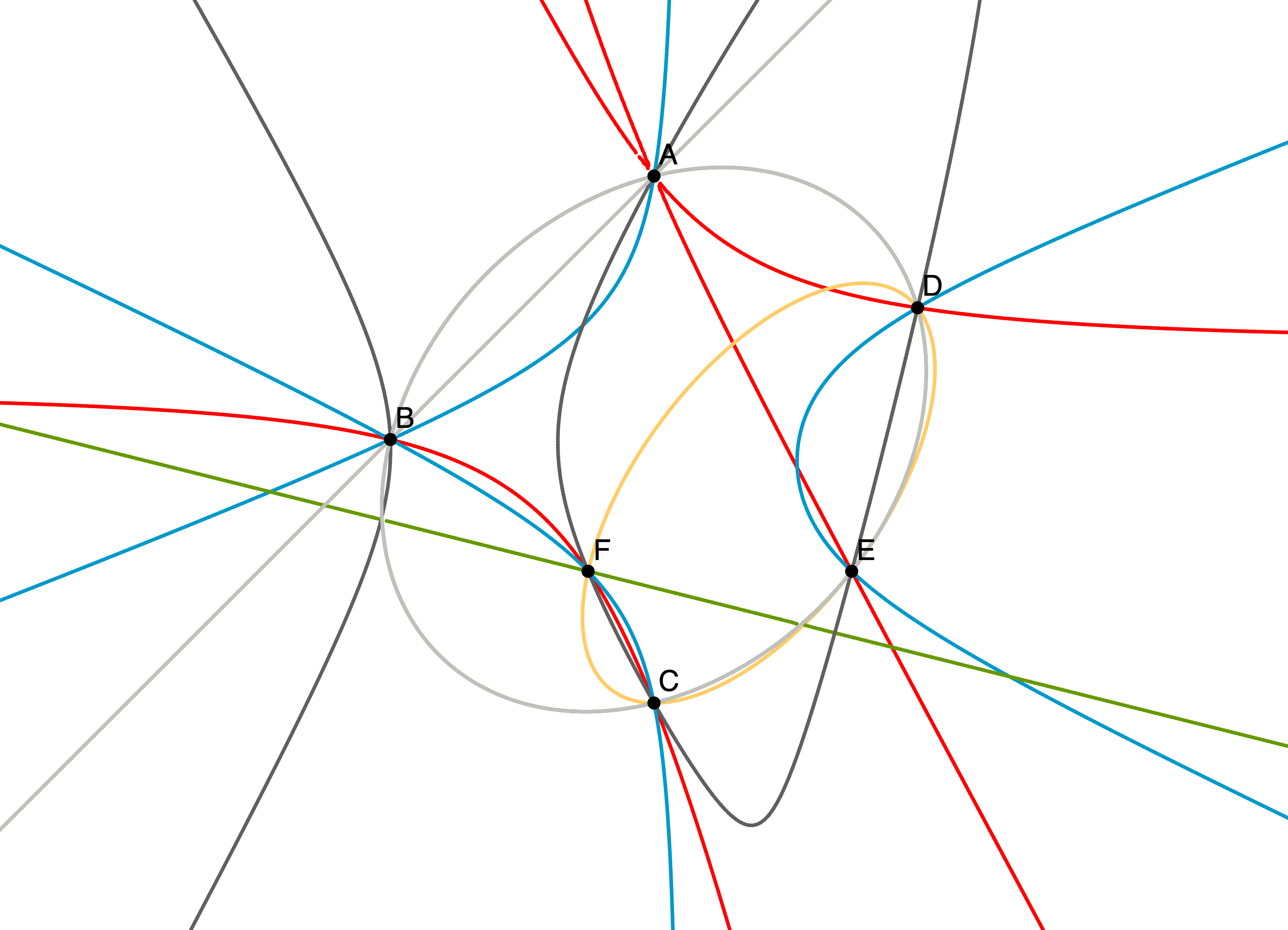
Figure 1: Semi-algebraic set P, with a curvy quadrilateral facet on S in red and its boundary lines.
The analysis involves intricate applications of the Lefschetz hyperplane theorem, residual arrangement analysis, and spectral sequences for relative cohomology. Smooth, irreducible residual curves of positive genus are constructed directly as transversal intersections of boundary divisors, a fact supported by explicit Macaulay2 computations.
Explicit Counterexample: Positive Geometry with Genus One
A semi-algebraic subset P⊂P3 is constructed, which is a positive geometry in the sense of Arkani-Hamed et al., yet for which (P3,∂aP) has genus $1$ (i.e., the relative Hodge structure acquires a nontrivial h1,0). The set P is essentially a cube with a single facet replaced by a portion of a cubic Del Pezzo surface, bounded by rational lines and supporting an elliptic curve in the residual arrangement.
This construction demonstrates through explicit residue computations (analytic and algebraic), and by tracking the weight components in the associated spectral sequence, that the canonical form remains unique, and all positive geometry axioms are satisfied in the original sense, despite the failure of the “genus zero pair” condition of Brown-Dupont. Thus, while the Hodge-theoretic framework captures the canonical form nicely in genus zero examples, the genus constraint is not actually necessary for positive geometry in the physical sense.
Implications, Theoretical Developments, and Future Directions
These results have several rigorous implications and suggest directions for further research:
- Non-equivalence of frameworks: The existence of positive geometries with positive genus disallows the simple identification of positive (physical) geometry with genus zero Hodge-theoretic pairs.
- Residual arrangements and higher genus: The positive genus detected arises from topologically nontrivial (often elliptic or higher genus) curves in the residual arrangement (i.e., "hidden" in the intersection of algebraic boundary components, and not reflected in the positive geometry's recursive residue structure).
- Limits of the Hodge-theoretic approach: Since amplituhedra of physical interest (e.g., m=4,k≥3) fall outside the genus zero regime, the Hodge-theoretic approach must be either generalized or modified to fully encapsulate the amplituhedron in its positive geometry sense. The generic positive genus does not, however, disqualify the amplituhedron from being a positive geometry as originally defined.
- Potential for new geometric invariants: Understanding the discrepancy between the two frameworks could stimulate the introduction of new invariants, perhaps classifying positive geometries by a tuple involving genus and other Hodge-theoretic data or higher codimension boundary intersection patterns.
- Practical consequence for scattering amplitude computations: The non-uniqueness of forms in the Brown-Dupont setting for positive genus cases is confined to holomorphic top forms, which do not affect recursive residue data and hence physical predictions, as the uniqueness up to addition of holomorphic forms is preserved.
Conclusion
This work delineates the limits of current Hodge-theoretic frameworks in describing amplituhedra as positive geometries. By explicitly constructing positive geometries of positive genus and proving that amplituhedra generically fall in this class for k≥3, it is shown that vanishing genus is not a necessary property for the existence and recursive compatibility of canonical forms. These findings clarify the structural landscape interpolated by the amplituhedron and suggest the need for refined or generalized frameworks that reconcile the algebraic and physical desiderata of positive geometry.
References
- "Positive Genus Pairs from Amplituhedra" (2601.11142)