- The paper establishes a bijective link between persistence diagrams and eigenvalue spectra of random matrices via Morse theory.
- It derives closed-form statistics for persistence entropy, confirming universal behavior across ensembles like GOE, GUE, and Wishart.
- The study demonstrates that persistence entropy effectively captures global spectral structure, outperforming traditional local spectral diagnostics.
Persistence Diagrams of Random Matrices via Morse Theory: Universality and Spectral Diagnostics
Theoretical Framework: Morse Theory Meets Random Matrix Theory
This work establishes a precise connection between persistent homology (via persistence diagrams, PDs) and the spectral properties of real symmetric random matrices, using Morse theory as the mathematical bridge. The principal construct is the quadratic form f(x)=x⊤Mx restricted to the unit sphere Sn−1, where M is a symmetric matrix with spectrum λ1≤⋯≤λn. The critical points of f are the eigenvectors of M, with the Morse indices determined by the ordering of eigenvalues.
The central theorem asserts that the sublevel set filtration of f yields a PD with exactly n−1 finite bars. Each bar appears in homological dimension k−1, has birth time λk, death time Sn−10, and length Sn−11—the eigenvalue spacings. Thus, the bar lengths of the PD are precisely the eigenvalue spacings, making the PD a bijective reencoding of the spectrum.
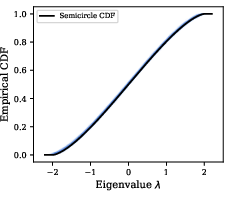
Figure 1: Eigenvalue empirical CDF for 200 independent GOE(100) matrices (blue), overlaid with the Wigner semicircle CDF (black), demonstrating eigenvalue universality and hence persistence diagram universality.
This identification enables the direct transfer of universality results from random matrix theory (RMT) to topological data analysis (TDA). In particular, for ensembles like the Gaussian Orthogonal Ensemble (GOE), eigenvalue distributions exhibit universality determined by global symmetry class, so the induced PDs inherit this universality property.
Analytical Results: Universal Statistics of Persistence Diagrams
The work derives closed-form statistics for persistence diagrams associated with RMT ensembles. Central among these is the persistence entropy (PE), defined as the Shannon entropy of the normalized eigenvalue spacings:
Sn−12
where Sn−13 is the total persistence.
Using asymptotic spectral densities, the paper produces closed-form ensemble-dependent expressions for PE. For GOE, where the spectral density is the Wigner semicircle law, the closed-form is:
Sn−14
Numerical experiments confirm that this asymptotic expression closely matches observed values, with systematic bias decaying as Sn−15 increases.
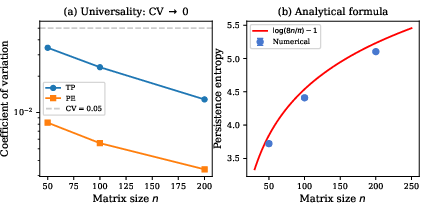
Figure 2: (a) Coefficient of variation of TP and PE vs.\ matrix size Sn−16, confirming universality; (b) empirical PE vs.\ the analytical closed-form prediction.
The universality claim is verified by showing that, for increasing Sn−17, the coefficient of variation of PE and TP vanishes, while the unfolded bulk spacing distributions empirically align with their theoretical surmises for GOE, GUE, and Wishart ensembles.
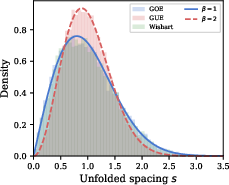
Figure 3: Unfolded bulk spacing distributions for GOE, GUE, and Wishart ensembles match predicted surmise distributions, confirming the universality of bar length distributions in persistence diagrams.
Persistence Entropy as a Complementary Spectral Diagnostic
A major practical contribution is demonstrating that PE can serve as an effective, sometimes superior, spectral diagnostic compared to standard local statistics like the mean level spacing ratio Sn−18. While Sn−19 is sensitive primarily to local level repulsion, PE captures the global shape of the eigenvalue spacing distribution.
Discrimination experiments between GOE and GUE matrices show that PE yields a larger AUC than M0 (0.978 vs. 0.952 at M1, non-overlapping CIs), and combining both statistics further improves discrimination, as they encode partially independent information.
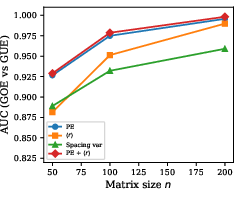
Figure 4: AUC for GOE vs. GUE discrimination; PE (circles) outperforms M2 (squares), with the best results from their linear combination (diamonds).
In the Rosenzweig–Porter model, which interpolates between GOE-type statistics and broader global spectral distributions, M3 remains insensitive to disorder until strong localization, whereas PE and spacing variance detect global changes in the spectrum at much weaker perturbations.
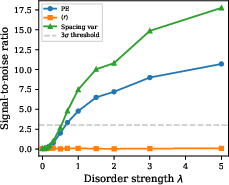
Figure 5: Signal-to-noise ratios for three spectral diagnostics (PE, spacing variance, M4) across the Rosenzweig–Porter model; PE and variance respond to density changes ahead of M5.
This establishes PE as a robust tool for diagnosing global spectral structure in random matrix ensembles and related models.
Implications, Limitations, and Future Directions
The bijection between the PD of M6 and the spectrum of M7 is information-theoretic: no information is gained, but the reformulation via Morse theory and TDA yields conceptual and methodological benefits. PE provides a statistically interpretable, natural summary that is competitive with or complementary to traditional spectral statistics, without tuning. Its sensitivity to global spectral density enables detection of structural changes invisible to local metrics.
While the closed-form for PE is asymptotically exact, finite-size corrections decay slowly due to edge effects in the spectral density. The approach is strictly for Hermitian ensembles; extensions to non-Hermitian matrices or non-quadratic Morse functions remain open. In high-dimensional statistical models (e.g., spiked Wishart), PE is not superior to specialized tests for signal detection, such as Tracy–Widom fluctuation analysis for outlier eigenvalues.
Future developments may include establishing concentration inequalities for PE (using eigenvalue rigidity theory), extensions to generalized ensembles, and applications to empirical spectra in physics, high-dimensional statistics, and machine learning.
Conclusion
This work rigorously connects random matrix theory, Morse theory, and persistent homology by showing that the PDs of quadratic forms on the unit sphere are exact encodings of eigenvalue spacings, inheriting the universality properties of their underlying ensemble. The persistence entropy statistic is analytically tractable, numerically robust, and captures global spectral structure, outperforming traditional diagnostics in key regimes. This synthesis offers both theoretical insight and practical tools for the analysis of random matrices and complex data spectra.
Reference: "Persistence diagrams of random matrices via Morse theory: universality and a new spectral diagnostic" (2603.27903)

