- The paper introduces DTP, a novel framework that decouples luminance and texture via a learnable wavelet transform to improve low-light image details.
- It employs dual-path processing with specialized luminance enhancement and multi-level texture restoration to balance noise suppression with detail preservation.
- Experimental results on the RELLISUR dataset show DTP outperforms state-of-the-art methods with significant PSNR, SSIM gains and LPIPS reduction.
Dual-Path Learning with Frequency Structural Decoupling for Low-Light Image Super-Resolution
Introduction
Low-light image super-resolution (LLISR) involves the restoration of images suffering from both pronounced noise due to low illumination and structural information loss caused by low resolution. Traditional pipelines often tackle enhancement and super-resolution tasks sequentially or jointly in the spatial domain, but these approaches exacerbate semantic entanglement—leading to artifacts, blurred texture, and structural ambiguities, particularly under extreme low-light conditions. The paper "Dual-Path Learning based on Frequency Structural Decoupling and Regional-Aware Fusion for Low-Light Image Super-Resolution" (2603.27301) introduces a Decoupling then Perceive (DTP) framework, characterized by explicit frequency-aware structural disentanglement, dual-path semantic-specific processing, and adaptive regional-aware fusion, aiming for robust and perceptually consistent LLISR outputs.
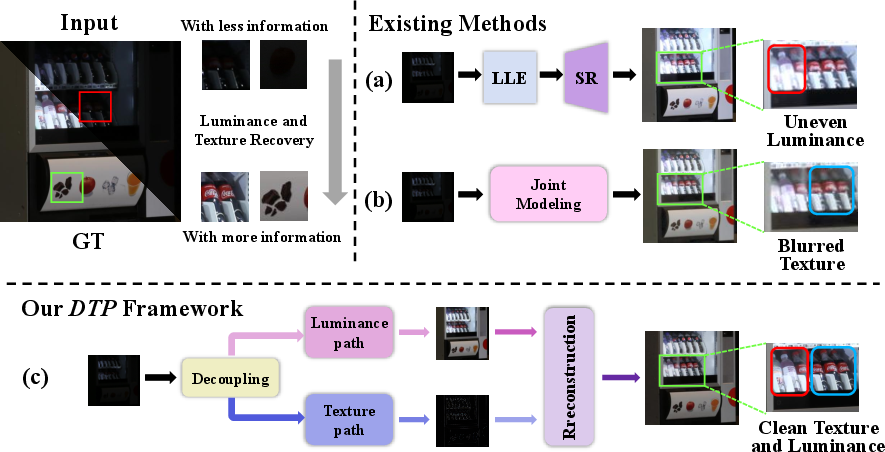
Figure 1: Comparison of existing LLISR methods—sequential and joint spatial-domain approaches induce artifacts and blur, while the proposed frequency-aware disentanglement cleanly separates and models luminance and texture, enabling superior detail and perceptual quality.
Frequency-Aware Structural Decoupling
DTP’s cornerstone is the Frequency-aware Structural Decoupling (FSD) module. Conventional techniques process spatial features holistically, leading to early-stage luminance-texture semantic entanglement that impedes effective learning and robust restoration. Instead, FSD applies a learnable wavelet transform to the input image, partitioning it into a low-frequency luminance component and distinct high-frequency texture subbands. A learnable vector α adaptively emphasizes these subbands, and a KL regularization on the luminance channel encourages compactness and alignment with natural image statistics.
This explicit separation enables subsequent modules to operate semantically: the luminance branch robustly enhances global illumination without polluting fine spatial detail, while the texture branch targets fine-grained residual structure recovery and noise attenuation through dedicated hierarchical denoising.
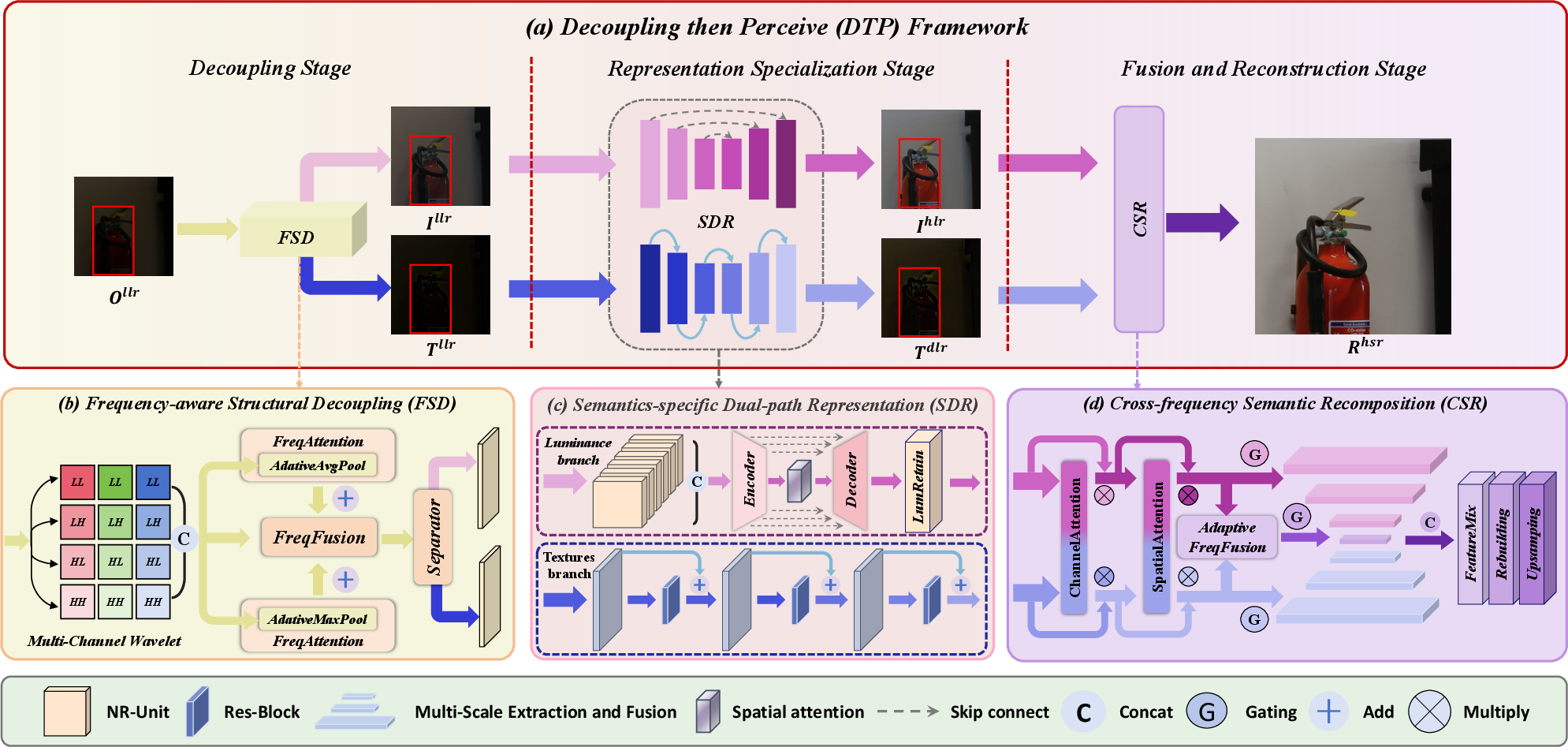
Figure 2: Overview of DTP. (a) Overall DTP pipeline; (b) Decoupling Stage (FSD) separates luminance and texture; (c) Representation Specialization Stage (SDR) processes each branch; (d) Fusion and Reconstruction Stage (CSR) recombines features for final output.
Semantics-Specific Dual Pathway Representation
Following frequency decomposition, the Semantics-specific Dual-path Representation (SDR) module assignments two specialized enhancement paths:
- Luminance Enhancement: Adopts a bio-inspired, Naka–Rushton-type activation to mimic human photoreceptor adaptation, providing non-linear brightness scaling responsive to local statistics, thus suppressing under/over-exposure and improving perceptual quality.
- Texture Restoration: Utilizes multi-level residual-based denoising, refining high-frequency cues through progressive removal of structured noise while preserving minute textures, crucial for visually sharp and realistic high-resolution outputs.
The orthogonal processing of these branches circumvents the typical trade-off between noise suppression and detail preservation, simultaneously advancing fidelity and perceptual realism.
Regional-Aware Cross-Frequency Fusion
The Cross-frequency Semantic Recomposition (CSR) module reunites the enhanced luminance and denoised texture channels via spatial-channel co-attention. Parallel attention pathways dynamically gate spatial and channel contributions, merging outputs according to content-dependent priorities. A learnable gating mask facilitates soft selection across spatial regions of varying semantic significance, and a final residual refinement enforces high-frequency integrity in the fusion stage.
This attentive fusion introduces regional adaptivity, countering the pitfalls of static concatenation and preventing semantic drift and structure degradation in spatially heterogeneous scenes.
Experimental Analysis
Extensive evaluation is conducted on the RELLISUR dataset, benchmarking both ×2 and ×4 upscaling factors versus leading LLISR and general-purpose SR methods. DTP demonstrates strong quantitative improvements, outperforming SOTA by +1.6% PSNR, +9.6% SSIM, and −48% LPIPS. Ablation studies confirm additive contributions from each module—incorporation of FSD, SDR, and CSR consistently raises PSNR and SSIM while reducing perceptual error.
Qualitative visualizations reveal clear gains: restored images via DTP display uniform luminance, sharp boundaries, and faithful fine textures, evading over-enhancement and structure collapse common in baseline models.
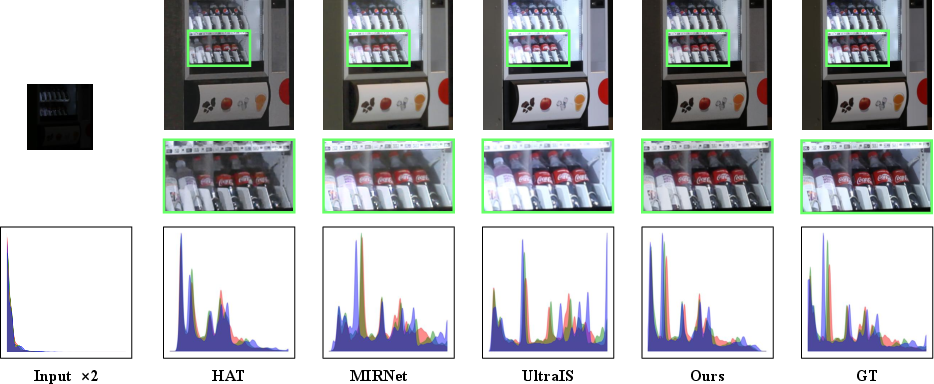
Figure 3: Qualitative comparison on RELLISUR (×2): DTP better reconstructs detailed regions and preserves faithful histogram distributions, whereas other methods introduce artifacts or lose texture.
DTP’s resilience under severe illumination degradation is particularly salient. At extreme exposures (−2.5 EV to −4.5 EV), competing methods manifest pronounced loss of details and over/under-saturation. In contrast, DTP preserves geometric and textural accuracy even at the lowest light settings, attributable to the frequency/semantics disentanglement and adaptive regional fusion.
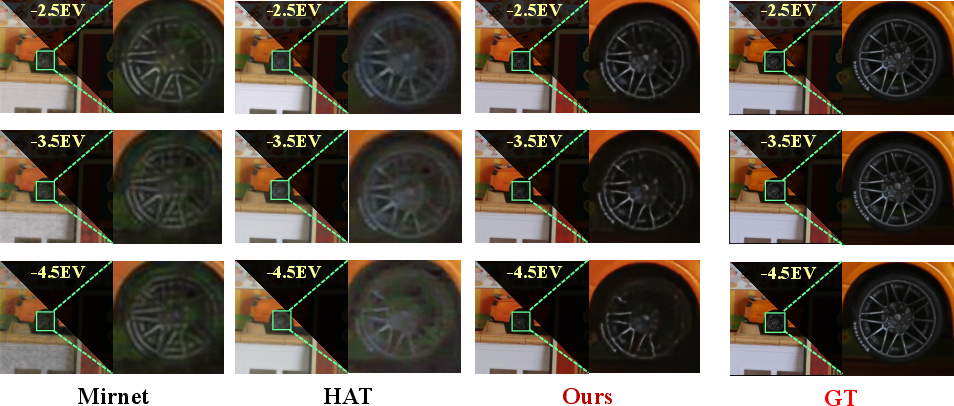
Figure 4: Visual results in extreme low-light (-2.5 EV to -4.5 EV): DTP maintains details and perceptual quality under conditions where other methods fail.
Practical and Theoretical Implications
The frequency-domain decoupling paradigm advances the theoretical understanding of semantic interference in LLISR and demonstrates the importance of early structural separation for robust, interpretable learning. In practical terms, DTP’s pipeline offers application benefits in surveillance, autonomous navigation, and computational photography, especially in unconstrained or adverse lighting environments where conventional end-to-end models break down.
The three-stage separation-specialization-fusion structure is generalizable, with future extension potential to other multimodal, multi-degradation restoration problems and possibly integration with self-supervised and domain adaptation techniques for cross-scene robustness.
Conclusion
This work presents a frequency- and region-aware dual-path LLISR framework that disentangles, specifically models, and contextually fuses luminance and texture features, systematically mitigating semantic confusion, artifact amplification, and structural loss that afflict prevailing LLISR methods. Both empirical and qualitative results support the efficacy and adaptability of the proposed strategy, highlighting its suitability for further research in robust low-light restoration, interpretable representation learning, and cascaded frequency-domain modeling in image reconstruction tasks.

