Sign Errors in "The Four Laws of Black Hole Mechanics"
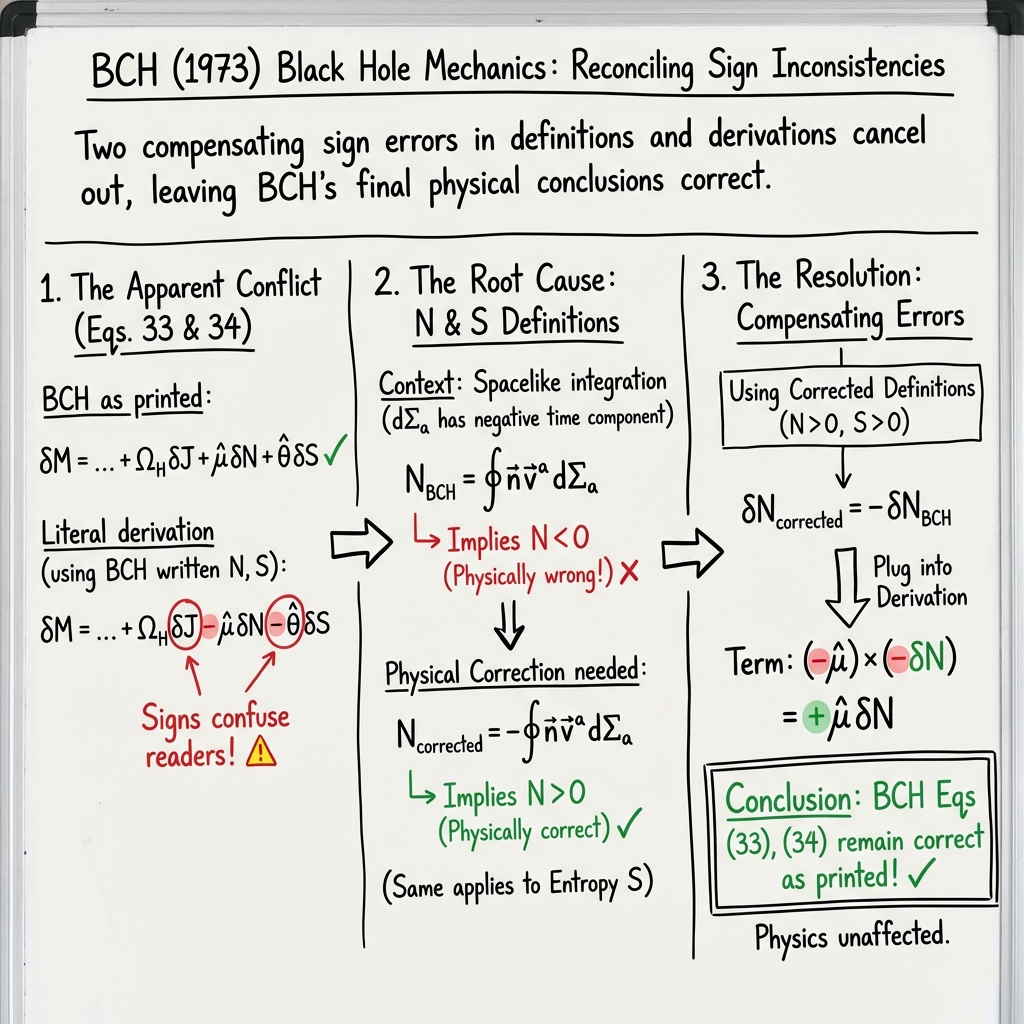
Abstract: In 1973, Bardeen, Cater, and Hawking published "The Four Laws of Black Hole Mechanics", establishing the mathematical framework that would later be understood as the thermodynamics of black holes. Central to the paper is equation (33), which writes the variation of the total energy-momentum integral in terms of physically meaningful quantities: angular momentum, particle number, and entropy. Equation (33) feeds into the differential mass formula, equation (34), which is the first law of black hole mechanics. This note identifies two compensating sign errors in the BCH paper. The first error, demonstrated by a derivation from equation (32), is that equations (33) and (34) should carry minus signs rather than plus signs on the last two integrals, those involving the redshifted chemical potential and the redshifted temperature. he second error is that the definitions of total particle number N and total entropy S given after equation (20) are missing minus signs that are required for these quantities to be positive. These two errors cancel, in that reversing the signs in the definitions of N and S to ensure positive quantities makes equations (33) and (34) correct. All conclusions of the BCH paper remain valid. This note is intended merely as a guide for readers who, in working through the derivation step by step, might otherwise be puzzled by the sign discrepancies. Numbered equations refer to the BCH paper; lettered equations are introduced in this note.
Paper Prompts
Sign up for free to create and run prompts on this paper using GPT-5.
Top Community Prompts
Explain it Like I'm 14
A simple explanation of “Sign Errors in ‘The Four Laws of Black Hole Mechanics’”
1. What is this paper about?
This short note looks at a famous 1973 paper by Bardeen, Carter, and Hawking (often called “BCH”) that set up the basic rules for how black holes behave, similar to the laws of thermodynamics. The author of this note says there are two small, matching sign mistakes (pluses vs. minuses) in BCH’s math. The good news: the mistakes cancel each other out, so the original conclusions remain correct. This note is meant to help readers who follow the derivation step by step and get confused by the signs.
2. What questions does it ask?
In simple terms, the note asks:
- Are the signs in two key BCH formulas (their equations (33) and (34)) correct?
- Are the definitions of total particle number (N) and total entropy (S) in BCH written with the right signs so that N and S come out positive, as they should?
- If there are sign issues, do they actually change the physics?
3. How did the author check it?
The author does two things:
- Carefully retraces BCH’s algebra: He starts from one equation (BCH’s (32)) and shows how it should lead to the next one (BCH’s (33)). While doing this, he keeps very close track of every plus and minus sign. Think of it like checking a long chain of steps in a math problem, looking for a flipped sign.
- Performs a “sanity check” on the definitions: He looks at the BCH definitions of total particle number N and total entropy S and tests them in a simple situation (like calm dust in flat space). With BCH’s signs, N and S come out negative even when the densities are positive—clearly unphysical. That shows those definitions need a minus sign to make N and S positive.
Helpful everyday analogies:
- Integrals are like adding up tiny pieces over a whole region.
- “Redshifted” temperature and chemical potential (written as and in physics) mean the values you’d measure far away from the black hole, after accounting for gravity slowing time near the black hole.
- Sign conventions are like choosing which direction is “positive” on a number line. If you flip your direction in one place but not another, your final answer can pick up an extra minus sign.
4. What did the author find, and why is it important?
Main findings:
- Two compensating sign errors:
- If you use BCH’s printed definitions of N and S as-is, the last two terms in their equations (33) and (34)—the ones that include the redshifted chemical potential and redshifted temperature —should actually carry minus signs, not plus signs.
- However, BCH’s definitions of total particle number N and total entropy S themselves are missing a minus sign. With the printed definitions, even a simple, sensible case would give you negative N and S, which makes no physical sense.
- When you fix the definitions (add a minus sign so N and S are positive), the signs in the big equations (33) and (34) come out exactly as BCH wrote them. In other words, the two errors cancel each other.
- The note also points out two minor typos in BCH’s intermediate steps (a swapped index in a Lie derivative identity, and a missing factor in a displayed relation). These typos do not affect the final results.
Why it matters:
- Equation (34) in BCH is the “first law of black hole mechanics.” It’s the black hole version of “first law of thermodynamics.” In words, it says a tiny change in the black hole’s mass equals contributions from rotation, particle number, and entropy:
- change in mass ≈ rotation term + change in particle number + change in entropy.
- Getting the signs right ensures that adding particles or entropy changes the mass in the correct way. The author shows BCH’s final statement still works once you define N and S with the correct sign.
5. What is the impact of this research?
- Clarity, not correction: The physics in BCH stands as originally claimed. The “first law” and the overall results remain valid.
- Better guidance for learners: Anyone carefully reproducing the derivation won’t be tripped up by sign mismatches if they use the corrected definitions for N and S.
- Reminder about conventions: In relativity, the choice of sign conventions (how you mark time and space directions, and how you define surface elements) matters. If you choose a convention, you must stick with it everywhere to keep quantities like particle number and entropy positive.
In short, this note doesn’t change black hole physics. It simply clears up plus/minus sign confusion so that students and researchers can follow the classic derivation without getting puzzled.
Knowledge Gaps
Knowledge gaps, limitations, and open questions
Below is a focused list of what the note leaves unresolved or only partially addressed—framed as concrete, actionable items for follow‑up work:
- Need a formal, coordinate‑free audit of BCH’s orientation and surface‑element conventions: explicitly define , the hypersurface normal’s direction, and sign choices to guarantee , , across all steps, and determine whether the “errors” are genuinely mistakes or merely convention mismatches.
- Independent cross‑checks of the sign structure using alternative derivations (e.g., ADM/Hamiltonian methods, Komar integrals, Iyer–Wald Noether‑charge formalism) to validate the relative signs of all first‑law terms, including the matter terms and .
- Clarify whether and how the horizon term is affected: verify the relative sign consistency among , , , , and in the first law, not just the and terms.
- Generalize the sign analysis beyond perfect fluids: check scalar fields, multi‑component fluids with several conserved , dissipative/viscous matter, and electromagnetic matter contributions to see if analogous sign subtleties arise and how to fix them consistently.
- Extend the analysis to charged and rotating black holes (Kerr–Newman) and to additional conserved charges and potentials (e.g., ): determine whether similar compensating sign issues appear and how they map onto BCH.
- Map the results across metric‑signature conventions: provide an explicit translation between mostly‑plus (used here) and mostly‑minus signatures, showing how each sign choice in , , , transforms to avoid ambiguity.
- Reassess the assumption that flipping and signs is “unphysical”: distinguish the always‑positive redshift factor from potentially sign‑varying chemical potentials (species‑dependent) and justify the constraint set on and more carefully.
- Verify derivation steps that assume the hypersurface is fixed and : analyze whether allowing moving boundaries, different hypersurface choices, or non‑Killing perturbations changes the sign conclusions in (32)→(33) and in the first law.
- Provide a complete, line‑by‑line derivation showing that the missing factor in the identity before (33) is indeed harmless, and that including it reproduces the term without introducing compensating sign changes elsewhere.
- Audit the entire BCH paper for additional sign/index typos beyond the two mentioned: produce a consolidated errata with corrected equations and a consistent set of conventions.
- Explore dependence on hypersurface orientation choices: devise definitions of and (e.g., using or explicit orientation prescriptions) that remain positive irrespective of the chosen future‑directed normal and document how BCH’s integrals should be written to enforce this universally.
- Test the corrected formulas on worked examples (e.g., slowly rotating dust, stationary fluids around Kerr, analytic toy models): compute both sides of the first law numerically to verify sign consistency in practice.
- Assess implications for extended black hole thermodynamics (with cosmological constant and – terms): determine whether similar sign ambiguities occur for and how to fix conventions in asymptotically (A)dS spacetimes.
- Evaluate downstream impact: survey subsequent literature and pedagogical sources to identify places where BCH’s original and definitions were used verbatim, and whether any published results might be susceptible to sign inconsistencies.
- Provide implementation guidance: specify a minimal, self‑consistent set of sign and orientation conventions (including , , and redshift factors) suitable for symbolic manipulation and numerical GR toolchains, to prevent reintroduction of the discrepancy.
Practical Applications
Immediate Applications
Below are actionable ways to use the paper’s clarifications on sign conventions and derivational checks right now, across academia, industry, policy, and daily life.
- Course corrections and teaching aids for black hole thermodynamics and GR
- Sectors: academia, education
- What: Update lecture notes, problem sets, and solution manuals to (i) state the mostly-plus signature and hypersurface orientation explicitly, (ii) define N and S with the correcting minus signs, and (iii) walk students through the sign flow from (32) to (33)/(34) as a case study in “debugging a derivation.”
- Tools/workflows: annotated derivation handouts; interactive notebooks demonstrating the sign bookkeeping step-by-step; a one-page “Convention Card” for surface elements and future-directed normals.
- Assumptions/dependencies: courses that teach BH mechanics; adoption of the mostly-plus convention; faculty willingness to incorporate errata.
- Reproducibility and peer-review checklists for theoretical papers using hypersurface integrals
- Sectors: academia, publishing
- What: Add a standard author/referee checklist to confirm (i) metric signature, (ii) orientation and sign of dΣa, (iii) positivity of extensive quantities (N, S) given definitions, and (iv) redshift factors for μ and T.
- Tools/workflows: journal submission templates with a “Conventions and Positivity Checks” section; referee forms prompting sign/positivity checks.
- Assumptions/dependencies: journal/editorial buy-in; minimal extra burden to authors.
- Symbolic verification notebooks to replicate and test the derivation
- Sectors: software, academia
- What: Public notebooks that reproduce the (32)→(33)→(34) derivation and highlight where sign flips occur, serving as regression tests for future derivations.
- Tools/workflows: Mathematica+xAct/xTensor, SymPy or SageManifolds notebooks; unit tests that fail if N or S become negative under stated conventions.
- Assumptions/dependencies: availability of symbolic packages; careful encoding of conventions.
- “Tensor-lint” macros and snippets for LaTeX to reduce sign mistakes at authoring time
- Sectors: software, publishing
- What: Lightweight LaTeX macros that standardize dΣa, future-directed normals, and definitions of global charges (J, N, S), automatically inserting the appropriate signs for the chosen signature.
- Tools/workflows: a small LaTeX package (e.g., gr-signs.sty) with signature toggles; templates for canonical definitions.
- Assumptions/dependencies: author willingness to use macros; consistent symbol naming.
- QA updates for GRMHD and numerical relativity documentation
- Sectors: astrophysics software, industry (HPC/scientific computing), academia
- What: Documentation cross-checks ensuring positive mapping of particle number and entropy densities to global integrals under stated surface-element conventions; unit tests that assert positivity of N and S in diagnostic routines.
- Tools/workflows: CI tests in codes like HARM, BHAC, KORAL, Einstein Toolkit; doc pages clarifying conventions and redshift factors.
- Assumptions/dependencies: code teams map local thermodynamic variables to global diagnostics; consistent orientation conventions.
- Knowledge-base annotations and errata linking in scholarly search
- Sectors: publishing, scholarly infrastructure
- What: Tag the BCH 1973 paper with community-vetted notes on the compensating sign errors and typographical issues, preventing confusion for new readers.
- Tools/workflows: arXiv overlays; Semantic Scholar/OpenAlex annotations; Crossref “relation-type: correction/annotation.”
- Assumptions/dependencies: platform support for post-publication notes; moderation to ensure accuracy.
- Case-study module on “debugging derivations” for advanced physics labs and MOOCs
- Sectors: education, edtech
- What: A short module where learners trace the derivation, identify where signs flip, and confirm that physical conclusions remain unchanged.
- Tools/workflows: interactive quizzes; side-by-side “as-written vs corrected” computation paths.
- Assumptions/dependencies: inclusion in existing MOOC curricula; access to computational tools.
- Best-practice guidance on explicitly stating conventions
- Sectors: academia
- What: Departmental or group-level guidance recommending explicit statements of metric signature, orientation, and normal vector properties in preprints and theses.
- Tools/workflows: a brief template paragraph authors can paste into methods sections.
- Assumptions/dependencies: local adoption and mentoring culture.
Long-Term Applications
These opportunities require additional development, scaling, or community adoption but can materially improve reliability and interoperability in theoretical and computational physics.
- Machine-assisted consistency checking for manuscripts
- Sectors: publishing, AI/software
- What: NLP + symbolic pipelines that parse LaTeX to identify signature choices, orientation, and definitions of global charges, then verify sign/positivity consistency across a paper.
- Tools/products: a “Scientific Equation Linter” plug-in for Overleaf/journal systems that flags likely sign mismatches in hypersurface integrals and redshifted thermodynamic terms.
- Assumptions/dependencies: robust LaTeX-to-symbolic parsing; author opt-in; curated convention ontologies.
- Formal verification of tensor-calculus derivations in proof assistants
- Sectors: academia, software
- What: Libraries for Lean/Coq/Isabelle that can formally certify statements like the (32)→(33) step under specified conventions.
- Tools/products: a GR manifolds library with oriented hypersurface integration and energy-momentum identities; machine-checked proofs of BH mechanics lemmas.
- Assumptions/dependencies: long-horizon development of differential geometry stacks; expert community engagement.
- Convention and metadata standards for relativity toolchains
- Sectors: standards, software, academia
- What: A machine-readable “GR Convention Ontology” enumerating metric signatures, orientations, and normalization choices, attached as metadata to code, datasets, and papers.
- Tools/products: JSON/YAML convention manifests; translators that map between mostly-plus and mostly-minus conventions while adjusting signs automatically.
- Assumptions/dependencies: community agreement; integration in repositories (Zenodo, arXiv) and code registries.
- End-to-end CI/CD regression tests for sign and positivity constraints in simulators
- Sectors: astrophysics software, HPC/industry
- What: Automated tests that verify conserved/global quantities remain physically meaningful (e.g., N, S ≥ 0 under declared conventions) across code changes and parameter regimes.
- Tools/products: CI dashboards; property-based testing frameworks for PDE solvers.
- Assumptions/dependencies: exposure of diagnostics in code; compute resources for regression suites.
- Editorial and funding policy to incentivize reproducibility in mathematical physics
- Sectors: policy, publishing, funding agencies
- What: Policies encouraging explicit convention statements, public derivation notebooks, and errata management for foundational works.
- Tools/products: proposal/review rubrics scoring convention clarity; journal policies requiring a “Conventions” subsection and machine-readable metadata.
- Assumptions/dependencies: stakeholder alignment; minimal administrative overhead.
- Cross-domain static analyzers for sign and positivity constraints in scientific/engineering codes
- Sectors: engineering, energy, finance, software
- What: Extend sign/positivity checking beyond GR to PDE/ODE models where densities and probabilities must remain non-negative and flux signs must be consistent.
- Tools/products: static analysis tools that infer invariants and flag sign-violating code paths; integration with modeling languages (Modelica, JAX-based PDE stacks).
- Assumptions/dependencies: domain-specific invariant libraries; developer adoption.
- Training datasets and benchmarks for AI theorem-proving and symb-algebra agents
- Sectors: AI research, academia
- What: Curated “sign pitfall” corpora (including this case) to train agents to catch convention-sensitive errors in long derivations.
- Tools/products: benchmark suites with graded difficulty; evaluation metrics tied to physical plausibility (positivity, covariance).
- Assumptions/dependencies: high-quality annotations; community challenges to drive progress.
- Consolidated “Black Hole Mechanics Toolkit”
- Sectors: academia, education, software
- What: A unified package containing canonical definitions, verified derivations, interactive visualizations of redshifted quantities, and example problems linked to numerical models.
- Tools/products: open-source Python/Mathematica toolkit; living documentation with CI-backed proofs.
- Assumptions/dependencies: sustained maintainership; interoperability with existing GR libraries.
Notes on feasibility across all applications:
- The paper’s corrections are contingent on explicit declaration of the mostly-plus metric signature, spacelike hypersurface orientation, and future-directed normal conventions; alternative signatures require corresponding sign adjustments.
- Physical predictions of BCH remain unchanged; the value lies in clarity, reproducibility, and error-prevention in related derivations and software.
- Adoption depends on community incentives (publishers, code maintainers, educators) and availability of easy-to-use tooling.
Glossary
- Asymptotic limit: The behavior of a spacetime or field at infinitely large distances; often used to compare with flat spacetime. "the asymptotic limit of BCH"
- Contravariant time component: The time component of a vector with an upper index, transforming contravariantly under coordinate changes. "has a positive contravariant time component"
- Covariant time component: The time component of a vector with a lower index, transforming covariantly under coordinate changes. "so its covariant time component is negative"
- Covector: A linear functional on vectors (an object with a lower index), also called a one-form. "the Lie derivative of a covector"
- Differential mass formula: The infinitesimal (first-law) relation connecting changes in black hole mass to other physical quantities. "the differential mass formula, equation (34)"
- Dust: An idealized pressureless fluid used in general relativity models. "static dust"
- Energy-momentum integral: A global integral of stress-energy over a hypersurface, representing total conserved quantities. "variation of the total energy-momentum integral"
- Energy-momentum tensor: The tensor T encoding the density and flux of energy and momentum in spacetime. "the variation of the energy-momentum tensor term"
- First law of black hole mechanics: The relation analogous to thermodynamics connecting changes in mass, area (entropy), angular momentum, and particle number. "which is the first law of black hole mechanics"
- Four-velocity: A timelike unit vector tangent to a particle’s worldline, giving its velocity in spacetime. "four-velocity vª = [1,0,0,0]"
- Future-directed unit normal: A unit vector normal to a hypersurface that points toward increasing time. "the future- directed unit normal to a spacelike hypersurface"
- Lie derivative: A derivative measuring the change of a tensor field along the flow of a vector field. "the Lie derivative of a covector"
- Metric tensor: The tensor g that defines distances and angles in spacetime. "variation of the metric tensor, hab = 8 gab"
- Minkowski spacetime: Flat spacetime of special relativity, used as the asymptotic reference for isolated systems. "in Minkowski spacetime, the asymptotic limit of BCH:"
- Mostly-plus signature: A metric-signature convention (-,+,+,+) where the time component is negative and spatial components are positive. "In BCH's mostly-plus signature"
- Prograde rotation: Rotation in the same sense as the system’s angular momentum or orbital direction. "prograde rotation gives J > 0."
- Redshift factor: The gravitational redshift multiplier relating local to asymptotic measurements (e.g., of temperature or chemical potential). "a negative redshift factor"
- Redshifted chemical potential: The locally measured chemical potential scaled by gravitational redshift to an asymptotic value. "the redshifted chemical potential u"
- Redshifted temperature: The locally measured temperature scaled by gravitational redshift to an asymptotic value. "the redshifted temperature 6"
- Spacelike hypersurface: A three-dimensional slice of spacetime where all tangent vectors are spacelike. "a spacelike hypersurface"
- Timelike vector: A vector with negative norm in mostly-plus signature, representing physically possible trajectories slower than light. "ua is a timelike vector"
- Unit timelike vector: A timelike vector normalized to have unit magnitude (e.g., a four-velocity). "vª is a unit timelike vector"
- Variation: An infinitesimal change (δ) applied to fields or functionals in derivations. "the variation of the energy-momentum tensor term"
- Volume element: The oriented measure (e.g., dΣa) used to integrate over hypersurfaces in spacetime. "sign conventions required by the volume element."
Collections
Sign up for free to add this paper to one or more collections.

