Thermodynamics of Hairy Black Holes in Quantum Regimes: Insights from Horndeski Theory
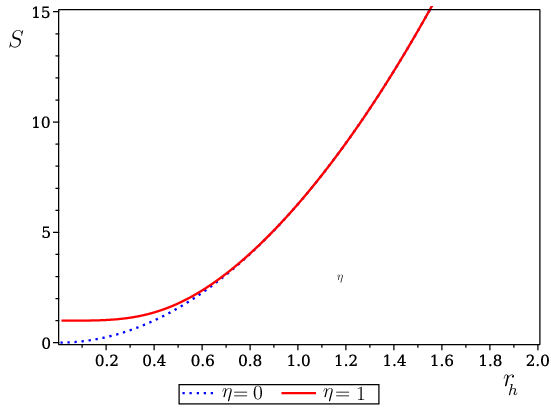
Abstract: We study non-perturbative quantum gravitational corrections to the thermodynamics and quantum work distribution of the $n$-dimensional Schwarzschild--Tangherlini--Anti-de Sitter black hole. Starting from the corrected entropy $S = S_0 + η\, e{-S_0}$, where $S_0$ is the Bekenstein--Hawking entropy, we derive the modified specific heat, internal energy, Helmholtz free energy, and Gibbs free energy in closed form. The specific heat retains the classical divergence at $r_h{*}=l\sqrt{(n-3)/(n-1)}$ for $n\geq 4$, but the quantum correction suppresses its magnitude by up to $78\%$ at small horizon radii. In the extended phase space, the uncharged black hole admits no van der Waals critical point; however, the non-perturbative correction induces a Hawking--Page transition for $n\geq 4$ that is absent in the semi-classical limit. The corrected Gibbs free energy turns negative at small $r_h$, opening a thermodynamic channel with no classical counterpart. Using the Jarzynski equality and Jensen inequality, we obtain the quantum work distribution during evaporation. The free energy difference $ΔF$ between two black hole states undergoes a sign reversal at small horizon radii for $n\geq 4$ when $η=1$, flipping the average quantum work from negative to positive. This sign reversal grows with the spacetime dimension, reaching $\langle W\rangle \approx +4.31$ for $n=10$. These findings demonstrate that non-perturbative quantum gravitational effects qualitatively alter the phase structure and evaporation energetics of AdS black holes, and they cannot be captured by perturbative corrections alone.
Paper Prompts
Sign up for free to create and run prompts on this paper using GPT-5.
Top Community Prompts
Explain it Like I'm 14
What this paper is about (big picture)
This paper looks at how tiny, purely quantum effects can change the “thermodynamics” (heat and energy behavior) of black holes, especially when the black holes are very small. The authors study a type of black hole that lives in a space with a negative “background pressure” (called Anti–de Sitter, or AdS space) and in any number of dimensions (not just our familiar 3D space). They ask: when a black hole shrinks to quantum sizes, do new effects appear that we can’t see with standard, approximate methods?
The main questions in simple terms
The authors focus on five clear questions:
- If we tweak the standard black hole entropy (a measure of its information/“disorder”) by adding a special quantum term, how do key thermodynamic quantities (like specific heat and free energies) change?
- Does this quantum tweak create new types of phase transitions (like water boiling) that don’t exist in the usual, classical picture?
- How do these changes depend on the number of spacetime dimensions?
- When a black hole evaporates (loses mass by Hawking radiation), how is the “work” involved in that process distributed, once quantum effects are included?
- Can these quantum effects flip the usual energy balance during evaporation—turning a process that used to “cost” energy into one that can “give” energy?
How they studied it (methods, with everyday analogies)
- Start with the usual entropy of a black hole (Bekenstein–Hawking entropy), which says entropy grows with the area of the black hole’s horizon. Think of it like: bigger surface area = more “information” stored.
- Add a quantum correction that becomes important only when the black hole is tiny:
- Standard entropy:
- Quantum-corrected entropy:
- Here, is a dial (0 means no correction, 1 means full correction). The extra term is super small when the black hole is big, but can matter a lot when the black hole is tiny. You can think of this as a “quantum floor” that stops the entropy from dropping too fast.
- Using this corrected entropy, they re-calculate:
- Specific heat: how much the black hole’s temperature changes when it gains/loses heat (like how quickly a pan heats up).
- Internal energy, Helmholtz free energy, and Gibbs free energy: different “energy accounts” that tell you which state is thermodynamically preferred. Free energy is like a “score” that tells you which setup wins in a fair competition at fixed conditions.
- Extended phase space: They treat the cosmological constant (a property of spacetime in AdS) as a pressure. This lets them draw pressure–volume relations, similar to those for gases, to check for “van der Waals”-type critical behavior (like the liquid–gas transition).
- Quantum work during evaporation: They use the Jarzynski equality (a tool from modern thermodynamics) to connect the statistics of work done during a process to the difference in free energy between the start and end. In very loose terms:
- Jarzynski equality: average of equals , where is work, is the change in free energy, and is 1/(temperature).
- Jensen’s inequality then gives a simple bound relating average work to free energy difference.
In short: they use a simple, universal quantum correction to the entropy, re-compute the black hole’s thermodynamics, and then study how evaporation “work” changes using standard nonequilibrium identities.
What they found (and why it matters)
- The specific heat still shows a classic “infinite spike” at a certain horizon size (a sign of a phase transition), just like in the usual picture. However, the quantum correction makes this spike much smaller for tiny black holes—by up to about 78%. Translation: near the quantum scale, the black hole’s thermal response is softened.
- No van der Waals critical point for uncharged black holes. In the extended phase space (treating spacetime’s cosmological constant as pressure), the uncharged AdS black hole doesn’t show the gas–liquid type critical point that charged black holes can have. This matches known results and shows the correction doesn’t magically create that type of transition.
- A new Hawking–Page transition appears because of the quantum correction when spacetime has 4 or more dimensions (n ≥ 4). The Hawking–Page transition is like a switch between “empty hot space” and a “black hole phase.” Classically, for these uncharged higher-dimensional black holes, there’s no such switch: the “empty space” wins. But with the quantum correction, the Gibbs free energy turns negative for small black holes, meaning the black hole phase can win at small sizes. This is a new thermodynamic channel that simply doesn’t exist without the quantum term.
- Internal energy increases at tiny sizes. The quantum correction raises the internal energy of very small black holes compared to the classical value, but for large black holes the difference is negligible. This fits the idea that the new effect is purely quantum and only matters near the “Planck scale” (the tiniest, most quantum regime).
- The evaporation “work budget” can flip sign in higher dimensions. Using the Jarzynski equality, the authors compute how the average work behaves as a black hole evaporates from a larger to a smaller size. With the quantum correction:
- For dimensions n ≥ 4, the free energy difference at very small sizes can become negative, which flips the average work from negative to positive. In simple words: the evaporation can switch from “needing” work to “producing” work.
- This effect grows with the number of dimensions. For example, in 10 dimensions, a typical case shows the average work becoming strongly positive (around +4.31 in the units they use).
Why this matters: It shows that tiny, non-perturbative quantum effects don’t just make small tweaks—they can qualitatively change the phase structure and energy flow of black holes. You cannot get these changes by the usual small, step-by-step corrections; you need the full exponential term.
Why these results are important
- New phase behavior: The quantum-induced Hawking–Page transition for n ≥ 4 means black holes can become thermodynamically preferred in regimes where, classically, they never would. That’s a sizable change in our “phase diagram” of black holes.
- Evaporation energetics: The sign flip in average work during evaporation shows that quantum gravity can reverse the usual energy expectations in higher dimensions. This could influence how we think about the end stages of black hole evaporation and about the matching story in the dual “holographic” theory (AdS/CFT).
- Dimension matters: The quantum effects become stronger as the number of dimensions increases, highlighting how higher-dimensional gravity (important in string theory) can behave differently in the deep quantum regime.
What this could mean going forward
- For theory: These results suggest that truly quantum (non-perturbative) gravity effects must be included to understand small black holes, their phase transitions, and their evaporation. Relying only on small, step-by-step corrections misses key physics.
- For holography (AdS/CFT): Because black hole thermodynamics in AdS is linked to a “dual” quantum field theory, the new phase behavior and work statistics may have a mirrored description in that dual theory—potentially offering fresh insights into strongly interacting quantum systems.
- For future studies: Adding electric charge or rotation could reveal even richer behavior (for example, interacting with known van der Waals-type transitions in charged AdS black holes). The same approach could also probe whether these quantum effects help with big open questions, like how information escapes a black hole.
In short: by adding a simple, universal quantum correction to black hole entropy, the authors find brand-new thermodynamic behavior—especially in higher dimensions—that changes how black holes can “win” thermodynamically and how they spend or produce energy as they evaporate.
Knowledge Gaps
Knowledge gaps, limitations, and open questions
The following points identify concrete gaps and unresolved issues that future work could address:
- Derivation of the exponential correction: The entropy ansatz S = S0 + η e{-S0} is taken as “universal,” but no first-principles derivation is provided for non-supersymmetric, neutral ST–AdS black holes; clarify the microscopic origin (e.g., instanton sectors, topological saddles) for this specific background.
- Physical meaning and calibration of η: The dimensionless parameter η is treated as a free control knob (often set to 1), with no guidance on its magnitude, sign, or dependence on spacetime dimension, charges, rotation, or boundary conditions; propose a method (e.g., matching to holographic 1/N effects or explicit QG computations) to fix or constrain η.
- Interplay with perturbative corrections: Only the non-perturbative exponential term is included, while known logarithmic and higher-order perturbative corrections are neglected; quantify the joint impact of S = S0 + α ln S0 + η e{-S0} and identify the crossover scale where non-perturbative effects dominate.
- Assumption of unmodified temperature: The temperature is kept identical to the semiclassical Hawking temperature despite modifying the entropy; assess whether consistent non-perturbative corrections to the geometry (and thus to T, surface gravity, and f(r)) alter the conclusions.
- Consistency with first law and Smarr relation: With S corrected but T and geometry unchanged, verify integrability of the first law (including V dP in extended phase space) and the Smarr relation; determine whether a consistent corrected mass/enthalpy exists.
- Extended thermodynamics consistency: The EoS P–V–T is treated as unchanged by the entropy correction; examine whether non-perturbative corrections induce shifts in the thermodynamic volume or pressure-dependent potentials via a fully consistent Legendre structure.
- Ensemble mixing and control variables: Parts of the analysis assume fixed l (canonical) while others invoke extended phase space (isobaric); clarify the ensemble and control variables used in each step of the free-energy and work calculations to avoid mixing ensembles.
- Specific-heat definition and stability: C_V is computed at “fixed volume (i.e., fixed l),” but in extended phase space V ∝ r_h{n−1} varies with r_h; provide a thermodynamically well-defined stability analysis (e.g., C_P and Hessians of the relevant potential) consistent with the chosen ensemble.
- Reliability of small-S0 expansion: Several results (e.g., average work) employ e{-S0} ≈ 1 − S0; quantify the error bounds of this truncation, specify the domain of validity (S0 ≪ 1), and re-evaluate key sign changes without this approximation.
- Numerical robustness and reproducibility: Many expressions contain incomplete gamma functions and approximations; provide error estimates, convergence checks, and independent cross-validations (e.g., Euclidean action calculations) of the numerical results.
- Baseline Hawking–Page transition: The claim that the uncorrected neutral ST–AdS black hole lacks a Hawking–Page transition for n ≥ 4 conflicts with standard results for Schwarzschild–AdS; re-derive G and the HP condition using established methods (on-shell action) and reconcile with known benchmarks.
- Treatment of n = 3 case: The use of ST–AdS formulas for n = 3 (BTZ regime) is nonstandard; redo the n = 3 analysis with the correct BTZ geometry and verify whether the qualitative conclusions (e.g., stability and HP behavior) persist.
- Jarzynski equality applicability: The application of the Jarzynski equality to evaporating black holes assumes well-defined Gibbs states and work protocols; explicitly justify the required conditions (initial canonical ensemble, unitary evolution, work measurement scheme) in the gravitational context.
- Choice of free energy in Jarzynski: Jarzynski relates work to the Helmholtz free energy at fixed volume/temperature; clarify whether F or G is the appropriate potential in the chosen ensemble (and whether V or P is held fixed) during the evaporation protocol.
- Nonequilibrium dynamics and backreaction: The evaporation process is treated via equilibrium free-energy differences without modeling radiation backreaction, graybody factors, or boundary reflectivity in AdS; develop an open quantum systems or stochastic thermodynamics model to capture these effects.
- Microcanonical vs canonical description: Small AdS black holes may not be well-described by canonical ensembles; assess the impact of a microcanonical or grand-canonical treatment on stability, free energies, and the work distribution.
- Holographic interpretation: Provide a dual CFT interpretation of the exponential entropy correction and the quantum-induced HP transition (e.g., nonperturbative 1/N contributions, instanton sectors), and identify boundary observables sensitive to these effects.
- Universality across dimensions: The strong n-dependence (e.g., enhanced sign reversal in ΔF with increasing n) lacks a large-n analysis or string-theoretic embedding; study the large-n limit and connect to specific holographic models where n is tied to CFT data.
- Parameter ranges and dimensional analysis: The scale at which S0 ≲ 1 (Planckian) is invoked without explicit dimensional restoration; reintroduce G, ℏ, and l_p to define the Planckian regime and map the “quantum floor” to physical scales.
- Alternative non-perturbative structures: Explore whether other non-perturbative structures (e.g., multi-instanton sums, e{-k S0} with k > 1) or nonlocal corrections produce qualitatively different thermodynamics or work statistics.
- Cross-check via Euclidean action: Independently compute corrected free energies using the Euclidean on-shell action (with appropriate counterterms) incorporating the non-perturbative correction to verify the sign and magnitude of G and F.
- Latent heat and critical exponents: For the quantum-induced HP transition, compute latent heat, Clapeyron slopes, and critical exponents (if any) to characterize the nature and universality class of the transition.
- Extension to charged/rotating/hairy cases: Generalize the analysis to Reissner–Nordström–AdS, Kerr–AdS, Gauss–Bonnet/Lovelock, and Horndeski (hairy) black holes to test how charges, rotation, higher curvature, and scalar hair modify the non-perturbative effects.
- Consistency with energy conditions and cosmic censorship: Verify that the parameter ranges yielding negative G and sign-reversed ΔF do not violate energy conditions or lead to pathologies (e.g., naked singularities) when backreaction is included.
- Boundary conditions and cavity setups: Specify and analyze the effect of boundary reflectivity (AdS asymptotics vs finite cavity) on equilibrium, stability, and the applicability of fluctuation theorems to the evaporation scenario.
- Title–content mismatch: The title references “Hairy Black Holes” and “Horndeski Theory,” but the analysis focuses on neutral ST–AdS black holes; either extend the study to Horndeski hairy solutions or adjust scope/title for consistency.
- Typographical/formatting errors in equations: Multiple broken equations (missing braces, factors) hinder reproducibility; provide a corrected, fully typeset appendix with all formulas to ensure clarity and independent verification.
Practical Applications
Immediate Applications
Below are near-term, actionable uses of the paper’s findings and methods across sectors. Each item notes key dependencies or assumptions that may affect feasibility.
- Academia (theoretical physics, condensed matter, high-energy theory)
- Incorporate non-perturbative entropy corrections into holographic modeling
- What: Use S = S0 + η e{-S0} to refine AdS/CFT analyses of phase structure (e.g., mapping Hawking–Page transitions to confinement–deconfinement in dual CFTs), and update stability criteria using the suppressed specific heat and quantum-induced Hawking–Page transition for n ≥ 4.
- Tools/workflows: Reproducible Python/Matlab/Mathematica notebooks that compute corrected C_V, E, F, G for ST–AdS; parameter scans over n, l, η; symbolic-numeric pipelines with robust special-function evaluation.
- Dependencies/assumptions: Validity of AdS/CFT mapping; BH temperature treated as uncorrected; η treated as a controllable parameter; results are for uncharged ST–AdS backgrounds.
- Benchmark non-equilibrium thermodynamics methods with a gravitational testbed
- What: Use the Jarzynski-equality-based derivations and the sign reversal of ΔF as a stringent test case for fluctuation theorems under strong finite-size corrections.
- Tools/workflows: “JarzynskiBench” scripts that compare estimators (Jensen bound, cumulant expansion) on the paper’s ΔF landscape; stress-test protocols for bias and variance at small “horizon radius” analogs.
- Dependencies/assumptions: Requires mapping BH parameters to effective lab/computational parameters; applicability is conceptual but immediately useful for method development.
- Quantum information and quantum thermodynamics
- Design and validate fluctuation-theorem protocols on quantum devices
- What: Use the dimension-dependent sign change of ΔF as a target behavior for validating nonequilibrium work protocols on NISQ platforms or trapped-ion simulators.
- Tools/workflows: Protocol templates that implement forward/backward quenches and Jarzynski estimators tuned to reproduce sign reversals in engineered Hamiltonians.
- Dependencies/assumptions: Requires constructing effective models whose free-energy landscape qualitatively matches the paper’s corrected ΔF; experimental noise control.
- Analog gravity experiments (optics, Bose–Einstein condensates, metamaterials)
- Qualitative tests of quantum-induced phase behavior
- What: Emulate the emergence of a “quantum-induced Hawking–Page-like transition” by tuning effective potentials or dispersion to reproduce a Gibbs-free-energy sign change at small effective radii/scales.
- Tools/workflows: Parameter-scan protocols in BEC or optical fiber analogs; data analysis scripts that mirror the paper’s G(r_h) zero-crossing detection.
- Dependencies/assumptions: Only qualitative correspondences are feasible; requires careful mapping from analog variables to thermodynamic proxies.
- Software and HPC (scientific computing)
- Special-function and thermodynamics toolkits
- What: Release a “BlackHoleThermoX” library implementing corrected thermodynamics (C_V, E, F, G) with stable, high-accuracy routines for incomplete gamma functions and Laguerre expansions in challenging regimes.
- Tools/workflows: C++/Python packages with vectorized kernels, GPU support; test suites covering n = 3–10, small-r_h asymptotics, and η ∈ [0,1].
- Dependencies/assumptions: Numerical stability for extreme arguments; validation against asymptotics and high-precision arithmetic.
- HPC benchmarking and numerical-analysis education
- What: Use the paper’s expressions as benchmarks for quadrature, special-function evaluation, and automatic differentiation under stiffness.
- Tools/workflows: Continuous-integration benchmarks; reproducible performance dashboards.
- Dependencies/assumptions: None beyond standard HPC environments.
- Education and outreach
- Modern modules on quantum thermodynamics and holography
- What: Graduate-level problem sets on non-perturbative corrections, phase structure, and Jarzynski equality; interactive visualizations of T(r_h), G(r_h), and ΔF(r_h1, r_h2).
- Tools/workflows: Jupyter notebooks; small web apps for parameter exploration.
- Dependencies/assumptions: Introductory familiarity with BH thermodynamics and statistical mechanics.
- Industry (biotech/chemistry modeling)
- Robust nonequilibrium free-energy estimation practices
- What: Use the paper’s “pathological” ΔF sign-reversal scenario as a stress test to detect estimator bias and sampling insufficiency in Jarzynski-based free-energy calculations (e.g., steered MD for ligand binding).
- Tools/workflows: Diagnostic protocols that flag estimator breakdown when ΔF crosses zero under strong corrections; cross-validation with Crooks’ theorem and bidirectional estimators.
- Dependencies/assumptions: Conceptual transfer from gravity to molecular systems; focuses on methodology, not domain physics.
- Policy and funding
- Support for cross-disciplinary quantum thermodynamics and analog gravity programs
- What: Use the paper as evidence that nonperturbative effects materially change nonequilibrium energetics, justifying investment in analog experiments and computational methods.
- Dependencies/assumptions: Emphasis on foundational science with broad methodological spillover (computation, quantum devices).
Long-Term Applications
These directions are plausible but require substantial research, generalization beyond idealized assumptions, or new instrumentation.
- Observational/astroparticle physics
- Primordial black hole (PBH) evaporation modeling
- What: Incorporate non-perturbative entropy corrections into late-stage PBH evaporation spectra and lifetimes to refine gamma-ray or neutrino background forecasts.
- Potential products/workflows: Pipelines that replace perturbative log-corrections with exponential terms near Planck scales; Bayesian inference modules for future PBH searches.
- Dependencies/assumptions: Real BHs are not AdS; needs generalized corrections for asymptotically flat spacetimes and inclusion of charge/rotation; Planck-scale physics must be observationally accessible.
- Quantum thermal machines and nanoscale energy systems
- Engine designs exploiting fluctuation-dominated regimes
- What: Leverage insights from ΔF sign reversals to design protocols that extract positive average work from strongly fluctuating micro-systems.
- Potential products/workflows: Control sequences for quantum heat engines; feedback protocols tuned to leverage nonequilibrium work relations.
- Dependencies/assumptions: Physical platforms exhibiting analogous non-perturbative corrections; precise control and readout at nanoscale.
- Holographic modeling of strongly coupled matter (QCD, condensed matter)
- Non-perturbative refinements of phase-transition modeling
- What: Map quantum-induced Hawking–Page transitions to confinement/deconfinement or metal–insulator transitions in dual theories, improving qualitative predictions in holographic QCD or strange metals.
- Potential products/workflows: Holographic simulators with exponential entropy corrections; fits to lattice/QCD or transport data including non-perturbative effects.
- Dependencies/assumptions: Existence of suitable duals; calibration against empirical data; extension to charged/rotating backgrounds.
- Quantum computing and algorithms
- Generalized free-energy estimators for high-dimensional, far-from-equilibrium systems
- What: Algorithms that stabilize Jarzynski/Crooks estimators under strong finite-size or non-perturbative corrections, inspired by the paper’s gravitational test cases.
- Potential products/workflows: Variance-reduced estimators, importance-sampling schemes, and quantum-assisted protocols for ΔF estimation in chemistry and materials.
- Dependencies/assumptions: Algorithmic transferability from model testbeds to real molecular systems; scalable quantum hardware or robust classical surrogates.
- Standards and validation for quantum devices
- Reference test suites for fluctuation theorems
- What: Community benchmarks that include “sign-reversal” cases to validate nonequilibrium work protocols in hardware.
- Potential products/workflows: Open datasets, conformance tests, and certification criteria for device performance on thermodynamic tasks.
- Dependencies/assumptions: Community adoption and consensus on benchmarks.
- Advanced analog gravity platforms
- Emulation of non-perturbative, small-scale corrections
- What: Engineer analog systems (e.g., metamaterials, photonic lattices) that mimic exponential corrections to entropy-like measures and permit controlled study of induced phase transitions.
- Potential products/workflows: Custom dispersion/interaction engineering to approximate corrected thermodynamics; high-resolution measurements of analog “free energy.”
- Dependencies/assumptions: Technological advances in analog platform control; credible mapping of theory to experiment.
- AI/ML for special-function-heavy physics
- Surrogate models for fast, accurate evaluation of corrected thermodynamics
- What: Train ML surrogates that emulate incomplete gamma and thermodynamic outputs (C_V, G, ΔF) across parameter regimes for rapid scans and uncertainty quantification.
- Potential products/workflows: Deployment in HPC workflows and interactive design tools.
- Dependencies/assumptions: High-quality training data and error certification; interpretability and stability guarantees.
- Comprehensive software suites for holographic thermodynamics
- Research-grade, commercializable platforms
- What: Integrate corrected BH thermodynamics, non-equilibrium work estimators, and holographic mapping utilities into a single suite (“HoloThermoLab”) for academic and industrial R&D.
- Potential products/workflows: Modular APIs, visualization dashboards, and interoperability with molecular simulation packages for cross-domain method transfer.
- Dependencies/assumptions: Sustained community demand; funding for long-term maintenance; extensibility to charged/rotating/flat-space cases.
Notes on global assumptions across applications:
- The paper’s results are derived for uncharged, n-dimensional Schwarzschild–Tangherlini–AdS black holes with an entropy correction S = S0 + η e{-S0}; real astrophysical BHs are not AdS and are macroscopic, so direct observation-oriented applications require substantial generalization.
- The temperature is treated as uncorrected; additional corrections could alter quantitative conclusions.
- The Jensen inequality provides a bound (not an exact equality) for average work; practical protocols must carefully account for estimator bias and variance.
Glossary
- ADM mass: The total mass of a gravitating system defined at spatial infinity in general relativity. "Here denotes the ADM mass, is the AdS radius related to the cosmological constant through "
- AdS black holes (Anti-de Sitter BHs): Black holes in spacetimes with negative cosmological constant, often with dual descriptions via CFTs. "A natural arena for studying these effects is provided by AdS BHs, which arise as solutions in the supergravity limit of string theory~\cite{4,4a,4b,4c,4d} and whose thermodynamics is dual to that of a boundary CFT~\cite{cft1,cft2}."
- AdS radius: The curvature scale l of Anti-de Sitter spacetime, related to the cosmological constant. "Here denotes the ADM mass, is the AdS radius related to the cosmological constant through "
- AdS/CFT correspondence: A duality between gravity in AdS spacetime and a conformal field theory on its boundary. "The Anti-de~Sitter/Conformal Field Theory (AdS/CFT) correspondence, as a concrete realization of holography, has been employed to derive these corrections from the dual conformal field theory (CFT) partition function~\cite{3a,3b,3c,3d}."
- Bekenstein--Hawking entropy: Black hole entropy proportional to horizon area, not volume. "The Bekenstein--Hawking entropy, which scales with the horizon area rather than the enclosed volume, lies at the heart of the holographic principle~\cite{20,21}."
- Boyle temperature: The temperature at which the second virial coefficient vanishes, making a gas behave ideally. "The Boyle temperature, at which vanishes, is formally infinite for the uncharged ST--AdS case."
- Canonical ensemble: A statistical ensemble at fixed temperature, relevant for equilibrium thermodynamics. "For , the temperature exhibits a minimum at , below which the canonical ensemble becomes unstable."
- Conformal Field Theory (CFT): A quantum field theory invariant under conformal transformations, often dual to AdS gravity. "The Anti-de~Sitter/Conformal Field Theory (AdS/CFT) correspondence, as a concrete realization of holography, has been employed to derive these corrections from the dual conformal field theory (CFT) partition function~\cite{3a,3b,3c,3d}."
- Conjugate volume: The thermodynamic volume conjugate to pressure in extended black hole thermodynamics. "For AdS BHs, the cosmological constant plays the role of thermodynamic pressure, and a conjugate volume can be introduced to define an extended phase space~\cite{pv1,pv2,pv4,pv5}."
- Cosmological constant: A term in Einstein’s equations that sets spacetime curvature (negative in AdS). "Here denotes the ADM mass, is the AdS radius related to the cosmological constant through "
- Crooks fluctuation theorem: A relation connecting the probability distributions of work in forward and reverse non-equilibrium processes. "The Crooks fluctuation theorem~\cite{6a} and the Jarzynski equality~\cite{6b} relate the quantum work to the difference in equilibrium free energies,"
- Equation of state: A relation among thermodynamic variables (e.g., P, V, T) characterizing a system. "the equation of state takes the form~\cite{12a}"
- Event horizon: The boundary beyond which events cannot affect an outside observer; defines the black hole surface. "Black holes (BHs) radiate thermally through Hawking radiation~\cite{1a,1b,1c,1a0}, with a temperature set by the surface gravity at the event horizon."
- Extended phase space: A framework where the cosmological constant acts as pressure, enabling P–V thermodynamics of black holes. "In the extended phase space, the uncharged black hole admits no van der Waals critical point; however, the non-perturbative correction induces a Hawking--Page transition for that is absent in the semi-classical limit."
- Generalized Laguerre polynomials: Orthogonal polynomials appearing in expansions related to special functions like the incomplete gamma function. "and are the generalized Laguerre polynomials, defined through the recurrence"
- Gibbs free energy: A thermodynamic potential indicating global stability at fixed pressure and temperature. "The Gibbs free energy determines the global stability in the isobaric ensemble."
- Hawking radiation: Thermal radiation predicted to be emitted by black holes due to quantum effects near the horizon. "Black holes (BHs) radiate thermally through Hawking radiation~\cite{1a,1b,1c,1a0},"
- Hawking temperature: The temperature associated with Hawking radiation, derived from surface gravity. "The Hawking temperature follows from the surface gravity:"
- Hawking--Page transition: A phase transition between thermal AdS space and a large AdS black hole. "the Hawking--Page transition~\cite{HP1983} --- has been studied extensively in the semi-classical limit."
- Helmholtz free energy: A thermodynamic potential F = E − TS, determining preference at fixed temperature and volume. "we derive the modified specific heat, internal energy, Helmholtz free energy, and Gibbs free energy in closed form."
- Holographic principle: The idea that information in a volume can be described by degrees of freedom on its boundary. "The Bekenstein--Hawking entropy, which scales with the horizon area rather than the enclosed volume, lies at the heart of the holographic principle~\cite{20,21}."
- Jacobson formalism: An approach deriving Einstein’s equations from thermodynamic identities at local Rindler horizons. "The deep connection between spacetime geometry and thermodynamics is most transparent in the Jacobson formalism~\cite{teda},"
- Jarzynski equality: A non-equilibrium relation linking the exponential average of work to free energy differences. "The Crooks fluctuation theorem~\cite{6a} and the Jarzynski equality~\cite{6b} relate the quantum work to the difference in equilibrium free energies,"
- Jensen inequality: A mathematical inequality used to bound averages of convex/concave functions, applied to work statistics. "Using the Jarzynski equality and Jensen inequality, we obtain the quantum work distribution during evaporation."
- Modular invariance: Symmetry under modular transformations in a CFT, constraining thermodynamic quantities like entropy. "The modular invariance of this partition function~\cite{mi12,mi14,mi16,mi18} implies that the leading quantum correction to the BH entropy takes the logarithmic form ,"
- Non-equilibrium quantum thermodynamics: The study of thermodynamic processes and fluctuations beyond equilibrium, at quantum scales. "For BHs at the Planck scale, the standard equilibrium description is insufficient, and one must turn to non-equilibrium quantum thermodynamics~\cite{mp6,mp7}."
- Non-perturbative quantum gravitational corrections: Corrections not captured by series expansions, often exponential in entropy. "We study non-perturbative quantum gravitational corrections to the thermodynamics and quantum work distribution of the -dimensional Schwarzschild--Tangherlini--Anti-de Sitter black hole."
- Partition function: A central object in statistical mechanics encoding the thermodynamics of a system. "The Anti-de~Sitter/Conformal Field Theory (AdS/CFT) correspondence, as a concrete realization of holography, has been employed to derive these corrections from the dual conformal field theory (CFT) partition function~\cite{3a,3b,3c,3d}."
- Planck scale: The scale where quantum gravity effects dominate and classical descriptions break down. "However, this perturbative treatment breaks down once the BH approaches the Planck scale."
- Pressure–volume (P--V) thermodynamics: The thermodynamic description including pressure and volume for black holes in AdS. "The resulting -- thermodynamics exhibits van der Waals (vdW)-type phase transitions and critical phenomena."
- Schwarzschild--Tangherlini–AdS black hole (ST--AdS BH): The higher-dimensional generalization of Schwarzschild–AdS solutions. "We work with the static, spherically symmetric metric of an -dimensional ST--AdS BH~\cite{5,51,52,54}:"
- Specific heat at constant volume (): The heat capacity at fixed volume/AdS radius, diagnosing local stability. "The local thermodynamic stability of a BH is governed by the sign of the specific heat at constant volume (i.e.\ at fixed AdS radius ),"
- Specific volume: A volume-like variable normalized for convenience in the equation of state analysis. "Introducing the specific volume"
- Surface gravity: A measure of gravitational acceleration at the horizon, proportional to the Hawking temperature. "The Hawking temperature follows from the surface gravity:"
- Thermodynamic pressure: The interpretation of the cosmological constant as pressure in black hole thermodynamics. "For AdS BHs, the cosmological constant plays the role of thermodynamic pressure,"
- Upper incomplete gamma function: A special function Γ(z,x) appearing in integrals of exponential terms. "where is the upper incomplete gamma function,"
- van der Waals (vdW) equation: An equation of state modeling non-ideal fluids, used as an analogy for black hole P–V behavior. "The equation of state~\eqref{EoS} is a special case of the vdW equation"
- van der Waals critical point: The point where first- and second-derivative conditions yield a liquid–gas-like criticality. "In the extended phase space, the uncharged black hole admits no van der Waals critical point;"
- Virial coefficient: Coefficients in the virial expansion that quantify interaction corrections to ideal gas behavior. "we identify the sole non-vanishing virial coefficient as"
- Virial expansion: An expansion of the equation of state in powers of inverse volume, capturing interaction effects. "Comparing with the virial expansion"
Collections
Sign up for free to add this paper to one or more collections.

