Measurement-induced non-commutativity in adaptive fermionic linear optics
Published 26 Mar 2026 in quant-ph | (2603.24950v1)
Abstract: Fermionic linear optics (FLO) with Gaussian resources is efficiently classically simulable. We show that this is no longer the case for such quantum circuits for fermions with internal degrees of freedom, equipped with mid-circuit number monitoring and classical feedforward. In our architecture, the measurement record routes the selected blocks into a fixed-order Bell-fusion pairing geometry. On the level of classical description, this implies realizing a situation in which the permutation sum no longer collapses to a single determinant or Pfaffian. Each post-selected branch expands as a signed sum of path-ordered products of typically non-commuting dressed blocks, and branch amplitudes are matrix elements of the resulting non-commutative trace polynomials. Numerically, we observe Porter-Thomas statistics as the output distribution and a rapid growth of the minimal order-respecting matrix product operator bond dimension. These results thus establish mid-circuit measurement-induced non-commutativity as a route to sampling hardness for noninteracting fermions under reasonable complexity assumptions, without introducing coherent two-body interactions into the FLO evolution.
The paper shows that mid-circuit measurement with adaptive feedforward transforms efficiently simulable FLO into classically intractable systems.
It introduces a protocol architecture using Bell-fusion and auxiliary qudits to induce non-commutative contraction orders in determinantal operator kernels.
Numerical analysis reveals that the MPO bond dimensions grow exponentially, supporting the claim of sampling complexity and classical hardness.
Measurement-induced Non-commutativity in Adaptive Fermionic Linear Optics
Introduction and Context
The paper "Measurement-induced non-commutativity in adaptive fermionic linear optics" (2603.24950) addresses a core open problem in quantum computational complexity: whether measurement, classical feedforward, and constrained connectivity can promote free-fermion (Gaussian) architectures—which are otherwise efficiently simulable—to regimes of classical intractability. Historically, fermionic linear optics (FLO) and matchgate circuits are efficiently classically simulable due to the collapsibility of many-body amplitudes to determinants or Pfaffians [Knill2001Fermionic, Terhal2002Classical, Jozsa2008Matchgates]. In contrast, the bosonic counterpart (boson sampling) is generically classically hard due to the permanent's #P-hardness [Aaronson2011The]. Proposals to achieve quantum advantage in fermionic systems have typically relied on non-Gaussian resources or magic states [Oszmaniec2022Fermion]. This work demonstrates that mid-circuit measurement, adaptive feedforward, and fusion-based readout alone—without coherent two-body interactions—are sufficient to generate measurement-induced non-commutativity and sampling hardness in FLO.
Protocol Architecture
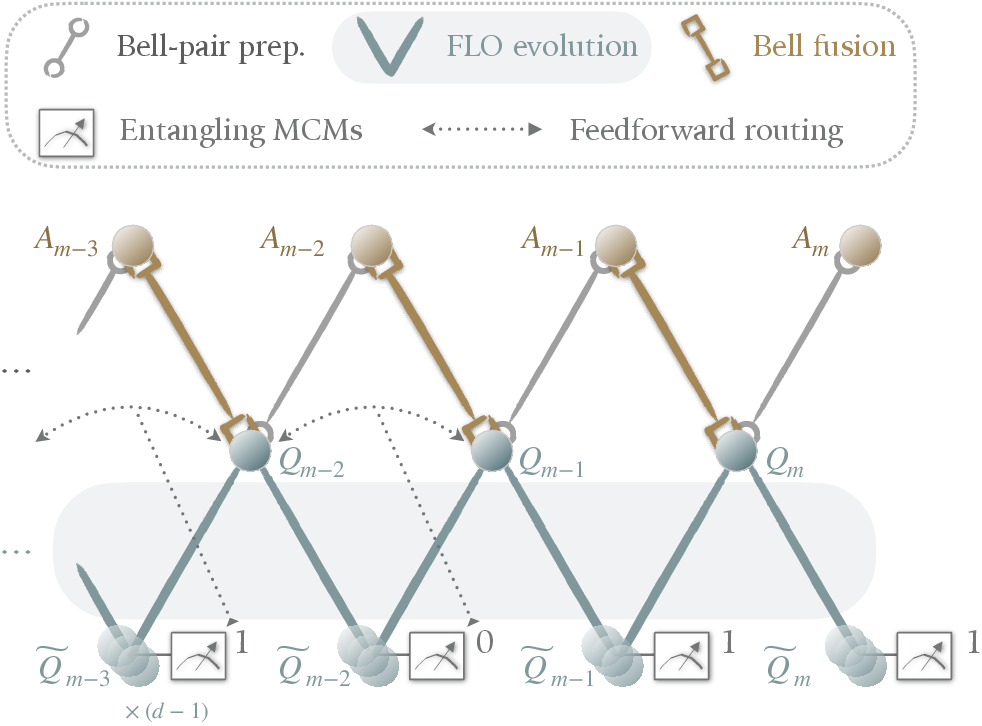
The central architecture consists of a chain of spatial blocks, each hosting d fermionic modes, and three coupled registers per block: a logical qudit Qj, an auxiliary qudit Aj, and a local auxiliary register Qj. The logical qudits encode vacuum-plus-single-particle sectors, while the auxiliary systems mediate adaptive measurement and Bell-fusion readout.
The protocol proceeds as follows:
Initialization: Input fermions are Bell-entangled with auxiliary systems.
Encoding & FLO Evolution: Number-conserving FLO evolution acts on encoded orbitals, generating a single-particle propagator V.
Mid-Circuit Monitoring (MCM): Decoding and measurement of flag qubits project the system onto the collision-free, single-occupation sector. This selects an n×n block submatrix S from V.
Feedforward Routing & Bell Fusion: Measurement records classically route selected blocks into a fixed Bell-fusion geometry. Bell basis measurements yield byproduct operators.
Boundary Projection: The final auxiliary is measured in a fixed basis, yielding the joint branch probability.
Figure 1: Monitored adaptive FLO architecture—auxiliary and logical registers encode occupation, measurement, and fusion steps that induce non-commutative contraction order.
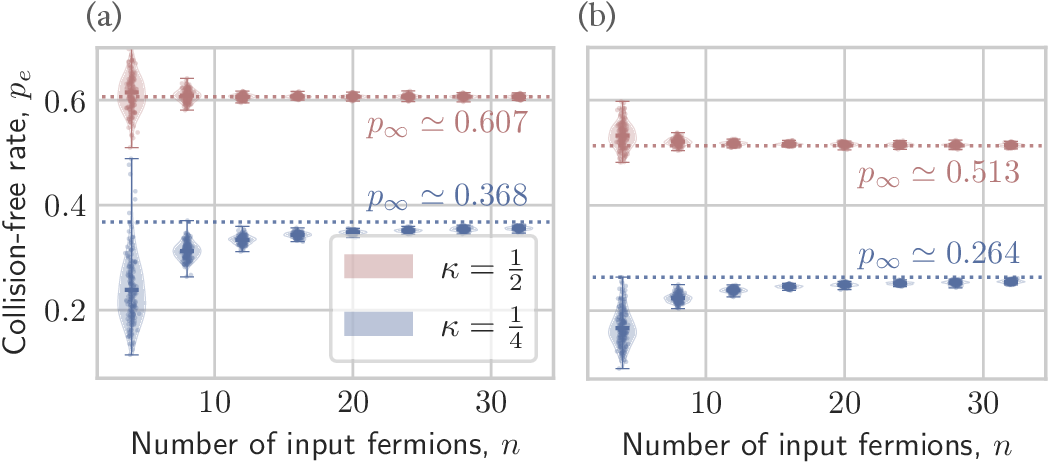
Conditioning on a collision-free outcome (which numerically occurs with constant probability at dilution m=κn2 as d0) (Figure 2), the encoded FLO implements a determinantal operator kernel,
d1
which, post-feedforward, is evaluated via a fixed order of Bell fusion projections. Each branch becomes a non-commutative contraction: d2
where the contraction enforces order, absorbs byproducts into "dressed" blocks d3. These yield path-cycle decompositions: open paths on the contracted auxiliary graph contribute ordered products, closed cycles correspond to scalar trace-loop factors. Consequently, each post-selected branch is a non-commutative trace polynomial in the variables d4.
Figure 2: Empirical collision-free post-selection probability d5 in the dilute regime matches the predicted asymptotic rate; probability is non-vanishing with increasing d6 for d7.
For instance, at d8: d9
and, at general Qj0, every permutation contributes exactly one block per fusion step, enforcing strong algebraic dependencies and loss of commutativity.
Numerical Diagnostics: Memory Growth and Non-commutativity
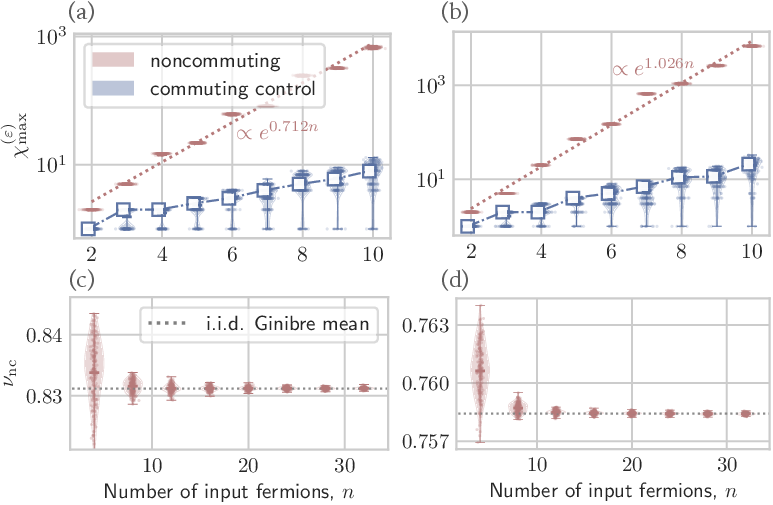
To quantitatively probe simulated classical tractability, the sequential contraction (constrained to the enforced fusion order) is analyzed as a matrix product operator (MPO). The bond dimension Qj1 of such an MPO provides a lower bound on classical sequential memory. Numerically, in the monitored-FLO ensemble, Qj2 grows exponentially with Qj3. Contrastingly, in a commuting control (e.g., block-diagonal Qj4), this growth is suppressed (Figure 3). Analytical results show that, in the algebraically generic regime, the minimal required MPO bond dimension is Qj5—exponential in Qj6 at its maximum.
Figure 3: The maximally truncated MPO bond dimension Qj7 grows rapidly in the monitored-FLO ensemble, but not for commuting controls. Dressed block commutator norms confirm strong non-commutativity in typical instances.
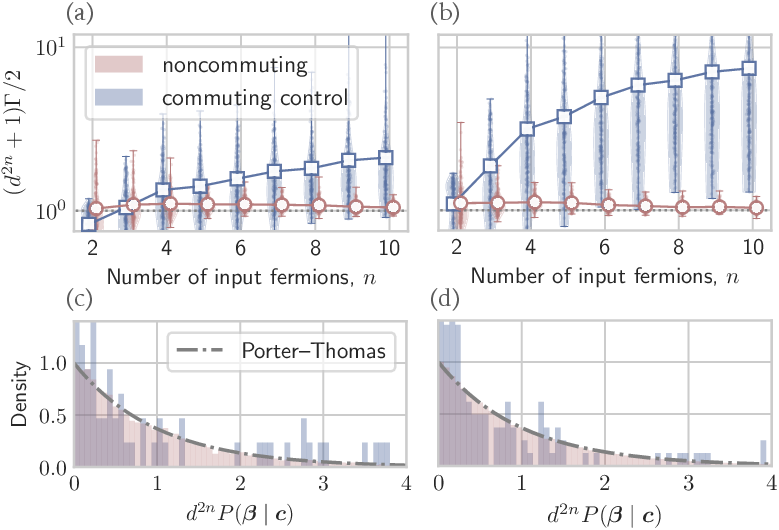
The branch output distributions Qj8 exhibit Haar-like anti-concentration and, after normalization, match the Porter-Thomas distribution—a hallmark of chaotic quantum circuits. The second-moment diagnostic Qj9 is close to the random-state prediction for typical instances (Figure 4). Commutator diagnostics substantiate that anti-commutative effects are robust to physical constraints, matching i.i.d. Ginibre ensemble statistics for typical realizations.
Figure 4: Haar-normalized second moment and Porter-Thomas distribution tests confirm sampling complexity and anticoncentration for monitored-FLO branches.
Complexity-theoretic Implications
The core hardness conjecture presented is as follows:
Fix Aj0, Aj1. For Haar-random number-conserving FLO conditioned on a collision-free record, estimating Aj2 within Aj3 relative error is Aj4-hard for a constant fraction of outcomes (Conjecture 1).
Via Stockmeyer's approximate counting paradigm, approximate sampling from the branch distribution is hard (unless the polynomial hierarchy collapses), assuming anticoncentration and the conjecture above. This route to sampling hardness does not require non-Gaussian resource injection or coherent interactions, but arises from measurement-induced non-commutative contraction order—an orthogonal mechanism to prior FLO advantage schemes.
The underlying algebraic structure connects directly to known Aj5-hard non-commutative determinantal objects (Cayley's row-ordered determinant [Arvind2010On, Chien2011Almost, Gentry2014Noncommutative]), and, in cyclic-closure variants, to the Aj6-hard fermionant [Mertens2013The].
Experimental and Practical Considerations
The construction is compatible with realistic architectures. Number-conserving free-fermion gates can be decomposed into standard two-mode Givens rotations, with polynomial gate overhead [Oszmaniec2022Fermion]. Adaptive feedforward and Bell-fusion operations can be compiled into swap networks for 1D and 2D architectures, or implemented directly in systems with dynamic connectivity such as neutral-atom arrays [Bluvstein2022A, Evered2023High, Bluvstein2024Logical, Wright2019Benchmarking, Postler2022Demonstration]. Mixed-dimensional (qudit-qubit) block encoding can be realized efficiently in leading platforms, including superconducting and trapped-ion circuits [Morvan2021Qutrit, Hrmo2023Native].
Future Directions
Several lines of inquiry are opened by this work:
Circuit Depth: The circuit depth required for anti-concentration and sampling hardness is likely to be shallower than in bosonic or universal random circuits, suggesting routes to shallow-depth sampling advantage [Dalzell2022Random, Oh2026Classical].
Physical Realization: Candidate implementations can exploit dynamic atom arrays or trap architectures for efficient feedforward routing and fusion.
Complexity-theoretic Reductions: Connections to non-commutative algebraic complexity warrant further reductions and comparative analysis with commutative permanent/permanent-like quantum advantage schemes.
Conclusion
This work establishes measurement-induced non-commutativity as a distinct and sufficient mechanism to circumvent classical simulatability in FLO. By combining mid-circuit monitoring, classical feedforward, and enforced contraction order via fixed Bell-fusion geometry, Gaussian FLO circuits become classically intractable under standard assumptions—without the need for interactions, non-Gaussianity, or magic states. These results highlight a route toward sampling-complexity advantage in fermionic platforms, rooted in algebraic structure rather than interaction-based computational triggers.