Hamilton decompositions of the directed 3-torus: a return-map and odometer view
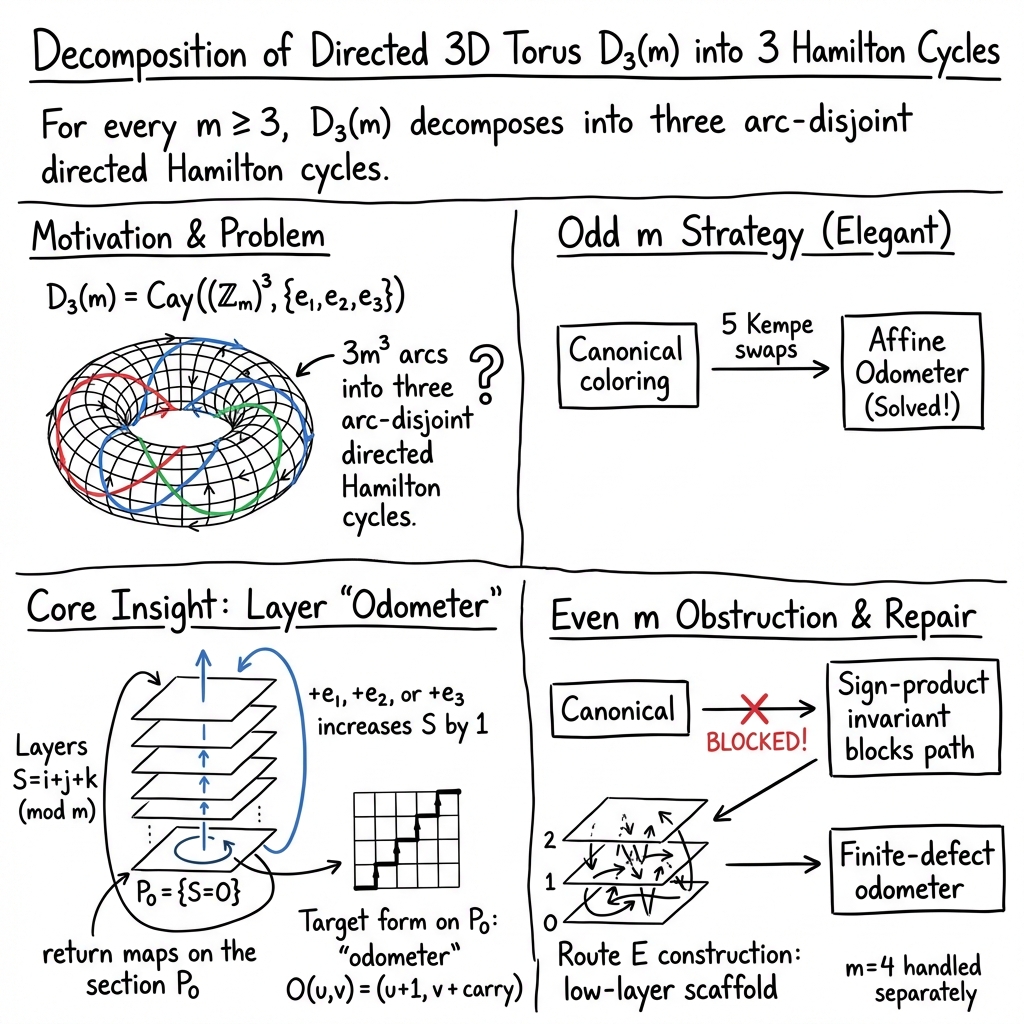
Abstract: We prove that the directed 3-torus D_3(m), or equivalently the Cartesian product of three directed m-cycles, admits a decomposition into three arc-disjoint directed Hamilton cycles for every integer m >= 3. The proof reduces Hamiltonicity to the m-step return maps on the layer section S=i+j+k=0. For odd m, five Kempe swaps of the canonical coloring produce return maps that are explicitly affine-conjugate to the standard 2-dimensional odometer. For even m, a sign-product invariant rules out Kempe-from-canonical constructions, and a different low-layer witness reduces after one further first-return map to a finite-defect clock-and-carry system. The remaining closure is a finite splice analysis, and the case m=4 is handled separately by a finite witness. A Lean 4 formalization accompanies the construction.
Paper Prompts
Sign up for free to create and run prompts on this paper using GPT-5.
Top Community Prompts
Explain it Like I'm 14
What is this paper about?
This paper studies a special kind of directed graph (a network of points connected by one‑way arrows) built by wrapping a 3D grid so that it loops around in all three directions. Mathematicians call it the directed three-dimensional torus, written as , where tells you how big each loop is.
The main goal is to show that, no matter which size you choose, you can split all the arrows of this graph into exactly three big directed loops (called Hamilton cycles), and each loop goes through every point exactly once without repeating edges. This is called a directed Hamilton decomposition into three cycles.
What questions does the paper answer?
- Can the directed 3D torus be split into three big loops (directed Hamilton cycles) for every ?
- If yes, how can we actually build those three loops?
- Why does one method work smoothly when is odd but needs a different trick when is even?
- Can we reduce the complex 3D motion to a simpler 2D “clock-and-carry” model that’s easy to understand and analyze?
How do they approach the problem?
The key idea is to look at motion layer by layer and compress the problem to a simpler “return map” on a single slice of the graph.
Think of the graph as a 3D wrap‑around city where every point has three one‑way roads: one step east (i+1), one step north (j+1), and one step up (k+1). Each move increases the “floor number” by 1. Because every arrow always goes up exactly one floor, you must return to the ground floor in exactly steps. So instead of watching the full 3D journey, you only need to watch where each journey lands back on the ground floor after moves. That landing rule is called the return map.
They model the return map using a simple machine: the odometer. Picture a car’s mileage counter:
- The first dial (the “clock”) increases by 1 at every step.
- When it wraps around (back to 0), the next dial (the “carry”) increases by 1.
Mathematically, the odometer on two dials is the map , where is 1 if is zero (a wrap) and 0 otherwise.
The paper shows how to adjust the arrows so their return maps on the ground floor behave like this odometer (or a simple variation of it). When that happens, you get one big cycle that covers all points on the floor, and therefore a Hamilton cycle in the full graph.
Two tools are central to the approach:
- Kempe swaps: Think of them as swapping colors on certain loops to change which arrow each color uses at a point. They use these swaps to adjust the graph so the return map becomes an odometer (in the odd case).
- A parity invariant (sign-product): A mathematical “even/odd” property that never changes under Kempe swaps. This proves that, when is even, you cannot reach the desired arrangement from the simplest starting pattern just by swapping.
Because of that barrier, the even case needs a different explicit construction (Route E) that changes the directions only on the lowest floors and still produces the right odometer-like behavior after a careful analysis.
What did they find?
- Main result: For every integer , you can split the directed 3D torus into exactly three arc-disjoint directed Hamilton cycles. That means all arrows are used exactly once, with no overlaps between the three loops, and each loop visits every point.
- Odd : They start from the simplest setup and apply exactly five Kempe swaps on two low floors to get a new arrangement. Its return maps on the ground floor are, after simple coordinate changes, exactly the odometer. Since the odometer is a single big loop on the floor, each color is a Hamilton cycle in the full graph.
- Even : A parity obstruction shows you can’t reach the goal by Kempe swaps from the simplest setup. So they build a new low-floor arrangement (Route E) by hand:
- Above floor 2, everything stays simple (the usual directions).
- On floors 0, 1, and 2, they carefully assign directions that mimic clock-and-carry behavior, with only finitely many small “defect” spots.
- They then perform one more reduction: a first-return analysis on “lanes” (a set of points that track the carry). This cuts the 2D motion down to a 1D “carry map.” After checking that this 1D map cycles through all lanes and that the total step count fits, they conclude the full map is a single cycle—so each color gives a Hamilton cycle.
- Boundary case : Handled by a direct finite check.
- Formal verification: The construction and formulas are checked in Lean 4, a computer proof assistant, adding confidence that every step is correct.
Why is this important?
This problem sits at a meeting point of several classic topics in graph theory:
- Hamilton cycles in products of cycles,
- directed versions of these problems,
- and decomposition questions (splitting all arrows or edges into large cycles).
By solving the three-factor directed case cleanly for all , the paper fills a gap between older results (two-factor cases and general Hamiltonicity) and broader theorems about directed products. The new “clock-and-carry” return-map viewpoint is also a powerful method: it turns a large 3D problem with points into a simpler 2D and then 1D problem, making the structure much clearer.
Additionally:
- The parity invariant (sign-product) is a neat, simple rule that explains why certain natural approaches cannot work in even sizes.
- Route E shows how to carefully “repair” the mechanism when parity gets in the way, without overcomplicating the whole graph.
- The Lean 4 formalization means the proof has been machine-checked for correctness, which is rare and valuable in combinatorics.
What does it mean going forward?
- Methodological impact: The return-map and odometer framework is likely useful in other problems where motion has a built-in “layer drift.” It isolates the real difficulty (the carry) and reduces the problem dimension using first-return maps.
- New tools: The parity invariant for Kempe swaps can inform future work about when simple recoloring methods will fail and when new constructions are needed.
- Robust constructions: The even-case design shows how keeping most of the structure simple (canonical) and modifying only small “low-floor” parts can still achieve global goals.
- Verified proofs: Using Lean 4 encourages more computer-assisted verification in discrete math, which can prevent subtle mistakes in complex case analyses.
In short, the paper proves a clean, complete result for all sizes, introduces a friendly “odometer” way to think about complex graph motion, and backs it up with computer verification—making the solution both elegant and reliable.
Knowledge Gaps
Knowledge gaps, limitations, and open questions
Below is a concise, actionable list of what the paper leaves missing, uncertain, or unexplored, organized to guide future work.
Scope and generalization beyond the symmetric 3-torus
- Extension to higher dimensions: Does admit a decomposition into arc-disjoint directed Hamilton cycles for ? Are there parity or Kempe invariants analogous to the sign-product barrier that affect feasibility for even ?
- Unequal side lengths: For the directed 3-torus with mixed moduli , what arithmetic conditions (if any) guarantee a decomposition into three arc-disjoint Hamilton cycles? The paper treats only .
- Alternative generating sets: Beyond the standard generators , what happens for other 3-element generating sets of ? If the generators form a basis (invertible matrix in ), the case is isomorphic; what about dependent generating sets that still generate the group?
- Mixed orientations and larger step sets: For Cayley digraphs on with step sets including negative directions (e.g., ) or more general steps, can one systematically decompose into Hamilton cycles equal to the out-degree? The return-map/odometer framework may extend but is unaddressed.
- Non-abelian or other abelian groups: Can the return-map methodology (layer function and odometer reduction) be adapted to Cayley digraphs on other groups where generators admit a homomorphism to increasing a “layer” by $1$? The paper does not discuss conditions under which such a reduction exists.
Methodological and structural questions within the 3-torus
- Uniform even- construction: Route E depends delicately on and requires finite splices and casework (with a special witness). Is there a residue-class–free, uniform, and conceptually simpler construction for even (e.g., a fully affine or odometer-conjugate scheme) that avoids ad hoc defect scaffolds?
- Quantitative bounds on defects: The paper asserts the defect set is a finite union of lines plus finitely many points and that the number of “stalls” per orbit is (independent of ), but gives no explicit uniform bound. What is the sharp bound on the number of stalls per orbit and the exact size/structure of the defect sets for each color?
- Minimality of odd-case swaps: The odd case uses five Kempe swaps supported on two adjacent layers. Is five swaps minimal? Can one characterize all minimal Kempe sequences from the canonical coloring that yield a Hamilton decomposition?
- Kempe connectivity and invariants: For odd , are all Hamilton-decomposing colorings Kempe-equivalent (within the same sign-product class)? For even , within the parity-allowed class, is there Kempe connectivity among Hamilton decompositions, and can Route E be reached from other decompositions by Kempe swaps? Are there further Kempe invariants beyond the sign-product that classify connected components?
- Symmetry and canonicality: The constructions (especially Route E) break many automorphisms of . Are there Hamilton decompositions exhibiting large automorphism groups of the torus (e.g., invariant under a subgroup of or coordinate permutations)? Can one classify “most symmetric” decompositions?
- Affine/odometer normal form: The paper gives affine odometer conjugacy for odd and a finite-defect odometer normal form for even . Can one formulate and prove a general “odometer normal form” theorem that characterizes when a direction assignment on a layered digraph yields a return map conjugate to a skew product with primitive clock and primitive carry, including necessary and sufficient conditions?
- First-return splice theory: The even case resolves closure via a finite splice on lane transversals. Can this be abstracted into a reusable theorem giving sufficient conditions for a single -cycle from (i) a bulk clock step, (ii) bounded stall set, and (iii) a specified splice permutation? A general criterion would avoid bespoke case analysis.
- Classification of return maps: Which return maps arise from valid direction assignments? Can these be classified (up to affine conjugacy and finite-defect modifications) as skew-products with primitive and suitable “carry profiles” ?
- Robustness/local repair: If a small set of arcs is perturbed (e.g., adversarially re-assigned), are there local switch operations (beyond Kempe swaps) or local “odometer repairs” that restore a Hamilton decomposition without global redesign? The stability of the constructions is not analyzed.
- Unified treatment of : The boundary case is handled by an ad hoc finite witness. Can Route E be adapted to cover uniformly, or is there a structural obstruction that necessitates separate handling?
Generalizations connected to known literature
- Products with two or more distinct cycle lengths: Prior work gives Hamiltonicity and some decomposition results for products of two directed cycles. For three directed cycles of distinct lengths, can one characterize when a 3-cycle Hamilton decomposition exists (if at all)? Are there arithmetic obstructions analogous to those in the 2D case?
- Hamilton paths and prescribed endpoints: Darijani–Miraftab–Morris identify the 3-factor product as a boundary for arc-disjoint Hamilton paths. Does the return-map/odometer method adapt to construct multiple arc-disjoint Hamilton paths with prescribed endpoints in ? Which endpoint patterns are feasible?
Algorithmic and formalization aspects
- Constructive algorithms and complexity: The paper presents explicit formulas and a Lean verification but does not provide algorithmic complexity bounds. Can one implement a deterministic algorithm that constructs the three Hamilton cycles in time (or better) with streaming output and memory? What are the constants and practical performance for large ?
- Enumeration and random sampling: How many distinct Hamilton decompositions exist for up to graph automorphisms? Can one efficiently sample a random Hamilton decomposition (approximately or exactly) using the odometer framework?
- Scope and artifacts of the Lean 4 formalization: The paper claims a Lean 4 formalization but does not detail its scope. Which parts (odd case, even case including splices, witness) are fully machine-checked? Are the route definitions, defect sets, and splice permutations encoded declaratively or by computation? Is the artifact publicly available and reproducible?
- Data-structure representations: For practical computation/verification, what are the most efficient representations of the color maps and return maps (e.g., sparse defect overlays on bulk translations)? This is implicit but not discussed.
Further conceptual questions
- Beyond the sign-product invariant: Are there additional, finer Kempe invariants (e.g., per-plane signs, layerwise parity classes, or local winding numbers) that constrain reachable colorings, particularly in even ? A complete invariant set could clarify Kempe connectivity classes.
- Links to Gray codes/de Bruijn objects: The odometer interpretation suggests connections to Gray codes and de Bruijn-like cycles on grids. Can the constructed Hamilton cycles be interpreted as Gray codes with structured ordering constraints, enabling transfers of techniques/results?
- Design of carry profiles: In the skew-product view , can one systematically design to achieve primitive total carry with minimal or no defects for even ? A general synthesis method would streamline even- constructions.
- Automorphism-lifted generality: The method relies on the layer function . For other layer functions (e.g., with units), does the same return-map analysis carry through, and can it yield alternative decompositions with different symmetry profiles?
Practical Applications
Overview
This paper proves that, for any integer , the directed three-dimensional torus admits a decomposition of all arcs into three arc-disjoint directed Hamilton cycles. The proof contributes:
- A return-map reduction to a 2D Poincaré section (layer plane), modeled by an “odometer” (clock-and-carry) mechanism.
- A sign-product invariant that explains parity obstructions for even under Kempe swaps.
- Constructive, explicit decompositions: five Kempe swaps for odd ; a new low-layer “Route E” design for even with a finite-defect odometer normal form.
- A complete formalization of the construction and its correctness in Lean 4.
These ingredients yield deployable, certified constructions of three conflict-free, system-spanning cycles in a broad class of 3D grid-like systems, and introduce general methods (return maps, first-return reductions, invariant-based obstructions, and finite-defect splicing) that extend beyond this specific graph.
Below are practical applications organized by immediacy, with sector tags, candidate tools/workflows, and assumptions/dependencies noted for each.
Immediate Applications
The following items can be implemented now because the paper provides explicit, constructive rules (including closed-form return maps and finite case-handling), along with a Lean 4 proof artifact that can be turned into code or proof-carrying libraries.
- Robust link scheduling on 3D torus interconnects (HPC/NoC)
- Sector: software/hardware, networking, HPC, Network-on-Chip (NoC)
- Use: Build three link-conflict-free, system-spanning rings (Hamilton cycles) to implement TDMA time slots, backbone circuits for diagnostics, link-training, or periodic data collection. The rings cover all directed links exactly once, enabling full utilization without contention.
- Tools/workflows:
- A “TorusCycleKit” that generates the three cycles from coordinates using the paper’s formulas (odd via five Kempe swaps; even via Route E rules).
- Slot tables for routers or switch firmware (e.g., Blue Gene/Cray-like 3D torus or k-ary n-cube with toroidal wrap).
- Lean 4 certificates for proof-carrying scheduling components.
- Assumptions/dependencies:
- Network topology approximates a 3D torus (wrap-around links present).
- Routers can follow predetermined cycles; clocks or phases synchronized to avoid slot drift.
- For even , the schedule must use Route E’s low-layer rule-set; for odd , the affine odometer construction suffices.
- Collision-free multi-robot loop routes on toroidal conveyors or storage grids
- Sector: robotics, logistics/warehousing, manufacturing automation
- Use: Assign three disjoint cycles for fleets moving on toroidal conveyor grids (3D loops or stacked loops with wrap-around); supports periodic inspection, restocking, or shuttling without collisions.
- Tools/workflows:
- Route synthesis from coordinates to cycle membership for each robot cohort.
- Simple “clock-and-carry” controllers that step robots along cycle edges at each tick.
- Assumptions/dependencies:
- Physical layout can be mapped to a 3D toroidal lattice or emulated by adding “virtual wrap” movements.
- No blocked edges at runtime (or else require the long-term fault-tolerant extensions below).
- Deterministic, fair overlay routing on toroidal P2P or DHT-like coordinate spaces
- Sector: distributed systems, networking
- Use: Use the three edge-disjoint Hamilton cycles as rotating token rings for resource allocation, leader election, or fair polling across nodes embedded on a 3D toroidal coordinate ring (e.g., hashing into ).
- Tools/workflows:
- Overlay embedding of participants into .
- Token-passing protocols following the cycles for fairness and liveness.
- Assumptions/dependencies:
- Stable participant embedding and connectivity that preserves directed edges (or overlay routing that simulates them).
- Synchronous or bounded-delay messaging to keep token spacing predictable.
- Structured memory/array traversal for testing and scrubbing
- Sector: hardware validation, memory systems, embedded systems
- Use: Generate -length directed traversals of a 3D address space (e.g., bank-row-column), with three disjoint passes to support multiple phases of scrubbing, BIST patterns, or stress tests without bus conflicts.
- Tools/workflows:
- Address generators using the odometer form for odd ; finite-defect corrections (Route E) for even .
- Firmware routines for periodic coverage without overlap.
- Assumptions/dependencies:
- Logical addressing admits a 3D modulo- decomposition.
- Access ordering benefits from cyclicity (e.g., thermal, aging, or coupling tests).
- Formal, verifiable scheduling artifacts for safety-critical platforms
- Sector: avionics/automotive (TSN/AFDX-like), industrial control
- Use: Provide formally certified scheduling patterns (path and slot assignments) to regulators and integrators; the Lean 4 proof acts as assurance of decomposition correctness and absence of contention on modeled topologies.
- Tools/workflows:
- Lean 4 proof objects plus extracted schedules for system integration.
- Compliance documentation backed by proof logs.
- Assumptions/dependencies:
- Target interconnect topologies reasonably modeled as 3D tori.
- Toolchain support to translate formal constructions to configuration artifacts.
- Teaching and research modules on return maps and odometers
- Sector: education, academia
- Use: Classroom-ready examples of Poincaré return maps in discrete dynamics, finite-state odometers, Kempe swaps with invariants, and proof engineering in Lean.
- Tools/workflows:
- Jupyter/Lean notebooks that compute return maps, visualize layer dynamics, and verify key lemmas.
- Assumptions/dependencies:
- None beyond standard teaching infrastructure.
- Test-case and benchmark generation for graph algorithms
- Sector: software engineering, algorithmics
- Use: Construct massive single-cycle permutations over states and three disjoint cycles covering all arcs—useful for stress-testing traversal, permutation ranking/unranking, and cycle-detection algorithms.
- Tools/workflows:
- Data generators emitting explicit cycle orders and edge sets.
- Assumptions/dependencies:
- Ability to map your test domain to or simulate it.
Long-Term Applications
These applications require additional research, engineering, or extensions of the paper’s techniques (e.g., to non-toroidal or faulty networks), or they build on the methodological contributions (return-map/odometer reductions, invariant barriers, finite-defect splicing) to new problem classes.
- Fault-tolerant cycle scheduling with dynamic edge/node failures
- Sector: HPC/NoC, distributed systems, robotics
- Vision: Extend the finite-defect/first-return framework to maintain near-Hamilton decompositions in the presence of failures by introducing localized splices around faults (dynamic “defect tracks”) while preserving global cycles.
- Dependencies/assumptions:
- Fast detection and localization of faults; ability to reconfigure “low-layer” rules (Route E-like patches) on the fly.
- Theoretical development to ensure global single-cycle preservation under bounded defect density.
- Generalization to non-toroidal 3D meshes and to higher dimensions
- Sector: HPC/NoC, logistics, robotics
- Vision: Adapt the return-map and lane-transversal approach to 3D meshes with boundaries (no wrap) via boundary splicing, and to -dimensional tori/meshes (k-ary n-cubes), producing arc-disjoint Hamilton cycles for generators.
- Dependencies/assumptions:
- New invariants and splice libraries to handle boundaries and mixed generator sets.
- Potential parity/invariant barriers analogous to the even- Kempe barrier, requiring bespoke repairs.
- Time-sensitive networking (TSN) and deterministic Ethernet templates
- Sector: networking, industrial control, automotive/avionics
- Vision: Use cycle decompositions as building blocks for deterministic, conflict-free communication schedules on topologies that approximate toroidal grids (e.g., factory floors), with verified jitter bounds via formal methods.
- Dependencies/assumptions:
- Mapping plant layouts to grid-like overlays; integration with TSN schedulers; formal co-verification of end-to-end flows.
- Multi-robot coverage in dynamic environments
- Sector: robotics, smart warehouses, agriculture
- Vision: Combine the clock-and-carry plan with real-time replanning (finite splices) for obstacle encounters, keeping robots on disjoint “lanes” and using return sections for safe merges/splits.
- Dependencies/assumptions:
- Online detection and control; safety guarantees for splicing operations; performance analysis under stochastic disturbances.
- Compiler and runtime scheduling on toroidal task graphs
- Sector: software systems, parallel programming
- Vision: Exploit the cycles to schedule periodic tasks mapped onto toroidal process/rank grids (e.g., stencil codes), ensuring conflict-free communication phases and balanced load.
- Dependencies/assumptions:
- Compiler support to emit schedule phases; mapping from logical ranks to consistent with the network.
- Verified algorithm libraries for graph decompositions
- Sector: formal methods, software infrastructure
- Vision: Release Lean-verified libraries implementing return-map reductions, sign-product invariants, and finite-defect splicing for broader graph families (Cayley digraphs, products of cycles, grid graphs), enabling proof-carrying scheduling and routing components.
- Dependencies/assumptions:
- Continued development of mathlib and extraction pipelines from Lean to executable code; standard APIs for integrating proofs with system configurations.
- Frequency assignment and reconfiguration with Kempe invariants
- Sector: wireless networking, spectrum management
- Vision: Apply sign-product and related invariants to reconfiguration problems (e.g., channel reassignments) to detect parity barriers and preclude futile recoloring sequences; design “repair families” analogous to Route E for feasible reassignments.
- Dependencies/assumptions:
- Modeling frequency conflict graphs amenable to these invariants; engineering of localized “repairs” compatible with regulatory constraints.
- Hardware controllers and counters from clock-and-carry design
- Sector: embedded systems, digital design
- Vision: Use the odometer/return-map lens to synthesize small controllers that realize layer-by-layer behavior with guaranteed periodicity and coverage (e.g., address generators, DMA patterns), extending to multi-lane, multi-phase controllers (three disjoint cycles).
- Dependencies/assumptions:
- RTL component libraries and verification flows integrating these constructions; performance tuning to match throughput/latency constraints.
- Space-filling and scanning patterns for imaging and additive manufacturing
- Sector: imaging, 3D printing, materials testing
- Vision: Adapt cycle-based traversals for coverage patterns on periodic lattices (e.g., multi-pass inspection, energy deposition patterns), using disjoint cycles for parallel heads/phases.
- Dependencies/assumptions:
- Physical stages/fields approximate periodic grids; process benefits from cyclic passes; boundary treatments for non-toroidal workspaces.
Notes on Feasibility and Assumptions
- Topology dependence: The core result assumes a 3D torus (wrap-around in all three directions) with unit steps along axes. Applications to meshes or irregular topologies require boundary splicing or additional repairs.
- Parity and construction choice: For odd , the five-swap affine construction applies directly; for even , Route E’s low-layer assignments and finite splice logic must be used (explicitly provided).
- Synchronization: Many scheduling uses presuppose a global or bounded-drift clock to realize stepwise movement along cycles.
- Faults and dynamics: The paper’s constructions target static, fault-free graphs. Robustness to failures is an active-extension area (finite-defect methods are a promising starting point).
- Formalization: The Lean 4 formalization can be leveraged to produce proof-carrying artifacts; engineering effort is needed to integrate with operational toolchains.
By combining explicit, constructive cycles with a general “return-map and odometer” methodology, the paper supports both immediate deployment on toroidal systems and a roadmap for extending clock-and-carry design principles to broader scheduling, routing, and verification challenges.
Glossary
- Abelian Cayley digraph: A Cayley digraph whose underlying group is abelian (commutative), used here for structural Hamiltonicity arguments. "As an abelian Cayley digraph, also lies in the broader Hamiltonicity tradition"
- Affine bijection: A bijective affine map (linear map plus translation) over . "hence all three maps are affine bijections of "
- Affine-conjugate: Two maps related by an affine change of coordinates; their dynamics are equivalent up to that transformation. "return maps explicitly affine-conjugate to the odometer."
- Affine line: A one-dimensional affine subset (translate of a one-dimensional subspace) defined by linear equations mod . "define the affine lines "
- Arc-disjoint: Subgraphs share no directed edges (arcs) in common. "admits a decomposition into three arc-disjoint directed Hamilton cycles"
- Bump maps: Author-defined elementary coordinate “increment” maps used to describe local moves. "For define "
- Cartesian product: The graph product where vertices are tuples and edges advance in exactly one coordinate at a time. "equivalently the Cartesian product of three directed -cycles"
- Cayley graph: A graph (here, a digraph) on a group where edges connect elements to their translates by specified generators. "Let be the directed Cayley graph with arc set"
- Clock-and-carry mechanism: A dynamical pattern where one coordinate advances uniformly (clock) and another changes only on wraparound events (carry). "finite-defect perturbations of the same clock-and-carry mechanism."
- Direction assignment: A per-vertex assignment of which generator each color uses, not necessarily giving permutations. "A direction assignment on is a triple with "
- Directed Hamilton cycle: A directed cycle that visits every vertex exactly once. "admits a decomposition into three arc-disjoint directed Hamilton cycles"
- Directed three-dimensional torus: The directed Cayley graph on with standard generators; a product of three directed cycles. "We prove that the directed three-dimensional torus"
- Finite-defect (odometer normal form): A system that is odometer-like except on a bounded, explicitly described defect set. "Finite-defect odometer normal form for Route~E"
- First-return map: The map induced on a subset by advancing to the next return to that subset. "first-return map on the lane transversal "
- First-return reduction: Reducing dynamics by passing to the map taking points to their first return to a chosen section. "A further first-return reduction converts the remaining closure into a finite splice analysis"
- Functional digraph: The directed graph of a function where each vertex has outdegree one. "The color- subgraph is the functional digraph of "
- Hamilton decomposition: A partition of a graph’s edges (arcs) into Hamilton cycles. "A directed Hamilton decomposition of is a partition of its arcs into three arc-disjoint directed Hamilton cycles."
- Hamiltonicity: The property of admitting a Hamilton cycle. "Hamiltonicity on the full vertex set therefore reduces to the cycle structure of an -step return map on "
- Kempe-chain recoloring: A technique that swaps colors along alternating color paths/cycles to modify a coloring. "Kempe-chain recoloring is a classical tool in graph coloring"
- Kempe equivalence: Two colorings are Kempe-equivalent if one can be obtained from the other by a sequence of Kempe swaps. "for background on Kempe equivalence see Mohar"
- Kempe map: The permutation whose cycles are the -alternating cycles. "define the Kempe map ."
- Kempe swap: The operation that exchanges two colors along entire cycles of the corresponding Kempe map. "The Kempe swap of colors on is the operation producing a new triple "
- Lane transversal: A chosen set of representatives (lanes) intersecting each bulk orbit once per clock cycle, used for first-return analysis. "lane transversal "
- Layer function: The function defining parallel “layers” increased by each legal step. "Define the layer function ."
- Lean 4: A modern interactive theorem prover used to formalize the construction. "The construction has been formalized in Lean~4."
- Odometer (two-dimensional): The model map with a clock and carry coordinate. "Define "
- Parity barrier: An obstruction based on parity/sign that prevents reaching a goal via certain operations. "Parity barrier for Kempe-from-canonical when is even"
- Plane invariance (of Kempe maps): The property that Kempe maps preserve the layer planes . "Plane invariance of Kempe maps"
- Return map: The map obtained by iterating a color steps to return from to itself. "let be the return map."
- Sign (of a permutation): The parity () determined by whether a permutation is even or odd. "For a permutation on a finite set, let denote its sign."
- Sign-product invariant: The product of permutation signs across colors, invariant under Kempe swaps. "Sign-product invariant"
- Stall: A step where the orbit deviates from the bulk (generic) translation branch. "A stall is a step at which the return map departs from the generic (uniform-translation) branch."
- Transducer: Here, a finite-step rule system encoding low-layer behavior before bulk motion. "Three-step transducer reduction"
- Unit (in ): An element invertible modulo (coprime to ), ensuring a permutation action. "Since is a unit, is an -cycle"
Collections
Sign up for free to add this paper to one or more collections.