Machine vision with small numbers of detected photons per inference
Abstract: Machine vision, including object recognition and image reconstruction, is a central technology in many consumer devices and scientific instruments. The design of machine-vision systems has been revolutionized by the adoption of end-to-end optimization, in which the optical front end and the post-processing back end are jointly optimized. However, while machine vision currently works extremely well in moderate-light or bright-light situations -- where a camera may detect thousands of photons per pixel and billions of photons per frame -- it is far more challenging in very low-light situations. We introduce photon-aware neuromorphic sensing (PANS), an approach for end-to-end optimization in highly photon-starved scenarios. The training incorporates knowledge of the low photon budget and the stochastic nature of light detection when the average number of photons per pixel is near or less than 1. We report a proof-of-principle experimental demonstration in which we performed low-light image classification using PANS, achieving 73% (82%) accuracy on FashionMNIST with an average of only 4.9 (17) detected photons in total per inference, and 86% (97%) on MNIST with 8.6 (29) detected photons -- orders of magnitude more photon-efficient than conventional approaches. We also report simulation studies showing how PANS could be applied to other classification, event-detection, and image-reconstruction tasks. By taking into account the statistics of measurement results for non-classical states or alternative sensing hardware, PANS could in principle be adapted to enable high-accuracy results in quantum and other photon-starved setups.
Paper Prompts
Sign up for free to create and run prompts on this paper.
Top Community Prompts
Explain it Like I'm 14
Overview
This paper is about teaching machines to “see” when there’s almost no light—sometimes only about one photon per measurement. The authors build a framework called photon‑aware neuromorphic sensing (PANS) that treats the camera like a true photon counter and trains the whole system (the optics plus the computer algorithm) to work well in ultra‑low‑light conditions.
Think of photons like raindrops. In bright light, many drops hit your bucket (the sensor), so measuring is easy. In the dark, only a few drops arrive, and randomness dominates. PANS accepts that randomness and learns to make the most of every drop.
What questions did the researchers ask?
- Can we design machine‑vision systems that work reliably when only a few photons are detected per decision?
- How do we train such systems if the sensor’s output is random (a “photon click” or not) instead of a smooth number?
- Can we co‑design the optical part (what happens to light before the detector) and the digital part (the neural network after the detector) so they work together through this “detection bottleneck”?
- Do photon‑aware training strategies beat more conventional training when light is extremely scarce?
How did they approach the problem?
They built and analyzed a complete pipeline from light to decision, and they modeled the physics faithfully.
The core idea: model single‑photon detection as it really behaves
- Single‑photon detectors output a binary result per read: 1 if at least one photon clicks, 0 if none.
- If the expected number of photons is λ (lambda), the chance of a “click” is:
- P(click) = 1 − e{−λ}
- That’s like flipping a biased coin whose bias depends on λ.
Training through randomness: a clever gradient trick
Neural networks usually need smooth signals to learn. A binary, random “click” isn’t smooth. To pass learning signals backward through this step, the authors use a straight‑through estimator (STE) but scale the gradient by e{−λ}. Intuition:
- When λ is small (few photons), changes matter a lot, so gradients are strong.
- When λ is large (almost always clicking), changes matter less, so gradients shrink.
- This matches the physics and keeps training stable.
Extra training tricks that make it work
- Initialization: Start with optical weights that produce λ values in a “just right” zone (not too big, not too small) so learning signals aren’t lost.
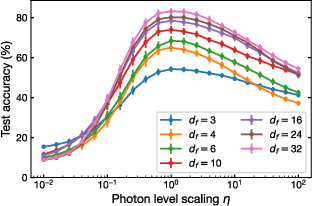
- Slope annealing: Temporarily rescale λ by a factor η during training (like adjusting the “sensitivity”) and slowly change η to help the optimizer find good solutions.
- Intensity clamping: Put an upper limit on λ during training to avoid saturation (where everything clicks and gradients vanish).
- Batch normalization after detection: Once the random binary outputs are in the digital domain, normalize them to stabilize training.
Inference: averaging multiple shots helps
- If you repeat the measurement K times and average, randomness averages out, making the signal more reliable.
- Training with K=1 (single shot) still generalizes well when you use larger K at test time.
Two optical “front ends”: active and passive
PANS is a general framework—you can plug in different optical encoders before the detector.
- Active PANS (structured illumination):
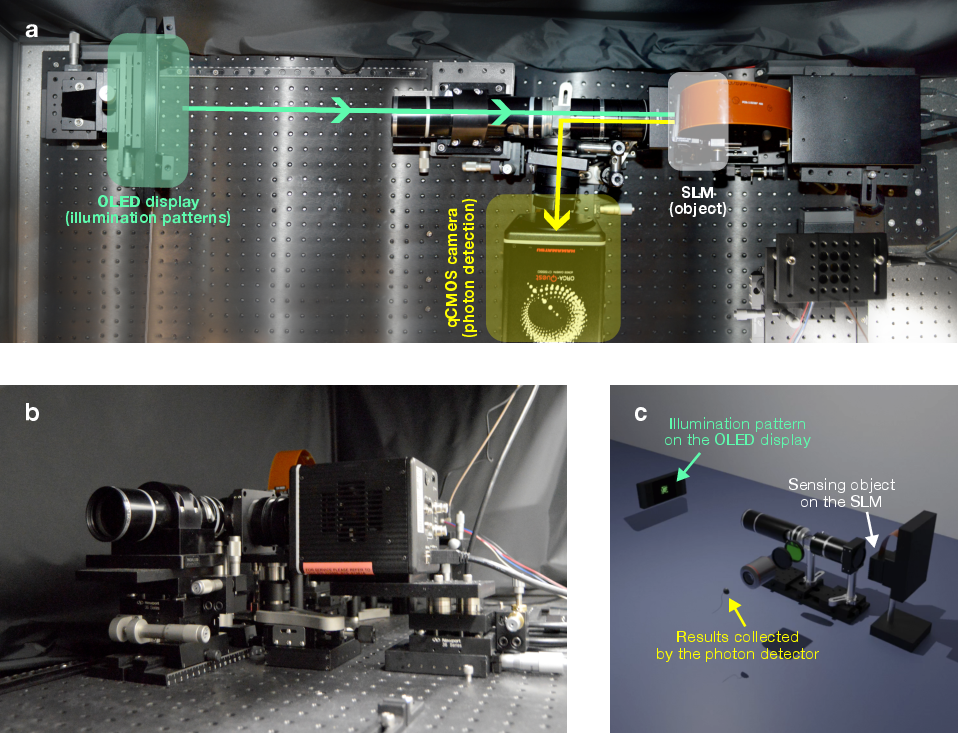
- You shine designed light patterns onto the object (like projecting patterns), collect the total transmitted/reflected light with a single bucket detector, and repeat with several patterns.
- Mathematically, each pattern produces λ = w ⋅ x (a weighted sum of the object’s properties), like a dot product.
- Because light intensity can’t be negative, they train unconstrained parameters and square them to make physical, non‑negative illumination.
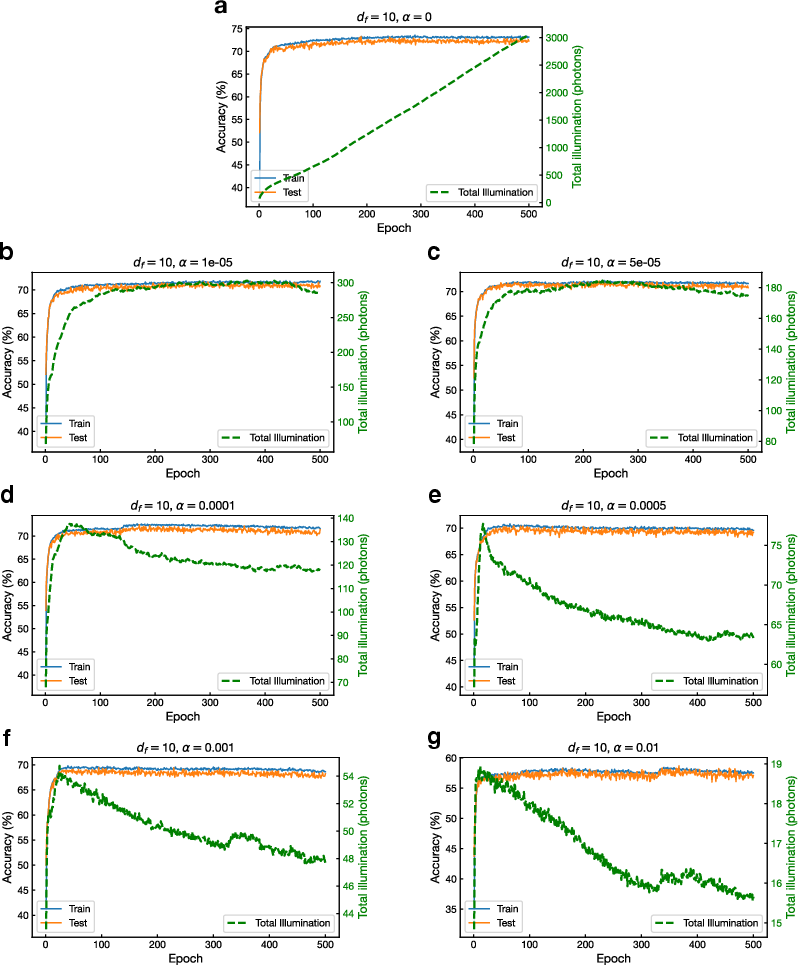
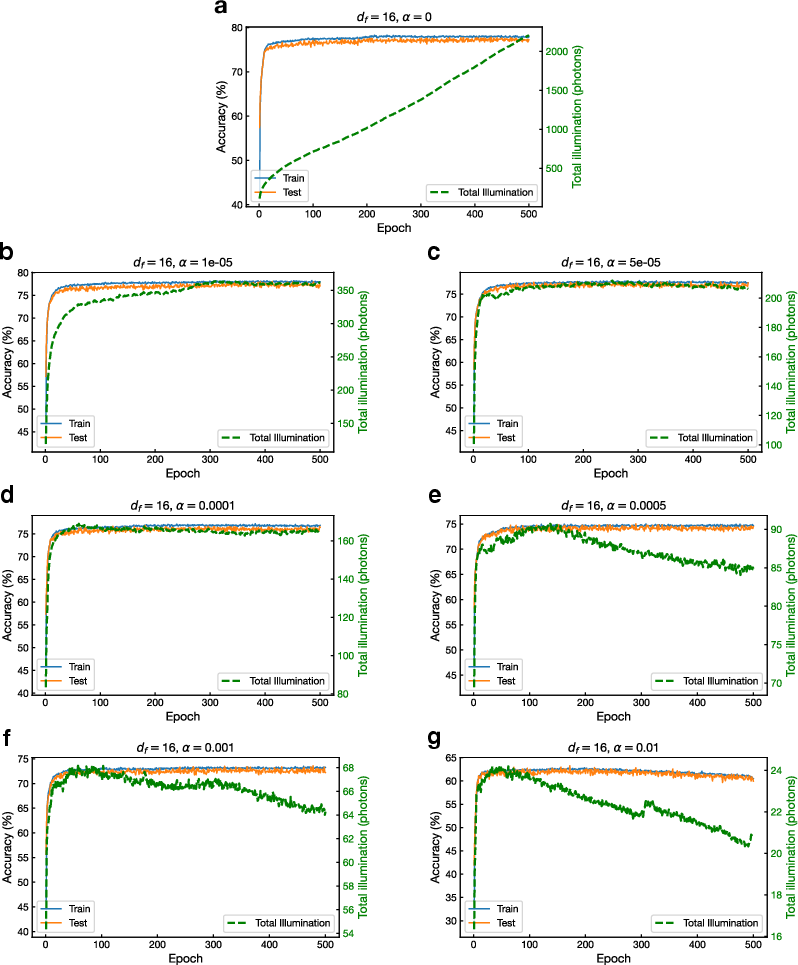
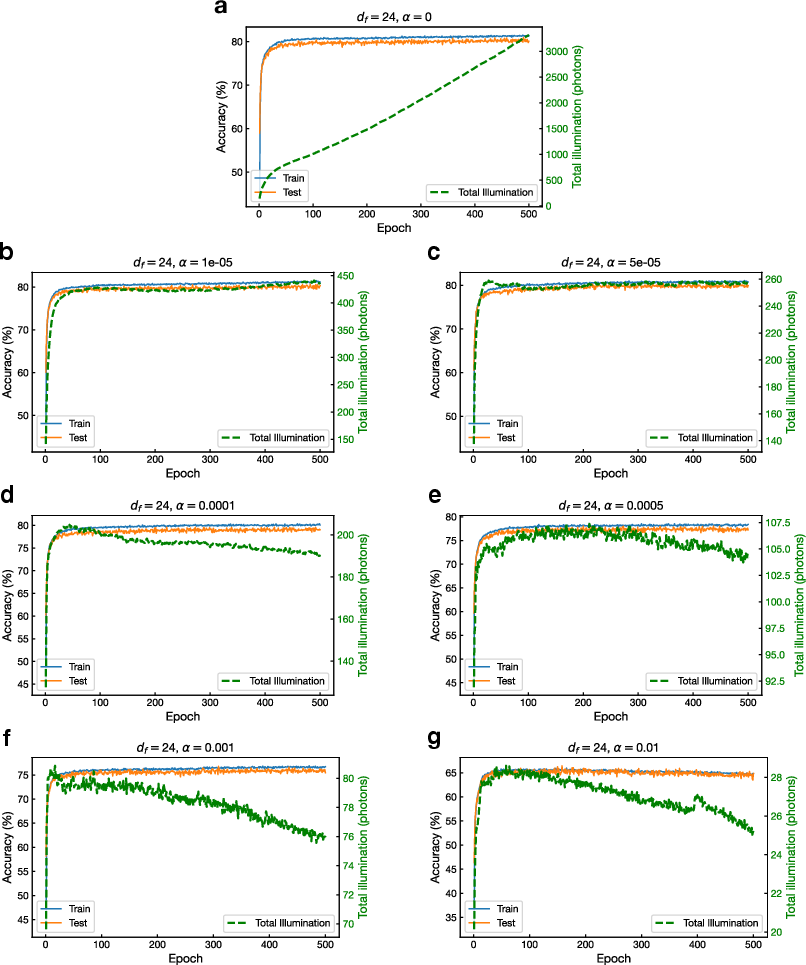
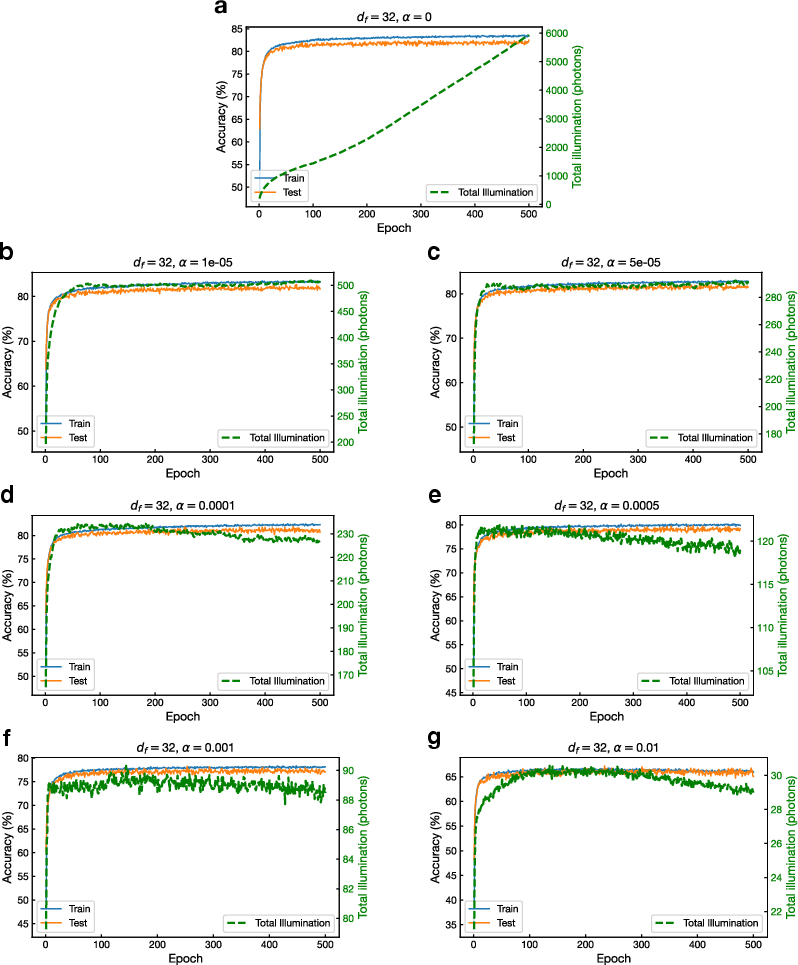
- They also control the “photon budget” by adding an L2 penalty that directly equals total light used, so you can train for different light budgets on purpose.
- Passive PANS (linear optical processors):
- You can’t control the light source (e.g., starlight, scattered light), but you can pass incoming light through a learnable optical transformer (like a mixing board for light).
- The optical field is multiplied by a matrix W (E’ = W·E), and the detector measures intensity, which is the square of the field amplitude.
- They derive how to compute gradients through this “square law” so the optical matrix can be trained end‑to‑end.
A useful way to think about the system: the detection bottleneck
- Before the detector, you can still shape and rearrange light (the optical encoder).
- At the detector, analog light becomes digital counts, and randomness discards information—what’s lost here is gone forever.
- After the detector, the digital neural network can be as smart as you want, but it can only use the information that survives the bottleneck.
- So the smart move is to optimize the optics to feed the detector the most useful information possible.
What did they find, and why is it important?
- Modeling detection as a true random, binary process during training leads to better behavior in the few‑photon regime than treating it as a simple, noisy, deterministic step.
- The gradient scaling by e{−λ} keeps learning focused where it matters: at low photon counts, where decisions are most uncertain and informative.
- Operating near about one photon per measurement (around λ ≈ 0.7) is a sweet spot for extracting information efficiently in this binary‑click setting.
- Practical training tools—careful initialization, slope annealing, intensity clamping, and post‑detection normalization—make optimization stable and effective.
- The framework works with both “active” (you control illumination) and “passive” (you transform incoming light) optical setups.
- Photon budget can be built directly into the loss, so the system learns to “spend” photons where they help the task most.
Why it matters:
- In very low light, conventional methods that ignore true photon statistics can fail because they don’t account for how much information the detector throws away. By being photon‑aware, PANS learns optical encoders that are robust in the scarcest‑photon conditions.
What could this change in the real world?
- Night‑time and low‑light vision: Cameras that see better with less light for drones, robotics, or security—while using fewer photons and less power.
- Safer, faster scientific imaging: Microscopes that collect useful data from light‑sensitive samples without damaging them (e.g., live cells).
- Space and remote sensing: Better performance when light is extremely limited and every photon is precious.
- Eye‑safe LiDAR and low‑power sensors: Active systems that illuminate scenes smartly, using minimal light for safety and efficiency.
- Privacy‑preserving or minimal‑pixel imaging: Systems with few detectors (even a single detector) that still perform tasks like recognition by projecting optimized patterns.
Big picture: When detection is the biggest limitation, the best strategy is to optimize everything that happens before detection. PANS gives a principled, physics‑aware way to do exactly that, letting machines make confident decisions from only a handful of photons.
Knowledge Gaps
Knowledge gaps, limitations, and open questions
Below is a single, concrete list of unresolved issues and open questions that future work could address.
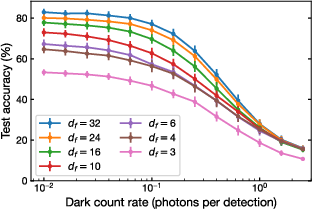
- Detection modeling beyond ideal Poisson/SPD clicks: How do detector non-idealities (finite quantum efficiency, dead time/hold-off, afterpulsing, dark counts, background light, multi-pixel crosstalk, saturation/pile-up) alter the forward model and affect training/inference?
- Alternative photon statistics: The framework claims generality but does not quantify performance under non-Poisson statistics (e.g., thermal/chaotic light, Bose–Einstein, squeezed/quantum states); how should the loss and gradient estimators be adapted and validated in these regimes?
- Uncertainty in “statistic form doesn’t matter”: The claim that the precise detection statistics have little effect on simulations is qualitative; what regimes and tasks does this hold for, and where does it break?
- Gradient estimator theory: The custom STE with damping e{-λ} is argued to be “unbiased” only for the gradient of the expected activation, not the expected loss; what is the bias/variance of the estimator relative to REINFORCE, Gumbel-Softmax, or other surrogate-gradient methods, and how does this impact convergence guarantees?
- Hyperparameter selection: There is no principled guidance for choosing the slope annealing schedule (η, θ), clamp λ_max, and their mapping to physical units; how should these be tuned relative to photon budgets, task difficulty, and hardware limits?
- Calibration procedure: Inference requires calibrating a global scaling (η) to map trained parameters to optical power; what practical procedures (and uncertainties) are needed to calibrate and maintain this mapping on real hardware?
- Batch normalization after detection: How robust is BN to shifts in photon budget, small batch sizes, or single-sample inference at test time? Would LayerNorm/GroupNorm or normalization-free approaches be more stable under extreme photon scarcity?
- K-shot inference trade-offs: What is the empirical/theoretical scaling of accuracy with K (shots), given constraints on time, motion, or dose—i.e., what is the optimal K under real-time and safety constraints?
- Joint optimization of d_f (feature dimension): The choice of number of detected features is not addressed; how should d_f be optimized jointly with photon allocation to maximize task performance under fixed photon/time budgets?
- Photon allocation strategy: The framework lacks explicit constraints or methods for allocating photons across features/patterns; can one learn or enforce structured budgets per feature or adaptively per sample?
- Active PANS timing constraints: Structured illumination with d_f patterns likely implies sequential measurements (one bucket detector); how does measurement time, motion, and latency limit applicability in dynamic scenes, and can adaptive or reduced-pattern protocols help?
- Active PANS model mismatch: The linear intensity dot-product λ = w·x assumes a simple transmissive object without scattering/multipath, PSF blur, or vignetting; how should the encoder be trained with realistic forward models that include these effects?
- Non-negativity via squaring: The squared parameterization may suppress gradients near zero and bias solutions; is softplus or other monotone mappings preferable, and how do these choices impact sparsity and convergence?
- Photon budget regularization fidelity: Penalizing ||Ẇ||2 assumes total illumination equals ∑w_ij, ignoring object-dependent transmission, optical throughput, and detector efficiency; how can the loss incorporate per-sample photon counts and hardware efficiency to enforce true photon budgets?
- Hardware quantization and constraints (active): DMD/SLM devices impose binary/multi-bit quantization, finite contrast, and spatial/temporal non-idealities; how robust is PANS to quantization, and what mapping or training strategies ensure implementability?
- Background and ambient light: The forward model omits additive background counts (λ → λ + λ_bg); how should training incorporate unknown or time-varying backgrounds and their statistics?
- Passive PANS physical realizability: The passive encoder trains an unconstrained real matrix W, but many optical processors implement approximately unitary/orthogonal transforms with loss; what constraints must be enforced during training to ensure physically realizable, power-conserving transformations?
- Coherence assumptions in passive PANS: The presented passive model assumes coherent fields (λ = |W E|2); how does the approach extend to spatially/temporally incoherent light where intensity, not field, is the appropriate variable?
- Phase stability and calibration (passive): Interferometric encoders are sensitive to phase drift and fabrication imperfections; what online calibration or robust training strategies are needed to maintain performance over time?
- Input field access (passive): The model assumes access to the incident field vector E; in practical systems E is not directly known—how does one encode/train with only intensity measurements or partial field information?
- Crosstalk and correlations: The model assumes independent detectors and shots; how do optical/electronic crosstalk and temporal correlations (due to dead time) degrade performance, and how can training be made robust?
- Transition out of few-photon regime: How does the method behave as λ increases into moderate/high-flux regimes where SPD saturation and pile-up occur or when photon-number-resolving detectors become preferable?
- Information-theoretic limits: There is no analysis of achievable error rates or mutual information as a function of photon budget, d_f, and task complexity; can bounds guide architecture and budget selection?
- Sim-to-real gap: The framework is validated in simulation (here) with idealized models; what is the performance when deployed on real hardware with calibration errors, drift, and device non-idealities, and how can domain adaptation be integrated?
- Comparative baselines: The paper does not compare against alternative stochastic training methods (e.g., policy gradients, expected-value backprop) or classical photon-efficient sensing (e.g., optimal matched filtering, GLRT); what are the relative gains across photon budgets?
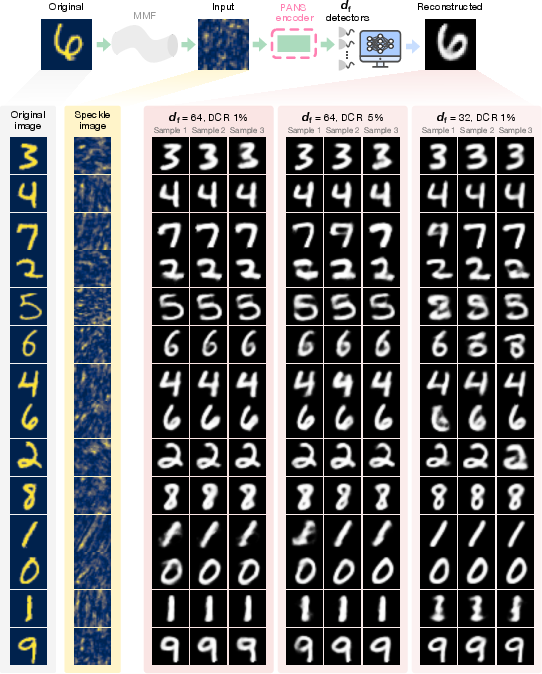
- Task breadth: The work focuses on classification-style sensing; how does PANS extend to dense prediction (segmentation), reconstruction (especially under sparsity priors), or parameter estimation with uncertainty quantification?
- Computational cost and variance: Stochastic sampling through SPD increases gradient variance; what are the convergence rates, sample complexity, and practical training costs, and can variance-reduction techniques help?
- Adaptive/closed-loop sensing: The encoder is fixed post-training; can active PANS benefit from adaptive illumination that conditions later patterns on earlier measurements to improve photon efficiency?
- Multi-modal and spectral extensions: How should PANS be extended to multi-spectral, polarization, or time-of-flight modalities with different statistics and constraints?
- Choice of digital back-end: The architecture f_θ is not specified; how sensitive is performance to model capacity, and can lightweight models suffice given the information loss at detection?
- Robustness to distribution shift: How stable is a trained encoder to changes in object distribution, lighting, or sensor characteristics, and can one integrate test-time adaptation or self-calibration?
Practical Applications
Immediate Applications
The following applications can be deployed with current hardware (SPADs, DMD/SLM-based projectors, photonic meshes, GPUs) and standard ML toolchains, using the paper’s photon-aware training, straight-through estimator with exponential damping, squared-parameterization for non-negativity, and photon-budget regularization.
- Low-photon fluorescence/confocal microscopy for reduced phototoxicity (Healthcare, Biomedical Imaging)
- Tools/products/workflows: DMD-based structured illumination + bucket/SPAD detector; PANS-trained illumination patterns and digital decoder; K-shot averaging for precision; photon-budget control via L2 on trainable patterns.
- Use cases: Live-cell imaging with minimal bleaching; rapid phenotyping/classification tasks under extreme light constraints; targeted illumination for sparse markers.
- Assumptions/dependencies: Access to DMD/SLM and SPADs; calibration of slope η and photon budget to real hardware; modeling nonidealities (dark counts, dead time, afterpulsing).
- Photon-efficient LiDAR object classification and ranging under low return flux (Robotics/Autonomy, Mobility)
- Tools/products/workflows: Learned scan/illumination patterns and receiver feature mapping; SPAD LiDAR front-ends with PANS-trained encoder; adaptive K-shot for SNR control.
- Use cases: Night-time or long-range detection with reduced emitted energy; power-constrained drones/UGVs.
- Assumptions/dependencies: Eye-safety limits; environmental variability (fog/rain); synchronization and timing jitter modeling.
- Starlight-level surveillance and night-vision recognition using SPAD cameras (Defense/Security, Public Safety)
- Tools/products/workflows: SPAD or intensified sensors; photon-aware end-to-end training for classification and detection with single-bit/low-bit measurements.
- Use cases: Person/vehicle detection in extreme low light; border/wildlife monitoring with minimal illumination.
- Assumptions/dependencies: Privacy and civil liberties compliance; managing sensor dark noise and background light; domain shift robustness.
- High-speed industrial inspection with ultra-short exposures (Manufacturing, Semiconductors)
- Tools/products/workflows: Structured illumination patterns that maximize defect separability at few photons; PANS training with intensity clamping and slope annealing; bucket/SPAD detection for rapid throughput.
- Use cases: Detecting micro-defects on moving lines; imaging photosensitive materials (e.g., photoresists) without damage.
- Assumptions/dependencies: Precise timing/synchronization; representative training data covering defect modes; motion blur considerations.
- Energy-frugal edge vision sensors for IoT and wearables (Energy, Consumer Electronics)
- Tools/products/workflows: Low-power SPAD modules plus microcontroller/NPU running PANS decoder; adaptive K-shot to trade latency for accuracy; photon-budget regularized training.
- Use cases: Occupancy sensing, gesture detection, battery-operated cameras, smart doorbells that work in near-dark environments.
- Assumptions/dependencies: Embedded compute constraints; efficient batch-norm equivalents (e.g., folded parameters) at inference; ambient light variability.
- Passive optical front-ends with real-valued photonic meshes (Academia, Prototyping; Photonics)
- Tools/products/workflows: Lab-scale integrated photonics or free-space optical processors implementing learned real-valued linear transforms; PANS gradients mapping to phase settings; post-detection digital decoding.
- Use cases: Demonstrations of photon-aware passive encoding for few-photon classification; benchmarks across photonic platforms.
- Assumptions/dependencies: Hardware availability and calibration; coupling loss, phase drift, and temperature compensation.
- Astronomy and spaceflight star trackers under photon-starved conditions (Aerospace)
- Tools/products/workflows: SPAD-based sensors; PANS-trained feature mappings for star detection/identification at low photon budgets; K-shot averaging tuned to spacecraft dynamics.
- Use cases: SmallSat/CubeSat attitude determination with small apertures; deep-space navigation with minimal exposure time.
- Assumptions/dependencies: Radiation-hard sensors; thermal management; background (zodiacal light) modeling.
- Software toolkit for photon-aware training and benchmarking (Software, Academia)
- Tools/products/workflows: PyTorch/TensorFlow modules for SPD activations (Bernoulli with p=1−e−λ), STE with e−λ damping, slope annealing and intensity clamping; dataset wrappers to simulate photon-starved regimes; “photon-per-inference” metrics and K-shot evaluation protocols.
- Use cases: Rapid prototyping of PANS with existing image/task datasets; reproducible benchmarks comparing non-PA vs PA training.
- Assumptions/dependencies: Community adoption; integration with hardware-in-the-loop when available; documentation of detector nonidealities.
Long-Term Applications
These opportunities require further research, scaling, or hardware co-design (e.g., integrated photonics, quantum light sources, standards), but are natural extensions of the paper’s framework and findings.
- Co-designed PANS perception chips (SPAD arrays + programmable photonics + on-chip NN) for ultra-low-power vision (Semiconductors, Robotics, Mobile)
- Tools/products/workflows: Monolithic/heterogeneous integration of SPADs, reconfigurable photonic encoders, and NPUs; hardware-aware PANS training; online calibration.
- Assumptions/dependencies: Fabrication yield and variability; low-latency control of photonic weights; power/thermal budgets.
- Photon-minimizing clinical imaging protocols (Healthcare)
- Tools/products/workflows: PANS-optimized illumination and detection for ophthalmology, pediatric imaging, endoscopy; exposure-aware training objectives; clinical-grade K-shot strategies.
- Assumptions/dependencies: Clinical trials, regulatory clearance (FDA/CE); device interoperability; robust safety/quality metrics.
- Night-time autonomous driving stacks with photon-efficient cameras/LiDAR (Mobility)
- Tools/products/workflows: Joint training of multi-sensor photon-aware encoders and fusion back-ends; dynamic photon allocation across tasks (detection, tracking, segmentation).
- Assumptions/dependencies: Large-scale validation, adversarial weather/night datasets; certification; cost constraints.
- Quantum-enhanced photon-aware sensing (Quantum Sensing, Metrology)
- Tools/products/workflows: Extending PANS to non-classical detection statistics (squeezed/entangled light) with appropriate forward models and gradient estimators; quantum-compatible encoders.
- Assumptions/dependencies: Stable quantum sources/detectors; loss sensitivity; new unbiased/low-variance gradient estimators.
- Covert/low-observable remote sensing with minimal emitted photons (Defense)
- Tools/products/workflows: Learned illumination waveforms and sparse probing patterns; task-aware photon allocation to remain below detectability thresholds.
- Assumptions/dependencies: Policy/ethics, export controls; environmental robustness; countermeasure resilience.
- Adaptive, self-calibrating photon-aware sensors (Autonomy, Industrial IoT)
- Tools/products/workflows: Hardware-in-the-loop online learning of encoder parameters W to new domains (fog, dust, underwater) with physical constraints; continual learning safeguards.
- Assumptions/dependencies: Safe online training; monitoring for drift/failure; compute budgets on edge devices.
- Standardization and policy for “photon budget per inference” and exposure-aware AI (Policy, Standards)
- Tools/products/workflows: Benchmark suites reporting photons-per-task, K-shot settings, detector stats; procurement guidelines prioritizing low-exposure sensing for public deployments; sustainability metrics (energy and photon budgets).
- Assumptions/dependencies: Consensus-building (IEEE/ISO/IEC); transparent reporting; alignment with privacy regulations.
- Privacy-preserving, low-information capture sensing (Public Sector, Smart Cities)
- Tools/products/workflows: PANS encoders that transmit only task-relevant few-photon features (not reconstructible images); on-device classification with minimal data storage.
- Assumptions/dependencies: Formal privacy guarantees (irreversibility across detection bottleneck); auditing standards; legal frameworks.
- Scientific instrumentation for photon-starved domains (Astronomy, Biology, Materials)
- Tools/products/workflows: Telescope instrument modes and beam-shaping optics trained for particular science tasks (e.g., transient classification); cryogenic/SPAD detectors with PANS-based inference pipelines.
- Assumptions/dependencies: Integration with observatory pipelines; calibration transfer across instruments; modeling of background/systematics.
- Education and workforce development in physics-informed ML for sensing (Academia)
- Tools/products/workflows: Curriculum and lab kits (DMD + SPAD + PANS software); shared datasets in few-photon regimes; challenge problems emphasizing detection bottlenecks.
- Assumptions/dependencies: Affordable hardware kits; community repositories; sustained funding.
Cross-cutting assumptions and dependencies that affect feasibility
- Hardware availability and fidelity: SPADs/bucket detectors, DMD/SLM projectors, photonic meshes; characterization of dark counts, dead time, afterpulsing, timing jitter, and background flux.
- Calibration mapping: Accurate slope η calibration and mapping from trained weights to physical intensities; compensation for losses and nonidealities; stability over time.
- Domain representativeness: Training distributions matching deployment (objects, lighting, backgrounds); strategies for domain adaptation and robustness.
- Throughput/latency trade-offs: K-shot averaging reduces variance but increases latency; application-specific limits must be respected.
- Safety and regulations: Laser/illumination eye-safety; medical exposure limits; privacy policies for surveillance use; export controls for defense applications.
- Software maturity: Availability of photon-aware training libraries, differentiable optics components, and hardware-in-the-loop tooling; documentation and community benchmarks.
Glossary
- Active PANS: A photon-aware approach where the illumination is actively controlled to encode information before detection. "Active PANS with structured illumination"
- Batch normalization: A technique that normalizes layer activations using batch statistics to stabilize and accelerate training. "We employ batch normalization on the -dimensional feature vector immediately after the detection stage."
- Bernoulli random variable: A binary random variable taking value 1 with probability p and 0 otherwise. "The SPD activation can thus be regarded as a Bernoulli random variable:"
- Binary entropy: The entropy of a Bernoulli variable, measuring uncertainty as a function of its success probability. "the binary entropy of is maximized when $P_{\mathrm{SPD}(\lambda)=0.5$, corresponding to photons."
- Binary probabilistic neuron: A stochastic neuron that outputs binary values according to a probability derived from its input. "modeled as a binary probabilistic neuron"
- Bucket detector: A single-pixel detector that integrates total optical power without spatial resolution. "bucket detector (single-photon counter)"
- Coded apertures: Patterned masks that modulate incoming light spatially to alter the measurement process. "Examples of such optical transformations span a wide range: spatial binning or downsampling, coded apertures, structured illumination patterns used in compressive sensing, transmission through scattering media, and diffractive optical elements."
- Compressive sensing: A framework that exploits signal sparsity to reconstruct signals from fewer measurements than Nyquist sampling. "structured illumination patterns used in compressive sensing"
- Detection bottleneck: The irrecoverable information-loss point where analog optical signals are converted to digital measurements under photon limitations. "the detection bottleneck---the physical process where analog optical signals are irreversibly converted to digital measurements."
- Diffractive optical elements: Optical components that shape wavefronts via diffraction to implement transformations. "diffractive optical elements."
- End-to-end (E2E) optimization: Jointly learning the optical front end and digital back end parameters for a task. "This end-to-end (E2E) optimization discovers task-specific transformations that may be far more efficient than generic designs."
- Field-amplitude encoding: An encoding scheme where expected photon counts are proportional to the squared magnitude of a weighted optical field. "Field-amplitude encoding: "
- Few-photon regime: An operating condition with on the order of one photon per measurement, making detection highly stochastic. "through the detection bottleneck in the few-photon regime."
- Indicator function: A function that returns 1 if a condition is true and 0 otherwise. "and $\mathbf{1}_{\{\cdot\}$ is the indicator function."
- Intensity clamping: Capping predicted intensities during training to prevent saturation and vanishing gradients. "Slope annealing and intensity clamping"
- Intensity encoding: An encoding where expected photon counts are the non-negative dot product of optical weights and input intensities. "Intensity encoding: "
- K-shot inference: Averaging K independent stochastic detection shots to reduce variance during inference. "In -shot inference, we use independent binary SPD readouts and average them to obtain the activation:"
- Kaiming uniform initialization: A weight initialization method designed for deep networks to maintain signal variance. "We employ Kaiming uniform initialization~\cite{he2015delving} with a modified scaling factor."
- L2 regularization: A penalty term proportional to the sum of squared parameters to control model complexity or physical budgets. "We incorporate photon budget control through L2 regularization on the parameterization :"
- LiDAR: A sensing technique using laser pulses to measure distances and form 3D maps. "LiDAR~\cite{gao2018object}"
- Linear optical processor: An optical system that implements a linear transformation on input field amplitudes. "The optical encoder is a linear optical processor characterized by a transmission matrix $W \in \mathbb{R}^{d_\text{f} \times d_{\text{in}$."
- Non-negativity constraint: The physical requirement that optical intensities or illumination weights must be non-negative. "Non-negativity constraint and squared parameterization"
- Non-negative orthant: The subset of a vector space where all components are non-negative. "explicit projection onto the non-negative orthant"
- Optical matrix-vector multiplication: Performing matrix-vector products using optical hardware that transforms light fields. "optical matrix-vector multiplication."
- Passive PANS: A photon-aware approach that learns transformations on incoming light without controlling illumination. "Passive PANS with linear optical processors"
- Photon-aware neuromorphic sensing (PANS): A framework that explicitly models stochastic photon detection during training to optimize through the detection bottleneck. "photon-aware neuromorphic sensing (PANS) framework."
- Photon budget: The total number of photons available to allocate across measurements or features. "photon budget constraints"
- Photon shot noise: Random fluctuations in detected counts due to the discrete nature of photons. "The raw detection outputs exhibit significant variance due to photon shot noise, particularly at low photon counts."
- Photon-starved conditions: Situations with very limited optical energy where detection becomes highly non-deterministic. "under photon-starved conditions, this bottleneck becomes the critical limiting factor."
- Poisson statistics: The statistical model describing independent photon arrival counts in a fixed interval. "Assuming photon arrivals follow Poisson statistics:"
- Poissonian statistics: A characterization indicating that the photon counts follow a Poisson distribution (typical for classical light). "We focus on Poissonian statistics, which govern photon arrivals for classical light sources,"
- Projected gradient descent: An optimization method that projects parameter updates back onto a feasible set after each step. "Unlike projected gradient descent, which requires an explicit projection onto the non-negative orthant after each update,"
- Quantization-aware training: Training that models quantization effects in the forward pass to improve robustness. "employ robustness techniques such as quantization-aware training"
- Scattering media: Materials that randomize light via multiple scattering, used as complex optical encoders. "transmission through scattering media, and diffractive optical elements."
- Single-photon counter: A detector capable of registering individual photon arrivals. "bucket detector (single-photon counter)"
- Single-photon detection (SPD): A binary detection process indicating whether at least one photon was detected in a measurement window. "single-photon detection (SPD) process"
- Single-shot: Using only one stochastic measurement realization without averaging. "we report results with (single-shot inference)"
- Spatial light modulators: Devices that spatially modulate amplitude or phase of light for programmable optical processing. "spatial light modulators"
- Straight-through estimator (STE): A gradient estimator that passes gradients through non-differentiable stochastic nodes using a surrogate. "We employ a straight-through estimator (STE)~\cite{bengio2013estimating,hubara2016binarized, ma2025quantum},"
- Structured illumination: Projecting designed light patterns onto an object to encode information before detection. "structured illumination patterns used in compressive sensing"
- Transmission matrix: A matrix describing how input optical modes map linearly to output modes in an optical system. "The transmission matrix of a general linear optical processor can have complex-valued elements."