LumosX: Relate Any Identities with Their Attributes for Personalized Video Generation
Abstract: Recent advances in diffusion models have significantly improved text-to-video generation, enabling personalized content creation with fine-grained control over both foreground and background elements. However, precise face-attribute alignment across subjects remains challenging, as existing methods lack explicit mechanisms to ensure intra-group consistency. Addressing this gap requires both explicit modeling strategies and face-attribute-aware data resources. We therefore propose LumosX, a framework that advances both data and model design. On the data side, a tailored collection pipeline orchestrates captions and visual cues from independent videos, while multimodal LLMs (MLLMs) infer and assign subject-specific dependencies. These extracted relational priors impose a finer-grained structure that amplifies the expressive control of personalized video generation and enables the construction of a comprehensive benchmark. On the modeling side, Relational Self-Attention and Relational Cross-Attention intertwine position-aware embeddings with refined attention dynamics to inscribe explicit subject-attribute dependencies, enforcing disciplined intra-group cohesion and amplifying the separation between distinct subject clusters. Comprehensive evaluations on our benchmark demonstrate that LumosX achieves state-of-the-art performance in fine-grained, identity-consistent, and semantically aligned personalized multi-subject video generation. Code and models are available at https://jiazheng-xing.github.io/lumosx-home/.
Paper Prompts
Sign up for free to create and run prompts on this paper using GPT-5.
Top Community Prompts
Explain it Like I'm 14
What is this paper about?
Imagine you’re directing a short movie where two friends walk through a park: one wears a red hat and glasses, the other wears a blue jacket and a backpack. You want a video-making AI to keep each person’s face and outfit correct the whole time, even when both are on screen. That’s hard—AIs often mix things up.
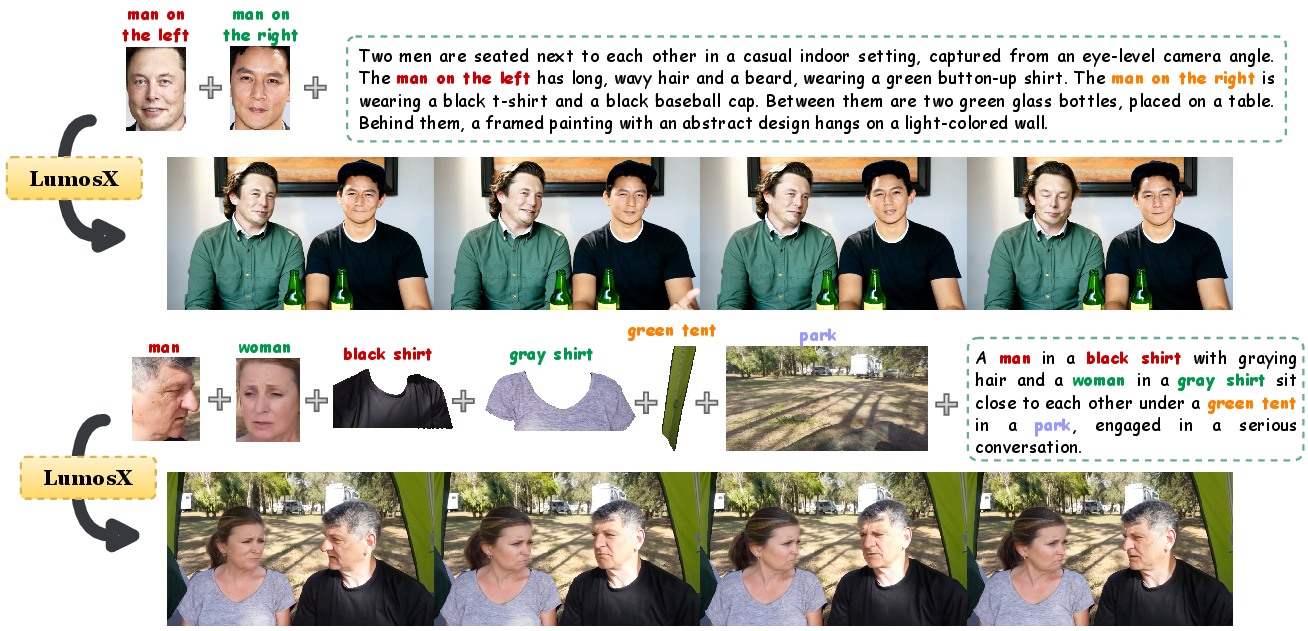
This paper introduces a system called Lumos (also referred to as X) that makes personalized videos from text and example images, while keeping each person’s identity (their face) correctly matched with their own attributes (like clothing, accessories, and hairstyle). It’s designed to handle multiple people and objects in the same video without confusion.
What questions did the researchers ask?
The team focused on three simple questions:
- How can we make sure each person in a video keeps their own face and their own attributes (like “the boy with the red hat”) without mixing them up with others?
- What kind of training data do we need so the AI learns these correct face–attribute pairings?
- Can we build model “rules” that tell the AI which face belongs with which attributes—and prove this works better than current methods?
How did they do it?
The researchers improved both the data the AI learns from and the way the AI thinks during video generation.
1) Building better training and test data (like making a clean “cast list” and costume notes)
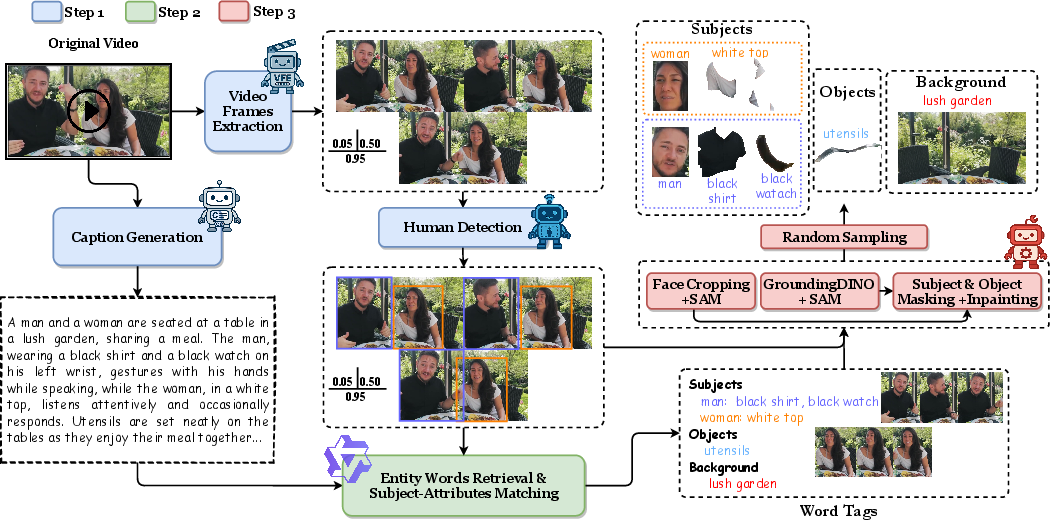
They created a data pipeline that:
- Writes better captions for each video (using a smart captioning AI) and detects where people are in several frames.
- Finds the “entity words” (like “man,” “woman,” “glasses,” “blue jacket,” “park”) and uses a multimodal AI to match the right attributes to the right person, even if there are two “men” in the same scene.
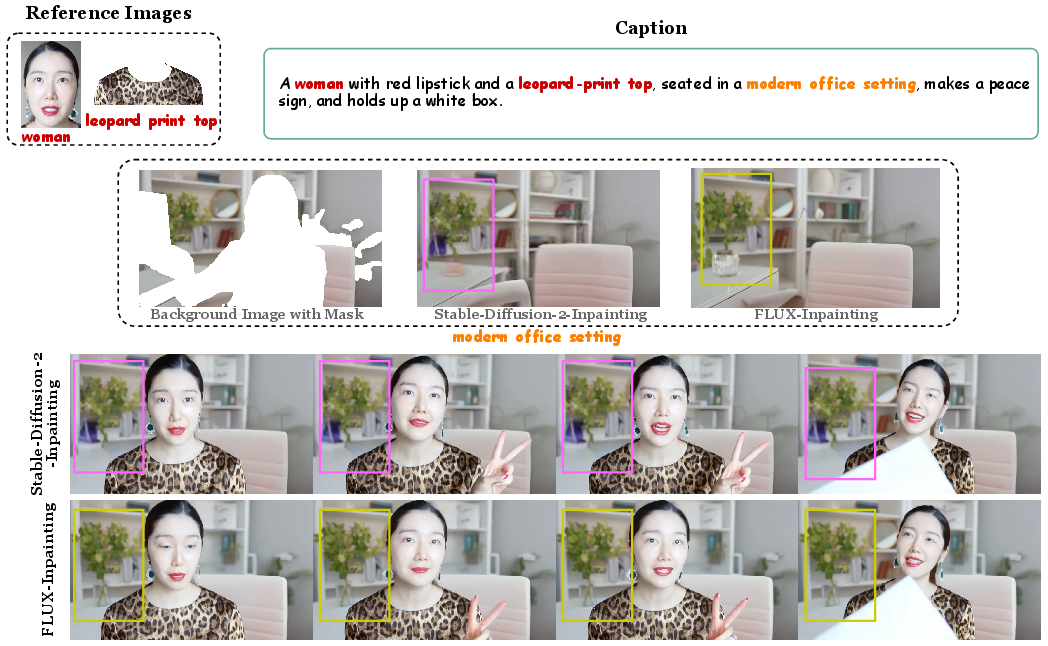
- Cuts out faces and attributes from the images (like making sticker sheets for each subject), picks out objects, and cleans the background using inpainting so it can be used as a separate reference.
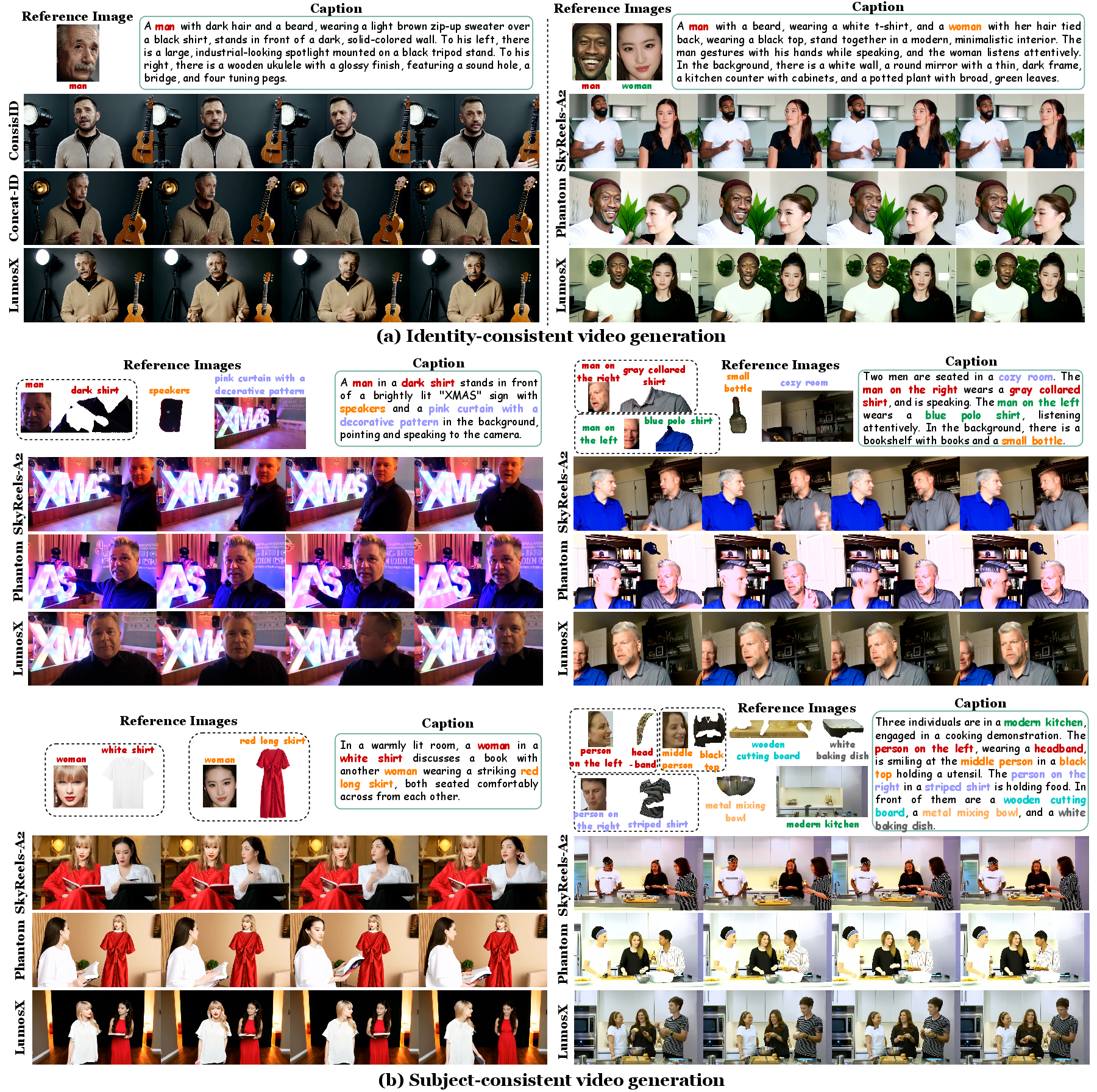
Result: for each video, they have clear reference images for faces, attributes, objects, and background—with explicit labels tying the right attributes to the right person. They also built a test benchmark with two tasks:
- Identity-consistent generation: keep the same face as the reference.
- Subject-consistent generation: keep each face and its attributes correctly paired, plus follow the overall prompt and scene.
2) Designing the model (like setting ground rules for who can “talk” to whom)
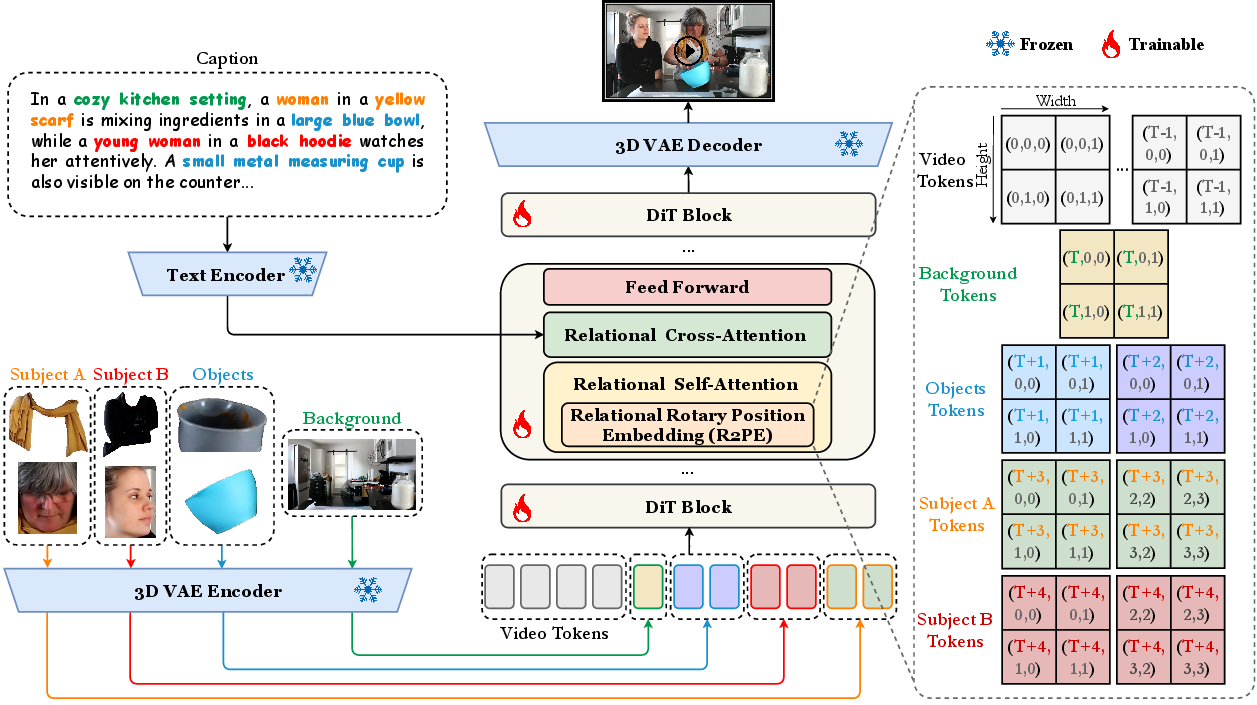
They start from a powerful text-to-video model and add three “relationship-aware” tools to keep faces and attributes together:
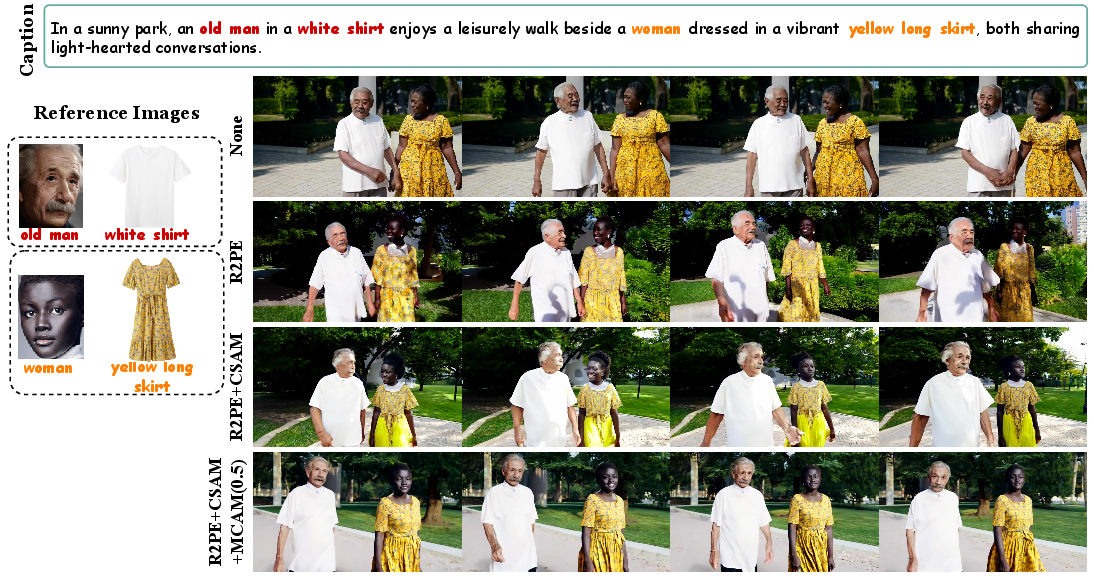
- Relational Rotary Position Embedding (R2PE): Think of placing tokens (tiny pieces of information) on a 3D grid. R2PE puts a person’s face and their own attributes in matching “slots,” so the model naturally learns they belong together.
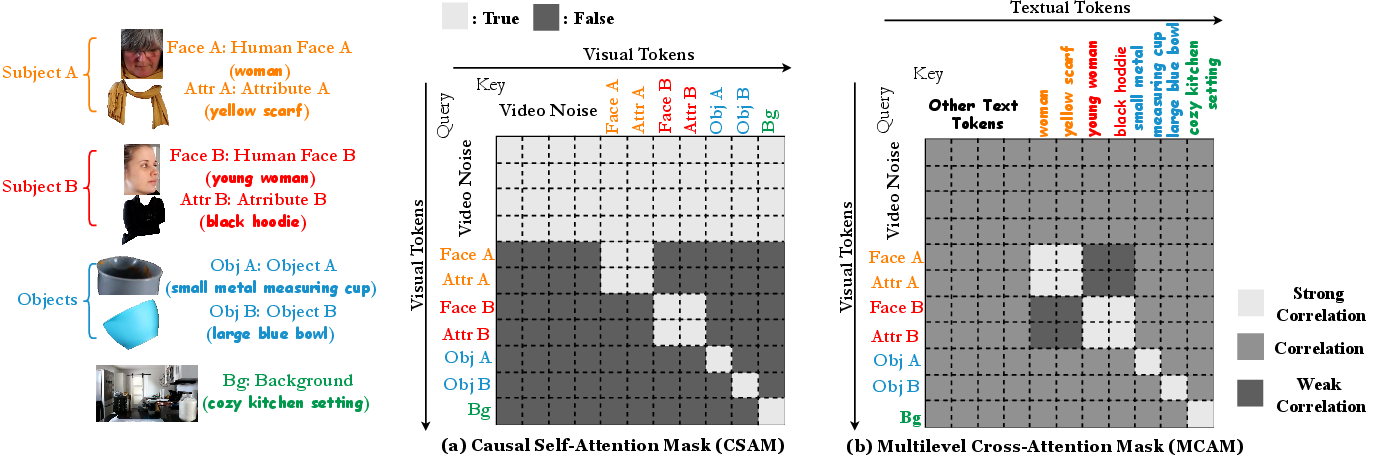
- Causal Self-Attention Mask (CSAM): Imagine a group chat where only certain people can reply to each other. CSAM sets rules so the video-making part of the model can “listen” to the reference images (faces/attributes), but different subjects don’t interfere with each other. This helps avoid “attribute swapping.”
- Multilevel Cross-Attention Mask (MCAM): This is like highlighting the lines in a script that belong to each actor. MCAM strengthens the connection between a subject’s visual tokens (face/attributes) and the exact words that describe them, while weakening connections to other subjects’ descriptions. It also boosts the clarity of each reference image’s meaning.
Together, these tools reduce confusion and make sure “who is who” stays consistent across the whole video.
What did they find?
- Better identity matching: The system keeps people’s faces consistent with their reference images more accurately than other advanced methods.
- Better subject–attribute alignment: When there are multiple people, it’s much better at keeping the right clothes, accessories, and hairstyles attached to the correct person—less “hat-swapping” or “glasses-swapping.”
- Strong overall video quality: It follows the text prompt well, keeps motion natural (not just copy-pasted frames), and performs strongly on their new benchmark.
In tests against well-known systems (like SkyReels-A2 and Phantom), Lumos/X achieved top scores, especially on keeping identities and face–attribute pairings correct.
Why does this matter?
- More reliable personalized videos: Creators, advertisers, and filmmakers can generate scenes with multiple people while keeping everyone’s look correct.
- Better control and fewer mistakes: Clear face–attribute pairing means fewer weird mix-ups, making videos look more professional and believable.
- Useful for many applications: From virtual try-ons (keeping the right outfit on the right person) to storytelling and e-commerce demos, this kind of precise control is a big step forward.
In short, this research shows how careful data design plus “relationship-aware” model rules can make AI-generated videos much more accurate and consistent—especially when lots of people and details share the screen.
Knowledge Gaps
Knowledge gaps, limitations, and open questions
The following points summarize concrete gaps and unresolved questions in the paper that future work could address:
Data and benchmark construction
- Reliance on MLLMs for annotation without human verification: The face–attribute bindings and subject-group assignments are inferred by Qwen2.5‑VL and not validated; the paper does not report precision/recall or inter-annotator agreement for these labels. Quantifying and reducing annotation noise is needed.
- Sparse temporal sampling for data creation: Only three frames (5%, 50%, 95%) are used to derive captions, detections, and conditions, which may miss attribute changes, occlusions, or motion-specific cues across the video. The impact of denser temporal sampling is unstudied.
- Single reference image per entity: Both training and inference use one image per face/attribute/object/background, limiting variability. The efficacy of multi-image conditioning (and fusion strategies) is not explored.
- Inpainted “clean backgrounds”: Backgrounds are synthesized via FLUX inpainting after removing subjects/objects; this may introduce distribution shift or artifacts. There is no analysis of realism, artifact rates, or comparison to using true background frames.
- Scope limited to human-face subjects: “Subject” is defined as a face with attributes; generalization to non-human identities (pets, branded items) or multi-part identities is untested.
- Long-tail scarcity of multi-subject data: Training includes only 0.23M two-subject and 0.03M three-subject samples and no cases with >3 subjects. Generalization and failure rates as the number of subjects increases are not evaluated.
- Selection bias toward clear, frontal faces: The pipeline requires clear facial features with minimal occlusion, potentially underrepresenting profiles, occluded faces, extreme poses, and low-light scenarios. Bias analysis and augmentation for such cases are missing.
- Demographic and domain bias: The paper does not report demographic distributions (age, skin tone, gender) or domain diversity of faces/attributes. Fairness audits of identity preservation and attribute binding across demographics are absent.
- Reproducibility and release: It is unclear whether the processed dataset and the benchmark (with ground-truth bindings) will be publicly released, and whether annotations include sufficient metadata for replication and auditing.
- Entity retrieval accuracy and robustness: The accuracy of entity/attribute extraction and matching (Qwen2.5‑VL + detectors) is not reported; comparisons to alternative MLLMs, error analyses, and robustness to paraphrases/synonyms are missing.
Modeling and training
- Token-to-entity alignment ambiguity in MCAM: The method assumes a reliable mapping between textual tokens (e.g., “man in red shirt”) and visual condition tokens. How these mappings are derived and disambiguated for long, compositional, or paraphrased prompts is not specified or evaluated.
- Hyperparameter sensitivity and stability: MCAM’s strength parameter r and downsampling factor d are briefly swept on a reduced setting; no systematic sensitivity analysis on the full model/data is provided. Guidelines for robust defaults remain open.
- Approximate similarity scaling for MCAM: The dynamic scaling s is approximated via downsampled attention scores to work with fused kernels; the approximation error and its impact on quality are not quantified. Custom kernels or exact implementations could be investigated.
- Computational overhead and efficiency: The added R2PE/CSAM/MCAM mechanisms’ training/inference cost (latency, memory) versus the baseline DiT is not measured. Throughput–quality trade-offs and optimizations are unexplored.
- Scalability to longer, higher-resolution videos: Experiments use ~5 s, 480p videos at 16 FPS; performance and stability on longer durations, higher FPS, and 4K resolutions are not assessed.
- Attribute capacity and expressivity: Training restricts each subject to ≤3 attributes; behavior with more attributes, nested/relational attributes (e.g., “wearing the son’s hat”), and non-visual attributes is unknown.
- Conflict resolution among conditions: The model’s behavior when text and visual references conflict (e.g., face image with “no glasses” but an attribute image of glasses) is not studied; policies for precedence and robustness are absent.
- Variable and larger numbers of subjects: Beyond three subjects, mask design, attention scaling, and degradation modes are not analyzed. Methods for dynamic subject discovery and grouping at inference time are unaddressed.
- Text-only multi-subject generation: The approach and masks rely on explicit visual conditions; how to form reliable subject groups and bindings from text-only prompts with ambiguous coreference remains an open problem.
- Temporal attribute dynamics: The framework encodes static face–attribute bindings; handling time-varying attributes (e.g., changing clothes, putting on sunglasses mid-video) is not supported or evaluated.
- Interaction with generic T2V behavior: The potential side effects of R2PE/CSAM/MCAM on generic text-to-video generation (without conditions) are not studied; does explicit binding reduce general text adherence or diversity?
Evaluation and analysis
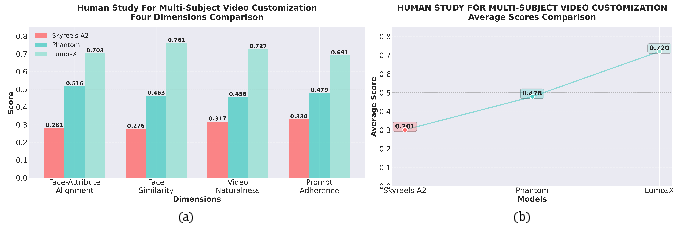
- Lack of human evaluations: All comparisons rely on proxy metrics (ArcSim/CurSim, CLIP, ViCLIP, Dynamics). Human preference studies for identity fidelity, attribute correctness, temporal consistency, and overall quality are absent.
- No direct metric for face–attribute pairing correctness: The benchmark infers subject/attribute localization via detectors and computes CLIP/Image similarities, but a task-specific metric for correct cross-subject attribute assignment (with verified ground truth per frame) is missing.
- Detector-dependent scoring: When detectors fail to find a subject/attribute, the score is set to zero, conflating detector recall with generation quality. Detector-invariant or human-verified assessments are needed.
- Failure mode taxonomy: The paper does not present a systematic analysis of common failure types (e.g., attribute swaps, identity drift, temporal flicker, background bleed, object misplacement) or their frequencies.
- Statistical rigor: Results on the 500-video benchmark lack variance estimates, confidence intervals, or statistical significance tests across runs/seeds.
- Generalization across domains: The model is trained on Panda70M-derived samples and evaluated on YouTube videos; transfer to other domains (e-commerce, cinematic content, sports, surveillance) and OOD compositional prompts is untested.
Baselines and comparisons
- Cross-backbone parity: Baselines differ in backbone sizes and training data (e.g., Wan2.1‑14B vs 1.3B); robust cross-backbone comparisons or re-training baselines under matched conditions are not provided.
- Broader method comparisons: Comparisons omit recent control- and mask-aware T2V methods or alternative relational binding strategies; ablations against stronger attention-control baselines are limited.
Ethics, safety, and misuse
- Privacy and consent for faces: The use of web-crawled faces for training/evaluation is not discussed with respect to consent, privacy, or compliance with platform policies.
- Bias and harm assessment: Potential biases in identity preservation/attribute binding (e.g., across skin tones, genders, cultural garments) and misuse risks (e.g., impersonation, deepfakes) are not addressed; mitigation strategies are unspecified.
- Sensitive attributes and contexts: Handling of sensitive or protected attributes (e.g., uniforms, religious attire) is not considered; policies for filtering or user warnings are absent.
Deployment and robustness
- Real-world input robustness: The system’s tolerance to low-light, compression artifacts, motion blur, occlusions, or misaligned crops in user-provided reference images is not evaluated.
- UI and authoring workflows: Practical guidance for end-users to specify subject groups, attributes, and relationships (e.g., coreference resolution in prompts) is not designed or studied.
- Sample efficiency and accessibility: Training requires ~883 GPU-days; methods for distillation, low-rank adaptation, parameter-efficient tuning, or smaller backbones to democratize usage are not explored.
These gaps suggest concrete avenues for future work: building human-verified datasets and metrics for face–attribute alignment, broad robustness and fairness evaluations, scalable and efficient implementations of relational attention, handling text-only and dynamic-attribute scenarios, and establishing ethical safeguards for real-world deployment.
Practical Applications
Immediate Applications
Below are concrete, deployable use cases that can be built with the paper’s data pipeline and model innovations (Relational Self-Attention with R2PE/CSAM and Relational Cross-Attention with MCAM) as described.
- Application: Multi-subject ad creatives with identity and wardrobe consistency
- Sectors: advertising, e-commerce, media/marketing
- Potential tools/workflows: A creative studio or SaaS that takes (a) model headshots, (b) product attribute images (shirts, glasses, shoes), (c) object/place assets, and (d) brand backgrounds, then generates 5–10 s clips with precise face–attribute alignment for multiple actors in the same scene
- Assumptions/dependencies: Rights/consent for faces and assets; performs best with ≤3 attributes per subject (training-aligned); default model demonstrated at ~480p and ~5 s; GPU inference; quality of inputs (clean face/attribute references) governs results
- Application: Catalog and PDP “try-on” videos from still assets
- Sectors: retail/fashion/e-commerce
- Potential tools/workflows: CMS plugin that composes product attributes (tops, glasses, jewelry) with a cataloged model face and brand background to auto-generate short product videos; batch generation pipeline
- Assumptions/dependencies: Legal clearance for model identities; attributes must be clear and segmented; video duration and resolution follow current backbone limits
- Application: Pre-visualization for film/TV with controllable actors and props
- Sectors: film/TV, VFX, pre-production
- Potential tools/workflows: NLE plugins (Premiere/Resolve) to synthesize storyboard/pre-viz shots by binding specific actor faces to costume/prop images and set backgrounds; adjustable multi-subject layouts without test-time finetuning
- Assumptions/dependencies: High-fidelity delivery may still require VFX passes; current method targets short clips; relies on accurate attribute object masks
- Application: Brand-safe UGC and influencer content with controlled outfits/backgrounds
- Sectors: social media marketing, creator economy
- Potential tools/workflows: Mobile/desktop app to generate multi-person skits where each influencer’s identity is preserved while brand-approved wardrobe and backgrounds are locked in via attribute/object references
- Assumptions/dependencies: Consent and disclosure requirements; moderation to prevent misuse; attribute limit per subject
- Application: Scenario-based compliance and safety micro-videos
- Sectors: enterprise training, manufacturing, energy, construction
- Potential tools/workflows: Generator that ensures identities map to roles and PPE attributes (e.g., hardhat, vest) for multi-worker scenarios; rapid creation of varied, short compliance clips
- Assumptions/dependencies: Domain-appropriate attribute references (PPE images); quality control for visual realism; internal compliance approval
- Application: Multi-character game cinematic snippets from assets
- Sectors: gaming, interactive media
- Potential tools/workflows: Tool to turn character portraits and gear/item images into cutscenes with consistent identity–gear associations across multiple characters in the same scene
- Assumptions/dependencies: Best for short, non-interactive clips; art style alignment to game assets may require fine-tuning or style prompts
- Application: Benchmarking and evaluation for multi-subject video generation
- Sectors: academia, AI labs, model evaluation
- Potential tools/workflows: Adoption of the released benchmark tasks (identity-consistent and subject-consistent generation) and metrics (ArcSim/CurSim, ViCLIP, CLIP/DINO) to compare models; internal A/B testing for new T2V backbones
- Assumptions/dependencies: Access to benchmark assets and metric implementations; consistent preprocessing; reproducibility of mask/detector pipeline
- Application: Dataset curation pipeline for subject–attribute-aware training data
- Sectors: academia, AI R&D, internal ML teams
- Potential tools/workflows: Use VILA for captions, YOLOv9 for detections, Qwen2.5-VL for entity extraction and face–attribute matching, GroundingDINO+SAM for segmentation, and FLUX for background inpainting to assemble labeled, clean multi-subject datasets
- Assumptions/dependencies: Availability of the listed models; compute for inpainting/segmentation; quality control for MLLM attribution errors
- Application: Privacy-preserving synthetic videos for demos and QA
- Sectors: finance, healthcare, public sector IT
- Potential tools/workflows: Replace real employee/patient backgrounds with approved scenes and bind faces to neutral uniforms/accessories for internal demos or user-testing without exposing real environments
- Assumptions/dependencies: Strict consent and governance; clearly watermarked synthetic outputs; legal review for identity handling
- Application: Bias and robustness testing for vision systems
- Sectors: AI assurance, compliance, regulated industries
- Potential tools/workflows: Generate controlled video suites by holding identity constant while varying attributes (e.g., glasses, headwear) and vice versa; useful for stress-testing face/vision models for confounders and demographic fairness
- Assumptions/dependencies: Carefully curated attribute sets; clear provenance and labeling; does not substitute for real-world datasets
- Application: Personalized greetings and event clips with multi-person alignment
- Sectors: daily life, consumer apps
- Potential tools/workflows: Simple consumer app to produce short celebratory videos with friends’ faces matched to chosen outfits and a themed background (e.g., wedding, birthday)
- Assumptions/dependencies: Consent and age-appropriate safeguards; content filters; short-duration outputs
- Application: API product for multi-condition video generation
- Sectors: software/platforms
- Potential tools/workflows: REST/gRPC API that accepts face images, attribute/object/background references, and a prompt; returns short videos with guaranteed face–attribute bindings via MCAM/CSAM enforcement
- Assumptions/dependencies: GPU-backed serving; content moderation; throughput limits and cost management
Long-Term Applications
These applications are feasible with further research, scaling, higher resolutions/durations, or additional safeguards/integrations.
- Application: Production-grade digital doubles with wardrobe continuity across scenes
- Sectors: film/TV, VFX, media production
- Potential tools/workflows: End-to-end pipeline generating multi-scene sequences, preserving actor identity and wardrobe continuity over minutes/hours; integration with shot planning and asset management
- Assumptions/dependencies: Higher-res/longer-duration generation; scene-to-scene continuity modeling; legal/union frameworks for synthetic performers
- Application: Interactive virtual sales associates and try-on in AR/VR
- Sectors: retail, XR
- Potential tools/workflows: Real-time or near-real-time video avatars binding user identity to different apparel/accessory attributes; dynamic background staging for AR showrooms
- Assumptions/dependencies: Low-latency inference; hardware acceleration; on-device guardrails; identity consent and security
- Application: Telepresence avatars with controllable attire and environment
- Sectors: enterprise collaboration, education, healthcare
- Potential tools/workflows: Live or semi-live synthetic feeds ensuring identity retention while standardizing attire (e.g., lab coat) and backgrounds (e.g., HIPAA-safe room) for professionalism/compliance
- Assumptions/dependencies: Real-time T2V performance; robust face tracking; strong watermarking and provenance to prevent spoofing
- Application: Synthetic patient and clinician training libraries with multi-role consistency
- Sectors: healthcare, medical education
- Potential tools/workflows: Large video libraries showing consistent patient identities across encounters with controlled clinical attributes (gowns, devices) and multi-role teams for rare scenarios
- Assumptions/dependencies: Clinical validation; de-biasing and representational diversity; strong privacy and ethics controls
- Application: Industrial/energy safety simulators with role-locked PPE and environments
- Sectors: energy, manufacturing, construction
- Potential tools/workflows: Extended multi-scene training modules simulating complex sites with multiple workers, each bound to appropriate PPE attributes and tools across scenarios
- Assumptions/dependencies: Longer sequences, higher realism; domain-specific safety signifiers; integration with LMS/VR systems
- Application: Creative automation at broadcast scale for localized ads
- Sectors: advertising, finance, telecom
- Potential tools/workflows: Mass-personalized variants of ads with consistent spokesperson identities and localized wardrobe/backgrounds per market/segment
- Assumptions/dependencies: Scalable compute; automated QA and brand safety; compliance with local advertising and disclosure rules
- Application: Content provenance and policy frameworks using subject–attribute maps
- Sectors: policy/regulation, platforms
- Potential tools/workflows: Embed machine-readable subject–attribute bindings and generation metadata into C2PA-like manifests to improve traceability and enable policy enforcement
- Assumptions/dependencies: Standards adoption; interoperable watermarking; platform integration and auditability
- Application: Real-time director tools for on-set iteration
- Sectors: media production
- Potential tools/workflows: On-set consoles to tweak wardrobe/prop attributes for digital stand-ins while keeping actor identity stable, enabling immediate visual alternatives
- Assumptions/dependencies: Edge compute; optimized backbones; coordinated VFX pipelines
- Application: Cross-modal extensions (3D avatars, audio-visual dubbing) with relational binding
- Sectors: gaming, XR, localization
- Potential tools/workflows: Extend R2PE/CSAM/MCAM concepts to 3D/4D avatar generation and lip-synced dubbing that keeps identity tied to language- or region-specific attributes (costume, set dressing)
- Assumptions/dependencies: New model families and datasets; multi-modal synchronization; evaluation benchmarks
- Application: Secure testbeds for face/vision systems with controllable confounders
- Sectors: public sector, defense, regulated finance
- Potential tools/workflows: Large-scale synthetic video corpora varying attributes systematically to evaluate operational systems for spoofing robustness and bias over time
- Assumptions/dependencies: Governance and ethics approvals; continuous validation against real-world performance; robust anonymization/watermarking
Notes on Feasibility and Risks (cross-cutting)
- Model scope and limits: The demonstrated system targets ~5 s, ~480p clips and performs best with ≤3 attributes per subject group; scaling to longer/higher-res content needs larger backbones or hierarchical generation.
- Pipeline dependencies: Data quality relies on VILA (captioning), YOLOv9 (detection), Qwen2.5-VL (entity/attribute matching), GroundingDINO+SAM (segmentation), and FLUX (inpainting); errors in any stage propagate.
- Compute: Training required ~883 GPU-days (H20 class); inference requires modern GPUs and careful cost control for production use.
- Legal/ethical: Explicit consent for face usage; protection against deepfake misuse via watermarking, provenance metadata, content moderation, liveness/consent verification, and transparent disclosures.
- Generalization: The “subject” formulation is human-face-centric; extending to non-human identities (e.g., animals) or complex groups needs additional data/modeling.
- Portability: Integrations were done on Wan2.1 DiT; porting to other T2V or multi-modal backbones is feasible but non-trivial engineering.
Glossary
- 3D Rotary Position Embedding (3D-RoPE): A positional encoding scheme that extends Rotary Position Embeddings to 3D (spatial and temporal) tokens for better video attention. "3D Rotary Position Embedding (3D-RoPE~\cite{su2024roformer})"
- 3D variational autoencoder (VAE): A 3D extension of VAEs that encodes/decodes video sequences into latent representations. "3D variational autoencoder (VAE) "
- Adam optimizer: A widely used adaptive gradient optimization algorithm for training deep networks. "Training uses the Adam~\cite{kingma2014adam} optimizer"
- ArcFace: A face recognition loss/model that improves discriminative power via additive angular margin. "based on ArcFace~\cite{deng2019arcface}"
- ArcSim: A face identity similarity metric computed using ArcFace embeddings. "FaceSim-Arc (ArcSim), based on ArcFace~\cite{deng2019arcface}"
- Causal Self-Attention Mask (CSAM): An attention mask enforcing causal and group-structured interactions within self-attention. "a Causal Self-Attention Mask (CSAM)"
- CFG scale: The guidance strength used in classifier-free guidance during sampling in diffusion models. "set the CFG scale to 6."
- CLIP-I: An image-text representation similarity metric using CLIP; here used for image-to-image comparisons. "and CLIP-I~\cite{radford2021learning} between these regions and the corresponding reference images."
- CLIP-T: A text-image similarity metric using CLIP to assess semantic alignment with prompts. "we compute CLIP-T~\cite{radford2021learning} between the cropped image regions and the corresponding text prompts"
- Concat-ID: A baseline method for identity-preserving video generation using concatenated subject inputs. "Concat-ID (Wan2.1-1.3B)~\cite{zhong2025concat}"
- ConsisID: A method focused on identity-consistent video generation from face references. "ConsisID (CogVideoX-5B)~\cite{yuan2024identity}"
- Cross-Attention: An attention mechanism that conditions one set of tokens (e.g., video) on another (e.g., text). "Cross-Attention is employed to incorporate text conditions."
- Cross-frame attention: An attention mechanism that links information across frames to improve temporal consistency. "via cross attention and cross-frame attention."
- CurricularFace: A face recognition training strategy that adjusts sample difficulty over time (curriculum learning). "based on CurricularFace~\cite{huang2020curricularface}"
- CurSim: A face identity similarity metric computed using CurricularFace embeddings. "FaceSim-Cur (CurSim), based on CurricularFace~\cite{huang2020curricularface}"
- DINO-I: A feature similarity measure using self-supervised DINO (Vision Transformers) for image-image comparisons. "and DINO-I~\cite{oquab2023dinov2} and CLIP-I~\cite{radford2021learning}"
- Diffusion inpainting: Using diffusion models to fill in or reconstruct masked regions, e.g., backgrounds. "apply the diffusion inpainting model FLUX~\cite{flux} to generate a clean background."
- Diffusion Transformer (DiT): A diffusion model architecture that replaces U-Nets with Transformers for scalable generation. "Diffusion Transformer (DiT) architectures~\cite{peebles2023scalable}"
- EMA (Exponential Moving Average): A technique that maintains a smoothed version of model weights during training. "EMA decay of 0.99"
- Florence-2: A vision model used here for detecting person subjects from text prompts. "we first use Florence-2~\cite{xiao2024florence} to detect the person subjects"
- Flow Matching: A generative modeling framework that matches probability flows instead of noise schedules. "combined with Flow Matching~\cite{lipman2022flow}"
- FLUX: A diffusion-based inpainting model used to synthesize clean backgrounds. "the diffusion inpainting model FLUX~\cite{flux}"
- GroundingDINO: An open-set object detector that aligns text with detected regions for grounding. "GroundingDINO~\cite{liu2024grounding} combined with SAM segments each entity within the global image."
- Hunyuan Video: A large-scale video DiT model demonstrating strong spatio-temporal generation. "Models like Hunyuan Video~\cite{kong2024hunyuanvideo}"
- Latent diffusion models (LDMs): Diffusion models that operate in a compressed latent space for efficient generation. "Latent diffusion models (LDMs)~\cite{rombach2022high}"
- MAGI-1: A large video generation/modeling system used for scaling and efficient attention. "and MAGI-1~\cite{magi1} have scaled the parameters of video DiTs to more than 10 billion"
- MagiAttention: An efficient attention mechanism introduced by MAGI-1 to accelerate attention computations. "we employ the MagiAttention mechanism proposed in~\cite{magi1}"
- Multilevel Cross-Attention Mask (MCAM): A numerical mask in cross-attention that enforces different levels of correlation between visual and textual tokens. "Multilevel Cross-Attention Mask (MCAM)"
- Multimodal LLMs (MLLMs): LLMs that process and reason over multiple modalities like text and images. "while multimodal LLMs (MLLMs) infer and assign subject-specific dependencies."
- Open-set: Refers to handling classes/entities not seen during training, enabling broad generalization. "supports open-set entities."
- OWLv2: An open-world object detector used to localize attributes and objects from prompts. "and then apply OWLv2~\cite{minderer2023scaling} to detect the bounding boxes"
- Panda70M: A large-scale video dataset used as the base for training data construction. "built on Panda70M~\cite{chen2024panda}"
- Phantom: A multi-subject video customization baseline built on Wan2.1. "Phantom (Wan2.1-1.3B)~\cite{liu2025phantom}"
- Qwen2.5-VL: A multimodal LLM used for entity retrieval and face-attribute matching. "Qwen2.5-VL~\cite{bai2025qwen2}"
- Relational Cross-Attention: A cross-attention module that explicitly encodes and reinforces subject group relations. "Relational Cross-Attention with a Multilevel Cross-Attention Mask (MCAM)"
- Relational Rotary Position Embedding (R2PE): A position embedding that ties faces and attributes within the same subject group. "Relational Rotary Position Embedding (R2PE)"
- Relational Self-Attention: A self-attention module that models and preserves dependencies within subject groups. "Relational Self-Attention and Relational Cross-Attention enable causal conditional modeling"
- SAM (Segment Anything): A general-purpose segmentation model used for extracting masks. "use SAM~\cite{kirillov2023segment} to segment attribute masks."
- SkyReels-A2: A strong multi-subject video generation baseline leveraging large DiT backbones. "SkyReels-A2 (Wan2.1-14B)~\cite{fei2025skyreels}"
- Spatio-temporal Self-Attention: Attention over both spatial and temporal dimensions to capture video dynamics. "full spatio-temporal Self-Attention is used to capture complex dynamics"
- Text-to-video (T2V): Generating videos from textual prompts; also refers to T2V model backbones. "Built on the T2V model Wan2.1~\cite{wang2025wan}"
- VILA: A vision–LLM used to generate richer video captions. "captions generated by the large visionâLLM VILA~\cite{lin2024vila}"
- ViCLIP-V: A video-video semantic similarity metric for comparing generated to ground-truth videos. "ViCLIP-V~\cite{wang2024videoclip}"
- Video DiTs: Diffusion Transformers specialized for video generation with spatio-temporal attention. "video DiTs achieved unprecedented performance in modeling long-range dependencies across both spatial and temporal dimensions"
- VideoCLIPXL (ViCLIP-T): A video-text similarity model used to evaluate prompt adherence. "VideoCLIPXL (ViCLIP-T)~\cite{wang2024videoclip}"
- Wan2.1: A text-to-video generative model serving as the backbone for the proposed framework. "Wan2.1~\cite{wang2025wan} text-to-video backbone"
Collections
Sign up for free to add this paper to one or more collections.