First measurement of time-dependent CP violation in the decay flavor-changing neutral-current decay B0→KS0μ+μ−
Published 13 Mar 2026 in hep-ex | (2603.13223v1)
Abstract: A flavor-tagged time-dependent analysis of B<sup>0→</sup>KS<sup>0μ<sup>+μ<sup>− decays is performed across the full dimuon mass range excluding the J/ψ and ψ(2S) resonance regions. The analysis uses proton-proton collision data collected by the LHCb experiment in 2011--2018 at center-of-mass energies of 7, 8 and 13TeV, corresponding to an integrated luminosity of 9fb<sup>−1. The CP violation parameters are determined to be C=−0.13±0.32±0.04 and S=+0.82±0.29±0.05, where the first uncertainties are statistical and the second are systematic.The results are consistent with the Standard Model prediction. This is the first experimental study of time-dependent CP violation in b→sl<sup>+l<sup>− processes.
The paper reports the first time-dependent CP violation measurement in B0→KS0μ+μ– decays, providing new constraints on CP-violating phases in b→s transitions.
It uses LHCb collision data with advanced multivariate classifiers and unbinned likelihood fits to extract CP observables with effective tagging and resolution methods.
The measured values (C = -0.13±0.32 and S = +0.82±0.29) are consistent with Standard Model predictions, thereby limiting potential new physics scenarios.
Time-Dependent CP Violation in B0→KS0μ+μ−: First Measurement
Motivation and Theoretical Context
The flavor-changing neutral-current (FCNC) transition b→sℓ+ℓ− constitutes a powerful probe of physics beyond the Standard Model (SM) due to its suppression at tree level and sensitivity to loop-level contributions. Anomalies have been reported in branching ratios and angular observables for several B meson decays, compatible with non-SM contributions to four-fermion effective couplings [Capdevila:2023yhq, Alguero2023]. However, complementary observables are required to discriminate the underlying dynamics and elucidate possible new sources of CP violation.
Time-dependent analyses of neutral B decays are particularly sensitive to the imaginary components of the Wilson coefficients that parameterize b→sℓ+ℓ− transitions [Descotes-Genon2021]. CP violation arising via interference between B0--Bˉ0 mixing and decay amplitudes provides theoretically robust access to new CP-violating phases. The decay B0→KS0μ+μ− enables the first time-dependent CP violation measurement in a b→sℓ+ℓ− channel, allowing direct constraints beyond those accessible from time-integrated observables.
The time-dependent CP asymmetry is defined as
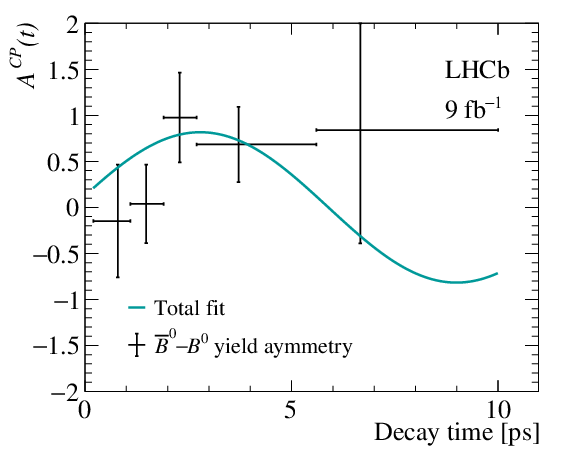
ACP(t)=Ssin(Δmdt)−Ccos(Δmdt)
with S characterizing mixing-induced CP violation and C direct CP violation. The SM predicts C≈0 and S≈sin(2β), where β is the well-measured CKM phase [Fleischer2023]. New physics models introducing extra weak phases can substantially alter C and S from their SM values [PRD107075].
Experimental Apparatus and Selection Strategy
The measurement utilizes pp collision data from LHCb spanning 2011--2018, totaling 9fb−1 at s= 7, 8, and 13 TeV. The LHCb detector is a forward spectrometer optimized for b- and c-quark hadron studies, featuring precision tracking, PID, and efficient muon identification [LHCb-DP-2008-001].
Signal candidates are constructed from KS0→π+π− and μ+μ− pairs. Kinematic, topological, and PID selections—leveraging multivariate classifiers (BDTG)—suppress backgrounds (including misidentified Λb, D−, and combinatorics). PID observables are combined via multivariate techniques and a kinematic fit, with decay topology optimized for maximum signal significance.
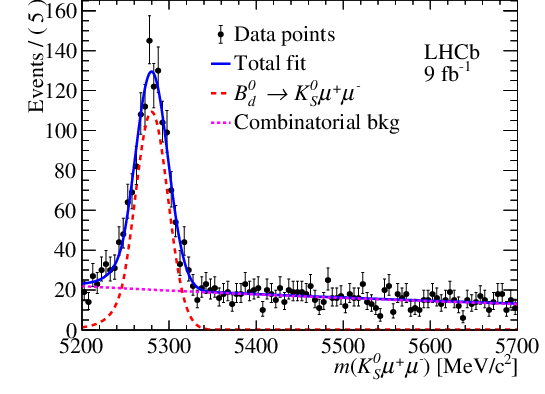
The signal is extracted by fitting the B0 mass spectrum with a Crystal Ball function, and combinatoric background is modeled exponentially.
Figure 1: Mass distribution of selected B0→KS0μ+μ− candidates in all categories, superimposed with fit results.
Time-Dependent Analysis: Tagging and Likelihood Fits
The production flavor is determined using both same-side (SS) and opposite-side (OS) tagging algorithms [LHCb-PAPER-2016-039, LHCb-PAPER-2011-027], each yielding a tagging decision and calibrated mistag probability. Combined, these produce effective tagging efficiencies ε⟨D2⟩=(2.7±1.1)% (Run 1) and (4.1±0.6)% (Run 2). The calibrated mistag probability ω is crucial for the likelihood modeling.
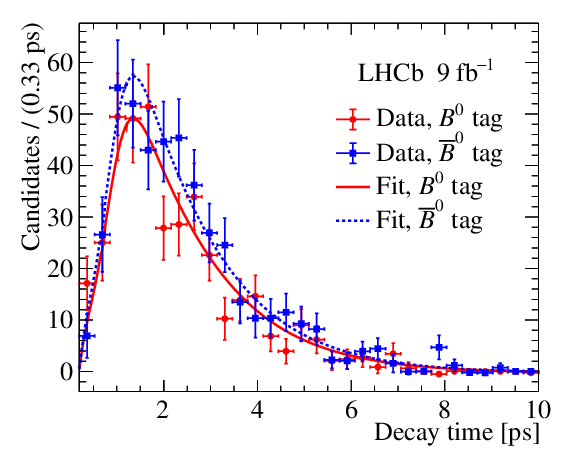
The decay-time distribution includes convolution with a multi-Gaussian resolution function (effective resolution ∼60 fs), and acceptance corrections via a cubic spline parametrization. Systematic effects due to time resolution and acceptance are negligible compared to statistical uncertainties.
CP violation parameters are determined via a weighted unbinned maximum-likelihood fit performed on Run 1 and Run 2 samples, exploiting sWeights for background subtraction [Pivk:2004ty]. Fixed parameters include the B0 lifetime and oscillation frequency, constrained to world averages.
Figure 2: (Left) background-subtracted decay-time distributions for flavor-tagged B0 and Bˉ0 candidates with fit overlay; (Right) time-dependent CP asymmetry, showing signal yield asymmetry with dilution corrections and maximum-likelihood curve.
Results and Numerical Summary
The total signal yield is 941±55. The time-dependent fit in the inclusive q2 range (excluding J/ψ and ψ(2S)) yields: C=−0.13±0.32(stat)±0.04(syst)S=+0.82±0.29(stat)±0.05(syst)
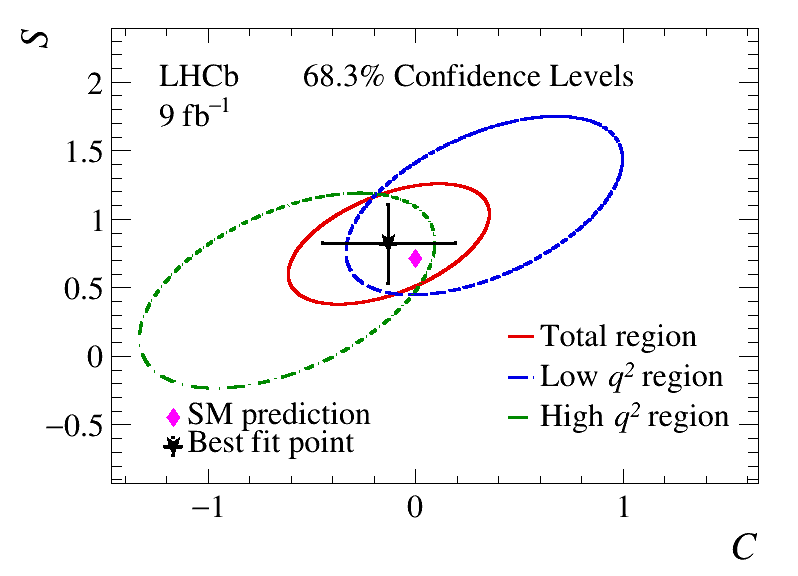
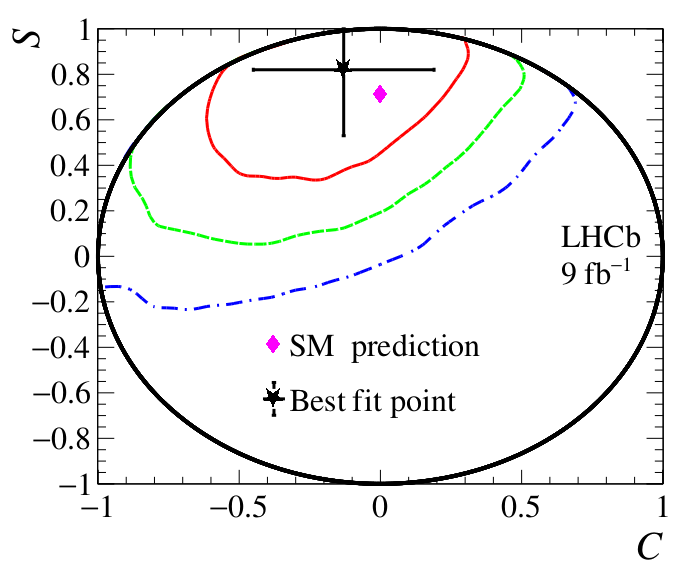
with correlation coefficient $0.50$. These values are consistent with SM predictions (C≈0, S≈0.72) [Fleischer2023, PDG2024]. Subrange fits indicate no statistically significant deviation or q2 dependence.
Profile likelihood scans yield confidence regions for (C,S), compared to the SM expectation.
Figure 3: Two-dimensional confidence regions for C and S as obtained from profile likelihood scans across low-q2, high-q2 and total sample, contrasted with the SM prediction.
Employing the Feldman–Cousins approach, physical boundary C2+S2≤1 is enforced, and confidence intervals are derived via constrained likelihood-ratio ordering.
Figure 4: Confidence regions for C and S in the total q2 range under the physical constraint, compared to SM predictions.
Systematics are dominated by flavor tagging calibration and fit biases, but remain sub-leading relative to statistical uncertainties. Alternative fits, splitting by KS category, magnet polarity, and period, as well as checks in control channels, confirm robustness.
Implications and Outlook
This result constitutes the first measurement of time-dependent CP violation in an exclusive b→sμ+μ− decay, representing a new experimental avenue for discriminating new physics contributions to CP violation. The observables C and S exhibit no evidence for deviation from SM expectations, providing constraints on new sources of CP-violation in FCNC transitions that are robust against hadronic uncertainties and complementary to existing measurements of branching ratios, angular distributions, and LFU observables.
Given the persistent b→sℓ+ℓ− anomalies in time-integrated observables [Capdevila:2023yhq], the absence of sizeable time-dependent CP violation in B0→KS0μ+μ− constrains the parameter space for new physics models, especially those involving complex Wilson coefficients in the effective Hamiltonian (such as C9, C10, or C7) [Fleischer:2025ucq, PRD107075, Descotes-Genon2011]. Theoretically clean access to the imaginary parts of these coefficients strengthens global fits and model discrimination [Descotes-Genon2021].
Prospects for the future include increased sensitivity with larger datasets from LHCb upgrades and Belle II, improved flavor tagging, and full angular analyses to disentangle CP-even and CP-odd eigenstates and probe additional observables and dependencies.
Conclusion
The time-dependent CP violation observables in B0→KS0μ+μ− have been measured for the first time, with results consistent with the Standard Model and no evidence for new sources of CP violation in b→sμ+μ− transitions. This methodology augments the arsenal of FCNC probes, facilitating direct constraints on new CP-violating dynamics. Future improvements in statistical precision and expanded analysis channels will further advance the discrimination of new physics in the flavor sector.